
Foreign News
Chinese nationals jailed over kidnapping and forced labour in South Africa


Seven Chinese nationals who smuggled Malawians to South Africa and subjected them to forced labour have been handed 20-year prison terms each.
The four men and three women were found guilty of human trafficking and kidnapping earlier this year by a South African court.
Their sentence comes nearly six years after they were arrested when local authorities raided a factory in Johannesburg and found 91 Malawian nationals, 37 of them children, working in appalling conditions.
Human trafficking is a major concern in South Africa, with the country regarded as a “source, transit and destination”, according to the government.
The group – Kevin Tsao, Chen Hui, Qin Li, Jiaqing Zhou, Ma Biao, Dai Junying, and Zhang Zhilian – were found guilty on 158 of the 160 counts for which they were charged.
These include helping illegal immigrants remain in South Africa and violating the country’s labour laws by failing to register their operations and and keep a record of their earnings among others.
The factory raid came after authorities received a tip-off from a worker who had managed to escape.
It later emerged that employees were forced to work 11-hour shifts, seven days a week, without proper training or safety equipment.
They were also paid far below South Africa’s minimum wage of $1.64 (£1.22) per hour and had their pay docked if they wanted time off.
According to South Africa’s labour laws, employees cannot work more than nine hours a day and are generally entitled to a “weekly rest period of at least 36 consecutive hours” that includes Sunday, unless a different agreement is reached.
One man testified that workers were not allowed to leave the heavily guarded factory premises, even to buy food, which he described as dirty and unsuitable for human beings.
According to authorities, the victims had been smuggled into the country in shipping containers.
Mr Tsao worked as a manager at the factory, named Beautiful City, while his co-accused were supervisors, according to local news site News24. The factory made inner cottons for blankets using recycled material.
South Africa’s prosecuting authority welcomed the sentence, saying it would help “bolstering our fight against human trafficking”.
“Human trafficking has become a scourge in our country, we have become a destination as South Africa for human trafficking [due to] various reasons, including our porous borders,” spokesperson Phindi Mjonondwane said.
The department of labour, which was part of the raid in 2019, also welcomed the sentence handed down as it urged for greater collaboration between government departments to “root out all these issues”.
[BBC]


A pair of twin mountain gorillas has been born in the eastern Democratic Republic of Congo – a rare occurrence for the endangered primates, conservationists at Virunga National Park say.
The community trackers, who discovered 22-year-old Mafuko hugging her newborns on Saturday, said the mother and her two baby sons all appeared to be well and healthy.
Twin births are thought to account for about 1% of all mountain gorilla births, though exact data is not widely available.
Virunga, situated in a conflict-prone part of DR Congo, is Africa’s oldest and largest national park and was set up 100 years ago to protect mountain gorillas of which there are fewer than 1,100 left in the wild
They are only found in the Virunga and in national parks over the border in Rwanda and Uganda, according to the International Union for the Conservation of Nature (IUCN), which compiles a Red List of threatened species.
The last birth of mountain gorilla twins in Virunga National Park was in September 2020.
Mafuko herself gave birth to twins in 2016, but they both died within a week.
Young gorillas rely entirely on their mothers for care and transport – and are extremely vulnerable in what can be a dangerous environment where poachers and many armed groups operate.
The authorities at the park say additional monitoring and protection measures have been put in place to ensure the twins’ survival during this critical period. Rangers would closely observe the young family and provide support if needed, they said.
A gorilla’s pregnancy lasts for about eight-and-a-half months, and females usually give birth to one infant every four years.
According to Virunga conservationists, Mafuko has had a remarkable history of survival herself.
Born in 2003 into the Kabirizi family, she lost her mother to armed attackers when she was four years old. She joined the Bageni family when she was 10 – and to date has been pregnant and given birth five times.
Conservationists at Virunga, which is a Unesco World Heritage Site, say her latest offspring represent a significant boost for efforts to protect the endangered species.
Thanks to anti-poaching patrols and community programmes – supported by the European Union and Unesco – mountain gorilla numbers in Virunga have slowly increased over the past decade.
This success which is documented by the IUCN and other partners, led to their status being upgraded from “critically endangered” to “endangered” in 2018.
Virunga spans 7,800 sq km (3,000 sq miles) and is home to an astonishingly diverse landscape – from active volcanoes and vast lakes to rainforest and mountains.
[BBC]
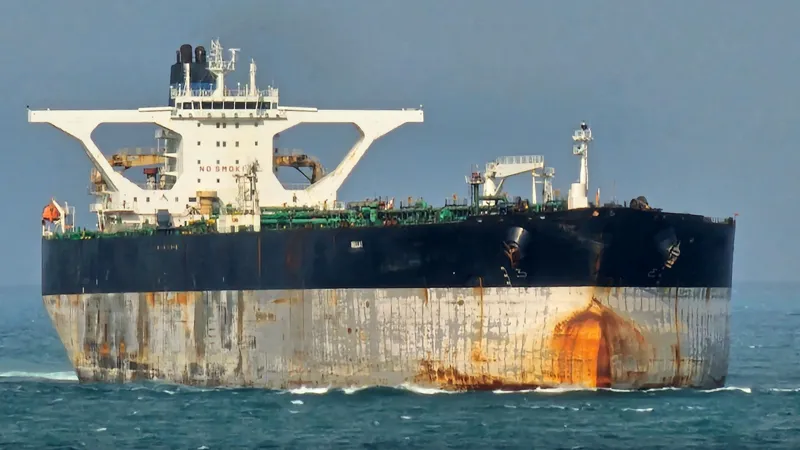
Russia has reportedly deployed a submarine and other vessels to escort an oil tanker – which is also being pursued by US forces – across the Atlantic.
The ship, currently between Iceland and the British Isles, has been accused of breaking US sanctions and shipping Iranian oil. It has historically transported Venezuelan crude oil but is reporting to be empty at the moment.
Previously named Bella 1, its name has been changed to Marinera and it has also reportedly been reflagged from a Guyanese to a Russian vessel.
President Donald Trump said last month that he was ordering a ‘blockade’ of sanctioned oil tankers entering and leaving Venezuela, a move the government there described as “theft”
Two US officials have confirmed to CBS News, the BBC’s US media partner, that Russia has sent a submarine and other navy vessels to escort the tanker.
The US Coast Guard tried to board it last month in the Caribbean when it was believed to be heading towards Venezuela. The Coast Guard had a warrant to seize the ship over its alleged breaking of sanctions.
The vessel has since dramatically changed course and its approach to Europe has coincided with the arrival of around 10 US military transport aircraft as well as helicopters.
Russia says it is “monitoring with concern” the situation around the ship.
“At present, our vessel is sailing in the international waters of the North Atlantic under the state flag of the Russian Federation and in full compliance with the norms of international maritime law,” its foreign ministry said.
“For reasons unclear to us, the Russian ship is being given increased and clearly disproportionate attention by the US and Nato military, despite its peaceful status,” it said.
Two US officials told CBS News earlier on Tuesday that American forces were planning to board the ship, and that Washington preferred to seize it rather than sink it.
BBC Verify has been looking at footage released by Russia Today, reportedly taken onboard an oil tanker, which shows a ship in the distance matching the profile of a US Coast Guard Legend-class cutter.
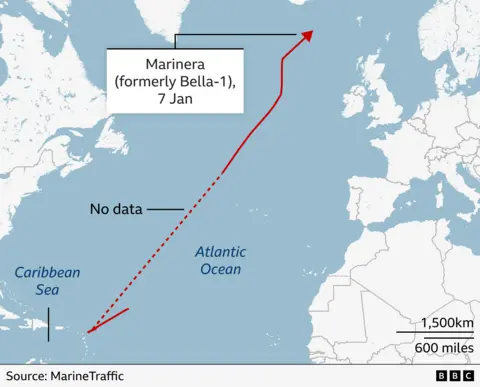
It has also been monitoring the latest reported location of the Marinera. According to AIS location data from ship-tracking platform Marine Traffic, its location as of Tuesday morning was in the North Atlantic Ocean, about 300km (186 miles) south of Iceland’s shoreline.
Previous AIS tracking data suggests it travelled north, past the western coast of the UK over the past two days.
On Tuesday, the US military’s Southern Command posted on social media that it “remains ready to support our US government agency partners in standing against sanctioned vessels and actors transiting through this region.
“Our sea services are vigilant, agile, and postured to track vessels of interest. When the call comes, we will be there.”
Before any US military operation was launched from the UK, Washington would be expected to inform its ally.
For now, the UK Ministry of Defence says it will not comment on other nations’ military activities.
The US officials quoted by CBS suggested that America could mount an operation like one conducted last month when US forces seized the Skipper, a large crude oil tanker, flagged to Guyana, that had just left port in Venezuela.
Under international law, vessels flying a country’s flag are under the protection of that nation. However, simply changing a ship’s name and flag doesn’t necessarily change much, Dimitris Ampatzidis, senior risk and compliance analyst at maritime intelligence firm Kpler, told BBC Verify.
“US action is driven by the vessel’s underlying identity [IMO number], ownership/control networks, and sanctions history, not by its painted markings or flag claim,” he said.
Michelle Bockmann, a maritime intelligence analyst at Windward, said changing to a Russian registry could “complicate US enforcement efforts”.
“Under the UN Convention of the Law of the Sea, there’s a provision that allows a stateless vessel to be boarded by authorities. By reflagging to Russia, the vessel is no longer able to be boarded under this provision,” she explained.
Bockmann adds that she has previously observed vessels changing their flag mid-voyage, but “it’s highly unusual and only seen with dark fleet tankers”.
The potential stand-off over the oil tanker comes days after the US shocked the world with the arrest of Venezuela’s Nicolás Maduro in Caracas. It bombarded targets in the city during the operation to extricate him and his wife on suspicion of weapon and drug offences.
Since he was seized, BBC Verify has identified three US-sanctioned tankers that have switched to a Russian registry, including the Marinera.
This follows a broader trend.
Since the seizure of the Skipper, BBC Verify has identified 19 US-sanctioned oil tankers that have switched to a Russian registry, with many of them having previously sailed under a false flag.
[BBC]

The survivor of a gang rape in the northern Indian state of Haryana has been discharged from hospital a week after her horrific assault, a police official told the BBC.
The 26-year-old mother-of-two was taken to hospital in Faridabad city on the morning of 30 December with serious head and facial injuries and several fractures.
Her sister said she was out visiting a friend and was waiting for transport just after midnight when two men in an ambulance offered her a lift. They drove her to a deserted place where they raped her and then threw her out of the speeding vehicle.
A police spokesman said they had acted swiftly and arrested the two men and seized the vehicle.
The woman was discharged by the hospital on Monday night following treatment and surgeries.
Senior police official Mukesh Kumar told the BBC that they have approached the court to allow her to visit the prison for an “identification parade”.
Once the court order comes, she would be asked to pick out the two suspects from a crowd of men.
The police said the crime took place on the intervening night of 29th and 30th December.
“The incident took place between 12.30 and 02:00. One stood outside the van and kept an eye on the surroundings while the other raped the woman inside the van,” Yashpal Yadav, public relations officer of Faridabad police, said.
Police had questioned the suspects, who were later produced in court and sent to prison, he added.
A doctor at the hospital where the survivor was treated had said that the woman was brought in “at around 05:30 on 30 December… she had a lot of injuries”.
Shalini Chopra, a social worker and an opposition politician, who spoke to the survivor after she was discharged from the hospital told the BBC that the woman was “better but still in pain”.
The case has provoked anger and outrage in India and drawn comparisons with the horrific gang-rape of a 23-year-old woman on a bus in Delhi in December 2012.
That crime had made global headlines, led to huge protests in Delhi and several other cities and forced the government to introduce tough new anti-rape laws that included the death penalty for the most gruesome attacks.
Four men convicted of the gang-rape and murder were hanged in 2020. One of the rapists died in prison while a juvenile was freed after spending time in a reform centre.
But despite the heightened scrutiny of sexual crimes since then, tens of thousands of rapes and sexual assaults continue to be reported every year.
According to latest police records, 29,670 rapes and 2,796 attempted rapes were reported in 2023. In addition, police also recorded 849 cases of child rapes and 94 cases of attempted rapes of children.
[BBC]

Greenland allies vow action if Trump moves to seize world’s largest island

Landslide early warnings issued to the Districts of Badulla, Kandy, Matale and Nuwara Eliya

Coe commits World Athletics support to Jamaica

Rare mountain gorilla twins born in Africa’s oldest national park

ECB launch ‘thorough review’ in wake of 4-1 Ashes defeat

Warning for deep depression over South-east Bay of Bengal Sea area

‘Dates have the highest sugar content to fight Coronavirus’

Sunday Island 27 December – Headlines

#SundayIsland 17th December – Headlines

Sunday Island – 28th March

Sunday Island Headlines – 21 March

Sunday Island – 21st February – Headlines
-

 News3 days ago
Interception of SL fishing craft by Seychelles: Trawler owners demand international investigation
-
 News3 days ago
Broad support emerges for Faiszer’s sweeping proposals on long- delayed divorce and personal law reforms
-

 News4 days ago
Private airline crew member nabbed with contraband gold
-

 News2 days ago
Prez seeks Harsha’s help to address CC’s concerns over appointment of AG
-

 News2 days ago
Govt. exploring possibility of converting EPF benefits into private sector pensions
-

 Features3 days ago
Educational reforms under the NPP government
-

 News6 days ago
Health Minister sends letter of demand for one billion rupees in damages
-

 Features4 days ago
Pharmaceuticals, deaths, and work ethics