
Latest News
Asia Cup 2025: Kuldeep bags four as India demolish UAE in 17.4 overs


It took just 106 balls for India to begin their defence of the Asia Cup with the most comprehensive of wins. It took them just 79 balls to bowl UAE out, and just 27 to chase down their target.
UAE’s 57 was the lowest total any team had achieved against India in T20Is. India’s 4.3-over chase was their quickest in T20Is.
UAE came into this match on the back of encouraging displays against Pakistan and Afghanistan in the tri-series they recently hosted, but all that promise came to nothing against the relentless quality of India’s bowling, with Kuldeep Yadav taking four wickets in no time to celebrate his return to action after a long tour of England spent entirely on the bench.
Thereafter, it was just a question of how quickly India would get to their target, and the answer – mostly delivered by their new opening combination of old buddies Abhishek Sharma and Shubman Gill – was a one-worder: very.
A lot of interest surrounded India’s selection for this game, with particularly intense debate surrounding their wicketkeeper, bowling-attack composition, and No. 8. These were India’s choices:
Gill displaced Sanju Samson from the opening position as expected, but Samson kept the keeping gloves ahead of Jitesh Sharma. India picked both their wristspinners, Kuldeep and Varun Chakravarthy, and picked the batting allrounder Shivam Dube to give them genuine depth until No. 8, but this meant they only had one specialist quick in Jasprit Bumrah.
Some of these choices were surprises. The bigger surprise, perhaps, was that India won the toss – after 15 straight toss losses across formats.
For the first time since 2019, Bumrah bowled three overs inside the powerplay in a T20I. He took one wicket, crashing through Alishan Sharafu’s defences with a searing yorker, but also conceded four fours, three in one over to UAE captain Muhammad Waseem.
With Sharafu and Waseem hitting six fours and a six between them, UAE began well enough, scoring 41 for 2 in their powerplay. But they fell apart thereafter, losing their last eight wickets for the addition of just ten runs.
To their credit, UAE did not let the loss of two powerplay wickets curb their intent, but on this day they kept losing wickets to low-percentage shots. And they kept losing wickets to Kuldeep in the ninth over – three of them, to be precise.
First, Rahul Chopra took on the large outfield at the Dubai International Stadium and the protected long-on boundary and holed out. Three balls later, Waseem was lbw, missing a sweep against a bowler whose stock ball, straightening into the right-hander from left-arm over, is stump-to-stump by design.
Kuldeep finished the over with a trademark wrong’un to bowl the left-handed Harshit Kaushik through the gate, and UAE were already five down.
India used six bowlers, and five of them ended up on the wickets column, with Bumrah – who bowled three overs in the powerplay, a rarity for him – Varun and Axar Patel taking one each.
Dube, playing ahead of a second frontline quick to give India batting depth until No. 8, bagged three with his medium-pace, which meant he had taken 5 for 15 in four overs in his last two T20Is. His first two T20Is, it has to be mentioned, since his bowling quality came under severe scrutiny following India’s use of Harshit Rana as his concussion substitute against England in Pune.
Here, Dube couldn’t help but pick up wickets even when India didn’t want them. In his second over, a direct hit from Samson caught Junaid Siddique wandering out of his crease – a la Jonny Bairstow – after swinging at and missing a short ball. Siddique was given out stumped but India captain Suryakumar Yadav withdrew the appeal. Next ball, Siddique swung at and miscued a slower ball high in the air, and walked back, c Suryakumar b Dube.
They’ve been fast friends since the Under-14 level and might have been forgiven for wanting to take a bit of time savouring the feeling of opening together for India, but that was the last thing on the minds of Abhishek and Gill. They clattered 48 runs in just 3.4 overs before Abhishek fell, miscuing a hard-length ball from Siddique, and in that time they played a number of outrageous shots. The pick of them, perhaps, were a dancing flick for six by Gill off Mohammad Rohid, and a falling-away slap over long-off by Abhishek, off a short-of-length dart from the offspinner Kaushik.
India were ten away from victory when Abhishek fell, and Suryakumar – whipping his first ball off his hip for six – and Gill took just four balls to finish the job.
Brief scores:
India 60 for 1 in 4.3 overs (Abhishek Sharma 30, Shubman Gill 20*; Junnaid Siddique 1-16) beat UAE 57 in 13.1 overs (Alishan Sharafu 22, Muhammad Waseem 19; Jasprit Bumrah 1-19, Axar Patel 1-13, Varun Chakravarthy 1-04, Kuldeep Yadav 4-07, Shivam Dube 3-04) by nine wickets
[Cricinfo]

Latest News
Landslide Early Warnings issued to the Districts of Kandy, Kegalle, Matale and Ratnapura

The Hational Building Research Institute (NBRI) has issued landslide early warnings to the Districts of Kandy, Kegalle, Matale and Ratnapura valid from 2200 hrs on 03rd October upto 2200 hrs on 04th October 2026.
Accordingly,
LEVEL II (AMBER) landslide early warnings have been issued to the Divisional Secretaries Divisions and surrounding areas of Udu Dumbara and Minipe 8n the Kandy district, Dehiowita in the Kegalle district, and Ambanganga Korale and Matale in the Matale district.
LEVEL I (YELLOW) landslide early warnings have been issued to the Divisional Secretaries Divisions and surrounding areas of Rambukkana in the Kegalle district, Rattota in the Matale district, and Eheliyagoda in the Ratnapura district.

The head of Turkiye’s football refereeing body and four other officials have been placed in pretrial detention by a court as part of a corruption investigation, the state news agency Anadolu reports.
Ferhat Gundogdu, head of the Central Referees Committee, and six others appeared before a judge over allegations of manipulation of the referee administration process, Anadolu said on Saturday.
They appeared on Friday before a judge at Istanbul’s Caglayan courthouse on several charges, including forgery of official documents, breach of trust and illegal acquisition of personal data, the report said.
The judge remanded five people in custody and granted the other two conditional release, Anadolu said.
It was the latest scandal to shake football in Turkiye, coming exactly a year after the Turkish Football Federation (TFF) suspended 149 referees on charges of illegal betting.
On Thursday night, police from the illegal betting and sports crime unit also detained Yasin Kol, a referee from Turkiye’s top-flight Super Lig, as well as an assistant referee, media reports said.
Justice Minister Akin Gurlek said prosecutors are examining claims about “interference in the processes of referee classification, assignments, scoring and appointments as well as the exams on rules”.
During raids on Tuesday, police searched the VAR room at TFF’s headquarters in Istanbul. Observers said the investigation was likely linked to last year’s betting scandal and would have implications for the federation.
“It does seem to be a continuation of 2025, and it looks like it will continue further,” sports journalist Ayhan Sensoy told the AFP news agency.
Sensoy, who wrote a 2024 book on the issue called The Gambling Pit, said it was unlikely that federation bosses “have any chance of staying in office”.
So far, the TFF has not directly addressed the arrests as its top officials are due to fly home on Saturday after attending Friday night’s Belgium-Turkiye UEFA Nations League clash in Liege, which Turkiye lost 3-0.
[Aljazeera]
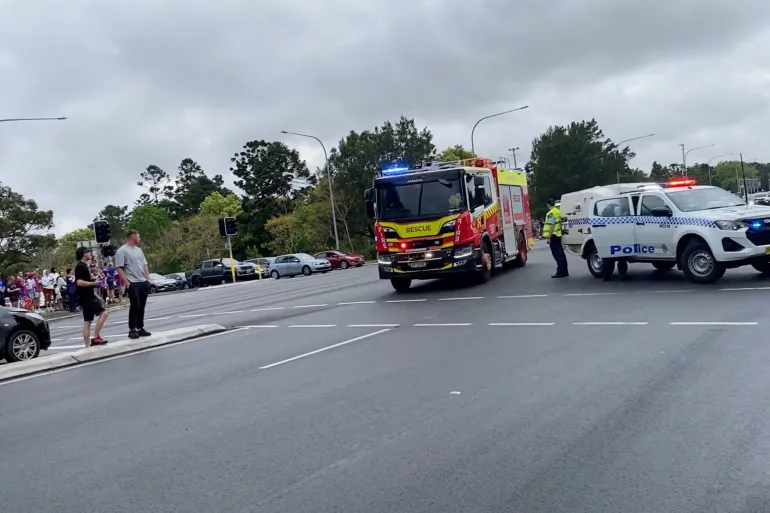
A car has crashed into a crowd of rugby league supporters in the eastern Australian city of Newcastle, injuring 10 people, including three children.
New South Wales police said on Saturday that two of the injured – a five-year-old girl and a 67-year-old man – were in a critical condition and the other eight were in stable condition in hospital.
Police said they had arrested the 18-year-old man driving the vehicle and were investigating what happened. They said the crash was not believed to be related to “terrorism”.
The crowd had gathered to farewell the local rugby league side, the Newcastle Knights, ahead of their grand final against the Sydney Roosters on Sunday.
Newcastle Lord Mayor Gavin Morris said the driver, a rugby league fan, had lost control of his vehicle and had been taken into custody.
“He was revving the car, he was excited, he was a supporter, he was there for the joy of the moment,” Morris told the national broadcaster ABC.
“Somehow he lost control of the car … and he’s gone into the crowd,” he added.
Prime Minister Anthony Albanese said: “My thoughts are with everyone injured or involved in the horrible incident this morning in Newcastle.”
“Rugby league brings people together, and this should have been a weekend of excitement and pride for Newcastle fans,” he wrote in a social media post.
[Aljazeera]

Landslide Early Warnings issued to the Districts of Kandy, Kegalle, Matale and Ratnapura

No handshakes and a delayed ceremony as India beat Pakistan at Asian Games

Showers or thundershowers will occur in most parts of the island after 1.00 p.m

Lanka enters new phase of prosecutions as hurdles clear

Police warn: Court evaders face property seizure

Nearly 20 Iranian tankers stranded off Lanka amid US sanctions

‘Dates have the highest sugar content to fight Coronavirus’

Sunday Island 27 December – Headlines

#SundayIsland 17th December – Headlines

Sunday Island – 28th March

Sunday Island Headlines – 21 March

Sunday Island – 21st February – Headlines
-

 News6 days ago
Police remove Thileepan statue in Jaffna
-

 Features6 days ago
The 22nd Amendment, constitutional recovery and illiberal slippage
-

 Features6 days ago
Of foreigners as CEOs of Lankan ventures
-

 Latest News4 days ago
Gold winner Tharanga gets brand-new Honda Vezel from SLAAJ
-

 News6 days ago
Sajith rejects Jt. Opp. protest sabotage claim; SJB TU chief demands remedial action
-

 Features4 days ago
Why Sri Lanka needs an Inclusive Civic Nationalism – urgently
-

 Features5 days ago
Thailand’s biggest new global star …
-

 News3 days ago
US-assisted ‘Ice’ detection: NPC to examine IGP’s move to transfer drug-busting team