
News
Chinese firm denies reports it withdrew from green power project for northern islands


China’s SINOSOAR- Hybrid Technology had not withdrawn from the execution of northern power projects as reported by certain Sri Lankan and Indian media outlets, Project Manager, Paul Cao said yesterday.
He said that SINOSOAR was the pre-winning bidder for the three islands mini-grid project in northern Sri Lanka.
“In the last couple of days, we noticed some misrepresented reports in some local media, claiming that our company took the initiative to suspend the project. This misinformation is against the truth and has violated the legitimate rights and interests of our company and affected the progress of the project. At present, the project is still under review process, and the progress of the project is unfortunately slow due to the interference of some third-party factors as far as we learned,” he said.
He added that the project concept was to uplift the lifestyle of the 35,710 rural households living in Delft, Analativu, Nainativu outer islands by promoting renewable energy. This was a loan proposal submitted to Asian Development Bank (ADB) by the previous Government of Sri Lanka in September 2015 and the main content of the project was to build a wind-photovoltaic-energy storage hybrid power generation system to replace the original Diesel generator power supply, strengthen the improvement of electricity conditions for residents on the islands, make full use of renewable energy to reduce the cost of fuel power generation, and provide green, continuous and stable power, he said.
“During the implementation of the Contract, the local Construction Management and Project Implementation will be subcontracted to Sri Lankan companies. There would be no Chinese laborers dispatched from China. In the context of the COVID-19 epidemic, this project will create more local employment opportunities for Sri Lanka. SINOSOAR as the EPC Contractor and the specialist in the mini-grid field, will be the key guarantee to the project success. Main facilities of the plant are supplied from China and the majority of construction materials will be procured locally in Sri Lanka,” he said.
Cao said that the project was funded by the Asian Development Bank which in full accordance with the international bidding procedures, and every step was open and transparent.
“Our company will strictly abide by the laws and regulations of Sri Lanka and the relevant requirements of the Asian Development Bank and Ceylon Electricity Board. At the same time, we firmly oppose any unwarranted interference by any third parties without legal and factual basis. Our company hopes that GOSL will strictly follow the international bidding procedures to implement the project, and protect the legitimate rights of the contractor, as well as its own seriousness and international reputation,” he said.



A group of Tamil Progressive Alliance (TPA) members, including its Leader Mano Ganesan, met President Anura Kumara Dissanayake on Thursday (02) morning at the Presidential Secretariat.
Extensive discussions were held on the issues faced by the Malayagam communities, particularly in relation to education, housing and land, as well as on the urgent measures required to address these concerns. The President paid special attention to all these matters.
Attention was also drawn to the recruitment of qualified Tamil-medium teachers to address the teacher shortage in estate sector schools and this too was discussed at length.
Members of Parliament P. Digambaram and V. Radhakrishnan, along with several other party members, were present at the meeting.

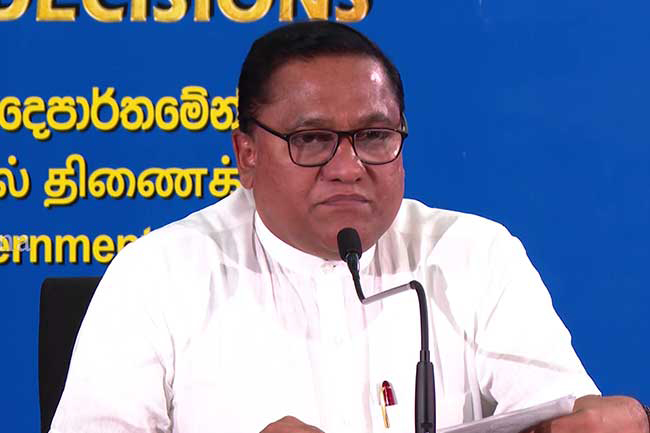
Minister of Foreign Affairs, Vijitha Herath, held talks with Deputy Foreign Minister of Russia Andrey Rudenko at the Foreign Ministry, in Colombo, on Thursday (02), with both sides reaffirming their commitment to strengthening bilateral relations.
The Sri Lanka Ministry of Foreign Affairs said the visiting Russian Deputy Minister noted that Russia regarded Sri Lanka as a long-standing friend.
Rudenko assured that Russia stood ready to support Sri Lanka when required, including in the swift supply of Russian oil to help address the current energy challenges, encouraging Russian investors to explore new opportunities in the country and promoting increased tourist arrivals.
He also expressed Russia’s readiness to provide compensation for Sri Lankan war veterans who had lost their lives in the ongoing conflict between Russia and Ukraine.
Minister Herath welcomed Russia’s willingness to assist, emphasising that Sri Lanka valued the support extended by its “old friend”, particularly at a time when the country was facing pressing energy needs.
He noted that the two countries shared nearly seven decades of diplomatic relations and said the present moment provided an opportunity to further strengthen ties, including through long-term trade agreements.
The discussions focused on enhancing cooperation in the fields of energy, investment, tourism and diplomacy, with both sides reiterating their commitment to further deepen the longstanding friendship between Sri Lanka and Russia.

Police yesterday arrested 157 foreign nationals in connection with an alleged organised online financial scam, conducted from a hotel in the Iranawila area in Chilaw.
The suspects were taken into custody during a raid carried out by the Police while they were staying at the hotel in Iranawila.
Police said the arrested group included 143 nationals from China, 13 from Bangladesh and one from Vietnam.
Investigators suspect the group had been involved in a coordinated online financial scam, targeting victims through digital platforms.
The suspects are being detained for further questioning while investigations are continuing to determine the full extent of the operation and whether additional individuals were involved.Police said further inquiries are underway.
By Norman Palihawadane

Iran executes two convicted members of banned opposition group

Afghanistan earthquake kills eight members of same family

Breakdown of the teams and groups of the FIFA World Cup in Canada, Mexico and the US after the final playoffs

365 US service members injured since start of Iran war – Pentagon

World Cup 2026: Italy’s football chief resigns after qualifying failure

Iran says it downed two US jets as search for one pilot continues

‘Dates have the highest sugar content to fight Coronavirus’

Sunday Island 27 December – Headlines

#SundayIsland 17th December – Headlines

Sunday Island – 28th March

Sunday Island Headlines – 21 March

Sunday Island – 21st February – Headlines
-

 News3 days ago
2025 GCE AL: 62% qualify for Uni entrance; results of 111 suspended
-

 News5 days ago
Tariff shock from 01 April as power costs climb across the board
-
 News6 days ago
Inquiry into female employee’s complaint: Retired HC Judge’s recommendations ignored
-
 Features7 days ago
When seabed goes dark: The Persian Gulf, cable sabotage, and race for space-based monopoly
-
 Features6 days ago
New arithmetic of conflict: How the drone revolution is inverting economics of war
-

 Editorial3 days ago
Search for Easter Sunday terror mastermind
-

 Business4 days ago
Hour of reckoning comes for SL’s power sector
-

 Sports6 days ago
Sri Lanka’s 1996 World Cup heroes to play exhibition match in Kuala Lumpur