
Editorial
Cattle slaughter ban


Within days of Prime Minister Mahinda Rajapaksa announcing his proposal to ban cattle slaughter but permit beef imports at a meeting of the government parliamentary group, where it touched a responsive chord among most MPs, the government got into reverse mode with spokesman Keheliya Rambukwella telling the post-cabinet news briefing that this matter had been laid by for a month. The government had obviously realized the error of rushed decision making, or had been nudged in that direction perhaps by the president, and decided not to hastily blunder into controversial areas without adequate study. Muslims, a beef eating community that also control beef and mutton stalls countrywide as well as most slaughter houses, would obviously be unhappy about any decision to ban the slaughter of cattle – something they have resisted over the years. They comprise a fair slice of our population and the new government will not wish to antagonize an entire community this early in its tenure. Surprisingly there was no angry outcry against the proposal no sooner it was publicized.
Nevertheless the first shot has been fired across the bows. We publish today a reader’s letter signed by a Muslim asking why only cattle? Saying, maybe tongue in cheek, that he welcomes the slaughter ban proposal, he asks why not also ban the slaughter of goats, pigs, deer, rabbits and what have you. He adds that to be fair on the quadrupeds, why not include the bipeds like fowl, duck, turkey and doves (we have not heard of doves being hunted for meat although snipe and teal-shooting was a popular sport many years ago). He also asks, sarcastically or otherwise we do not know, whether beef imports will not mean encouraging slaughter of cattle elsewhere to feed us. However that be, he has made a point.
A great many of the Buddhists among us do not eat beef. But they do relish mutton, pork, chicken and bush meat whenever available. This can be explained by the fact that although there is no ‘Sacred Cow’ concept here as in India, a lot of Lankans believe that it is sinful to slaughter and eat the flesh of an animal providing us with milk and playing a useful role as a draught animal to plough our fields and haul our loads. Of course bullock carts, hackeries, thirikkales and similar modes of transport are now receding into memory. However we do see the occasional bullock-drawn kerosene cart in Colombo and some of the other bigger cities. During the earlier and middle part of the last century, there were lot of these carts, owned by the father of the famed surgeon, Dr. P.R. Anthonis who had a large business distributing kerosene oil imported by multinational companies like Shell, Caltex and Standard Vacuum Oil Company until the Sirima Bandaranaike government nationalized the business of importing and distributing petroleum products.
Although it is illegal to slaughter buffaloes, who once served a very useful purpose tilling our rice fields, but have now been almost totally replaced by tractors, an illicit trade in buffalo meat has long existed. In addition to their value as a draught animal, buffalo milk which has a higher fat content than cow milk, is preferred for the making of curd with meekiri long enjoying a top ranking in the market. While on the subject of buffaloes, an anecdote related in parliament by the late Mr. Bernard Soysa during the debate on the Paddy Lands Act is worth retelling. The well-loved LSSP MP said that he and his comrades had toured the rice-gowing areas of the country to win over peasant support for the legislation. At Tissamaharama they told a group of farmers that they can till their fields in the future with tractors rather than buffaloes when an old farmer had piped, “but tractors won’t pataw danawa (calve) like buffaloes!”
Cattle thieving, inevitably for supplying illicit slaughter houses and butchers, has been rampant in the country for a very long period of time and continues either unabated or very poorly controlled to this day. A ban on the slaughter of these animals, will deliver a death blow to that menace and this will be widely welcomed in a country where many Buddhists seek merit by saving the lives of cattle bound for the abattoir. People doing such good deeds are often confronted with the problem of finding a safe haven for these animals to live out their natural life spans. The scarcity of such opportunities are known to sometimes result in the tragedy of once saved animals eventually ending under the butcher’s knife.
There are already meat and fish imports into the country to meet high-end demand in the big hotels where imported steaks and salmon are on offer, of course at a price that only the very rich can afford. In fact the domestic food processing industry imports mutton – we wrongly call goat meat mutton whereas mutton is the meat of a sheep or lamb – some of which is converted into corned mutton for export. In fact some non-beef eating Lankans domiciled abroad take back cans of corned mutton from here as corned beef is much more available where they live. Be that as it may, a ban on cattle slaughter will have ramifications that go well beyond the hostility of beef eaters who are not only Muslims. In the Eastern Province, for example, a tough and wiry peasantry has been created on beef and milk. Also, logical progression of a ban on cattle slaughter should eventually develop into a demand to end the fishing industry.
President Premadasa, in his tenure, halted government support for the inland fishing industry and some hatcheries producing fingerlings to stock irrigation reservoirs and tanks were closed. But inland fisheries have prevailed with perhaps some of those hatcheries resurrected. It is unlikely, if not impossible, for any country in the modern world to stop the consumption of animal protein. Even if the ban on cattle slaughter is not eventually imposed, we must ensure humane slaughter as a top priority. That is a must.



Sri Lanka has a very ‘promising’ government and a perennially protesting Opposition. The government makes various promises, which are like piecrusts made to be broken. The Opposition in a perpetual state of agitation bursts into protests at the drop of a hat. The two sides have been clashing in Parliament instead of sinking their political differences and cooperating at least in the aftermath of a disaster.
The Opposition has requested Speaker Dr. Jagath Wickramaratne to appoint a Parliamentary Select Committee (PSC) to probe the government’s alleged failure to mitigate the impact of Cyclone Ditwah despite repeated warnings issued by the Meteorology Department and the Irrigation Department. The government is determined to avoid a fate similar to that which befell the Yahapalana government following the Easter Sunday terror attacks, which became the undoing of that dysfunctional regime. It is therefore very unlikely to meet the Opposition’s demand at issue. Even if it agrees to appoint a PSC to probe its own alleged lapses, by any chance, it will not allow an Opposition MP to chair the committee and will go all out to frustrate its rivals’ efforts to ruin its political future.
Interestingly, some of the key Opposition members are former Yahapalana MPs who sought to derail a PSC probe into the 2015 Treasury bond scam. They craftily appointed a member of the JVP, which was a Yahapalana partner in all but name, as the Chairman of that PSC, and incorporated a slew of footnotes into the committee report in a bid to dilute it.
In this country, PSCs rarely help get to the bottom of the issues they probe. The PSC on the Treasury bond scam went out of its way to clear the then Prime Minister Ranil Wickremesinghe’s name, and helped the UNP scapegoat former Central Bank Governor Arjuna Mahendran and throw him to the wolves. In 2012, Mahinda Rajapaksa government turned a PSC probe into a witch-hunt against then Chief Justice Dr. Shirani Bandaranayake, who was subsequently wrongfully impeached. The PSC that investigated the Easter Terror attacks (2019) gathered a lot of valuable information but its findings, conclusions and recommendations were tainted by a glaring political bias.
Going by the government’s determined bid to let its MP Asoka Ranwala off the hook, following a road accident, how ruthless the JVP-led NPP will be in warding off threats to its political survival is not difficult to imagine. The Opposition can go on shouting until it is blue in the face but it will not be able to have the government’s alleged failure to heed disaster warnings and save lives investigated properly as long as the JVP/NPP is in power.
What we are witnessing on the political front, especially in Parliament, is like a drunken brawl at a funeral. The government and the Opposition are fighting while the country is mourning those who perished in recent floods and landslides.
What the political parties represented in Parliament ought to do at this juncture is to get their priorities right. They must stop clashing and make a concerted effort to carry out post-disaster rebuilding operations and strengthening the economy. They must not lose sight of the rapid depreciation of the rupee, and the disconcerting forecasts of an economic slowdown. The much-advertised revenue bubble, created by an unprecedented increase in vehicle imports, is about to burst, and the possibility of the country having a rupee crisis to contend with again cannot be ruled out. Foreign reserve targets are far from achieved, and there is a pressing need to boost the forex inflow and ensure that the country will be able to honour its pledge to resume foreign debt repayment in 2028.
All political parties have done precious little for the disaster victims. They have been only visiting the welfare centres and distributing relief materials collected from the considerate public. They ought to engage in post-disaster rebuilding actively. Reconstruction is a labour-intensive task. The self-righteous political leaders should mobilise their community level organisation for post-disaster rebuilding. Sadly, they have not even helped clean flood-hit houses.

Saturday 20th December, 2025
Disciplinary action has reportedly been taken against several police officers for their alleged failure to conduct a proper investigation into a recent accident caused by NPP MP Asoka Ranwala in Sapugaskanda. This move, we believe, has the trappings of a diversionary tactic. The police would have incurred the wrath of the government if they had conducted a breathalyzer test on Ranwala and produced him before a Judicial Medical Officer immediately after the crash where an infant, his mother and grandmother were injured.
Ranwala was subjected to a blood alcohol test more than 12 hours after the accident, according to media reports. The police would not have dragged their feet of their own volition. They were obviously made to do what they did. The law applies equally only to ordinary people. Will the police top brass explain why no disciplinary action was taken against the police officers who unashamedly sided with a group of JVP members involved in grabbing an office of the Frontline Socialist Party (FSP) in Yakkala in September 2025. After turning a blind eye to that blatant transgression, the police provided security to the JVP members who were forcibly occupying the FSP office. Thankfully, a judicial intervention made them leave the place. The current rulers claim they have not placed themselves above the law, unlike their predecessors. A wag says they have placed the law below them instead!
Having made a mockery of its much-advertised commitment to upholding the rule of law by intervening to prevent Ranwala from undergoing an alcohol test immediately after the aforesaid accident, the government is making attempts at face-saving. Curiously, blood samples obtained from Ranwala have been sent to the Government Analyst for testing! The government seems to have a very low opinion of the intelligence of the public, who voted for it overwhelmingly, expecting a ‘system change’.
It is being argued in some quarters that the disciplinary inquiry against the police officers has been scripted, and the charges against them will be dropped when the issue fizzles out. This argument is not without some merit, but there is a possibility of the government going to the extent of trying to clear its name at the expense of the police officers concerned if push comes to shove.
Successive governments have scapegoated police personnel and other state employees to safeguard their interests, and the incumbent administration is no exception; it has already sought to shift the blame for its failure to mitigate the impact of Cyclone Ditwah to the Meteorological Department, which, it has claimed, did not warn it about the extreme weather events fairly in advance. Opposition Leader Sajith Premadasa told Parliament on Thursday that the government had muzzled some senior officials of the Meteorological Department.
Some leaders of the incumbent government are bound to face legal action for their commissions and omissions when they lose power, and the state officials pandering to their whims and fancies will have to do likewise.
The public officials who are at the beck and call of politicians and carry out illegal orders should realise that they run the risk of being left without anyone to turn to in case they have to face legal action for their transgressions. Their ruthlessly self-seeking political masters will not scruple to sacrifice them.

Friday 19th December, 2025
Opposition Leader Sajith Premadasa has accused the government of interfering with the ongoing disaster relief programmes. Speaking in Parliament, on Thursday, he produced what he described as documentary proof to support his claim that disaster victims were required to have their applications for compensation endorsed by the heads of the Prajashakthi committees controlled by the JVP apparatchiks. Several other Opposition MPs have levelled the same allegation against the government in Parliament.
Two trade unions representing the Grama Niladharis have complained of political interference with their work, and even threatened to pull out of the disaster relief programmes unless they are allowed to carry out their duties and functions, free from political pressure.
Sri Lanka United Grama Niladhari Association (SLUGNA) President Nandana Ranasinghe told the media on 08 December that JVP/NPP politicians and their supporters were meddling with the disaster relief programmes at all levels and even obstructing the Grama Niladharis (GNs). He claimed that the political authority had sent letters to the District and Divisional Secretaries, directing them to appoint JVP/NPP members to the state-run welfare centres. SLUGNA Secretary Jagath Chandralal said state officials had been directed to obtain approval from the government members of the Prajashakthi committees for carrying out relief work. A few days later, addressing the media, Convenor of the Sri Lanka Grama Niladhari Association Sumith Kodikara also made a number of similar allegations. He said the NPP politicians were arbitrarily helping their supporters obtain Rs. 25,000 each as compensation. He stressed that only the disaster victims had to be paid compensation, and never had disaster relief programmes been politicised in that manner. These allegations are shocking enough to warrant probes, as we said in a previous comment.
Initially, the government denied the involvement of its Prajashakthi members in the process of selecting disaster relief beneficiaries, but now it allows them to work alongside state officials openly. This is an instance of the arrogance of power, which became the undoing of several previous governments, especially the ones led by the UNP and the SLPP. Minister K. D. Lal Kantha has gone on record as claiming that the Prajashakthi functionaries too should have a say in relief provision!
Funds the government is distributing among disaster victims belong to the state, and therefore no political party must be allowed to influence or control their disbursement. One can argue that it is prima facie unlawful for anyone other than authorised public officials to get involved in the process of distributing state funds as disaster relief. The Opposition should find out whether there is any legal provision for the involvement of the Prajashakthi functionaries in relief distribution or whether they are committing a transgression.
The government is apparently labouring under the mistaken belief that it can use disaster relief to shore up its approval rating as well as electoral prospects in view of the next election––the Provincial Council polls which it is coming under increasing pressure to hold next year. Political interference with disaster relief only exasperates the public beyond measure. A large number of disaster victims have held protests in several areas, claiming that they have been overlooked.
The JVP/NPP, which came to power promising to depoliticise the state institutions and revitalise the public service, should be ashamed of having stooped so low as to politicise the process of providing disaster relief. Politicians have a sense of shame only when they are out of power.
If the JVP/NPP leaders are wise, they will learn from the predicament of the Rajapaksas, who had to pay a heavy price for testing the patience of the public. The latter had to head for the hills with angry people in close pursuit. Now that the people have successfully got rid of a bunch of failed rulers, they may take to the streets again if their patience runs out. The government would do well to follow the established procedures in carrying out disaster relief programmes, without subjugating them to its political agenda and undermining their integrity.

Showers will occur in the Eastern, Uva and Central provinces and in Polonnaruwa and Hambantota districts.

Steps are being taken to abolish the Executive Presidency and establish a Parliamentary System of Government – Prime Minister

The full speech delivered by President Anura Kumara Dissanayake in Parliament (2025-12-19)

Lawyers slam NPP Mayor for claiming judicial powers

Electricity consumers oppose going to WB to cover CEB losses from Ditwah, instead of using funds in its kitty

PM rejects Hakeem’s call for involving ex-Presidents for disaster fundraising

‘Dates have the highest sugar content to fight Coronavirus’

Sunday Island 27 December – Headlines

#SundayIsland 17th December – Headlines

Sunday Island – 28th March

Sunday Island Headlines – 21 March

Sunday Island – 21st February – Headlines
-

 Midweek Review4 days ago
How massive Akuregoda defence complex was built with proceeds from sale of Galle Face land to Shangri-La
-

 News3 days ago
Pakistan hands over 200 tonnes of humanitarian aid to Lanka
-

 News3 days ago
Pope fires broadside: ‘The Holy See won’t be a silent bystander to the grave disparities, injustices, and fundamental human rights violations’
-
 News4 days ago
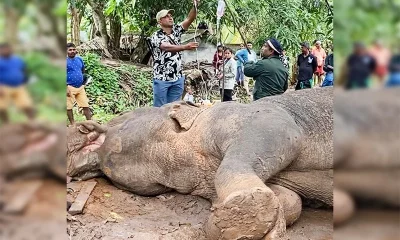
Burnt elephant dies after delayed rescue; activists demand arrests
-

 Editorial4 days ago
Colombo Port facing strategic neglect
-

 News2 days ago
Army engineers set up new Nayaru emergency bridge
-

 Business2 days ago
Unlocking Sri Lanka’s hidden wealth: A $2 billion mineral opportunity awaits
-

 News4 days ago
Sri Lanka, Romania discuss illegal recruitment, etc.