
Foreign News
Buddhism’s holiest site erupts in protests over Hindu ‘control’ of shrine

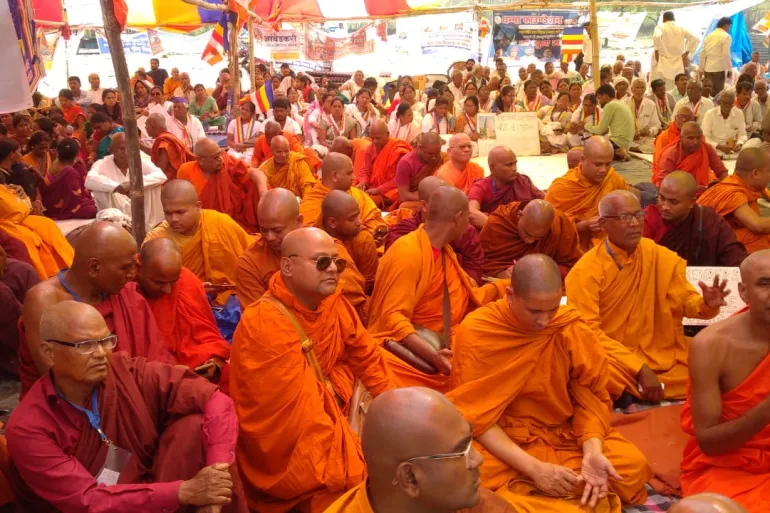
As he stood in a queue outside a makeshift tent kitchen for breakfast, 30-year-old Abhishek Bauddh could not help but reflect on the throngs of people around him in Bodh Gaya, Buddhism’s holiest site.
Bauddh has been visiting the town in eastern India’s Bihar state, where the Buddha gained enlightenment, since he was 15. “But I have never seen such an atmosphere. Buddhists from all over the country are gathering here,” he said.
For once, they are not in Bodh Gaya only for a pilgrimage. They are part of a protest by Buddhists that has erupted across India in recent weeks over a demand that control of Bodh Gaya’s Mahabodhi Temple, one of the faith’s most sacred shrines, be handed over exclusively to the community.
Several Buddhist organisations have held rallies, from Ladakh bordering China in the north to the cities of Mumbai in the west and Mysuru in the south. Now, people are increasingly trooping to Bodh Gaya to join the main protest, said Akash Lama, general secretary of the All India Buddhist Forum (AIBF), the collective leading the campaign. India has an estimated 8.4 million Buddhist citizens, according to the country’s last census in 2011.
For the last 76 years, the temple has been managed by an eight-member committee — four Hindus and four Buddhists — under the Bodh Gaya Temple Act, 1949, a Bihar state law.
But the protesters, including monks clad in saffron with loudspeakers and banners in their hands, are demanding a repeal of that Act and a complete handover of the temple to the Buddhists. They argue that in recent years, Hindu monks, enabled by the fact that the influence the community wields under the law, have increasingly been performing rituals that defy the spirit of Buddhism — and that other, more subtle forms of protest have failed.
The Bodh Gaya Math, the Hindu monastery that performs the rituals inside the complex, insists that it has played a central role in the upkeep of the shrine for centuries and that it has the law on its side.
The protesters point out that the Buddha was opposed to Vedic rituals. All religions in India “take care and manage their own religious sites”, said Bauddh, who travelled 540km (335 miles) from his home in the central state of Chhattisgarh to Bodh Gaya. “So why are Hindus involved in the committee of a Buddhist religious place?”
Sitting down with his plate of hot rice with dal, he said, “Buddhists have not received justice [so far], what should we do if we do not protest peacefully?”
Barely 2km (1.2 miles) away from the sacred fig tree in the Mahabodhi Temple complex where the Buddha is believed to have meditated, minibuses arrive on a dusty road from Patna, the capital of Bihar, carrying protesters from different parts of the country.
For some, who have regularly visited the shrine, the concern over Hindu rituals being performed at the temple complex is not new.
“From the very beginning, when we used to come here, we felt very disheartened to see rituals that Lord Buddha had forbidden being performed by people of other religions in this courtyard,” said 58-year-old Amogdarshini, who travelled from Vadodara in the western state of Gujarat to join the protests in Bodh Gaya.
In recent years, Buddhists have complained to local, state and national authorities about the Hindu rituals. In 2012, two monks filed a petition before the Supreme Court seeking a repeal of the 1949 law that gives Hindus a say in the running of the shrine. That case has not even been listed for a hearing, 13 years later. In recent months, the monks have again submitted memorandums to the state and central governments and have taken out rallies on the streets.
But things came to a head last month. On February 27, more than two dozen Buddhist monks sitting on a hunger strike for 14 days on the temple premises were removed at midnight by the state police, who forced them to relocate outside the temple.
“Are we terrorists? Why cannot we protest in the courtyard that belongs to us?” said Pragya Mitra Bodh, secretary of the National Confederation of Buddhists of India, who came from Jaipur in the western state of Rajasthan with 15 other protesters. “This temple management act and committee setup taints our Buddhist identity and the Mahabodhi temple can never completely belong to us unless the act is repealed.”
Since then, the protests have intensified — some, like Amogdarshini, who had already spent a couple of weeks in Bodh Gaya in January, have now returned to join the protest.
Stanzin Suddho, a travel agent from Ladakh who is currently in Bodh Gaya, said the protests are being funded by devotees’ contributions. “We do not stay for long,” he said, adding that he came with 40 others. “Once we go back, more people will join here.”
At the heart of the battle for the Mahabodhi Temple — a UNESCO World Heritage Site — is its long-contested legacy.
The temple was built by Emperor Ashoka, who visited Bodh Gaya in 260 BCE after embracing Buddhism, roughly 200 years after the Buddha’s enlightenment.
It remained under Buddhist management for years until major political changes in the region in the 13th century, said Imtiaz Ahmed, professor of medieval history at Patna University. The invasion of India by Turko-Afghan general Bakhtiyar Khilji “led to the eventual decline of Buddhism in the region”, Ahmed said.
According to UNESCO, the shrine was largely abandoned between the 13th and 18th centuries, before the British began renovations.
But according to the shrine’s website, a Hindu monk, Ghamandi Giri, turned up at the temple in 1590 and began living there. He started conducting rituals and established the Bodh Gaya Math, a Hindu monastery. Since then, the temple has been controlled by descendants of Giri.
In the late 19th century, visiting Sri Lankan and Japanese Buddhist monks founded the Maha Bodhi Society to lead a movement to reclaim the site.
In 1903, these efforts led the then-viceroy of India, Lord Curzon, to try to negotiate a deal between the Hindu and Buddhist sides, but he failed. Later on, both sides started mobilising political support and eventually, two years after India gained independence from British rule in 1947, Bihar’s government pushed through the Bodh Gaya Temple Act. The law transferred the temple’s management from the head of the Bodh Gaya Math to the eight-member committee, which is now headed by a ninth member, the district magistrate — the top bureaucrat in charge of the district.
But Buddhists allege that the Bodh Gaya Math — as the most influential institution on the ground — effectively controls the day-to-day functioning of the complex.
Swami Vivekananda Giri, the Hindu priest who currently looks after the Bodh Gaya Math, is unfazed by the protests, describing the agitations as “politically motivated” — with an eye on Bihar’s state legislature elections later this year.
“Our Math’s teachings treat Lord Buddha as the ninth reincarnation of [Hindu] Lord Vishnu and we consider Buddhists our brothers,” Giri told Al Jazeera. “For years, we have hosted Buddhist devotees, from other countries as well, and never disallowed them from praying on the premises.”
Giri says the Hindu side has been “generous in allowing four seats to Buddhists in the management committee”.
“If you repeal the Act, then the temple will solely belong to the Hindu side because we owned it before the Act and the independence [of India],” Giri said, taking a dig at the protesters. “When the Buddhists abandoned it after the invasion of Muslim rulers, we preserved and took care of the temple. Yet we never treated Buddhist visitors as ‘others’.”
Back at the protest site, Akash Lama, who leads the demonstrations, suggested that the protesters have little hope that the federal government of the Hindu majoritarian Bharatiya Janata Party (BJP), and the state government — in which the BJP is an alliance partner — will listen to their grievances.
“The rights of Buddhists are being gradually violated by using the Act. Buddhists have the right over the temple, so it should be handed over to the Buddhists,” he said. “We have been disappointed in the government and the Supreme Court [for failing to hear the case].”
But Bauddh, the protester from Chhattisgarh, still has hope — not in the government, but in the people he sees around him. “This unity makes our protest strong,” he said.
[Aljazeera]


Russia finished 2025 with what Ukraine described as an information operation designed to avoid engaging in peace talks and continue its war, despite suffering staggering casualties for meagre territorial gains this year.
On Monday, December 29, Russian Foreign Minister Sergey Lavrov accused Ukraine of attempting to assasinate Russia President Vladimir Putin at his residence at Lake Valdai, 140km (87 miles) northeast of Moscow.
“The Kyiv regime launched a terrorist attack using 91 long-range unmanned aerial vehicles (UAVs) on the state residence of the president of the Russian Federation in the Novgorod Region. All the UAVs were destroyed by the air defence systems of the Russian Armed Forces,” said Lavrov in a statement.
He did not say whether Putin was in residence at the time.
Lavrov’s Ukrainian counterpart, Andrii Sybiha, quickly dismissed the claim. “Almost a day passed and Russia still hasn’t provided any plausible evidence to its accusations of Ukraine’s alleged ‘attack on Putin’s residence’. And they won’t. Because there’s none. No such attack happened,” Sybiha said.
Russia produced photographs of drone debris lying in the snow two days later, but the drone’s location, manufacture and the time of its downing could not be corroborated from them.
“The attack on Putin’s Valdai residence is presumably a Kremlin fake,” wrote the opposition outlet Sota. “Residents of Valdai, where Putin’s ‘Dinner’ residence is located, told Sota that last night they did not hear the work of the air defence, which would have shot down 91 drones.”
Sota also pointed out that drones attacking Valdai “necessarily cross a specially protected airspace with objects of the Strategic Missile Forces, East Kazakhstan region, military aviation, closed administrative units such as Solnechny, Lake, etc.
“A drone crossing the territory of these facilities can fly to the Dinner residence only by miracle,” Sota said.
Lavrov’s claim also appeared at odds with an earlier announcement from the Russian Ministry of Defence that only 41 drones had been downed in the Novgorod region on the night of December 28-29.
Russia’s Defence Ministry later issued an update, saying another 49 drones had been shot down over Bryansk and one over Smolensk “flying in the direction of Novgorod region”.
Ukraine observers pointed out that Bryansk and Smolensk are hundreds of kilometres from Valdai.
The Institute for the Study of War (ISW), a Washington-based think tank, stated that none of the usual evidence of Ukrainian strikes accompanied the alleged attack, such as footage, heat signatures, statements from local officials, or local media reports.
For example, a successful Ukrainian attack against an oil depot in Rybinsk on December 31 was well-documented on social media. So was an attack on the Novoshakhtinsk refinery in Rostov a week earlier, as well as a number of other strikes during the week.

News of the alleged attack came a day after Ukrainian President Volodymyr Zelenskyy concluded successful talks with United States President Donald Trump in Florida, garnering a promise that US forces would participate in Ukraine’s security following any peace agreement with Russia.
It was the first time the US had agreed to such security guarantees, and it appeared to make Polish Premier Donald Tusk optimistic that the war in Ukraine could end early in 2026.
“Peace is on the horizon,” he told a cabinet meeting on Tuesday.
“The key result of recent days is the American declaration of willingness to participate in security guarantees for Ukraine after a peace agreement, including the presence of American troops, for example, on the border or on the line of contact between Ukraine and Russia,” Tusk said.
Zelenskyy said Ukraine’s allies, known as the Coalition of the Willing, were scheduled to meet in Kyiv on January 3 and in France three days later.
Lavrov’s announcement cast a pall on this optimism when he said, “Russia’s negotiating position will be reviewed.” On the same day, Putin ordered his forces in southern Ukraine to continue efforts to seize the unoccupied remainder of the southern Ukrainian region of Zaporizhia. Moscow controls three-quarters of the region.
Zelenskyy said Russia was “looking for a pretext” to escalate hostilities and avoid engaging in peace talks, following his successful meeting with Trump.
“Russia is at it again, using dangerous statements to undermine all achievements of our shared diplomatic efforts with President Trump’s team,” he wrote on social media.
Russia has repeatedly dashed Trump’s hopes for peace, refusing to cede occupied territory or to accept US and European forces on Ukrainian soil.
Yet Trump appeared to believe Moscow’s allegations.
“I don’t like it. It’s not good,” Trump told reporters on Monday. “It’s one thing to be offensive… It’s another thing to attack his house. It’s not the right time to do any of that. And I learned about it from President Putin today. I was very angry about it.”
Other US officials were not convinced. US Ambassador to NATO Matthew Whitaker expressed scepticism, telling an interviewer on Monday, “It’s unclear whether it actually happened.” On Wednesday, the Wall Street Journal reported that US intelligence had determined that Ukraine did not target Putin’s residence.
Moscow’s messaging appeared to bookend Zelenskyy’s meeting with Trump, targeting the US president.
Putin held staged meetings with his General Staff on Saturday, December 27, and Monday, just before and after Zelenskyy’s meeting with Trump, during which commander-in-chief Valery Gerasimov broadcast exaggerated claims of success.
He said Russian forces had occupied 6,640 square kilometres (2,564 square miles) of Ukrainian territory and seized 334 Ukrainian settlements in 2025. The ISW said it had “observed evidence indicating a Russian presence in 4,952 square kilometres (1912 sq miles)” and 245 settlements.
Ukrainian commander-in-chief Oleksandr Syrskii said territory amounting to 0.8 percent of Ukraine’s 603,550sq km (233,032sq miles) had been lost. at the cost of almost 420,000 dead and wounded Russians.
Ukraine’s General Staff estimated total Russian casualties for the war at more than 1.2 million, almost 11,500 tanks and 24,000 armoured fighting vehicles, more than 37,000 artillery systems, 781 aircraft and well in excess of 4,000 missiles.
By the end of 2025, Russian forces had still not taken Pokrovsk and Myrnohrad, the eastern Ukrainian towns in Donetsk that they had been fighting to capture for five months. They held 55 percent of Hulyaipole in the southern Zaporizhia region, despite claiming to have seized it. Even Russian military reporters admitted Russian forces were being squeezed out of Kupiansk in the northern Kharkiv region, despite claiming also to have seized that.
“Due to inaccurate reports on the situation to higher authorities, reserves that were ‘not needed’ for the capture and clearing of Kupiansk were redeployed to other areas,” wrote one Kremlin-friendly outlet, citing “systematic exaggeration of successes”.
While it remained doubtful whether Ukraine did target Valdai, Russia’s attacks on Ukrainian cities were documented. During the last week of the year, Russia launched just more than 1,000 drones and 33 missiles at Ukraine’s cities. Ukraine’s Air Force said it intercepted 86 percent of the drones and 30 of the missiles.


[Aljazeera]
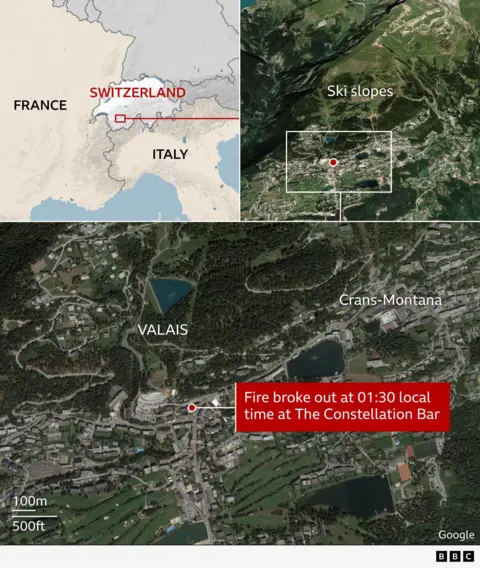
Around 40 people have died after a fire ripped through a bar in a ski resort in southern Switzerland, police have said. A further 115 people are injured, many of them “severely”.
The fire broke out at around 01:30 (00:30 GMT) during new year celebrations in a bar called Le Constellation in Crans-Montana.
Officials investigating the incident have not confirmed any cause, but categorically ruled out an attack.
People from multiple countries have been affected. Regional police commander Frédéric Gisler has said the priority in the coming days is to identify those who have died “so that their bodies can be returned rapidly” to their families.
Thirteen helicopters, 42 ambulances and 150 emergency responders were sent overnight to the scene of the fire in the Valais region, which is popular with tourists.
Most of the injured experienced severe burns and 60 people were sent to Sion hospital in Valais, with a “significant number” in a critical condition, Regional governor Mathias Reynard said.
Its intensive care unit was at full capacity and Reynard said the local community must take extra care to avoid needing hospital treatment unnecessarily.
“We are painfully aware that identifying the bodies, as well as the injured, may still take a terribly long time for the families involved,” Reynard added.
Some people have been taken to hospitals in other Swiss cities including Lausanne and Zurich which have specialist burns units.
A spokesperson for Lausanne University Hospital said they were treating 22 patients with burn injuries, while Zurich University Hospital said it was treating 12 patients for burns.
The Italian Foreign Ministry has told the BBC that 16 Italian nationals are currently missing, and between 12 and 15 others are receiving treatment in hospital.
The French foreign ministry said eight of its citizens were missing and that it could not rule out that French nationals were among the dead.
French media has reported that at least two of the injured are French nationals.
Three Italian nationals are being evacuated to Milan’s Niguarda hospital where there is a major burns unit, Italian councillor Guido Bertolaso has said.
They have burns across “30-40% of their bodies”, he told reporters, and they remain intubated, but “the fact they could be moved is a good sign”.
The precise number of dead and injured is not yet known, nor their nationalities but officials have confirmed that several nationalities were involved.
Speaking at a press conference on Thursday evening, officials said they did not know how many people were in the bar when the fire broke out.
State councillor Stéphane Ganzer described the bar as having a “young festive population” during the New Year’s Eve party.
Attorney General Beatrice Pilloud has said an investigation was under way “to identify the circumstances which caused this dramatic situation to occur”.
She was asked by journalists at the press conference about rumours that bottles of champagne carrying flares might have been the cause of the blaze, and whether the staircases were “very narrow”.
She replied that she could not confirm anything while the investigation is ongoing.
Ms Pilloud said the staircases did appear to be narrow, but investigations would assess whether they were in line with requirements.
She said “several hypotheses” for the cause of the blaze have been put forward, and the favoured theory was a “general fire which caused conflagration” – a large fire that causes a lot of damage, rather than an explosion.
Several witnesses have been interviewed, she said, and phones have also been recovered for analysis.
“At no time is there question of any attack”, she said.
Work is ongoing to identify the victims and return bodies to families as quickly as possible, Ms Pilloud said, adding: “To do that there is significant work which needs to be carried out. And this significant work will require the closure of the district.”
The Italian ambassador to Switzerland, Gian Lorenzo Cornado, said that it would take weeks to identify the dead.
A helpline has been set up for families: +41 848 112 117
The fire was “one of the worst tragedies that our country has experienced,” Swiss President Guy Parmelin told reporters.
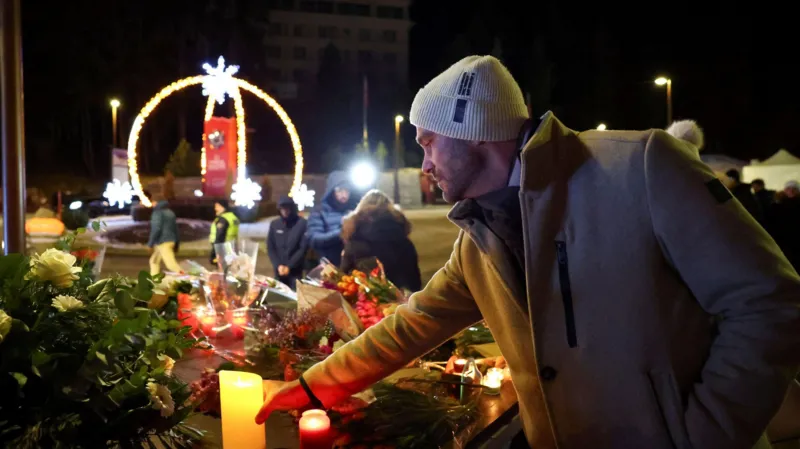
Local people gathered to pay tribute to the dead and injured at a vigil at Montana Station Church on Thursday evening, and floral tributes were laid near the scene of the fire.
Crans-Montana is a luxury ski resort, famous in the 1980s for hosting the World Cup skiing.
Le Constellation, which has been around for decades, has an upstairs with TV screens where people go and watch football matches, and a large bar downstairs for drinking and dancing.
The UK Foreign Office said its “thoughts are with all those injured and killed in the terrible tragedy” and consular staff were on standby to provide support to any British nationals affected.
King Charles said he and his wife Queen Camilla were “greatly saddened” to learn of the fire, and that it was “utterly heartbreaking that a night of celebration for young people and families instead turned to such nightmarish tragedy”.
French President Emmanuel Macron said France was welcoming the injured from Crans-Montana to its hospitals.
European Commission President Ursula von der Leyen said the EU was working with Swiss authorities to get medical help to victims through the EU’s civil protection mechanism.

Israel is to revoke the licenses of 37 aid groups working in Gaza and the occupied West Bank, saying they failed to meet requirements under new registration rules.
Well-known international non-governmental organisations (INGOs) such as ActionAid, the International Rescue Committee and the Norwegian Refugee Council are among those that will have their licenses suspended on 1 January, with their operations to end within 60 days.
Israel said the groups, among other things, had failed to hand over “complete” personal details of their staff.
The move was heavily criticised by foreign ministers from 10 countries including the UK, who said the new rules were “restrictive” and “unacceptable”.
In a joint statement, the foreign ministers of the UK, France, Canada, Denmark, Finland, Iceland, Japan, Norway, Sweden and Switzerland said the forced closure of INGO operations would “have a severe impact on access to essential services including healthcare”.
They added that the humanitarian situation in Gaza remained “catastrophic” and called on Israel’s government to ensure INGOs were able to operate “in a sustained and predictable way”.
Israel’s Ministry of Diaspora Affairs, which is in charge of registration applications, said the new measures would not impact the flow of humanitarian assistance to Gaza.
It added that aid continued to be delivered through “approved and vetted channels”, including UN agencies, bilateral partners, and humanitarian organisations.
It said the primary reason aid groups were having their licences revoked was “the refusal to provide complete and verifiable information regarding their employees,” which it said was critical to preventing “the infiltration of terrorist operatives into humanitarian structures”.
Earlier this month, UN-backed experts said there had been improvements in nutrition and food supplies in Gaza since a ceasefire was brokered between Israel and Hamas in October, but 100,000 people still experienced “catastrophic conditions” the following month.
Israeli military body Cogat, which controls Gaza’s crossings, said the organisations that will be suspended “did not bring aid into Gaza throughout the current ceasefire”.
It added that “even in the past their combined contribution amounted to only about 1% of the total aid volume”.
The Ministry of Diaspora Affairs said that fewer than 15% of organisations providing humanitarian assistance to Gaza were found to be in violation of the new regulatory framework.
That framework includes several grounds for rejection, including:
- Denying the existence of Israel as a Jewish and democratic state
- Denying the Holocaust or the Hamas-led attacks on Israel on 7 October 2023
- Supporting an armed struggle against Israel by an enemy state or terrorist organisation
- Promoting “delegitimisation campaigns” against Israel
- Calling for a boycott of Israel or committing to participate in one
- Supporting the prosecution of Israeli security forces in foreign or international courts
The Humanitarian Country Team of the Occupied Palestinian Territory – a forum that brings together UN agencies and more than 200 local and international organisations – previously warned that the new registration system “fundamentally jeopardises” the operations of INGOs in Gaza and the West Bank.
“The system relies on vague, arbitrary, and highly politicised criteria and imposes requirements that humanitarian organisations cannot meet without violating international legal obligations or compromising core humanitarian principles,” it said.
It added: “While some INGOs have been registered under the new system, these INGOs represent only a fraction of the response in Gaza and are nowhere near the number required just to meet immediate and basic needs.”
According to the Humanitarian Country Team, INGOs currently run or support most of Gaza’s field hospitals and primary healthcare centres, emergency shelter responses, water and sanitation services, nutrition stabilisation centres for children with acute malnutrition, and critical mine action activities.
In a statement, Israel’s Minister of Diaspora Affairs and Combating Antisemitism, Amichai Chikli, said: “The message is clear: humanitarian assistance is welcome — the exploitation of humanitarian frameworks for terrorism is not.”
Other organisations to be suspended include CARE, Medico International and Medical Aid for Palestinians.
[BBC]

Over 400,000 Russians killed, wounded for 0.8 percent of Ukraine in 2025

SCG curator ‘really happy’ with pitch for final Ashes Test

Showery condition is expected to enhance in the Eastern, Northern and Uva provinces during the coming days, due to the development of a low-level atmospheric disturbance to the East of Sri Lanka

GMOA warns of trade union action unless govt. urgently resolves critical issues in health sector

Elephant census urged as death toll nears 400

CTU raises questions about education reforms

‘Dates have the highest sugar content to fight Coronavirus’

Sunday Island 27 December – Headlines

#SundayIsland 17th December – Headlines

Sunday Island – 28th March

Sunday Island Headlines – 21 March

Sunday Island – 21st February – Headlines
-

 Sports4 days ago
Gurusinha’s Boxing Day hundred celebrated in Melbourne
-
 News2 days ago
Leading the Nation’s Connectivity Recovery Amid Unprecedented Challenges
-

 Sports5 days ago
Time to close the Dickwella chapter
-

 Features3 days ago
It’s all over for Maxi Rozairo
-

 News5 days ago
Environmentalists warn Sri Lanka’s ecological safeguards are failing
-
 News3 days ago
Dr. Bellana: “I was removed as NHSL Deputy Director for exposing Rs. 900 mn fraud”
-
 News2 days ago
Dons on warpath over alleged undue interference in university governance
-
 Features5 days ago
Digambaram draws a broad brush canvas of SL’s existing political situation