
Foreign News
Buddhism’s holiest site erupts in protests over Hindu ‘control’ of shrine

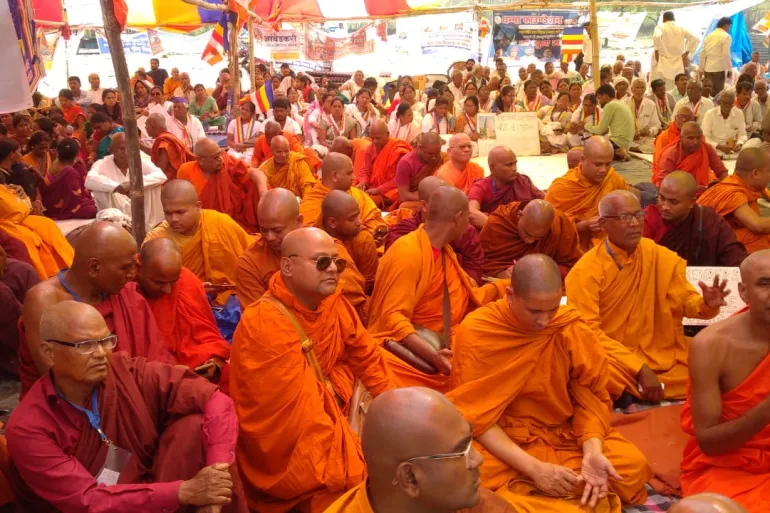
As he stood in a queue outside a makeshift tent kitchen for breakfast, 30-year-old Abhishek Bauddh could not help but reflect on the throngs of people around him in Bodh Gaya, Buddhism’s holiest site.
Bauddh has been visiting the town in eastern India’s Bihar state, where the Buddha gained enlightenment, since he was 15. “But I have never seen such an atmosphere. Buddhists from all over the country are gathering here,” he said.
For once, they are not in Bodh Gaya only for a pilgrimage. They are part of a protest by Buddhists that has erupted across India in recent weeks over a demand that control of Bodh Gaya’s Mahabodhi Temple, one of the faith’s most sacred shrines, be handed over exclusively to the community.
Several Buddhist organisations have held rallies, from Ladakh bordering China in the north to the cities of Mumbai in the west and Mysuru in the south. Now, people are increasingly trooping to Bodh Gaya to join the main protest, said Akash Lama, general secretary of the All India Buddhist Forum (AIBF), the collective leading the campaign. India has an estimated 8.4 million Buddhist citizens, according to the country’s last census in 2011.
For the last 76 years, the temple has been managed by an eight-member committee — four Hindus and four Buddhists — under the Bodh Gaya Temple Act, 1949, a Bihar state law.
But the protesters, including monks clad in saffron with loudspeakers and banners in their hands, are demanding a repeal of that Act and a complete handover of the temple to the Buddhists. They argue that in recent years, Hindu monks, enabled by the fact that the influence the community wields under the law, have increasingly been performing rituals that defy the spirit of Buddhism — and that other, more subtle forms of protest have failed.
The Bodh Gaya Math, the Hindu monastery that performs the rituals inside the complex, insists that it has played a central role in the upkeep of the shrine for centuries and that it has the law on its side.
The protesters point out that the Buddha was opposed to Vedic rituals. All religions in India “take care and manage their own religious sites”, said Bauddh, who travelled 540km (335 miles) from his home in the central state of Chhattisgarh to Bodh Gaya. “So why are Hindus involved in the committee of a Buddhist religious place?”
Sitting down with his plate of hot rice with dal, he said, “Buddhists have not received justice [so far], what should we do if we do not protest peacefully?”
Barely 2km (1.2 miles) away from the sacred fig tree in the Mahabodhi Temple complex where the Buddha is believed to have meditated, minibuses arrive on a dusty road from Patna, the capital of Bihar, carrying protesters from different parts of the country.
For some, who have regularly visited the shrine, the concern over Hindu rituals being performed at the temple complex is not new.
“From the very beginning, when we used to come here, we felt very disheartened to see rituals that Lord Buddha had forbidden being performed by people of other religions in this courtyard,” said 58-year-old Amogdarshini, who travelled from Vadodara in the western state of Gujarat to join the protests in Bodh Gaya.
In recent years, Buddhists have complained to local, state and national authorities about the Hindu rituals. In 2012, two monks filed a petition before the Supreme Court seeking a repeal of the 1949 law that gives Hindus a say in the running of the shrine. That case has not even been listed for a hearing, 13 years later. In recent months, the monks have again submitted memorandums to the state and central governments and have taken out rallies on the streets.
But things came to a head last month. On February 27, more than two dozen Buddhist monks sitting on a hunger strike for 14 days on the temple premises were removed at midnight by the state police, who forced them to relocate outside the temple.
“Are we terrorists? Why cannot we protest in the courtyard that belongs to us?” said Pragya Mitra Bodh, secretary of the National Confederation of Buddhists of India, who came from Jaipur in the western state of Rajasthan with 15 other protesters. “This temple management act and committee setup taints our Buddhist identity and the Mahabodhi temple can never completely belong to us unless the act is repealed.”
Since then, the protests have intensified — some, like Amogdarshini, who had already spent a couple of weeks in Bodh Gaya in January, have now returned to join the protest.
Stanzin Suddho, a travel agent from Ladakh who is currently in Bodh Gaya, said the protests are being funded by devotees’ contributions. “We do not stay for long,” he said, adding that he came with 40 others. “Once we go back, more people will join here.”
At the heart of the battle for the Mahabodhi Temple — a UNESCO World Heritage Site — is its long-contested legacy.
The temple was built by Emperor Ashoka, who visited Bodh Gaya in 260 BCE after embracing Buddhism, roughly 200 years after the Buddha’s enlightenment.
It remained under Buddhist management for years until major political changes in the region in the 13th century, said Imtiaz Ahmed, professor of medieval history at Patna University. The invasion of India by Turko-Afghan general Bakhtiyar Khilji “led to the eventual decline of Buddhism in the region”, Ahmed said.
According to UNESCO, the shrine was largely abandoned between the 13th and 18th centuries, before the British began renovations.
But according to the shrine’s website, a Hindu monk, Ghamandi Giri, turned up at the temple in 1590 and began living there. He started conducting rituals and established the Bodh Gaya Math, a Hindu monastery. Since then, the temple has been controlled by descendants of Giri.
In the late 19th century, visiting Sri Lankan and Japanese Buddhist monks founded the Maha Bodhi Society to lead a movement to reclaim the site.
In 1903, these efforts led the then-viceroy of India, Lord Curzon, to try to negotiate a deal between the Hindu and Buddhist sides, but he failed. Later on, both sides started mobilising political support and eventually, two years after India gained independence from British rule in 1947, Bihar’s government pushed through the Bodh Gaya Temple Act. The law transferred the temple’s management from the head of the Bodh Gaya Math to the eight-member committee, which is now headed by a ninth member, the district magistrate — the top bureaucrat in charge of the district.
But Buddhists allege that the Bodh Gaya Math — as the most influential institution on the ground — effectively controls the day-to-day functioning of the complex.
Swami Vivekananda Giri, the Hindu priest who currently looks after the Bodh Gaya Math, is unfazed by the protests, describing the agitations as “politically motivated” — with an eye on Bihar’s state legislature elections later this year.
“Our Math’s teachings treat Lord Buddha as the ninth reincarnation of [Hindu] Lord Vishnu and we consider Buddhists our brothers,” Giri told Al Jazeera. “For years, we have hosted Buddhist devotees, from other countries as well, and never disallowed them from praying on the premises.”
Giri says the Hindu side has been “generous in allowing four seats to Buddhists in the management committee”.
“If you repeal the Act, then the temple will solely belong to the Hindu side because we owned it before the Act and the independence [of India],” Giri said, taking a dig at the protesters. “When the Buddhists abandoned it after the invasion of Muslim rulers, we preserved and took care of the temple. Yet we never treated Buddhist visitors as ‘others’.”
Back at the protest site, Akash Lama, who leads the demonstrations, suggested that the protesters have little hope that the federal government of the Hindu majoritarian Bharatiya Janata Party (BJP), and the state government — in which the BJP is an alliance partner — will listen to their grievances.
“The rights of Buddhists are being gradually violated by using the Act. Buddhists have the right over the temple, so it should be handed over to the Buddhists,” he said. “We have been disappointed in the government and the Supreme Court [for failing to hear the case].”
But Bauddh, the protester from Chhattisgarh, still has hope — not in the government, but in the people he sees around him. “This unity makes our protest strong,” he said.
[Aljazeera]

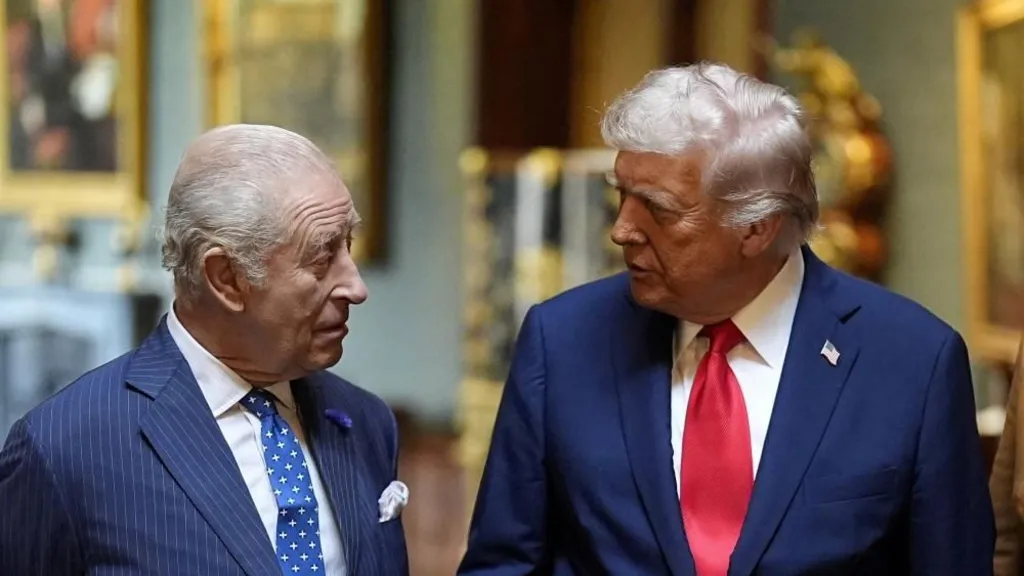
US President Donald Trump has said next week’s state visit from King Charles and Queen Camilla could help repair relations with the UK.
When asked in a phone interview with the BBC whether the visit could help repair the relationship, Trump said: “Absolutely. He’s fantastic. He’s a fantastic man. Absolutely the answer is yes.”
“I know him well, I’ve known him for years,” he said. “He’s a brave man, and he’s a great man. They would absolutely be a positive.”
The president also spoke about his relationship with UK Prime Minister Sir Keir Starmer, who he said could only “recover” if he changed course on immigration.
The King and Queen will travel to the US for a four-day visit beginning on Monday, and will meet with Trump at the White House.
The King will have a private meeting with the president and also deliver an address to Congress.
After two days in Washington DC, they will travel to New York, Virginia and Bermuda before returning to the UK.
The Foreign Office said the trip would mark the 250th anniversary of US independence, and would celebrate a partnership of “shared prosperity, security and history”.
In the five-minute interview on Thursday, Trump was also asked about his relationship with Sir Keir.
The two leaders have appeared at odds over the war in Iran, and the prime minister has faced mounting pressure over his decision to appoint Lord Mandelson as UK ambassador to the US.
In a post on Truth Social on Monday, Trump said Lord Mandelson was “a really bad pick” but the prime minister had “plenty of time to recover”.
When asked what he meant by that post, Trump said: “If he opened the North Sea and if his immigration policies became strong, which right now they’re not, he can recover, but if he doesn’t, I don’t think he has a chance.
Trump has repeatedly called on the UK to increase oil and gas extraction in the North Sea.
“I make my decisions based on what’s in the British national interest and not what other people say or do,” Sir Keir said while talking to broadcasters about the president’s comments on Thursday.
“That is why I took the decision that we would not be dragged into the war in Iran,” he said. “I’m not going to be diverted or deflected from that by what anybody else says.”
(BBC)
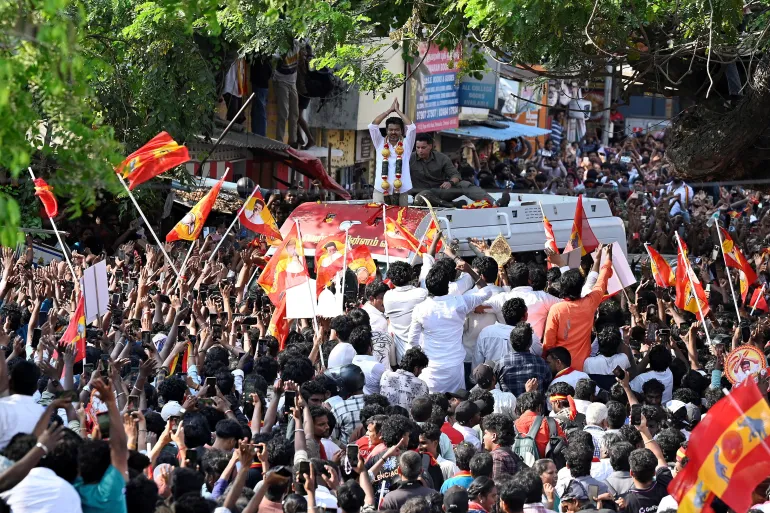
Standing on top of a customised van on a hot and humid afternoon in Tirunelveli, about 600km (373 miles) south of Tamil Nadu’s capital Chennai in southern India, C Joseph Vijay tells his supporters his opponents have joined hands to stop him from becoming the state chief minister.
“My rivals might appear different from outside, but they have only one aim: that Vijay should not become the chief minister,” says the 51-year-old actor-turned-politician to a mammoth crowd that begins to chant his name, which means “victory” in Tamil, in unison.
Tamil Nadu, one of India’s most developed states with impressive human development indices, also has a long history of electing film stars as leaders, some of whom are still revered by people as demigods years after their deaths.
As Tamil Nadu votes on Thursday to elect its 234-member state legislative assembly, Vijay’s bid for power is the latest addition to the state’s trend of film star-politicians, turning a traditionally bipolar battle into a triangular contest.

Vijay entered politics with much fanfare when he launched the Tamilaga Vettri Kazhagam (TVK) party in 2024, promising to end the decades-old dominance of the governing Dravida Munnetra Kazhagam (DMK) and the main opposition All India Anna Dravida Munnetra Kazhagam (AIADMK).
Incumbent Chief Minister MK Stalin leads the DMK and its 14-party Secular Progressive Alliance, in which the Indian National Congress is a junior partner. On the other hand, opposition leader Edappadi K Palaniswami of the AIADMK heads the 10-party National Democratic Alliance, which also includes Prime Minister Narendra Modi’s Bharatiya Janata Party (BJP).
The DMK and the AIADMK identify themselves as Dravidian parties, which derive their names from a powerful political and social justice movement in Tamil Nadu that opposed caste inequalities, championed social reforms, and rejected perceived attempts by India’s more dominant north Indian parties to impose Hindi – and upper-caste Hindu values – on the non-Hindi speaking southern states.
Dravidian parties have held power in Tamil Nadu continuously since 1967, with national parties like the Congress and the BJP playing secondary roles. While the BJP is contesting 27 seats in alliance with the AIADMK, the Congress is fighting for 28 seats as part of the DMK-led coalition.
More than 87 percent of Tamil Nadu’s 72 million people are Hindu, followed by Christians at 6.1 percent and Muslims at 5.8 percent, according to the last census conducted in 2011.
Among Hindus, the so-called “backward” or less-privileged castes constitute 45.5 percent, “extremely backward” castes 23.6 percent, while Dalits are at 20.6 percent. Dalits, formerly referred to as “untouchables”, fall at the bottom of India’s complex caste hierarchy and have faced marginalisation and violence for centuries.
Vijay, son of a Christian filmmaker father and a Hindu mother who is a background singer in films, belongs to the Vellalar community, an affluent agrarian group in Tamil Nadu with both Hindu and Christian members.
Vijay started his film career as a child actor in movies directed by his father. His 1992 debut as a hero, however, in Naalaiya Theerpu (Tomorrow’s Verdict), flopped. Following the setback, his father cast him alongside popular star Vijayakanth — who later founded his own political outfit, Desiya Murpokku Dravida Kazhagam (DMDK) — in Senthoorapandi (1993), which gave his career a new lease of life.
It was the 2004 film Ghilli (Gutsy), which carried a subtle political undertone, that catapulted Vijay to superstar status. He dropped hints about his political ambitions in the 2013 hit Thalaivaa (Leader), which was launched with the tagline: “Time to Lead”.
Soon, political messaging became central to many of Vijay’s subsequent films. Even the title of his yet-to-be-released Jana Nayagan (People’s Leader) — which he claims will be his final film — alludes to his political aspirations.
Riding on personal charisma, Vijay has attracted millions of supporters to his rallies, despite allegations of poor crowd management, which caused a stampede at one such gathering in September last year, killing 42 people.
He is expected to draw a share of Dalit and minority Christian votes that would have otherwise flowed to the DMK-led coalition. He is also banking on anti-incumbency votes that could have benefited the AIADMK alliance.
Yet analysts say Vijay’s ambition of becoming the next chief minister will not be as easy as the scripted blockbusters he has built his career on, since he faces two opponents with decades of experience in real politics.
That leads political commentator R Kannan to describe Vijay as “both a blessing and a curse” for the two Dravidian coalitions.
“When the AIADMK joined the BJP-led NDA, many predicted the Dravidian party would lose heavily, with minorities and Dalits flocking to the DMK. Vijay’s entry, however, has offered the AIADMK a ray of hope — he is expected to draw a decent share of votes that would otherwise have gone to the DMK,” he said.
“At the same time, he works in the DMK’s favour by siphoning off anti-incumbency votes that might have gone entirely to the AIADMK. For both Dravidian parties, he is at once a blessing and a curse.”
Vijay is aiming to follow the path of illustrious predecessors: Maruthur Gopalan Ramachandran, popularly known as MGR, and his protege, Jayaram Jayalalithaa – Tamil Nadu’s most beloved on-screen pair.
Born into poverty, MGR’s rise to stardom was nothing short of phenomenal. He captured the imagination of Tamil Nadu’s working class, who idolised him in return. From his first superhit, Rajakumari (Princess) in 1947, his films cast him as a champion of the masses, battling oppression and corrupt authority.
MGR launched the AIADMK in 1972 after breaking away from the DMK and served as Tamil Nadu’s chief minister from 1977 to 1987. He introduced several welfare programmes, the most significant being a free meal scheme for schoolchildren in order to eliminate malnutrition and boost school enrolment.
His political heir, Jayalalithaa, was a six-time chief minister between 1991 and 2016, when she became India’s first female state leader to die in office. She is remembered for launching several women-centric programmes, including all-women police stations and subsidised two-wheelers for working women, apart from her work in curbing female infanticide.

The DMK also has a history of film personalities, including the party’s founder, CN Annadurai, who rose to fame as a pathbreaking scriptwriter with films like Velaikkari (1949), and MGR as the party’s star campaigner and leader before he founded the AIADMK.
Soon, Muthuvel Karunanidhi emerged as another prominent writer, poet and screenwriter with films like Parasakthi (1952), meaning Supreme Power, often cited as a turning point in Tamil cinema. Directed by Krishnan-Panju and written by Karunanidhi, then 28 years old, the film fiercely attacked casteism and social inequality, while propelling the spread of the Dravidian ideology.
Karunanidhi, popularly known as Kalaignar (artist), wrote scripts for more than 75 films that resonated with the struggles of the working class, championing rationalism and social equality.
He won the Tamil Nadu Legislative Assembly election for a record 13 terms and served as the state’s chief minister for five terms between 1969 and 2011. He died at the age of 94 in 2018, with his son, Stalin, taking over as the DMK chief.
Film star-politicians who embraced Tamil identity politics flourished, while those who did not fell by the wayside.
“Successful leaders such as MGR, popularly known as Puratchi Thaalaivar [Revolutionary Leader], Jayalalithaa, who earned the monikers Puratchi Thalaivi [Revolutionary Female Leader] and Amma [Mother], embraced identity politics. Another popular film actor, Sivaji Ganesan, by contrast, could not make the same mark in politics even after he tried,” said Kannan, who has written biographies of MGR and Annadurai.

In 2005, popular actor Vijayakanth added to the starry mix by launching his DMDK party, another Dravidian political outfit. He made every attempt to position his party as an alternative to the DMK and the AIADMK, but failed. The party won just one seat in 2006 — Vijayakanth’s own — and drew a blank in 2009. Though he went on to become the leader of the opposition in the assembly in 2011, the election reverses forced him to seek alliances. The DMDK, now led by his wife Premalatha, is contesting 10 seats in alliance with the DMK.
Which is where, say analysts, Vijay’s pitch for power is unlikely to make an impact in this election. They say his TVK party does not fall in the long line of Dravidian parties that have a distinct political ideology and programme that appeals to their voters.
“Tamil Nadu is an ideologically and politically evolved state. Issues such as social justice, centre-state relations, and linguistic and cultural identity are paramount here. People will not back a politician without a clear ideology,” Ramu Manivannan, former professor of political science at the University of Madras, told Al Jazeera.
Manivannan said large crowds at Vijay’s rallies should not be mistaken for potential votes. “Film stars always attract crowds. To assume all of them will translate into votes is unfair.”
Vijay’s TVK is rooted in his fan clubs, which thrive on masculine aggression, said S Anandhi, retired professor at the Madras Institute of Development Studies.
“Vijay’s populist rhetoric — defying all authority — appeals strongly to the youth. But he never clarifies what he will actually do in power. He frames it as all established forces being arrayed against young men, and youngsters see this as an opportunity for a new kind of collectivisation. I would call it a dangerous class,” she told Al Jazeera.
Vijay appears to be banking heavily on two voter blocs: younger voters between 18 and 39 years, who number 23 million of the state’s 57 million voters, and women, who account for more than half of them.
At his rallies packed with young people and women, Vijay has alleged that Stalin’s true allies are “bribery and corruption”, framing the contest as a personal battle between himself and the chief minister.
Stalin, for his part, has largely brushed off Vijay’s attacks. “Newly-formed parties have a wrong notion that they can survive by criticising DMK,” he said in a recent interview.
Instead, Stalin has focused his attacks on the Modi government, accusing it of depriving Tamil Nadu of its share of federal funds, and framing the election as a contest between Tamil Nadu and New Delhi – a ploy that simultaneously targets the AIADMK for allying with an “adversary”, the BJP.
The AIADMK’s Palaniswami has countered by saying Stalin raises the centre-state issue only because he has “no achievements of his own to show”.
Despite their ideological differences, all parties are competing heavily on welfare promises in a state known for freebies during elections.
The DMK has pledged to double the monthly women’s allowance to 2,000 rupees ($21), offer 8,000 rupees ($85) in home appliance coupons, and build one million homes for the poor over five years. The AIADMK, also promising a monthly allowance of 2,000 rupees for women, has additionally offered free refrigerators to the poor and a one-time family grant of 10,000 rupees ($106).
Vijay’s TVK, hoping to cash in on the ongoing global fuel crisis, has promised six free LPG cylinders annually, 2,500 rupees ($26.5) monthly support for the female heads of a household, 8gm gold and a silk saree for poor women getting married, 4,000 rupees ($42.5) stipend for unemployed college graduates, and interest-free education loans of up to 2 million rupees ($21,257).
Still, Kannan feels Vijay can at best be a disruptor in the three-cornered contest.
“Vijay’s campaign gained momentum in the final lap. He turned what was a bipolar contest into a three-cornered one. But apart from his personal charisma, he lacks proper organisational machinery. Many of his party’s candidates are unknown faces,” he said.
[Aljazeera]

South Korean authorities have found that two fighter jets collided mid-air in 2021 because the pilots were taking pictures and videos.
The incident took place while the jets were on a flight mission in the central city of Daegu, according to Seoul’s Board of Audit and Inspection.
The pilots survived with no injuries, but the collision damaged the planes, costing the military 880 million won ($596,000; £440,500) in repairs.
One of the pilots, who has since left the military, was made to pay a fine of 88 million won.
The incident took place because that pilot had wanted to take photos to commemorate his last flight with his military unit.
Taking photos of significant flights was “a widespread practice among pilots at the time”, the audit board said in a report published on Wednesday.
The pilot had declared his intent to do so in a briefing before the flight, according to the report.
He was flying the wingman aircraft and was following the lead aircraft during the mission. While flying back to their base, he started taking pictures using his personal mobile phone.
Upon noticing this, the pilot of the lead aircraft then asked another pilot on his plane to film a video of the wingman aircraft.
The wingman pilot then abruptly flew his jet up higher and flipped it so that it could be better captured on camera. This manoeuvre brought the two planes very close to each other.
To avoid a crash, the lead aircraft tried to rapidly descend. But the two F-15K jets eventually collided, damaging the lead aircraft’s left wing and the wingman aircraft’s tail stabiliser.
South Korea’s air force suspended the wingman pilot, who has since left the military to work for a commercial airline.
Subsequently, the air force sought to fine the wingman pilot 880 million won to cover the full amount of the repair costs. When the pilot appealed against the fine, it prompted an investigation by the audit board.
The wingman pilot acknowledged his sudden manoeuvre led to the collision, but argued that the lead aircraft’s pilot had “tacitly consented” to the manoeuvre since he was aware that filming was taking place.
The audit board eventually ruled that the wingman pilot should only pay a tenth of what the air force sought.
It said that the air force should bear some responsibility for not properly regulating pilots’ personal use of cameras.
The board also took into account that the wingman pilot had a good track record prior to the incident, and that he had managed to prevent further damage by promptly commandeering a safe return of his aircraft to the base.
The report did not mention whether any action was taken against the other pilots involved in the incident.
[BBC]

Iran says ‘fully prepared’ for football team’s World Cup participation

LA 2028 Olympic cricket stadium in IPL proposal

Oil rises above $106 per barrel as US, Iran deadlocked in Strait of Hormuz

UAE captain Waseem fined and handed demerit point for criticising umpiring

Shanto century, Mustafizur five-for seals series win for Bangladesh

Showers above 75 mm are likely at some places in the Western, Sabaragamuwa, Central, North-western and Southern provinces

‘Dates have the highest sugar content to fight Coronavirus’

Sunday Island 27 December – Headlines

#SundayIsland 17th December – Headlines

Sunday Island – 28th March

Sunday Island Headlines – 21 March

Sunday Island – 21st February – Headlines
-
 News4 days ago
Rs 13 bn NDB fraud: Int’l forensic audit ordered
-

 Business7 days ago
Harnessing nature’s wisdom: Experts highlight “Resist–Align” path to resilience
-

 Opinion5 days ago
Shutting roof top solar panels – a crime
-

 News7 days ago
Gratiaen Trust announces longlist for the 33rd Annual Gratiaen Prize
-

 News6 days ago
From Nuwara Eliya to Dubai: Isha Holdings markets Agri products abroad
-
 News2 days ago
Lanka faces crisis of conscience over fate of animals: Call for compassion, law reform, and ethical responsibility
-

 News16 hours ago
No cyber hack: Fintech expert exposes shocking legacy flaws that led to $2.5 million theft
-
 News5 days ago
Church calls for Deputy Defence Minister’s removal, establishment of Independent Prosecutor’s Office