
News
Breakaway JVP faction decries Indo-Lanka MoUs as betrayal


… alleges Kanchana’s Electricity Act exploited to facilitate ‘deal’ with India
The Frontline Socialist Party (FSP) has alleged that President Anura Kumara Dissanayake entered into seven MoUs/Agreements with India without consulting Parliament or the Cabinet of Ministers.
Accusing President Anura Kumara Dissanayake, who is the leader of the Janatha Vimukthi Peramuna (JVP), as well as the National People’s Power (NPP), of undermining Sri Lanka’s sovereignty, the breakaway JVP faction pointed out the signing of seven MoUs/Agreements had coincided with the 54th anniversary of the JVP’s first insurrection.
The top FSP spokesman and their Education Secretary, Pubudu Jayagoda, told a press conference, at their Nugegoda party office, that the JVP had completely betrayed those who sacrificed their lives during the 1971 and 1987-1990 insurrections. Having completely changed its policy towards India, the JVP was now down on its knees before India, Jayagoda said.
The dissident JVPer emphasised that such vital MoUs/Agreements couldn’t be finalised without proper consultations. Declaring that the MoUs/Agreements hadn’t been released yet, Jayagoda said that the FSP, in terms of the Right to Information Act, sought the copies of them as the public couldn’t be deprived of their right to know.
The section, now calling themselves FSP, split from the JVP in early 2012 after major differences among the top leadership over the direction of the party. Anura Kumara Dissanayake succeeded Somawansa Amarasinghe as the JVP leader in Dec. 2014.
Referring to the MoU, in respect of the implementation of HVDC interconnection for import/export of power, Jayagoda said that the NPP took advantage of the new Electricity Act that was enforced by the Wickremesinghe-Rajapaksa government in late June last year to pave the way for a deal with India. The JVP-led NPP that moved court against the then Power Minister Kanchana Wijesekera’s Bill, and voted against the Bill at the second reading, exploited the same to its advantage, Jayagoda charged.
The Sri Lanka Electricity Bill repealed the 1969 Ceylon Electricity Board (CEB) Act and subsequent laws regarding the electricity industry.
Comparing the MoU, signed in the presence of President Dissanayake and Premier Narendra Modi, Jayagoda said that both Nepal and Bangladesh had been trapped in similar agreements they signed earlier.
Jayagoda alleged that Nepal was in such a pathetic situation even if they could meet electricity requirement through hydro-power generation, the agreement with India compelled them to obtain power from India.
Jayagoda pointed out that the government now boasted of a proposed new120 MW solar power plant at Sampur to be implemented in two stages after having crippled domestic solar power generation capacity. The former JVPer said that the NPP government was bending backwards to appease India and pursuing an agenda inimical to Sri Lanka.
Jayagoda dealt with the MoU on cooperation in the field of sharing successful digital solutions implemented at population scale for digital transformation. The FSP spokesman said that the Indian-funded project to issue digital NIC would be disastrous as it would enable India to gather information.
Commenting on a MoU that covered the health sector, Jayagoda alleged that the government had agreed to share authority exercised by the National Medicine Regulatory Authority (NMRA) with India.
Jayagoda said that the MoU on defence cooperation undermined the country’s vital security interests and jeopardised relations with other countries.
The FSP said that political parties, represented in Parliament, were largely silent and seemed to be reluctant at least to express their views on the betrayal of the country.
By Shamindra Ferdinando



News
Establishment of an Institutional Framework to Inagurate Upper Hydro Catchment Areas Management Authority

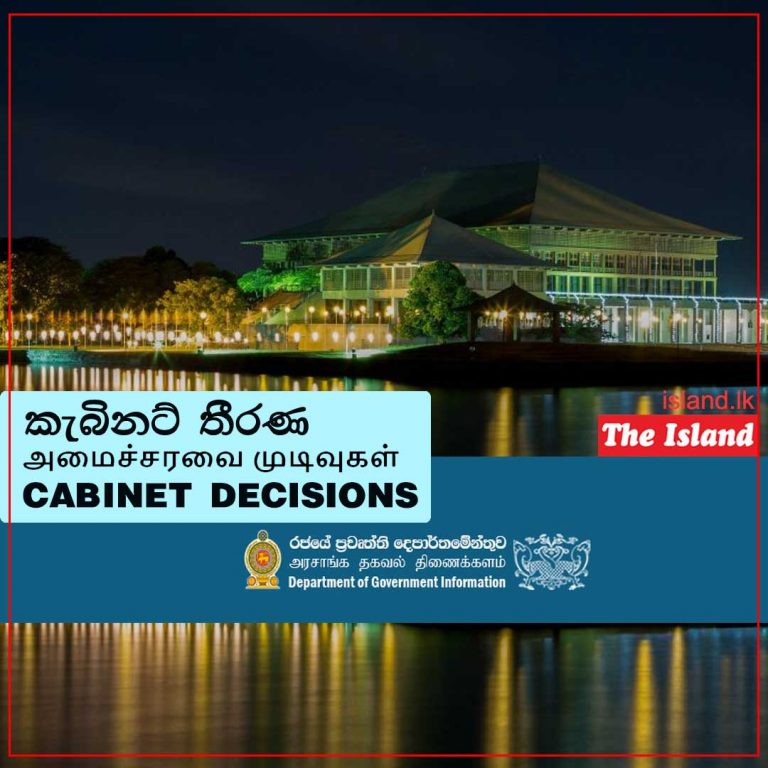
Policy approval of the Cabinet of Ministers was granted at their meeting held on 08.06.2026 to establish the Upper Hydro Catchment Areas Management Authority for identification and
execution of a formal and long – lasting remedy to secure the central hills including the upper hydro catchment areas enabling them to sustain amidst extreme weather conditions
due to natural calamities and human activities as well as to be used for the sustainable development of the country.
Accordingly, a concept paper has been prepared including
institutional structure, activities, powers, active subject area as well as administrative and coordination mechanism for the proposed authority by an expert technical committee appointed by the Secretary to the President.
Based on the said concept paper, the Cabinet of Ministers granted approval to the resolution furnished by the President to instruct the Legal Draftsman to prepare a draft bill including legal provisions required for the establishment of Upper Hydro Catchment Areas Management Authority.
News
Introduction of Flora and Fauna (Regulation of actions of the Indigenous Community within the nominated areas) Regulations
With the objective of securing the traditional livelihood and the eco system of the indigenous community, it has been recognized the necessity of introducing a formal regulation methodology to secure their engagement in livelihood activities by being more sensitive to the existing laws.
Thereby, the Fauna and Flora (regularizing) regulations under the Fauna and Flora Protection Ordinance (Authority 469) have been prepared so that nominated activities within the prescribed area to a member of the indigenous community
who has been registered for securing the rights acquired from law or custom or usage or traditional stance to execute an act within a certain state land that is fundamental to the survival of the indigenous community permission can be granted
Accordingly, the Cabinet of Ministers granted approval to the resolution furnished by the Minister of Environment to publish the said regulations in the government gazette notification and thereby submit to the Parliament for its concurrence.
Latest News
M. M. D. J. Senarathne, appointed Director General of the Department of National Botanical Gardens
The Cabinet of Ministers approved the resolution furnished by the Minister of Environment to appoint M. M. D. J. Senarathne, who is the senior most officer in Grade I of Sri Lanka Scientific Service se

Establishment of an Institutional Framework to Inagurate Upper Hydro Catchment Areas Management Authority
Introduction of Flora and Fauna (Regulation of actions of the Indigenous Community within the nominated areas) Regulations
M. M. D. J. Senarathne, appointed Director General of the Department of National Botanical Gardens

Harmanpreet Kaur steps down as India captain

Turkiye, Pakistan agree Saudi Arabia military deployment under Mecca pact

Rumesh Tharanga among nominees announced for World Athlete of the Year 2026

‘Dates have the highest sugar content to fight Coronavirus’

Sunday Island 27 December – Headlines

#SundayIsland 17th December – Headlines

Sunday Island – 28th March

Sunday Island Headlines – 21 March

Sunday Island – 21st February – Headlines
-

 Latest News7 days ago
Gold winner Tharanga gets brand-new Honda Vezel from SLAAJ
-

 News6 days ago
US-assisted ‘Ice’ detection: NPC to examine IGP’s move to transfer drug-busting team
-

 Features7 days ago
Why Sri Lanka needs an Inclusive Civic Nationalism – urgently
-

 Editorial5 days ago
Colombo Port drug bust: The plot thickens
-

 News7 days ago
Civil society activist accuses govt. of favouring Ven. Gnanasara
-
 Midweek Review7 days ago
Dappula’s Easter Sunday ‘grand conspiracy’ claim demolished
-

 Editorial7 days ago
When crime bosses rise above law and shrines
-
Editorial6 days ago
Drug busting, transfers and trust deficit