
News
Bimal claims most of inherited issues already tackled by NPP govt.

By Saman Indrajith
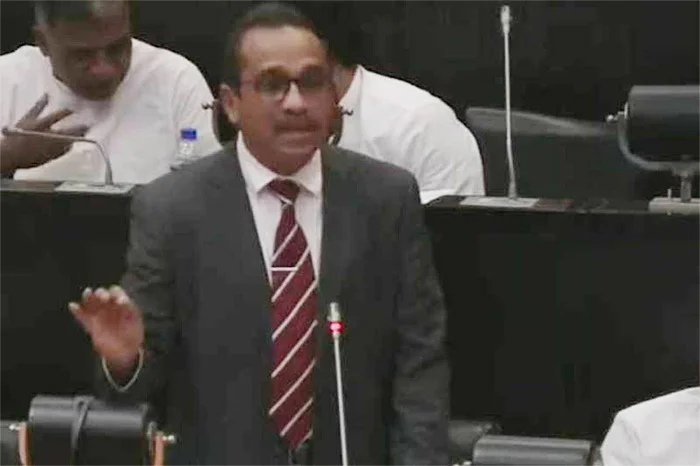
Leader of the House and Transport Minister Bimal Ratnayake told Parliament on Tuesday that during its first 100 days, the JVP/NPP government had to address problems inherited from previous regimes. Most of these issues had now been tackled and were in the process of being solved.
Delivering the concluding speech of the second reading debate on the 2025 Budget from the government benches, Minister Ratnayake stated: “None of these problems were caused by any decisions we made. Yet, we took responsibility for them, as we believe it is our duty to find solutions. We addressed them in a manner that ensures they will not recur. In doing so, we always opted for sustainable solutions.
Soon after assuming power, the government faced several pressing issues, including delays in passport issuance, shortages of rice, coconut, and salt in the market, a backlog in container clearance at the port, and a crisis following the release of the Grade Five scholarship examination results, which threatened to bring parents onto the streets. Additionally, the prices of essential goods reached unprecedented highs, and an underworld killing spree emerged. All these problems were the result of mismanagement by previous administrations.
“We introduced scientific solutions to each of these issues, and all of them are now on the path to being resolved. The passport issuance delay is being addressed, and there are no longer queues at the passport office. We regret the inconveniences caused by the shortages of rice, coconut, and salt. Short-term measures were implemented to address these shortages, and we assure you that these issues will be a thing of the past by next November, thanks to the long-term solutions currently being implemented. Container clearance at the Colombo Port has almost returned to normal levels, and the issue is being resolved in a way that prevents its recurrence. The Grade Five scholarship issue was resolved by the courts, delivering a solution acceptable to the majority of parents and fair to most students. Prices of essential goods are declining, as shown by retail chain statistics, which also indicate an increase in sales. As for the underworld killing spree, the police and security forces have been tasked with bringing it under control,” Ratnayake said.
“In addition, there were two moral issues: the first concerned the education certificates of the former Speaker, and the second involved the name change of a female Opposition MP. Since obtaining the former Speaker’s education certificates from overseas seemed time-consuming, immediate steps were taken to secure his resignation. Regarding the name change issue, Chief Government Whip Minister Nalinda Jayatissa informed the House on the same day that questionable remarks made by one of our MPs would be retracted, and we agreed to expunge them from the Hansard records.
“The 2025 Budget has also been prepared to address policy needs and provide solutions to the many problems our nation faces. A country cannot be developed by economists alone if there is no proper political management in place. Consider African nations with vast deposits of diamonds and oil that remain underdeveloped due to a lack of political management. During the debate, it was mentioned that foreign investors, who had come here with projects worth over $450 billion, turned away and invested elsewhere. This is unsurprising, as they were deterred by the corrupt political environment that prevailed at the time. A country cannot progress without political stability, backed by discipline, social stability upheld by discipline, and financial stability maintained by discipline. This Budget envisions achieving these stabilities.
For us, this is a historic occasion, as it is our first budget. We have long dreamed of presenting a budget of this nature to develop our country in line with our vision for systemic change. This Budget is also a tribute to those who sacrificed their lives for sharing that vision with us to transform this country,” Ratnayake said.

News
Establishment of an Institutional Framework to Inagurate Upper Hydro Catchment Areas Management Authority

Policy approval of the Cabinet of Ministers was granted at their meeting held on 08.06.2026 to establish the Upper Hydro Catchment Areas Management Authority for identification and
execution of a formal and long – lasting remedy to secure the central hills including the upper hydro catchment areas enabling them to sustain amidst extreme weather conditions
due to natural calamities and human activities as well as to be used for the sustainable development of the country.
Accordingly, a concept paper has been prepared including
institutional structure, activities, powers, active subject area as well as administrative and coordination mechanism for the proposed authority by an expert technical committee appointed by the Secretary to the President.
Based on the said concept paper, the Cabinet of Ministers granted approval to the resolution furnished by the President to instruct the Legal Draftsman to prepare a draft bill including legal provisions required for the establishment of Upper Hydro Catchment Areas Management Authority.
News
Introduction of Flora and Fauna (Regulation of actions of the Indigenous Community within the nominated areas) Regulations
With the objective of securing the traditional livelihood and the eco system of the indigenous community, it has been recognized the necessity of introducing a formal regulation methodology to secure their engagement in livelihood activities by being more sensitive to the existing laws.
Thereby, the Fauna and Flora (regularizing) regulations under the Fauna and Flora Protection Ordinance (Authority 469) have been prepared so that nominated activities within the prescribed area to a member of the indigenous community
who has been registered for securing the rights acquired from law or custom or usage or traditional stance to execute an act within a certain state land that is fundamental to the survival of the indigenous community permission can be granted
Accordingly, the Cabinet of Ministers granted approval to the resolution furnished by the Minister of Environment to publish the said regulations in the government gazette notification and thereby submit to the Parliament for its concurrence.
Latest News
M. M. D. J. Senarathne, appointed Director General of the Department of National Botanical Gardens
The Cabinet of Ministers approved the resolution furnished by the Minister of Environment to appoint M. M. D. J. Senarathne, who is the senior most officer in Grade I of Sri Lanka Scientific Service se

Establishment of an Institutional Framework to Inagurate Upper Hydro Catchment Areas Management Authority
Introduction of Flora and Fauna (Regulation of actions of the Indigenous Community within the nominated areas) Regulations
M. M. D. J. Senarathne, appointed Director General of the Department of National Botanical Gardens

Harmanpreet Kaur steps down as India captain

Turkiye, Pakistan agree Saudi Arabia military deployment under Mecca pact

Rumesh Tharanga among nominees announced for World Athlete of the Year 2026

‘Dates have the highest sugar content to fight Coronavirus’

Sunday Island 27 December – Headlines

#SundayIsland 17th December – Headlines

Sunday Island – 28th March

Sunday Island Headlines – 21 March

Sunday Island – 21st February – Headlines
-

 Latest News7 days ago
Gold winner Tharanga gets brand-new Honda Vezel from SLAAJ
-

 News6 days ago
US-assisted ‘Ice’ detection: NPC to examine IGP’s move to transfer drug-busting team
-

 Features7 days ago
Why Sri Lanka needs an Inclusive Civic Nationalism – urgently
-

 Editorial5 days ago
Colombo Port drug bust: The plot thickens
-

 News7 days ago
Civil society activist accuses govt. of favouring Ven. Gnanasara
-
 Midweek Review7 days ago
Dappula’s Easter Sunday ‘grand conspiracy’ claim demolished
-

 Editorial7 days ago
When crime bosses rise above law and shrines
-
Editorial6 days ago
Drug busting, transfers and trust deficit