
News
Bengaluru couple loses ₹4.75 crore in ‘digital arrest’ fraud, two from Hyderabad held


Bengaluru police arrested two men in a ₹4.75 crore cyber fraud case involving an elderly couple misled into believing they were under digital arrest
In a major breakthrough in a cross-border cyber fraud case, Bengaluru police have arrested two men from Hyderabad in connection with a ₹4.75 crore scam that saw an elderly couple manipulated into believing they were under “digital arrest,” Indian Express reported.
The arrests follow leads from cybercrime investigators in Chennai, and expose links to a broader criminal syndicate with alleged operations in Sri Lanka and Cambodia.
The accused have been identified as Eshwar Singh and Ramnarayan Chowdhary, both residents of Hyderabad. Singh, police say, is a habitual gambler with extensive ties to Sri Lankan casinos, while Chowdhary runs a departmental store in the city.
According to The Indian Express, the fraud came to light when cybercrime officials in Chennai stumbled upon a Bengaluru-based victim while working on a separate investigation. The Chennai team alerted Bengaluru’s Southeast division, prompting Deputy Commissioner of Police (DCP) Sarah Fathima to open a probe.
It soon emerged that a retired engineer and his wife from BTM Layout had been unknowingly targeted for months. The couple was allegedly coerced by cybercriminals into believing they were involved in a money laundering case and were required to cooperate with authorities. Under this false pretext, the couple transferred large sums of money to multiple accounts, eventually losing ₹4.75 crore.
“They thought they were following legal instructions. They even pledged property documents, all without informing their son or daughter,” said DCP Fathima. Their son lives in Malleswaram, while their daughter resides in Hebbal.
The investigation gained traction when a trail of ₹10 lakh led police to a Hyderabad bank account. The account holder claimed the money had been received on behalf of his landlord, Eshwar Singh. Singh, who was found to have made 33 trips to a casino in Sri Lanka, was arrested upon landing at Hyderabad airport.
Though Singh claimed the funds were part of a legitimate refund from the casino, investigators uncovered unusual banking arrangements. Due to irregularities in his tax filings, Singh had allegedly requested that casino payouts be sent to his tenant’s account instead of his own—an arrangement the casino honored, citing his status as a regular patron.
“We believe the cybercriminals exploited this existing channel, directing the defrauded money into the same account used by the casino,” a senior police officer said. Singh was subsequently taken into custody.
Police also arrested Chowdhary, the departmental store owner, who reportedly became entangled in the scam after cybercriminals gained his trust through frequent visits to his shop. His bank accounts were allegedly used to route money from various victims across India.
(Hindustan Times)

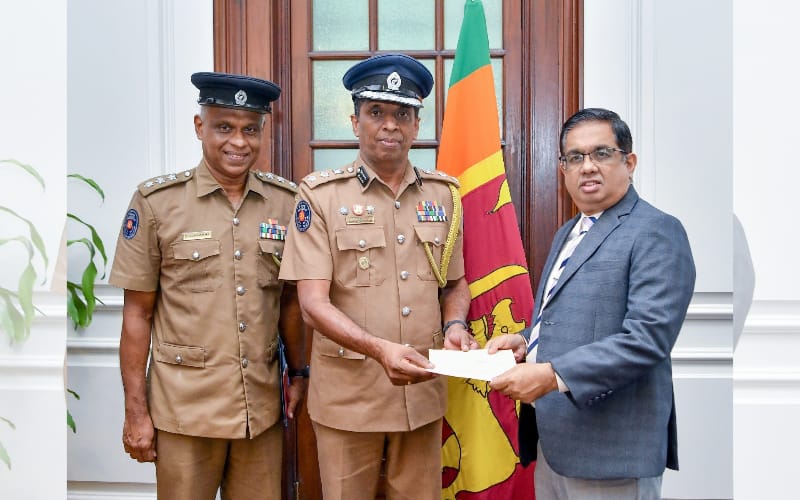
A sum of LKR. 9,687,462, raised from day’s salary officers of the Police Department, has been donated to the ‘Rebuilding Sri Lanka’ Fund, established to support the recovery of communities affected by Cyclone Ditwah and to assist in rebuilding the country following the disaster.
To date, officers of the Police Department have contributed over LKR. 74 million to the ‘Rebuilding Sri Lanka’ Fund through three such contributions of one day’s salary.
The donation was presented on Wednesday (22) afternoon at the Presidential Secretariat by the Personal Assistant to the Inspector General of Police, Senior Superintendent of Police C. C. Bamunuarachchi, to the Secretary to the President, Dr Nandika Sanath Kumanayake.
Chief Inspector Udaya Kumara, Officer-in-Charge of the Police Secretariat, was also present on the occasion.
[Presidents Media Division]
Latest News
Heat Index at Caution Level in the Northern, North-central, North-western, Western, Sabaragamuwa, Southern, and Eastern provinces and in Monaragala district during the day time
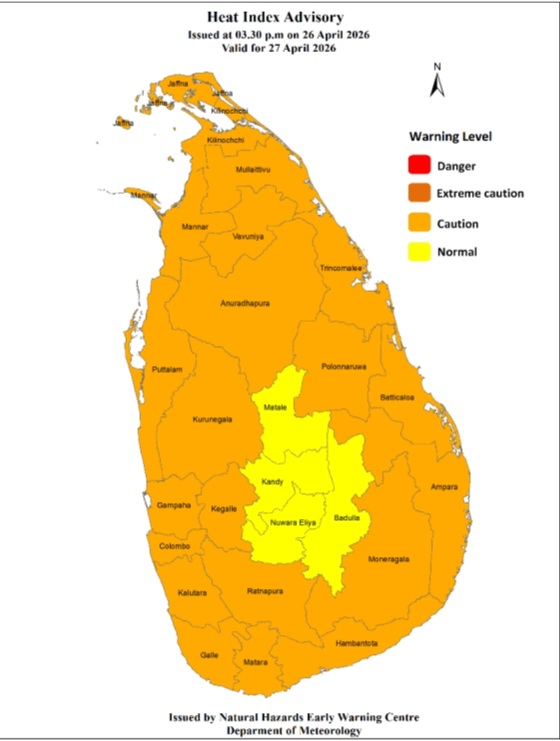
Warm Weather Advisory
Issued by the Natural Hazards Early Warning Centre
Issued at 3.30 p.m. on 26 April 2026, valid for 27 April 2026.
The Heat index, the temperature felt on human body is likely to increase up to ‘Caution level’ at some places in the Northern, North-central, North-western, Western, Sabaragamuwa, Southern, and Eastern provinces and in Monaragala district during the day time.
The Heat Index Forecast is calculated by using relative humidity and maximum temperature and this is the condition that is felt on your body. This is not the forecast of maximum temperature. It is generated by the Department of Meteorology for the next day period and prepared by using global numerical weather prediction model data.

Effect of the heat index on human body is mentioned in the above table and it is prepared on the advice of the Ministry of Health and Indigenous Medical Services.
ACTION REQUIRED
Job sites: Stay hydrated and takes breaks in the shade as often as possible.
Indoors: Check up on the elderly and the sick.
Vehicles: Never leave children unattended.
Outdoors: Limit strenuous outdoor activities, find shade and stay hydrated.
Dress: Wear lightweight and white or light-colored clothing.
Note:
In addition, please refer to advisories issued by the Disaster Preparedness & Response Division, Ministry
of Health in this regard as well. For further clarifications please contact 011-7446491.


Opposition and SJB Leader Sajith Premadasa has called for the appointment of a Parliamentary Select Committee (PSC) to investigate the illegal diversion of Treasury funds, amounting to US$2.5 million to a third-party account.
Premadasa has said both the chairmanship and a majority of the Committee’s membership should be held by the Opposition to ensure impartiality.
The government has not only failed to account for the loss of US$2.5 million but also deliberately withheld information from Parliament, the Committee on Public Finance (COPF) and the public, Premadasa has told the media, accusing the ruling party of seeking to deflect responsibility by initiating an internal departmental inquiry, which he describes as a biased process designed to justify predetermined conclusions.
The Opposition Leader has said only a transparent and independent probe could establish the facts, adding that such an investigation could be effectively carried out through a Parliamentary Select Committee led by the Opposition.
He has also warned that the alleged failure to inform Parliament about the missing funds amounted to a serious breach of accountability.

Police officers donate LKR 9,687,462 from day’s salary to ‘Rebuilding Sri Lanka’ Fund

Iran’s top diplomat in Russia as Tehran intensifies efforts to end the war

Rinku, Narine win Kolkata Knight Riders error-strewn Super Over game

Rabada and Sudharsan crush Chennai Super Kings

Showers or thundershowers will occur at several places in most parts of the island after 1.00 pm

Heat Index at Caution Level in the Northern, North-central, North-western, Western, Sabaragamuwa, Southern, and Eastern provinces and in Monaragala district during the day time

‘Dates have the highest sugar content to fight Coronavirus’

Sunday Island 27 December – Headlines

#SundayIsland 17th December – Headlines

Sunday Island – 28th March

Sunday Island Headlines – 21 March

Sunday Island – 21st February – Headlines
-
 News7 days ago
Rs 13 bn NDB fraud: Int’l forensic audit ordered
-

 News5 days ago
Lanka faces crisis of conscience over fate of animals: Call for compassion, law reform, and ethical responsibility
-
 News4 days ago
Whistleblowers ask Treasury Chief to resign over theft of USD 2.5 mn
-

 News4 days ago
No cyber hack: Fintech expert exposes shocking legacy flaws that led to $2.5 million theft
-

 News18 hours ago
BIA drug bust: 25 monks including three masterminds arrested
-

 Business2 days ago
Nestlé Lanka Announces Change in Leadership
-

 News5 days ago
USD 2 mn bribe: CID ordered to arrest Shasheendra R, warrant issued against ex-SriLankan CEO’s wife
-

 News2 days ago
Hackers steal $3.2 Mn from Finance Ministry