
Latest News
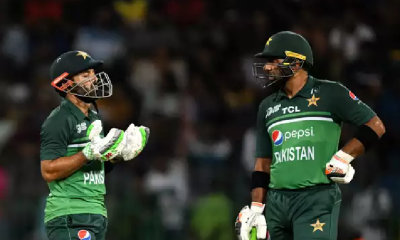
Babar and Iftikhar centuries serve up Pakistan victory

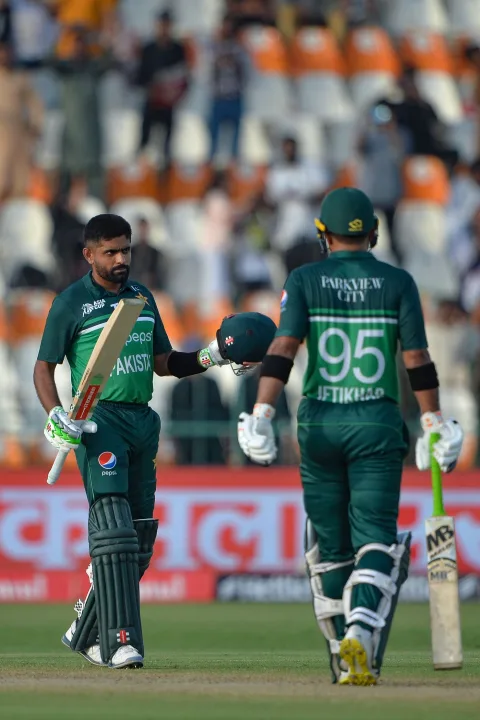
On a tricky pitch in Multan, Nepal had made early breakthroughs to leave Pakistan in a precarious position. Babar consolidated the innings during that period, taking 72 balls to reach his fifty. Gradually, he increased the tempo and moved from 51 to 100 in 37 balls. Once he reached his hundred, he went into the T20 mode and smashed 51 off the next 22 balls.
Suryakumar Yadav recently said that ODIs are challenging because you have to bat like all three formats. On Wednesday, Babar showed how to do it.
Babar and Ifthikar Ahmed, who smashed an unbeaten 109 off 71, added 214 off 131 balls in a fifth-wicket stand that lifted Pakistan to 342 for 6. Babar didn’t come out to field and Shadab Khan captained the side during the chase. It made little difference, as Nepal were bowled out for just 104 in 23.4 overs.
Nepal were making their Asia Cup debut, and playing against Pakistan for the first time in any format. That inexperience, and probably the nerves, showed on several occasions. In the first over of the match, Sompal Kami drifted down the leg side a couple of times, and Fakhar Zaman helped himself to two boundaries.
However, the slowness of the pitch and some good fielding came to Nepal’s rescue. With the ball not coming onto the bat, both Fakhar and Imam-ul-Haq struggled for timing. When Fakhar threw his bat at a length ball from Karan and got a thick outside edge, wicketkeeper Aasif Sheikh stretched to his left to grab it with both hands. In the next over, Rohit Paudel nailed a direct hit from mid-off to find Imam short.
With Pakistan 25 for 2, Babar and Mohammad Rizwan started rebuilding the innings. Playing risk-free cricket and still picking up a boundary here and there, they took the side to 100 in the 22nd over.
But then Nepal struck back, once again via their fielding. This time Dipendra Singh Airee, from cover, hit the stumps at the bowler’s end to find Rizwan’s bat and both feet in the air as the batter tried to avoid getting hit by the throw. Had Rizwan run normally and grounded his bat, he would have been safe. He made 44 off 50 balls.
Agha Salman attempted a sweep from well outside off and a reverse sweep in the first three balls he faced; neither shot fetched him any runs. Three overs later, he tried another reverse sweep, off Sandeep Lamichhane, but failed to keep it down and was caught at short third.
At 124 for 4, Pakistan were in trouble but Babar was unperturbed. Against spin, he used the cut shot well to rotate the strike, and reached his fifty in 72 balls.
While Nepal fielded like the World XI at certain times, they looked like Ilford Second XI at others. Having dropped Imam on 5 earlier, they put down Babar on 55, not to mention several other causal efforts resulting in misfields. Babar made them pay. He started finding the boundary with increasing frequency and got to his hundred in 109 balls. Fittingly, it was another cut shot against spin that took him to the milestone.
After that, he really opened up. In the 45th over, he hit Kami for 4, 4 and 6 off successive balls before smashing back-to-back sixes off Lamichhane.
From the other end, Iftikhar was even more brutal. In fact, it was his knock that allowed Babar to shift the gears gradually.
Iftikhar attacked right from the moment he came to the crease. He hit the first six of the innings when he launched Kami over deep midwicket in the 35th over. It took him just 67 balls to bring up his maiden ODI hundred against a helpless Nepal attack. In all, Iftikhar hit 11 fours and four sixes as Pakistan ransacked 129 in the last ten overs.
Shaheen Shah Afridi then picked up two wickets in the first over of the chase. He first strangled Kushal Bhurtel down the leg side before trapping Paudel lbw for a first-ball duck. In the next over, Naseem Shah had Aasif caught at first slip to make it 14 for 3.
Aarif Sheikh and Kami gave the innings some semblance of stability by adding 59 off 78 balls but the pair didn’t last long against Haris Rauf’s pace. He first cleaned up Aarif and then had Kami caught behind. The only resistance Pakistan’s fast bowlers faced was from the muggy weather: both Shaheen and Haris had to leave the field for a breather after their first spells.
Nepal’s lower order was no match for Shadab’s variations. Mixing his legbreaks and googlies, he picked up the last four wickets to finish with figures of 4 for 27.
Brief scores:
Pakistan 342/6 in 50 overs (Babar Azam 151, Iftikhar Ahmed 109*; Sompal Kami 2-85) beat Nepal 104 (Sompal Kami 28; Shadab Khan 4-27, Haris Rauf 2-16) by 238 runs.
(Cricinfo)









Iran has executed two men convicted of being members of the banned People’s Mojahedin Organization of Iran (PMOI/MEK) opposition group, in the latest action targeting dissidents, even as the United States – Israeli war on Iran drags on.
The two were executed on Saturday morning after the country’s Supreme Court upheld earlier sentences that convicted them of PMOI/MEK membership, and “armed rebellion through involvement in multiple terrorist acts”.
“Abolhassan Montazer and Vahid Baniamerian were hanged after trial and their sentences were upheld by the Supreme Court,” the Iranian judiciary website, Mizan Online, said on Saturday.
PMOI/MEK had initially supported the 1979 Islamic revolution that unseated the Iranian monarchy. However, in the 1980s, it fell out with the new leadership in Tehran and was designated a “terrorist” organisation. PMOI/MEK has since operated in exile.
Four other convicted members of the group were executed on March 30 and 31. According to information on the PMOI/MEK website, the men were: Mohammad Taghavi, Akbar Daneshvarkar, Babak Alipour and Pouya Ghobadi.
All six men were arrested and convicted by a Revolutionary Court in late 2024, according to PMOI/MEK.
The group condemned the executions in an April 2 statement, calling Tehran’s actions a “futile” attempt to suppress opposition.
“These brutal executions will not silence the opposition; instead, they will only intensify the resolve of Iran’s rebellious youth to overthrow the regime,” PMOI/MEK said.
Rights groups, too, have criticised the spate of hangings. Activists have long accused Iran of being the second most prolific executioner after China.
In a statement following the first set of hangings on March 31, Amnesty International accused Iranian authorities of torturing the men while they were held in prison and then abruptly transferring them to an unknown location shortly before their executions.
Amnesty further raised fears of more planned executions, including of protesters arrested during mass anti-government demonstrations in January, during which thousands were killed.
“It is unconscionable that even as the population is reeling from conflict and mass bereavement amid the ongoing aerial bombardment by Israel and the USA, the authorities of the Islamic Republic of Iran continue to weaponize the death penalty to eradicate dissenting voices and further terrify people,” said Diana Eltahawy, Amnesty International’s deputy regional director for the Middle East and North Africa.
Since the US and Israel’s war on Iran began on February 28, Tehran has executed several people, including Kouroush Keyvani, a dual Iranian-Swedish national convicted on charges of spying for Israel in a case that has drawn outrage from Stockholm and the European Union.
One man convicted of acting on behalf of Israel and the US during the protests was also executed on Thursday.
Earlier, on March 19, four people – Saleh Mohammadi, Mehdi Ghasemi, and Saeed Davoudi – arrested in connection with the uprising, were killed.
Amnesty warns that another five young protesters previously sentenced to death could soon be executed after they were moved from the Ghezel Hesar prison to an unidentified location this week.
[Aljazeera]

An earthquake in Afghanistan has killed eight members of the same family when their home collapsed in the Gosfand Dara area of Kabul province.
Health Ministry spokesman Sharafat Zaman said on Saturday that a child aged around two years old was the only survivor. Afghanistan’s disaster management agency said the boy was injured
The 5.8-magnitude quake struck at 8:42pm local time (16:12 GMT) on Friday at a depth of 186km (115 miles). The US Geological Survey (USGS) said the epicentre was in the northeastern province of Badakhshan.
The capital Kabul is about 290km (180 miles) southwest of the epicentre.
There were no immediate reports of injuries or damage in areas closer to the epicentre. The province is remote so it can often take several hours before local authorities can relay information back to Kabul.
Strong tremors were felt in multiple parts of Afghanistan, including Kabul and the Indian capital New Delhi, witnesses told the Reuters news agency.
Pakistan also felt the quake, including in the capital Islamabad and Peshawar, Chitral, Swat and Shangla. There were no immediate reports of injuries or damage.
Afghanistan is frequently jolted by earthquakes along the Hindu Kush mountain range – near the junction of the Eurasian and Indian tectonic plates. On average, 560 people are killed by quakes there every year.
The deadliest tremor in the country’s recent history struck last August. The shallow magnitude 6 earthquake in eastern Afghanistan wiped out mountain villages, killing at least 2,200 people.
Most casualties were in Kunar province, where Afghans typically live in wood and mud-brick houses along steep valleys.
Impoverished Afghanistan often faces difficulty in responding to natural disasters, especially in remote regions.
Many homes in rural and outlying areas are poorly built with bricks, wood and mud.
[Aljazeera]
Latest News
Breakdown of the teams and groups of the FIFA World Cup in Canada, Mexico and the US after the final playoffs

Iraq’s qualification for the FIFA World Cup 2026 has completed the lineup of 48 nations for the tournament hosted by Canada, Mexico and the United States.
The Lions of Mesopotamia edged Bolivia 2-1 on Tuesday to win the second final of the FIFA Playoff tournament in Mexico. In the first final earlier, Democratic Republic of the Congo beat Jamaica 1-0.
In the other games, Turkiye, Bosnia and Herzegovina, Sweden and Czechia were the final four teams to complete the European quota of World Cup qualification.
Widely considered the most famous sporting event in the world, the 2026 FIFA World Cup will be its biggest ever. Forty-eight nations will play instead of the usual 32, with 104 matches in 16 venues across the three host nations.
Argentina will look to defend the trophy lifted by iconic captain, Lionel Messi at Qatar 2022. Cape Verde, Curacao, Jordan and Uzbekistan will make their debut.
The World Cup’s first game will be a throwback to 2010 when Mexico take on South Africa on June 11 in Mexico City in a replay of the tournament opener then. Football fans will hope the opening goal this year matches the screamer scored by Lawrence Tshabalala from the South African hosts then.
Mexico in group A – which includes South Korea and Czechia – will be one of the toughest of the 12 groups.
Team USA are alongside Australia, Paraguay and Turkiye.
Canada, too, face the challenging task of making it out of a group comprising Switzerland, Qatar and Bosnia.
Here’s a breakdown of the 48 teams in the 12 groups:
Group A:
- Mexico
- South Korea
- South Africa
- Czechia
Group B:
- Canada
- Switzerland
- Qatar
- Bosnia and Herzegovina
Group C:
- Brazil
- Morocco
- Scotland
- Haiti
Group D:
- USA
- Australia
- Paraguay
- Turkiye
Group E:
- Germany
- Ecuador
- Ivory Coast
- Curacao
Group F:
- Netherlands
- Japan
- Tunisia
- Sweden
Group G:
- Belgium
- Iran
- Egypt
- New Zealand
Group H:
- Spain
- Uruguay
- Saudi Arabia
- Cape Verde
Group I:
- France
- Senegal
- Norway
- Iraq
Group J:
- Argentina
- Austria
- Algeria
- Jordan
Group K:
- Portugal
- Colombia
- Uzbekistan
- DRC
Group L:
- England
- Croatia
- Panama
- Ghana
[Aljazeera]

Iran executes two convicted members of banned opposition group

Afghanistan earthquake kills eight members of same family

Breakdown of the teams and groups of the FIFA World Cup in Canada, Mexico and the US after the final playoffs

365 US service members injured since start of Iran war – Pentagon

World Cup 2026: Italy’s football chief resigns after qualifying failure

Iran says it downed two US jets as search for one pilot continues

‘Dates have the highest sugar content to fight Coronavirus’

Sunday Island 27 December – Headlines

#SundayIsland 17th December – Headlines

Sunday Island – 28th March

Sunday Island Headlines – 21 March

Sunday Island – 21st February – Headlines
-

 News3 days ago
2025 GCE AL: 62% qualify for Uni entrance; results of 111 suspended
-

 News5 days ago
Tariff shock from 01 April as power costs climb across the board
-
 News6 days ago
Inquiry into female employee’s complaint: Retired HC Judge’s recommendations ignored
-

 Features7 days ago
When seabed goes dark: The Persian Gulf, cable sabotage, and race for space-based monopoly
-

 Features6 days ago
New arithmetic of conflict: How the drone revolution is inverting economics of war
-

 Editorial3 days ago
Search for Easter Sunday terror mastermind
-

 Business4 days ago
Hour of reckoning comes for SL’s power sector
-

 Sports6 days ago
Sri Lanka’s 1996 World Cup heroes to play exhibition match in Kuala Lumpur