
Features
Awesome showband in our midst!


Surprise! Surprise! Last Friday, March 27th, I decided to check out the scene at Shore by O, situated in Mount Lavinia.
My trip was mainly to see Aquarius, in action, together with their new singer, April Schokman, and I was truly amazed by what the band had to offer.
Honestly, April’s presence, in the lineup, has certainly given Aquarius a new feel to their music, and presentation, and I would now classify them as an awesome showband.
We do have, in our scene, bands of repute, but…showband? Aquarius excels in this category.
April is a bundle of dynamite, while performing, and she certainly brings dynamism into her whole act.
I would pick her as the most colourful singer, we have at the moment, and with a quality voice to match.
Lending her support, Friday evening, to highlight the outfit’s status as a super-duper showband (thumbs up from me) were Sajith and Ruwini, and they, too, did excel.
Although the weather, last Friday evening, was a damper, Aquarius did heat up the scene; they were all fired up, and the crowd loved it.
If you want to experience another night of awesome entertainment, with Aquarius, I would suggest you head to the Irish Bar and Grill, next Wednesday, April 7th, from 7.00 pm onwards.

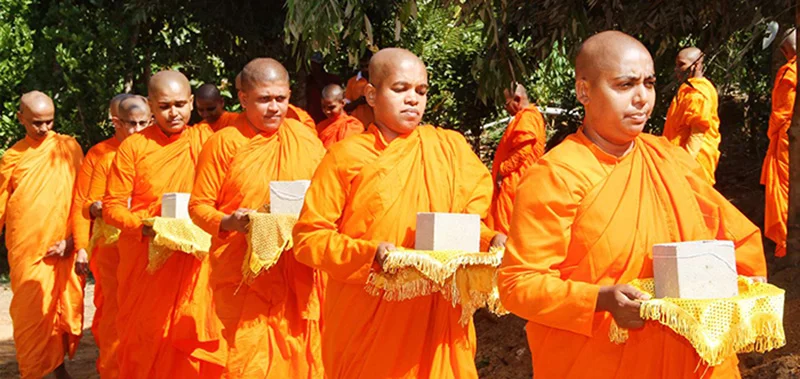
A robe without recognition:
 by Anushka Kahandagamage
Education is the right of every child. Yet somewhere between childhood and the robe, that right becomes precarious for many Buddhist women in Sri Lanka, threatening not only their social standing, but their fundamental access to learning and the institutional discrimination they face. This piece is not about Buddhist disciplinary rules, which discriminates women, rather about how the state’s refusal to fully recognise bhikkhunis as bhikkhunis quietly determines what they are, and are not, permitted to learn.
Unlike dasasil mathas, who occupy a distinct and unofficial category within Buddhist renunciation, bhikkhunis belong to a formally ordained order recognised within Buddhist monastic tradition itself. Dasa sil mata means ‘ten-precept mother.’ They are women who observe the ten precepts (rather than the fuller Vinaya) and live a renunciant, celibate life, often in robes, but formal ordination has not translated into formal recognition by the state. Even after a Supreme Court ruling affirmed their right to be identified as bhikkhunis on their National Identity Cards, many still do not hold one. This stems from the hesitation of the male-dominated Buddhist hierarchy to recognise these women as part of the Theravada tradition, specifically refusing to validate their higher ordination. The identity card lists her title as Dasa Sil Mata. The ruling exists on paper, but they are still waiting for their identity cards. This is not a small bureaucratic oversight. It is the first link in a longer chain, one that reaches, eventually, into the classroom.
A Name Withheld
In Sri Lanka, there are 827 pirivenas, traditional monastic colleges that have, for centuries, served as the primary institutions of Buddhist education. Of these, only 12 are dedicated to female renunciants at all, and of those 12, just five serve fully ordained nuns specifically. The imbalance is stark on its face: 827 institutions for monks, five for fully ordained nuns. But the discrimination here is not only a matter of numbers, but it is also written into the very language used to name these institutions. Monks’ schools are called pirivena, a term carrying centuries of institutional weight, historical continuity, and state recognition under Sri Lanka’s education laws. Bhikkhunis’ schools, by contrast, are not called pirivenas at all. They are designated Buddha Sravika Meheni Adhyapana Ayathanaya (Institute for the Education of Buddha’s Female Disciples), a separate, parallel term that, however similar in function, withholds from bhikkhuni institutions the same legal and institutional status that the word ‘pirivena’ confers. Since there are ten-precept mothers, the institutes have not given the same name as the pirivena and lack the official as well as social recognition they deserve.
A Pattern a Century in the Making
Following the decline of the Buddhist nun (bhikkhuni) order after the Polonnaruwa period, the first woman to be robed again was ordained in 1905 as a dasasil matha. Although dasasil mathas have long served important religious and societal roles, they have historically lacked access to formal education. Unfortunately, today also, this pattern continuous to exist. Education, in this context, is never just about literacy or dhamma study. It is the currency of religious authority. A bhikkhuni denied equivalent education or educated in an institution the state refuses to name a pirivena, is denied that religious authority. She may know the Tipitaka as well as any monk yet will lack the institutional stamp that would make a lay community trust her reading of it. It was not indifference from the public; it was the accumulated effect of a system that has spent centuries teaching devotees, implicitly, that a woman’s robe does not carry the same weight as a man.
The female renunciants, both dasasil mathas and bhikkunis, although they wear robes, have not been regarded as individuals capable of comprehending or preaching dhamma, simply because they are women. This is most visible in education, the pirivena system, developed historically to train bhikkhus, offered dasasil mathas and bhikkunis no equivalent institutional pathway, no comparable curriculum, certification, or state recognition. This exclusion is notable because it runs counter to Sri Lanka’s broader educational trends, where women have historically outnumbered men in general university enrolment, the gap here is specific to monastic/religious education rather than a reflection of wider societal restrictions on women’s schooling. The country’s National Education Commission Policy has a section on Pirivena education. However, it does not address the education of Buddhist nuns, nor does it mention nuns within the policy. I recently learned that the policy was being reviewed, with a committee appointed by the Ministry of Education, scheduled to begin the review on the 1st of September. This presents an important opportunity to raise the issue of nuns’ education and advocate for its inclusion in the revised policy.
The monks and nuns’ education institutes are funded by the government, which allocates only 5,000–6,000 LKR per student for the entire year. This sum is grossly inadequate to cover even basic institutional needs, accommodation, food, learning materials, and the maintenance of the physical premises, let alone to support any meaningful expansion of the curriculum. With this level of funding, these education institutes are struggling to sustain themselves, and many are forced to rely almost entirely on external support simply to remain operational. This is where the disparity becomes most visible. As female renunciants have historically not been taken seriously, regarded neither as authoritative teachers of dhamma nor as figures worthy of the same reverence extended to their male counterparts, their education centres receive far fewer lay offerings than those for male renunciants. The result is a widening resource gap that mirrors and reinforces the very discrimination that caused it. Underfunded institutions produce fewer well-trained female scholars, which in turn reinforces the perception that female renunciants are less capable, a perception that then justifies continued underinvestment. Without deliberate intervention, either through equitable government allocation or targeted lay support, this cycle is likely to persist rather than resolve on its own.
Sitting Alone at the Bo Tree
I was at Jaya Sri Maha Bodhi in Anuradhapura, where a few monks sat preaching in the shade of the Bo Tree, each surrounded by small clusters of lay devotees. Nearby, I noticed a few female Buddhist renunciants, though I could not immediately tell whether they were bhikkhunîs or dasasil mathas, since visually, in their robes and demeanour, they appeared indistinguishable to an outside observer. Most of them sat alone, without the small crowds of devotees gathered around the monks nearby. This, too, is not incidental. Because women cannot enter the sâsana through the same pathway to ordination, available to men, many Buddhist female renunciants remain dasasil mathas, a status that carries the appearance of monastic life without its legitamised spiritual standing. They observe the 10 precepts, wear robes, and live in renunciation, yet occupy a lower, unofficial rung in the religious hierarchy, one that grants them neither the ordination lineage nor the institutional recognition given to monks. However, in June last year, the Supreme Court of Sri Lanka delivered a landmark majority ruling in SC/FR/218/2013, affirming that fully ordained Buddhist nuns have the fundamental right to use the title ‘Bhikkhuni’ on their National Identity Cards, legally recognising the de facto existence of the Bhikkhuni Sanga.
A Closed Loop
Social discrimination and educational discrimination feed each other in a closed loop. Because bhikkhunis have fewer, less recognised institutions, fewer are formally trained to a standard the public recognises. Because fewer are recognised as authoritative teachers, fewer devotees seek them out or support them. Because they attract fewer devotees, the education institutions of female renunciants remain under-resourced and easy to overlook in state budgets and in popular imagination alike. A dasasil matha or bhikkhuni without an active following also lacks the economic support that following brings, since in Sri Lanka’s monastic economy, devotees are patrons as much as students. The precarity is not only spiritual or bureaucratic; it is material, and it compounds across a lifetime spent in robes.
Until bhikkhunis’ education is named, funded, and recognised on the same terms as that of bhikkhus, this will remain a story not only about missing ID cards or under-resourced schools, but about an education system that continues to decide, quietly and continuously, which students are worth investing in. Education was supposed to be the one place where the women can speak for themselves, instead, for these women, it has become just another place where women have to ask permission to be heard.
(Anushka is a Sociologist who is working on contemporary Buddhist movements. She was formerly attached to the University of Colombo)
Kuppi is a politics and pedagogy happening on the margins of the lecture hall that parodies, subverts, and simultaneously reaffirms social hierarchies.
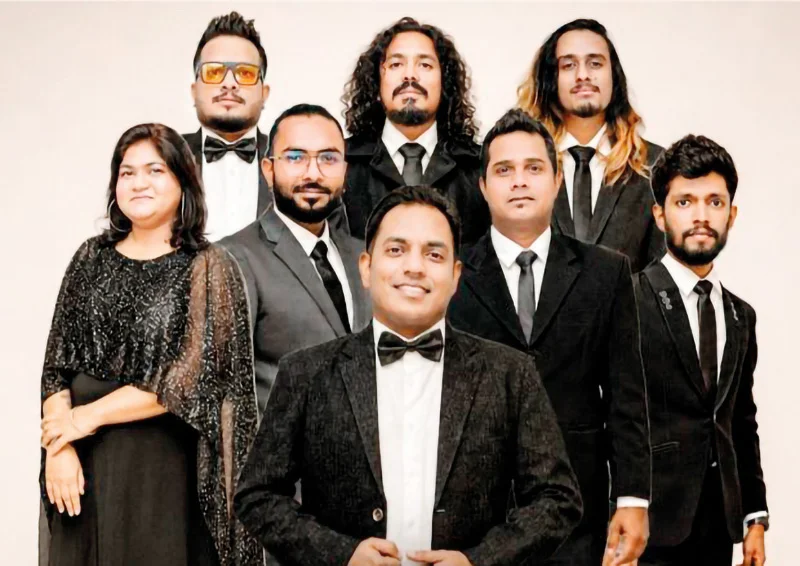
 Sri Lankan music knows no borders. Wherever our people go, our melodies follow — and our musicians make sure of it.
From Qatar’s Exit, to Melbourne’s EBONY, to Toronto’s Ceymphony, and Dubai’s Seven Notes, Sri Lankan bands abroad continue to keep the community connected to home, through song.
In July, Rajiv Sebastian set the Dubai stage alight with the band Seven Notes, creating an unforgettable night for Sri Lankans in the UAE. And the live-wire behind that magic? Niluk Uswaththa of Seven Notes.
Well, Niluk says he isn’t stopping there.
Now, Dubai is preparing for something truly special — ‘Memories of Milton – Live in Concert’, a grand musical tribute to one of Sri Lanka’s most beloved voices: Milton Mallawarachchi.
For more than a decade, Milton Mallawarachchi was a trending force in Sri Lankan music. With nearly 850 songs and over 35 albums to his name, he gave us melodies that became the soundtrack to our lives — songs of love, longing, and life itself.
On Saturday, 26th September 2026, from 8:00 PM to 3:00 AM, the Mercure Hotel, Al Barsha Heights, Dubai, will transform into a space of nostalgia.

Ranil Mallawarachchi; Carrying forward his father’s legacy / Yenuli Neriah
With the spotlight on Ranil Mallawarachchi — Milton’s eldest son, carrying forward his father’s legacy — along with Yenuli Neriah and Tharaka, the evening will certainly bring Milton’s timeless classics back to life … on one stage.
Seven Notes will do the needful, providing the live music that made Dubai dance before.
According to Niluk, this isn’t just a concert.
“It’s designed as a nostalgic musical journey — to bring cherished memories and beloved songs back to life,” he says.
And he promises: 26th September will be a night to remember.
In fact, Niluk Uswaththa has become a driving force for Sri Lankan entertainment in Dubai.
Through Seven Notes, he ensures the community always has something special to look forward to — especially when it comes to music that feels like home.
The success of these overseas shows naturally raises one big question back in Sri Lanka.
Yes, music lovers, in Sri Lanka, are keen to know whether the Seven Notes band will pop up in Colombo, sometime soon, for a live performance?
Music lovers, island-wide, will be watching … and waiting!

Melantha Perera may be a legendary musician, a prominent cultural leader, and currently President of the Cultural Council of the Divisional Secretariat — with a past role as Chairman of the Moratuwa Cultural Authority — but the music is still calling.
This September, the singer/keyboardist is packing his bags for Australia. It’s his fourth trip, Down Under, and his third time performing at ‘Moratuwa Night Three.’
Yes, first stop is Sydney for ‘Moratuwa Night Three,’ on Friday, 12th September, where Melantha will be seen in action, along with Noeline.
Music will be by Redemption, a talented band of Sri Lankan musicians, based in Australia.
Next will be Melbourne, Saturday, 20th September, where guests can ‘Sing Along with Melantha Perera.’
“I’m really looking forward to meeting up with my friends and music lovers, both in Sydney and Melbourne,” Melantha said ahead of the tour.
Back home, in Sri Lanka, Melantha keeps the music alive with Mintaka, a five-piece band led by Chris Dhason.
Well, if you’re in Sydney, or Melbourne, this month, this is your chance to join Melantha and sing along ….

The long road to educating Sri Lanka’s Bhikkhunis

CJ heads five-member bench to hear petitions against 22A

‘Memories of Milton – Live in Concert’ to enchant Dubai

Petrol price reduction boosts ASPI

A huge welcoming ‘Yes’ to Ai-CHA

Kandy Kings crowned Sri Lanka Tennis Premier League champions

‘Dates have the highest sugar content to fight Coronavirus’

Sunday Island 27 December – Headlines

#SundayIsland 17th December – Headlines

Sunday Island – 28th March

Sunday Island Headlines – 21 March

Sunday Island – 21st February – Headlines
-
 News7 days ago
Australia declines to release Finance Secy Suriyapperuma’s citizenship details
-

 News4 days ago
Eight politicians in drug kingpin probe
-
 News7 days ago
22A: BASL suggests CJ recuse himself from hearing petitions
-

 Features2 days ago
“Wrap Me Up in My Blazer”— A Gentlemanly Bradby Reminiscence
-

 Business4 days ago
Sri Lanka opens up: A new season of direct connectivity
-
 Features6 days ago
Insights from Chieftains of Uva: Genealogy of two Kandyan Families – Part II
-

 Features4 days ago
Redefining ageing in Sri Lanka
-
 Latest News5 days ago
Nepal-Tibet floods: What happened, what caused them and who is missing?