
Sports
Athletes urge rescheduling time trial after Covid 19 force cancellation

by Reemus Fernando
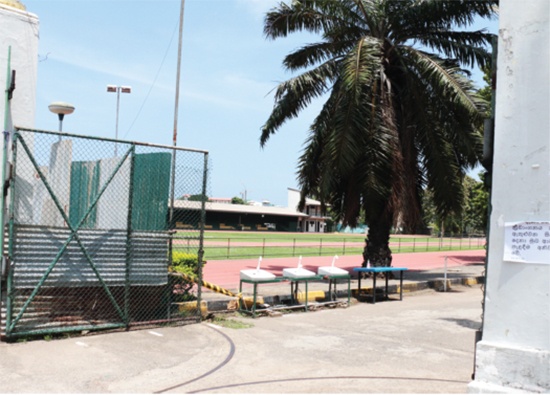
Sri Lanka Athletics on Monday will consider rescheduling the performance test which was canceled following the closure of the Sugathadasa Stadium due to Covid 19 concerns yesterday.
Officials decided to cancel the performance test which was scheduled to be held over the weekend after police curfew was imposed in several areas in Colombo North including Colombo 13 where the Sugathadasa Stadium is situated.
“The test was crucial for athletes who had trained. They requested to reschedule the event. We will decide on rescheduling the trial on Monday,” national coach Y.K. Kularatne told The Island after meeting with athletes.
“The meeting was with the athletes who are staying in the hostels at Torrington. The hostels will remain open for them and they will continue to train at Torrington,” said Kularatne.
He said that the decision to cancel the two day event was due to the police curfew and the closure of the Sugathadasa Stadium.
Top national athletes were due to engage in the two-day event which was arranged to assess their strengths after a long layoff. Athletes in the super pool and hundreds of leading junior athletes had trained under trying circumstances this year with the hope of competing after the health situation of the country improved.
Sri Lanka Athletics had previously scheduled their National Trial, the first competition for the year on October 23, 24 and 25 but they were compelled to make it a low key performance trial open only to athletes in the super pool and national pools due to the second wave of Covid 19.
Officials were ready to follow a long process to obtain permission for the event as the abandonment of a trial would deny competition exposure until the Senior National Athletics Championship in December.









The basketball fraternity came together to witness a closely fought final of the Sri Lanka Basketball League as Colombo Bulls and Colombo Basketball Club locked horns at Royal College indoor basketball courts on Sunday.
Although Colombo BC looked to be the better team on paper, Bulls held their own and looked set to end their dominance. However, during the closing stages of the game, Bulls committed a few costly errors and Colombo were quick to make them pay holding onto a four point win. The final score was 73-69. One highlight during the game was the efficacy of both teams in shooting free throws, but during the final few seconds Bulls were off the target with the pressure getting to them.
Colombo were the deserved winners as they won all seven games in the competition.
Rukshan Atapattu, Dasun Mendis, Nimesh Fernando and Simron Yoganathan performed exceptionally well in the final.
In the women’s final, Track Masters secured a seven point win over Bulls. They were trailing by four points at the end of the first half but turned the tables in the second half winning 53-46.
Devduni Perera, Anjalee Ekanayake and Benika Thalagala came up with superb performances during the final.
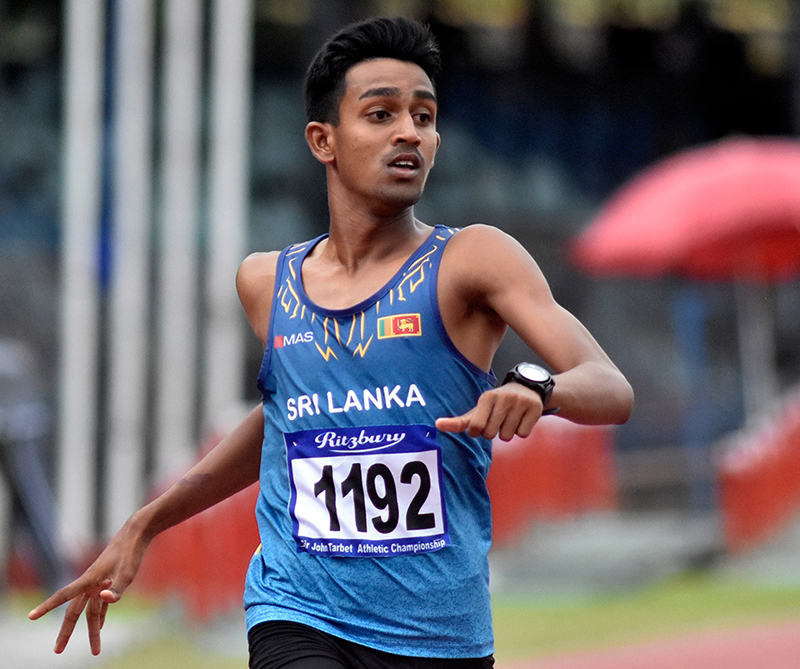
Sri Lanka’s long-standing dominance in the men’s 400 metres received another major boost as talented young sprinters, led by Omel Shashintha, delivered outstanding performances at the Junior Selection Trial held at Diyagama earlier this week.
The trial was conducted to select the national team for the upcoming Asian Junior Athletics Championships scheduled to be held in Hong Kong from May 28 to 31. The performances at the meet underlined that the 400 metres — widely regarded as Sri Lanka’s signature track event — continues to produce athletes capable of maintaining the country’s proud tradition.
Shashintha produced the highlight of the meet with a brilliant sub-46 second run to win the men’s 400 metres. The St. Sebastian’s College, Kandana athlete clocked an impressive 45.79 seconds, a time that would have been competitive even at senior national level. His performance currently stands as the fastest time in Asia in his age category this year and matches the 12th fastest time in the world so far in 2026, recorded by South Africa’s Kryn Romijn.
While Shashintha was the only athlete to dip under the 46-second barrier, two other promising runners also achieved the qualifying standards for the World Junior Athletics Championships which will be held later this year in Oregon, USA. Representing Kurunegala District, Sadew Rajakaruna finished second in 46.39 seconds, while Thisen Ranvidu of St. Peter’s College clocked 46.83 seconds to secure the required qualifying mark of 47.40 seconds.
Another promising athlete, I.M. Bogoda, narrowly missed the qualifying standard but came close with an encouraging performance.
The impressive depth displayed in the one-lap event also raises hopes of Sri Lanka fielding a strong 4×400 metres relay team at both the Asian Junior Championships and the World Junior Championships later this year.
Shashintha and Rajakaruna further strengthened their credentials by achieving qualifying standards in the 200 metres as well. Shashintha clocked 21.22 seconds, while Rajakaruna recorded 21.07 seconds, underlining their versatility across sprint events.
Both athletes already possess valuable international exposure, having competed alongside senior athletes on the global stage. Shashintha and Rajakaruna represented Sri Lanka at the World Athletics Indoor Championships last year, experience that is expected to benefit them greatly when they take on Asia’s best at the junior championship.
With such promising performances, the young sprinters appear ready to carry forward Sri Lanka’s rich 400-metre tradition established by legendary quarter-miler Sugath Thilakaratne and continued by current national stars Kalinga Kumarage and Aruna Dharshana.
Their performances at Diyagama suggest that Sri Lanka’s next generation of quarter-milers is well on track to keep the nation firmly among Asia’s leading sprinting powers.
by Reemus Fernando

Sri Lanka seamer Nuwan Thushara hauling his employer Sri Lanka Cricket before the courts has echoes of a legal duel that shook the game some half a century ago, when Tony Greig took on the England and Wales Cricket Board. The two cases, however, are chalk and cheese. Greig was England’s captain, a man calling the shots; Thushara, for all his slingy menace, is still trying to cement his place in the XI. Yet, in the eyes of the law, whether you’re the world’s premier all-rounder or carrying drinks, the playing field is meant to be level.
Thushara’s grievance stems from SLC refusing him a ‘No Objection Certificate’ to feature in the Indian Premier League. The board has drawn a hard line in the sand, no fitness, no NOC.
Those who passed the two kilometer run and skinfold test, the likes of Pathum Nissanka, Kamindu Mendis and Eshan Malinga, are cashing in in India. Thushara, having failed to meet the cut, has been left padded up in the pavilion. The Colombo District Court must now decide who has overstepped the crease. The learned judge knows better than us all.
Greig’s battle, by contrast, was taking on the authority head on. As England captain, he nailed his colours to the mast with Australian media tycoon Kerry Packer and his breakaway World Series Cricket. In doing so, he helped prise open the gates for several of the game’s leading players. The English board responded with a ban, barring him from Test and county cricket. Greig cried foul, calling it an “unlawful restraint of trade”. The case, famously known as Greig vs Insole, went the distance, with the court eventually ruling in favour of the England skipper.
Thushara’s case, though, appears to be on a stickier wicket. His argument hinges on his SLC contract expiring on March 31, freeing him to ply his trade in franchise cricket. But SLC seem to have a clause tucked up their sleeve that NOCs remain under their purview for a further three months post-contract. If that holds water, Thushara may find himself caught down the leg side.
From the board’s perspective, the argument is straightforward: professional cricketers must meet minimum fitness standards. In modern cricket, there are no passengers, every player must pull his weight in the field. Rather than take the legal route, Thushara might have been better served biting the bullet, hitting the gym and staging a comeback the hard way.
History offers a telling example. Aravinda de Silva, the nation’s finest batsman, once found himself given the cold shoulder by selectors in 2001 despite being the country’s leading run-scorer. The charge? Not fit enough. It seemed curtains on a glittering career as he spent 18 months out in the wilderness.
Then came a turning point. Mr. Michael Tissera, a selector with a keen eye and a cricketing brain, called Aravinda for a chat. Aravinda left the meeting having told Tissera that he needed six weeks. Over the next six gruelling weeks, he shed 21 kilos, rediscovered his edge and forced his way back into contention. What followed was vintage Aravinda, fast bowlers taken to the cleaners in Australia and South Africa. Everyone remembers the flicked six bisecting the mid-wicket and fine-leg fielders at Centurion. But not many know Tissera’s role in brining back the best of Aravinda.
That, perhaps, is the long and short of it. When the chips are down, the greats rewrite the script themselves.Sadly, such characters are few and far between these days. Equally rare are selectors in the mould of Tissera, men who know when to drop the axe and when to extend a lifeline.
by Rex Clementine

Sun directly overhead Dodanduwa, Rathgama, Yakkalamulla, Akuressa, Mulgirigala, Ranna, Kalamatiya and Ussangoda at about 12:13 noon today (05th April)

Showers expected in the Western, Sabaragamuwa, Central, Southern, Uva, Eastern and Northcentral provinces after 2.00 p.m.

Heat Index at Caution Level in the Western, Sabaragamuwa, Southern, Eastern, North-western, Northern and North-central provinces and in Monaragala district

Global ‘Walk for Peace’ to be held in Lanka

World Bank launches new 5-year partnership framework with Lanka

NASA’s Epic Flight, Trump’s Epic Fumble and Asian Dilemmas

‘Dates have the highest sugar content to fight Coronavirus’

Sunday Island 27 December – Headlines

#SundayIsland 17th December – Headlines

Sunday Island – 28th March

Sunday Island Headlines – 21 March

Sunday Island – 21st February – Headlines
-

 News3 days ago
2025 GCE AL: 62% qualify for Uni entrance; results of 111 suspended
-

 News5 days ago
Tariff shock from 01 April as power costs climb across the board
-
 News6 days ago
Inquiry into female employee’s complaint: Retired HC Judge’s recommendations ignored
-
 Features6 days ago
New arithmetic of conflict: How the drone revolution is inverting economics of war
-

 Editorial3 days ago
Search for Easter Sunday terror mastermind
-

 Business4 days ago
Hour of reckoning comes for SL’s power sector
-

 Sports6 days ago
Sri Lanka’s 1996 World Cup heroes to play exhibition match in Kuala Lumpur
-

 Features5 days ago
Seychelles … here we come