
Latest News
’As responsible governments, we must ensure that public finance serves as a catalyst for advancing the rights of every child and securing their future.’ – Prime Minister

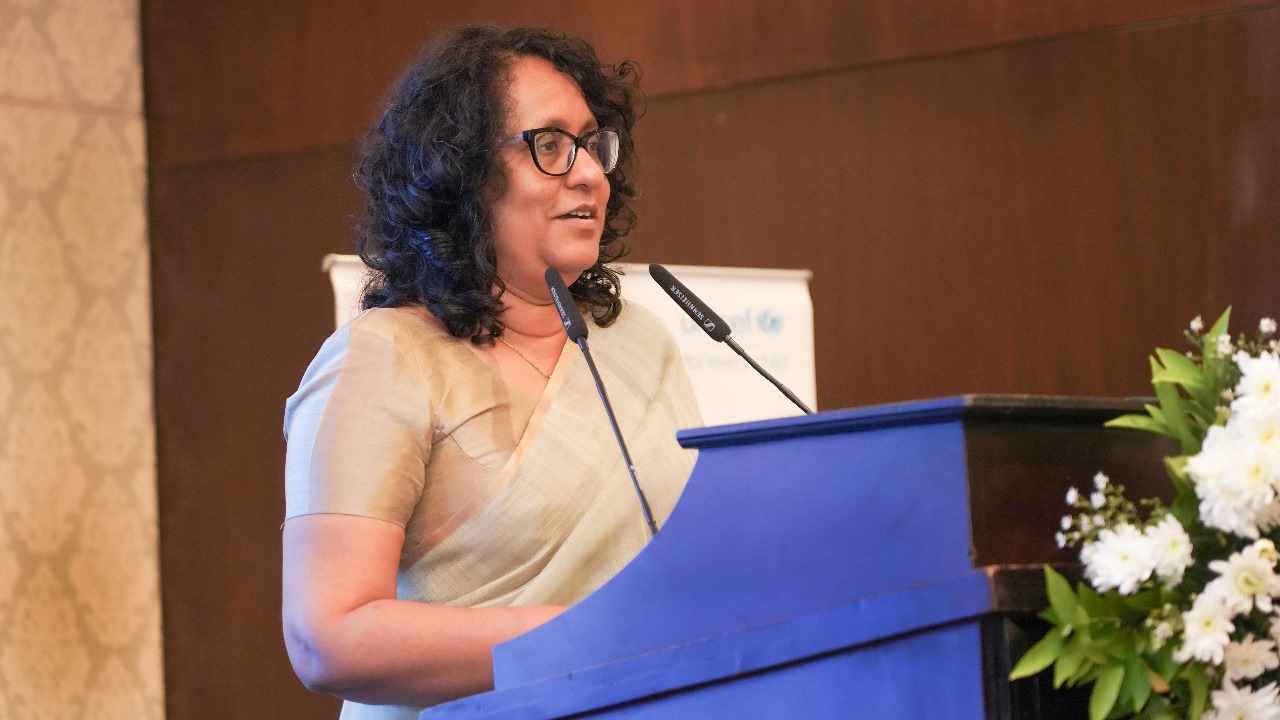
Prime Minister Dr. Harini Amarasuriya emphasized the critical importance of child-focused public financing, noting that “Government budgets are among the most powerful instruments for realizing the rights and well-being of children as enshrined in the Convention on the Rights of the Child. As responsible governments, we must ensure that public finance serves as a catalyst for advancing the rights of every child and securing their future.”
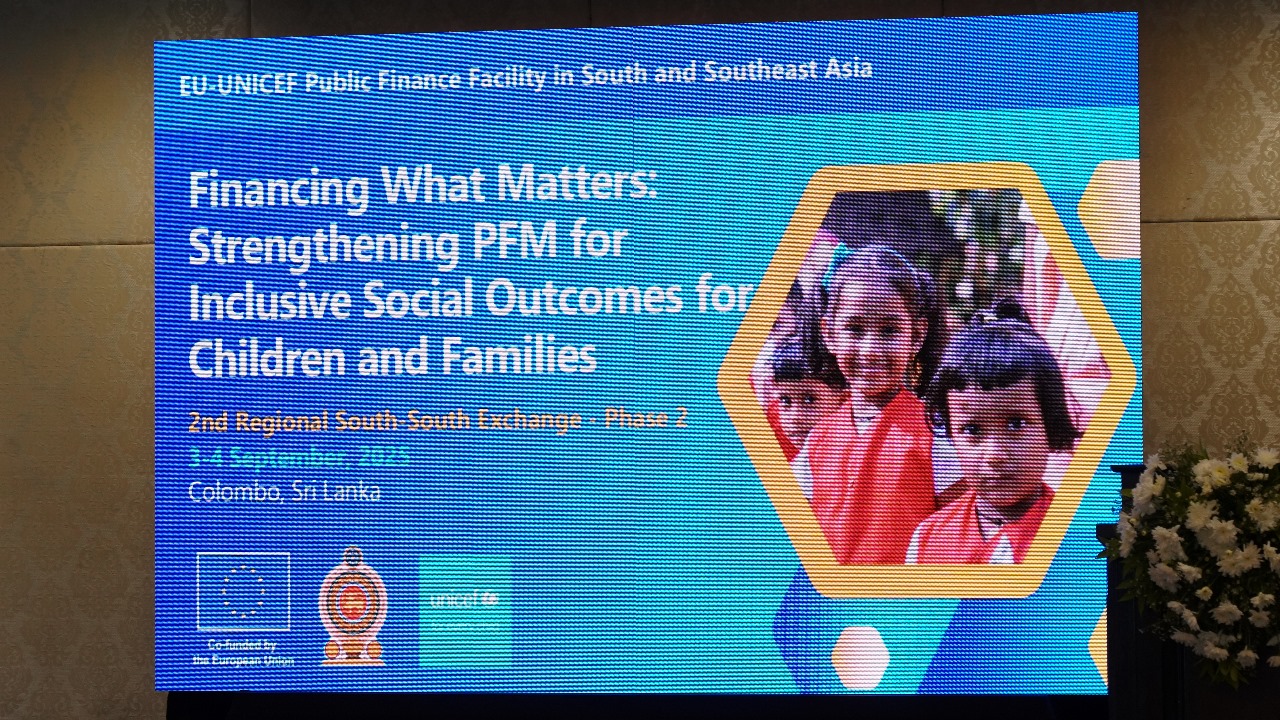
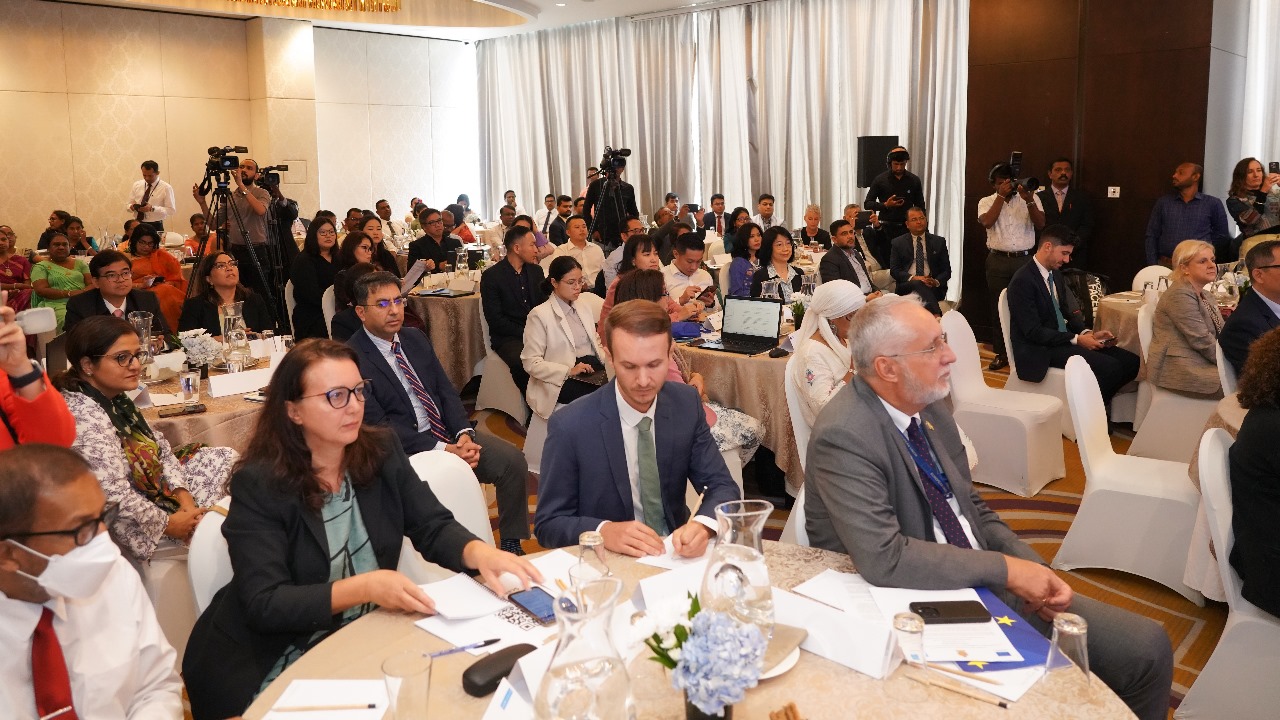
She made these remarks while addressing the two-day program on “Financing What Matters: Strengthening Public Financial Management for Inclusive Social Outcomes for Children and Families”, a Regional Knowledge Exchange held on 3rd and 4th September at NH Collection in Colombo under the EU-UNICEF Public Finance Facility. The event, implemented by UNICEF and supported by the European Union, served as a forum for dialogue between policymakers responsible for public financial management, budgeting, and expenditure processes across Asia, as well as international partners in this field.
In her address, the Prime Minister further stated:
“Our Government places children at the heart of our responsibilities, and as such, all our policies will reflect the best interests of the child. Being acutely aware of the continuing impact of economic challenges on our people particularly the most vulnerable, including our children the Government of Sri Lanka continues to pursue fiscal consolidation while prioritizing public investments in children and social protection.
In this regard, we have introduced specific child-focused budgetary measures in the 2025 budget. LKR 1 billion has been allocated to provide a monthly allowance of LKR 5,000 to children in institutional or guardian care—of which LKR 2,000 is credited to the child’s minor account, and LKR 3,000 provided to guardians for welfare expenses. LKR 500 million has been dedicated to improving capacity, infrastructure, and human resources in 379 certified child care institutions. A further LKR 1 billion has been proposed as a housing grant to support orphaned children in building stable homes or ensuring long-term security once they marry after the age of 18. In addition, LKR 250 million has been allocated to establish a child-friendly transport system, especially for institutionalized children required to travel to and from courts. LKR 200 million has been committed to establishing a specialized treatment center for children with Neuro-Developmental Disabilities (including autism) at the Lady Ridgeway Children’s Hospital, while LKR 250 million has been allocated to develop a model daycare center supporting inclusive early childhood development for children with NDD.
These allocations, together with historic increases in health and education budgets, reflect our Government’s commitment to protecting vulnerable children, strengthening families, and ensuring every child in Sri Lanka has access to education, nutrition, healthcare, and psycho-social support. By embracing innovation, supporting vulnerable populations, and aligning fiscal policy with sustainability, we aim to transform today’s challenges into opportunities for growth and resilience.”
Speaking at the event, Myo Zin Nyunt, Deputy Regional Director of the UNICEF East Asia and Pacific Regional Office, said: “By offering technical advice, training, and space for policy discussion, this Facility is helping countries like Sri Lanka make better budget choices, deliver services more effectively, and involve citizens including young people in decision-making.”
Carmen Moreno, Ambassador of the European Union to Sri Lanka and the Maldives, also addressed the gathering, highlighting the importance of prioritizing social sector spending, noting that without such investment societies will not be able to withstand future challenges.
The event was attended by the UN Resident Coordinator, Marc-André Franche, UNICEF Sri Lanka Representative, Emma Brigham, Dr. Harshana Sooriyapperuma, Secretary to the Ministry of Finance, Planning and Economic Development, officials from the EU and UNICEF regional offices in Bangkok, as well as senior officials from the Ministry of Finance Planning and Economic Development.
[Prime Minister’s Media Division]


A quick glance at the head to head record is enough to show the gulf between India and Sri Lanka in women’s T20Is. Despite that, the manner in which India have swept Sri Lanka aside two games in a row would have surprised watchers and the hosts alike. The story in the second T20I followed a similar script to the first. Once again, India’s spinners squeezed Sri Lanka’s middle order before one of their top-order batters made easy work of the chase.
Left-arm spinners Vaishnavi Sharma and N Shree Charani picked up two wickets apiece after Sneh Rana, in the XI in place of the indisposed Deepti Sharma, sucked out the momentum from Sri Lanka’s batting. If it was Jemimah Rodrigues’ half-century in the first game, Shafali Verma was at her brutal best in the second, finishing on an unbeaten 69 in just 34 balls, to help India get to the 129-run target at a run-rate close to 11 an over with 49 balls to spare.
India went 2-0 up at the end of the Visakhapatnam leg, with the next three games to be played in Thiruvananthapuram.
Sri Lanka were jolted in the opening over after being asked to bat. Vishmi Gunaratne’s uppish drive was caught by Kranti Gaud in her follow-through. Chamari Athapaththu then started the charge. After the defeat in the first game, she asked her batters to step up and find ways of scoring. She was intent on leading from the front. She used her feet against Gaud to slash her in front of point. Two balls later, Gaud almost got back at the Sri Lanka captain.
Charani, who dropped two simple catches on Sunday, misjudged Athapaththu’s slash and conceded a six. She charged in from the boundary line and then ran back, missed the ball completely despite a leap. Athapaththu blazed away with the field restrictions on, scoring 31 off 24 balls out of Sri Lanka’s 38 in 5.3 overs at that stage.
After her dismissal, Hasini Perera and Harshitha Samarawickrama continued to bat with high intent. They primarily scored square of the wicket and added 28 in the three-and-a-half overs. And then came the squeeze from India.
On a day she was newly crowned the No. 1 T20I bowler in the ICC rankings, Deepti missed a T20I for the first time since 2019 – after 92 straight games – because of a mild fever. Harmanpreet Kaur has often turned to her when in search of control, but on Tuesday, Rana fit into the role with ease.
Playing her first T20I in India since 2016 – she played 15 away from home in between – Rana’s first task was to stop a belligerent Athapaththu, and she delivered. She kept the Sri Lanka captain guessing with flight and dip before dismissing her. With Athapaththu itching to cut loose, Rana generously flighted one. It landed slightly shorter than Athapaththu expected because of the dip, and she ended up miscuing it to long-off.
Rana then returned with Perera and Samarawickrama scoring at a good tempo, bowled a maiden and that turned the tide. It allowed left-arm spinner Charani to slip in a few quiet overs, which resulted in Perera’s dismissal. Vaishnavi also returned to pick up her first international wicket, with Charani, who denied her in the first T20I by dropping a dolly at short fine leg, taking a simple catch at the same spot after Nilakshika Silva top-edged a sweep.
Sri Lanka hit 11 boundaries in the first nine overs, but could hit only two fours in the rest of their innings. They lost six for 24 to be restricted to a below-par total for the second game in a row, which was never going to challenge the hosts. Three run-outs for a second game in a row did not help matters either.
If Sunday was an opportunity missed by Shafali, she more than made up for it on Tuesday. She was happy to bide her time at the start, with Smriti Mandhana being the aggressor. Once Mandhana fell, caught at point in a bid to hit Kavisha Dilhari’s offspin inside out over the off side, Shafali took centrestage. Inoka Ranaweera’s left-arm spin with the field restrictions in place was just the tonic she needed.
Shafali hit Ranaweera for successive fours in the penultimate over of the powerplay – both by dancing down the track and lofting her over cover. She then took apart Athapaththu’s offspin, hitting here for 4, 6, 4 in the sixth over of the chase: first sweeping a short ball through backward square leg, then thumping a full ball straight into the sight-screen and then lifting one over extra cover.
With the in-form Rodrigues for company, there was no respite for Sri Lanka’s bowlers. Rodrigues also tore into Ranaweera, hitting her for two fours and a six as the left-arm spinner was taken for 31 in her two overs.
In an attempt to maintain the high tempo, Rodrigues holed out to long-on. Shafali soon completed her fifty from just 27 balls. She picked Shashini Gimhani’s left-arm wristspin from the hand and thumped her for back-to-back boundaries in a 12-run over that put India on the brink.
Sri Lanka earned a consolation when Malki Madara’s dipping yorker deceived Harmanpreet. But they knew, as Athapaththu conceded after the game, that the batters failed to make the helpful conditions count in successive games.
Brief scores:
India Women 129 for 3 in 11.5 overs (Smriti Mandhana 14, Shafali Verma 69*, Jemimah Rodrigues 26, Harmanpreet Kaur 10; Malki Madara 1-22, Kavya Kavindi 1-3, Kavisha Dilhari 1-15) beat Sri Lanka Women 128 for 9 in 20 overs ( Chamari Athapaththu 31, Hasini Perera 22,Harshitha Samarawickrama 33, Kavisha Dilhari 14, Kaushini Nuthyangana 11; Kranti Goud 1-31, Sneh Rana 1-11, Shree Charani 2-23, Vaishnavi Sharma 2-32) by seven wickets
[Cricinfo]

With the objective of enhancing the living conditions of the agricultural community and increasing the contribution of the agricultural sector to the GDP, ‘Smallholder Agribusiness Partnerships Programme’ is being implemented with the financial contribution form the government and the International Fund for Agricultural Development.
The Ministry of Agriculture, Livestock, Lands and Irrigation is
implementing the program in collaboration with the Regional Development Department of the Central Bank of Sri Lanka. All recoveries from loans provided under the program shall be directed to a revolving fund titled the “Sustainable Agricultural Fund”, which shall be utilized exclusively for the provision of
agricultural loans. Using the said fund, it is proposed to implement an agricultural loan scheme titled the “Sustainable Agriculture Programme” for individuals and institutions engaged in agriculture and related activities.
It is expected that an amount of Rs. 800 million from the funds available in the Sustainable Agriculture Fund will be allocated for the implementation of the Sustainable Agriculture Program in the year 2026.
Accordingly, the Cabinet of Ministers approved the proposal made by the President in his capacity as the Minister of Finance, Planning and Economic Development to implement the “Sustainable Agriculture Program” loan scheme through the Participatory Finance Institution as an annual program from the year 2026.

The Ministry of Education, Higher Education and Vocational Education has entered into agreements with Sri Lanka Insurance Corporation General Limited to execute the Suraksha Student Insurance programme which is implemented with the objective of facilitating to maintain student education activities of students who experience disturbances to education due to numerous health issues without any interruption.
From this, approximately 40 lacks of students educated in government schools, government approved private schools, Pirivena and assisted special schools are covered under health
insurance, accident coverage, and life insurance categories.
Considering the issues recognized when implementing this programme, the Cabinet of Ministers granted approval to the particulars furnished by the Prime Minister in her capacity in the post of the Minister of Education, Higher Education and
Vocational Education that the ‘Suraksha’ Student Insurance Programme for the year 2025 / 2026 will be implemented including the following amendments and thereby actions will be taken to issue relevant circular instructions.
• Implementation of ‘Suraksha’ Student Insurance Programme until 31.08.2026 in relation to the year 2025 / 2026
• Amendment of the annual income of low income category considered at granting parent death benefit from rupees 180,000/- to rupees 240,000/-
• Granting benefit up to rupees 75,000/- for the Scoliosis Brace which is used for correcting distortion of the spinal code and Cochlea Equipment.
• Granting benefits up to rupees Rs. 20,000/- for students those who are taking medicine for longer periods for ailments in the category of critical illness category and another 07 identified ailments.
• Adding 05 more ailments as Pneumothorax, Encephalitis, Thalassemia, Hereditary Spherocytosis and Sickle Cell Anemia which are in the critical ailment category.
• From 01.09.2025, providing opportunity to handover the claim applications for obtaining benefits to any regional office of Sri Lanka Insurance General Limited.

Navy seizes an Indian fishing trawler poaching in Sri Lankan waters north of Talaimannar

Several spells of showers may occur in Central, Uva and Eastern provinces and in Polonnaruwa and Mullaittivu districts

India’s External Affairs Minister meets Sri Lanka PM

Shafali 69 not out , spinners lead India’s rout of Sri Lanka

Sri Lanka’s coastline faces unfolding catastrophe: Expert

SOC examines proposed amendments to the Microfinance and Credit Regulatory Authority Bill

‘Dates have the highest sugar content to fight Coronavirus’

Sunday Island 27 December – Headlines

#SundayIsland 17th December – Headlines

Sunday Island – 28th March

Sunday Island Headlines – 21 March

Sunday Island – 21st February – Headlines
-

 News2 days ago
Members of Lankan Community in Washington D.C. donates to ‘Rebuilding Sri Lanka’ Flood Relief Fund
-

 News7 days ago
Pope fires broadside: ‘The Holy See won’t be a silent bystander to the grave disparities, injustices, and fundamental human rights violations’
-

 News7 days ago
Pakistan hands over 200 tonnes of humanitarian aid to Lanka
-

 Business6 days ago
Unlocking Sri Lanka’s hidden wealth: A $2 billion mineral opportunity awaits
-

 News6 days ago
Army engineers set up new Nayaru emergency bridge
-

 News7 days ago
Officials of NMRA, SPC, and Health Minister under pressure to resign as drug safety concerns mount
-

 News7 days ago
Expert: Lanka destroying its own food security by depending on imported seeds, chemical-intensive agriculture
-

 Editorial7 days ago
Flawed drug regulation endangers lives