
Sports
Aravinda inducted into ICC Hall of Fame

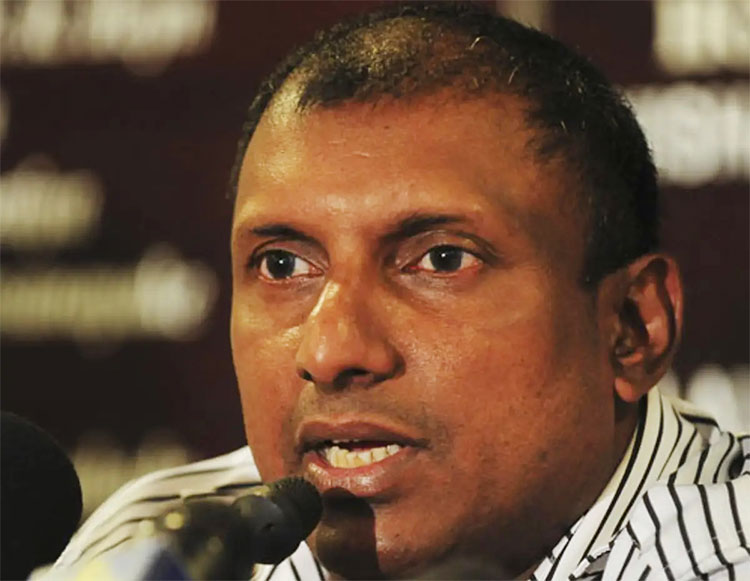
Former great Aravinda de Silva has been inducted into the ICC Hall of Fame, the International Cricket Council announced, making him the fourth Sri Lankan to join the elite group.
Aravinda will be honoured at the Wankhede Stadium during the World Cup semi-final along with Virender Sehwag and Diana Edulji.
Following a voting process conducted among existing Hall of Famers, media representatives and senior executives from FICA and the ICC, the three new names will be added to the prestigious list of legends that comprise the ICC Hall of Fame.
The ICC Hall of Fame honours the greatest international cricketers throughout the long history of the sport, and the enduring legacies of de Silva, Edulji and Sehwag see them join as inductees number 110, 111 and 112 respectively.
De Silva enjoyed a 19-year international career for Sri Lanka, notably playing a starring role in their memorable run to victory at the ICC Men’s Cricket World Cup in 1996.
“I am filled with profound gratitude as I accept the immense honour of being inducted into the ICC Hall of Fame. This achievement is a tribute to the dedication, sacrifice, and love that have shaped my cricketing journey,” Aravinda said.
“My family, my parents, my sister, my wife and children are my anchor, and deserve the deepest thanks for their unwavering support and sacrifice, which have propelled me towards success. My friends, steadfast companions throughout my highs and lows, have been my pillars of strength.
“To my coaches, teachers, fans and supporters, your relentless belief in me has fuelled my drive to succeed. My mentors and captains have guided and inspired me, and my teammates have been my extended family on this incredible journey. To the ones I have played against, thank you for enriching my game.
“My sincere appreciation goes to the ICC, and the Hall of Fame voting committee for this extraordinary recognition. I share this honour with all who have stood by and shaped me.
De Silva made his Test debut at Lord’s in 1984, and scored 75 as Sri Lanka recorded the first Test win in their history a year later, defeating India at Colombo. A first Test century followed against a Pakistan attack of Imran Khan, Wasim Akram and Abdul Qadir at Faisalabad the following month, and in 1991 he struck a then-national record individual score of 267 against New Zealand at Wellington.
The all-rounder was instrumental in Sri Lanka’s World Cup winning campaign in 1996, and his contributions during a memorable Final against Australia in Lahore are written in cricket folklore. De Silva took three key wickets with his off-spin to restrict Australia’s score, before scoring an unbeaten 107 to navigate his side out of trouble to win their maiden global crown. He was the first to score a century and take three wickets in the same World Cup match – and is still the only one to do so in a Final.
He signed off from Test cricket in 2002 with a double-century in his final innings and retired from all international cricket after the ICC Men’s Cricket World Cup in 2003.




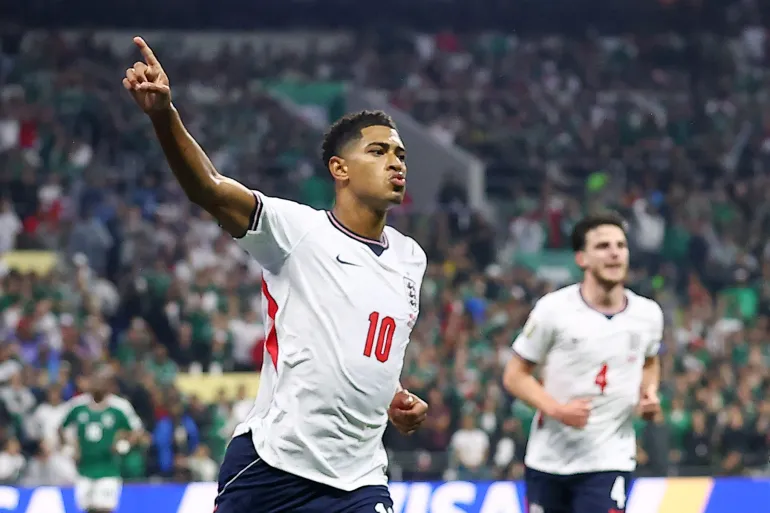
Jude Bellingham’s double inflicted a rare defeat on Mexico at their Estadio Azteca as 10-man England won a ne4ve racking World Cup claasic 3-2 to reach the quarterfinals.
Harry Kane also scored from the penalty spot as the Three Lions overcame Jarell Quansah’s red card, high altitude, and a fervent home support on Sunday to keep their quest for a first major tournament win in 60 years alive.
England have relied on Bellingham and Kane throughout the tournament, and the duo has carried them into a last-eight showdown with Erling Haaland’s Norway.
Bellingham struck twice in 98 seconds in the first half to condemn Mexico to just a third defeat in 90 matches at the Azteca.
Julian Quinones and Raul Jimenez reduced the Mexican arrears, but they fell short of a place in the quarterfinals.
Victory also helped to erase some of England’s nightmarish memories at the Azteca in the quarterfinals of the 1986 World Cup, when Diego Maradona scored a double for Argentina, including the infamous “Hand of God” goal.
Sunday’s match was delayed by an hour after a thunderstorm and heavy rain lashed the Mexican capital for hours before the planned 6pm (00:00 GMT) kickoff time.
Despite the sodden conditions, more than 80,000 fans crammed into the stadium to create a deafening noise.
England coach Thomas Tuchel was wary of a fast start from Mexico as his side adjusted to the altitude of 2,240 metres (7,350 feet) above sea level.
Mexico had flown out of the traps when they won a World Cup knockout game for the first time in 40 years against Ecuador 2-0 on Tuesday.
This time, England managed to keep Javier Aguirre’s side at bay, but they did need a crucial intervention from Jordan Pickford to deny Jimenez opening the scoring with a diving header that was headed for the bottom corner.
Tuchel made three changes to the side that needed a heroic performance from Kane to prevent an embarrassing early exit to DR Congo.
Quansah was forced to deputise at right-back with Reece James not fit to start for a third consecutive game, opening up Tuchel to criticism over his decision not to select more specialist cover in the position.
Anthony Gordon and Bukayo Saka also started out wide, and both made telling contributions.
Saka’s cross picked out Bellingham to power in a header for the first goal Mexico conceded in five World Cup games.
The hosts failed to compose themselves, as within two minutes, the Real Madrid midfielder had doubled England’s lead.
Kane’s ball across fell perfectly for Bellingham to power in his fourth goal of the tournament.
Yet what should have been a comfortable lead was nearly wiped out by half-time.
Quinones blasted in his fourth goal of the tournament to spark the Mexico rally after England failed to clear a free kick.
Jimenez drilled wide and saw another header saved by Pickford before Bellingham made a last-ditch intervention to deny Cesar Montes a certain equaliser.
Nico O’Reilly nearly restored England’s two-goal cushion as his deflected shot cannoned off the post.
Quansah was shown a straight red card on 54 minutes after a VAR review for a mistimed lunge on Jesus Gallardo.
But just six minutes later, the 10 men had added to their lead when Gordon was wiped out by Mexico goalkeeper Raul Rangel and Kane emphatically dispatched the penalty.
The England captain’s sixth goal of the tournament puts him just one behind Haaland, Lionel Messi and Kylian Mbappe in the race for the Golden Boot.
The game took another huge momentum swing when, this time, Kane was penalised for a foul inside his own box and Jimenez slotted home the penalty to set up a frantic final 20 minutes.
England, though, stood tall, defending at times frantically to resist the Mexican wave during 11 minutes of additional time, and have reached a third consecutive FIFA World Cup quarterfinal.
(Aljazeera)

Erling Haaland scored two late goals to send Norway through to their first World Cup quarterfinal with a stunning 2-1 win over Brazil, which condemned the five-time champions to their earliest exit since 1990.
Norway goalkeeper Orjan Nyland produced a sensational display on Sunday and saved a first-half penalty from Bruno Guimaraes before Haaland struck twice in the last 11 minutes to stun Brazil at New York New Jersey Stadium.
Neymar pulled a goal back deep into stoppage time with Brazil’s second spot kick of the match.
Haaland’s brace took him level with Lionel Messi on seven goals for the tournament as Norway booked a showdown against either cohosts Mexico or England in Miami on July 11.
For Brazil, who hired Carlo Ancelotti in a bid to end a 24-year World Cup drought, it is the sixth straight tournament they have been knocked out by European opposition.
The last time Brazil failed to reach at least the quarterfinals came 36 years ago, when they lost 1-0 to archrivals Argentina in the last 16.
Gabriel Martinelli was rewarded for scoring the stoppage-time winner against Japan in the previous round, as the Arsenal winger replaced the injured Lucas Paqueta in the lone change to Brazil’s lineup.
Norway were boosted by the return of Julian Ryerson, the Borussia Dortmund defender fit again after missing the past two games with a thigh injury.
Patrick Berg thought he had given Norway the lead inside three minutes, but his effort was ruled out for offside in the build-up.
After a rocky start, Brazil won a penalty when Kristoffer Ajer clattered into Matheus Cunha in the box.
The Brazilians were left furious as referee Ismail Elfath initially waved away their appeals, but VAR intervened, and the decision was overturned.
Guimaraes stepped up, but Nyland guessed correctly, diving low to his left to push away the Newcastle midfielder’s tame penalty.

Nyland again came to Norway’s rescue, getting a crucial touch to Martinelli’s low drive as it flashed across goal, denying Guimaraes a simple tap-in.
When Martin Odegaard lost possession on the edge of his own box, Nyland once more saved Norway as he stuck out a leg to thwart Vinicius Junior.
Haaland had struggled to make a significant impact, but his strength created a glorious opening for Norway before half-time.
The striker caused problems for Gabriel Magalhaes and Marquinhos in the Brazil defence before the ball broke kindly for Odegaard, whose effort was well saved by Alisson.
Norway coach Stale Solbakken brought on Oscar Bobb and Andreas Schjelderup at the break for Antonio Nusa and Alexander Sorloth, but it was the introduction of Endrick that almost changed the game immediately.
Vinicius Junior slipped Endrick through on goal with a delightful outside-of-the-foot pass, only for the teenager to dink wide as Nyland came out to close him down.

Nyland continued to frustrate Brazil, producing a good save to claw away Rayan’s fierce strike before making another outstanding stop to deny Guimaraes, although the offside flag went up.
The arrival of Neymar in the 67th minute drew huge roars from the largely pro-Brazil crowd.
It was Norway who eventually broke the deadlock, though, and it came through an inevitable source.
Schjelderup whipped in a cross from the left and soared above Gabriel to power a header into the corner.
As Brazil desperately chased an equaliser, an incredible fingertip save from a back-pedalling Nyland prevented Ajer from looping the ball into his own net.
Haaland gave Norway breathing space as he hammered low into the corner from the edge of the box in the 90th minute.
It proved vital when Neymar converted a penalty in the 10th minute of stoppage time, preceded by an unseemly spat with Nyland, following an elbow on Casemiro.

(Aljazeera)
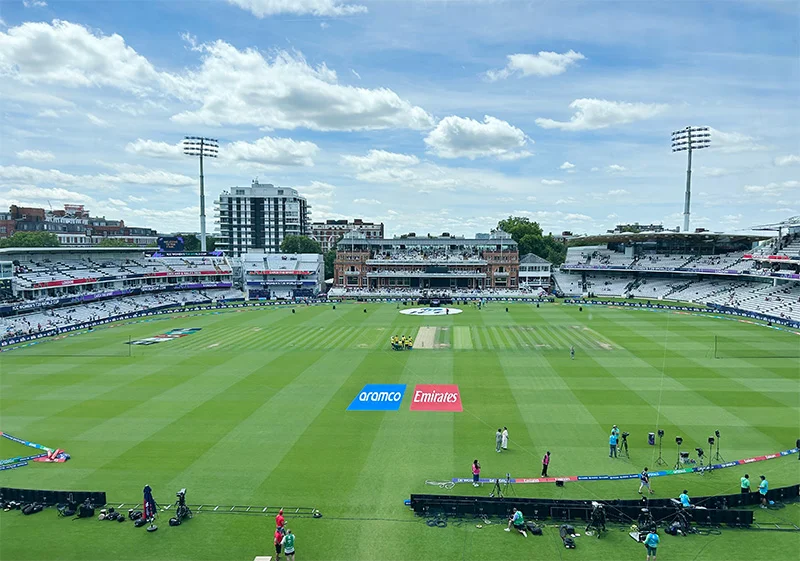
Visiting Lord’s is always a special occasion. The place leaves an indelible mark on everyone who walks through its gates, even if only once. Popularly known as the Home of Cricket, Lord’s houses the England and Wales Cricket Board, the Marylebone Cricket Club, custodians of the Laws of the game, and at one stage, even the International Cricket Council before Indian cricket administrator Jagmohan Dalmiya broke with tradition and moved the organisation’s headquarters to Dubai.
The Lord’s Pavilion, dressing rooms, museum and the famous Long Room are every cricketer’s delight. It becomes even more special if you manage to get your name on the Honours Boards. Rumesh Ratnayake, Sidath Wettimuny, Mahela Jayawardene, Kumar Sangakkara and Angelo Mathews, to name just a few, have all achieved that distinction.
Aravinda de Silva may not have his name on the board, but he certainly left his mark at Lord’s. In the Benson and Hedges Cup final, he produced a stunning century for Kent against Lancashire, taking on Wasim Akram and company. It is not often that a player ends up on the losing side and is still named Man of the Match, but Aravinda’s charm was such that the organizers made an exception.
Sangakkara too enjoyed some unforgettable moments at Lord’s. MCC President Christopher Martin Jenkins invited him to deliver the prestigious Cowdrey Lecture and he produced one of the finest speeches the game has heard. The address received a standing ovation and many Sri Lankans in attendance, including former Board President Vijaya Malalasekera, were moved to tears.
It was also at Lord’s that Sri Lanka lifted the Emirates Trophy, two years after becoming World Champions.
Several Test matches involving Sri Lanka at Lord’s are fondly remembered. Their inaugural Test at the venue in 1984 is recalled for its batting feast. Duleep Mendis was so dominant that he forced England’s golden boy Ian Botham to resort to off-spin, while narrowly missing centuries in both innings.
In 2006, after being bowled out for 192 and conceding a first innings deficit of 360, Sri Lanka were asked to follow on. They responded with one of the finest rearguard actions in their Test history.
Batting for almost three days, a majestic century by captain Mahela Jayawardene, backed by six half-centuries from his teammates, earned Sri Lanka a memorable draw.
Four years earlier, they had England firmly on the ropes. After piling up more than 550 runs and securing a first-innings lead of nearly 300, Sri Lanka enforced the follow-on. But a string of dropped catches in the slips denied them what would have been a famous victory at Lord’s.
The 2014 Test, of course, went right down to the wire. England thought they had sealed victory when last man Nuwan Pradeep was given out in the final over. Fortunately, in the pre-Niroshan Dickwella era, Sri Lanka used the Decision Review System judiciously. With one review still available, Pradeep challenged the decision and it was overturned, much to Sri Lanka’s delight. The match ended in a draw and Sri Lanka went on to win the next Test at Headingley, securing their first ever Test series victory in England.
A Test win at Lord’s, however, still remains elusive.
Several Sri Lankans have also made Lord’s their home ground while representing Middlesex in county cricket. Chaminda Vaas is the most celebrated among them. But almost a century before Vaas, there was Dr Churchill Gunasekara, the first Ceylonese to play County cricket. He was a member of Middlesex’s County Championship-winning sides in 1920 and 1921.
Rex Clementine
in London

Death toll in violent clashes at Negombo Prison rise to 25

The Government is committed to equipping children with new technology and knowledge – PM

Bellingham inspires 10-man England to beat Mexico 3-2 in last-16 thriller

Haaland scores twice as Norway stun Brazil 2-1 in World Cup 2026 last 16

A few showers will occur in the Western and Sabaragamuwa provinces and in Galle, Matara, Kandy and Nuwara-Eliya districts

Appointment of SPO to probe AG on hold until establishment of Ind. Public Prosecutor’s Office

‘Dates have the highest sugar content to fight Coronavirus’

Sunday Island 27 December – Headlines

#SundayIsland 17th December – Headlines

Sunday Island – 28th March

Sunday Island Headlines – 21 March

Sunday Island – 21st February – Headlines
-
 Features6 days ago
Climate action to bring South Asia together
-

 News6 days ago
Chamuditha to seek removal of injunction on Youtube programme
-

 News1 day ago
Singapore-based Buddhist monk marks nearly four decades of humanitarian service
-

 News2 days ago
Freedom 250: US Embassy celebrates America’s 250th Independence Day through magic of American cinema
-

 News3 days ago
CIABOC to question Harak Kata on Rs. 200 mn bribery allegation
-
 News3 days ago
SLAF conducts successful rescue mission under UN command in Central African Republic
-
 Opinion6 days ago
Matara Maha Keralla– Uprising against the Dutch
-

 Midweek Review5 days ago
H’tota port’s strategic status remains focal point of geopolitical scrutiny