
Sports
An underdog, a positive approach and the victory no one saw coming

By Reemus Fernando
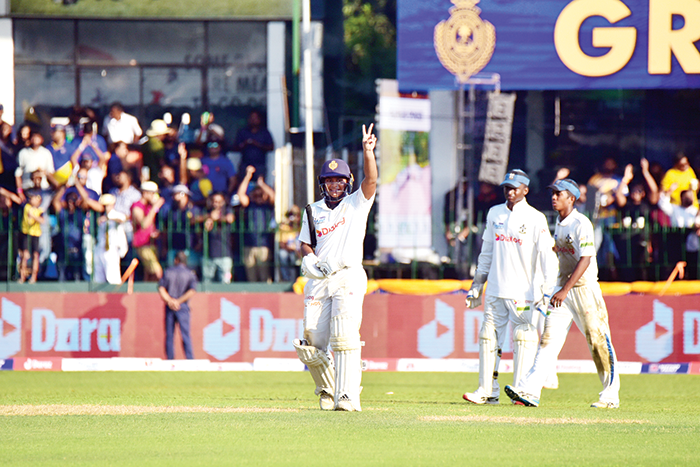
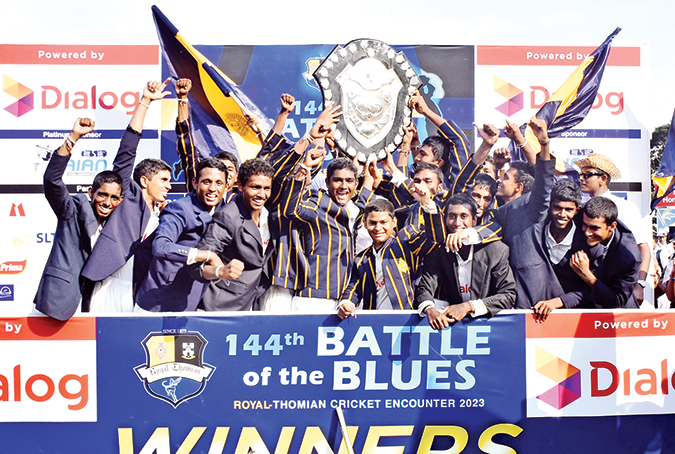
Royal beat the odds to register a stunning 180 runs victory against their arch-rivals S. Thomas’ at the 144th Battle of the Blues at the SSC on Saturday. It was a victory no one saw coming as the outfit trained by Rohan Soysa entered the annual battle as underdogs.
Royal’s back-to-back defeats at the hands of Trinity in the run up to the historic encounter were overshadowing even the couple of victories they had registered during the season and the fact that they had reached the quarter-finals at the end of the league stage. Reaching the last eight of the tournament was something their arch-rivals had failed to achieve. S. Thomas’ on the other hand had remained unbeaten though they failed to reach the business end of the tournament.
Both teams had wanted to bowl first under overcast conditions on day one and the Thomians had the ideal start to the annual battle as they took the first three wickets for just 19 runs. That was when Dasis Manchanayake came to the crease. The new ball was just eight overs old when he started the repair job with Ovina Ambanpola. Despite the early damage, the Royalists stayed positive. “Manchanayake’s approach was decisive,” said Royal coach Rohan Soysa following the victory.
Manchanayake rewarded for staying positive in adversity After being four wickets down for 63 runs at one stage, Royal recovered to post 326 runs for eight wickets declared thanks to the record-breaking partnership put on by Manchanayake and Ramiru Perera. The stage for victory was built on that partnership as the pair put on 229 runs off 293 balls. In the process the pair broke a 70-year-old partnership record for the fifth wicket. Manchanayake stayed there for five hours as they disappointed Thomians during an entire second session.
There was no turning back for Royal from then on as they won all sessions.Few expected Royal to declare on their overnight score under clear skies on day two morning. By lunch they had accounted for four top-order batsmen in the Thomian innings except for opener Senadhi Bulankulame. By tea on day two Royal were in complete command as they dismissed their opponents for 153 runs and they needed just 26 overs in the final session to amass 168 runs for the loss of four wickets.
Manchanayake entered the Battle of the Blues record books as the only Royal captain to score a century and a half-century in a match. In history only two batsmen had done that (M. Thotiwilage 95 and 108 in 2001 and Ganganath Rathnayake 75 and 111n.o. in 2011). What was more remarkable was the fact that the rare achievement coincided with victory. Ramiru Perera too could have earned the rare achievement had not Royal declared their innings on the overnight score on day three morning. Perera was unbeaten on 46 runs.
Incidentally, of the players who batted, Royal had only three batsmen reaching double figures in the first innings. And in the second innings apart from Manchanayake and Perera, Uvindu Weerasekara was the only batsman to top 20 runs. Royal’s Sri Lanka Under 19 player Sineth Jayawardena (1 & 4) failed in both innings.
Royal and two other schools had received exemptions from Sri Lanka Cricket to field their Sri Lanka Under 19 players in the weekend’s Big Matches despite Sri Lanka Under 19 leaving for UAE for a tournament. As expected pacemen played a crucial role in the match. Ranuka Malaviarachchi, Bulan Weerathunga and Sandesh Ramanayake accounted for ten wickets in the match with the latter becoming the third brother of the Ramanayake family to associate with a Royal victory.






by Reemus Fernando
Vetum Chandul de Zoysa of Galewela Central hogged the limelight on the opening day of the All Island School Games Athletics Championship as he shattered one of Rumesh Tharanga’s longstanding meet records on Friday.
Chandul, who is trained by his parents, both physical education instructors, improved Rumesh Tharanga’s 2017 record twice during the event.
He first shattered the record when he cleared 55.67 metres in his third attempt to enter the best eight as the leader.
Then he further improved the record with a performance of 55.83 metres.
Tharanga’s record of 55.58 metres stood unshaken since 2017.
Current world leader in the javelin throw, Rumesh Tharanga took part in both the javelin and discus throw when he was attending St. Peter’s College.

Prima KottuMee has come on board as the Silver Sponsor of the Asia Rugby Emirates Sevens Series 2026, throwing its weight behind Sri Lankan rugby as the national team prepares to take on the region’s best.
The prestigious tournament will reach its climax in Colombo on 17 and 18 October, giving local rugby enthusiasts an opportunity to witness some of Asia’s finest talent in action on home soil.
The 2026 edition features 24 national teams, with 12 sides each competing in the men’s and women’s categories, promising two days of fiercely contested rugby.
Prima KottuMee has been a longstanding supporter of Sri Lankan rugby, extending its backing to the sport at school, club and national levels.
Over the years, the brand has played an active role in supporting players, teams and tournaments, contributing to the development and promotion of rugby across the country.
With Colombo set to host the final leg of the series, Prima KottuMee hopes to add further momentum to the occasion while reaffirming its commitment to nurturing local sporting talent.

by Rex Clementine
The long awaited overhaul of Sri Lanka Cricket has reached a decisive stage, with the Supreme Court set to play a pivotal role next week in determining the fate of the proposed new constitution.
For months, legal experts have been burning the midnight oil, working on sweeping reforms aimed at dragging cricket administration into the modern era and bringing its governance structure into line with international standards. The draft constitution was presented to Parliament and following days of debate, received the legislature’s initial nod. The matter is now before the Supreme Court, where interested parties have been given an opportunity to raise objections.
A lawyer and former cricket board chief Thilanga Sumathipala have so far filed objections. The judges will examine whether these challenges have merit and more importantly, whether the proposed constitution is compatible with the law of the land.
One contentious provision that has raised eyebrows among key stakeholders is the proposal to strip District Cricket Associations of their voting rights.
October 20 is the deadline for submitting objections. The court will then fix dates for arguments, following which the judges are expected to communicate their determination to the Speaker of Parliament within 48 to 72 hours.
Parliament will subsequently have to complete the remaining legislative formalities before the new constitution can become law, potentially drawing the curtain on decades of mediocrity, mismanagement and administrative wrangling in cricket administration.
More objections had been anticipated from those who have called the shots at Maitland Place in recent years. Although several expressed reservations behind closed doors, few have shown any appetite for a courtroom battle.
There is a delicious irony here. When these gentlemen were running Sri Lanka Cricket, they would dash to Hulftsdorp at the drop of a hat, seeking judicial intervention even if a reporter called them ‘misfits’. Now, with the very structure that sustained them facing the axe, they appear to have developed a sudden case of cold feet.
The proposed constitution promises greater transparency in the running of the cash rich cricket board. Equally important is the emphasis on efficiency and professionalism, with suitably qualified individuals expected to occupy key administrative positions rather than appointments being dictated by friendships, club loyalties or reputations earned on the cricket field.
The Sunday Island learns that the Attorney General’s Department has been providing legal advice and expertise to the Cricket Transformation Committee from the outset.
Former ICC legal officer David Becker was also brought on board to lend his expertise to the drafting of the new constitution.
For years, successive governments have been reluctant to confront the cricket establishment, despite mounting public pressure for meaningful reform. Administrators survived one controversy after another, even weathering a unanimous parliamentary resolution calling for their removal following the national team’s disastrous performances.
Their survival owed much to their connections in the corridors of power. Whenever their positions came under serious threat, the spectre of Sri Lanka losing its ICC membership was raised, effectively holding the country’s cricketing future to ransom.
This time, however, the familiar manoeuvres have been conspicuous by their absence.
President Anura Kumara Dissanayake recognised the depth of public dissatisfaction with cricket administration and opted for a different approach. Rather than installing a political loyalist, as has so often been the practice when filling influential positions, he entrusted the responsibility to Eran Wickramaratne, a figure from the opposition political camp.
A former first-class cricketer and banker, Wickramaratne brought financial expertise to an institution where fiscal discipline had long been a subject of concern.
AKD also enlisted the services of three respected former cricketers; Kumar Sangakkara, Roshan Mahanama and Sidath Wettimuny, to help steer Sri Lankan cricket through a difficult period.
It is said that members of the Cricket Transformation Committee, despite hailing largely from the Colombo and Kandy elite, have been so impressed by President AKD’s vision and his hands off approach to cricket administration that they are now inclined to cast their votes for the NPP at the next election. That, if true, would be quite a political transformation in its own right.
The results on the field have not arrived as quickly as supporters would have wished. Sri Lanka’s performances remain a source of frustration and there is still a mountain to climb before the national team can regain its standing among the game’s elite.
But one significant change is already evident. Those entrusted with the responsibility of putting cricket back on its feet have sent an unmistakable message: no individual, however celebrated or influential, is bigger than the game.
Even the superstars are beginning to fall in line.
That, in itself, is no small achievement in a cricketing culture where reputations have too often carried more weight than results.
The real test, of course, lies ahead. A new constitution alone will not produce world class cricketers or restore Sri Lanka to its former glory. But sound administration is the foundation on which lasting success must be built.
After years of false starts, broken promises and endless power struggles, Sri Lankan cricket finally has an opportunity to turn the page.

Record 1,600 students take Russian Classical Ballet examination in Sri Lanka

Half a million people join protests in France, but some turn violent

Deadly fire breaks out at Canada military base

Showers or thundershowers will occur in most parts of the island after 1.00 p.m.

Buddhist hierarchy demands prison perks for monk convicts

Debate on NCM against Speaker postponed indefinitely

‘Dates have the highest sugar content to fight Coronavirus’

Sunday Island 27 December – Headlines

#SundayIsland 17th December – Headlines

Sunday Island – 28th March

Sunday Island Headlines – 21 March

Sunday Island – 21st February – Headlines
-

 Latest News5 days ago
Nissanka’s return headlines Sri Lanka’s Test squad against Pakistan
-

 Latest News6 days ago
Farhan and Sadaqat help Pakistan seal series in style
-
 Features6 days ago
Intake 16: 45 years of duty and honour
-
 News6 days ago
Malwathu Chapter issues statement on talks with President over Gnanasara Thera’s robes
-
 News6 days ago
CP alleges NPP has taken the blame for illegal US sanctions on Iranian vessels
-

 News4 days ago
Sri Lanka, India caught in US-Iran ship crisis
-

 Opinion6 days ago
How long can Sri Lanka remain silent on its demographic crisis?
-
 Latest News4 days ago
Kusal Mendis’ unbeaten 87 hands Sri Lanka consolation win