
News
AMS explains primary reason for exodus of medical specialists


One of the key factors that contributed to the exodus of medical specialists from the state sector is the disparity of the total remuneration received by the state medical specialists when compared to parallel grades in the government sector, the Association of Medical Specialists (AMS) says.
There was always a shortage of medical specialists in the system but that gap increased rapidly due to the economic crisis, the AMS has said in a media statement.
“Shortage was mostly created both by the exodus of medical specialists from the state sector (migration or joining non-state sector) and by failure to return after overseas training, the AMS said.
“The disparity of total remuneration received by the state medical specialists when compared to parallel grades in the government sector is mainly due to the certain allowances like transport and other service specific allowances for medical specialists were placed at much lower level.
“For example, the mandatory out of the hours and offsite on call duties performed by state sector medical specialists were not recognized for suitable remuneration and even the onsite out of the hours on call duties were remunerated only after compiling lengthy daily entries and monthly form filling.”
The essential non-clinical administrative work done by medical specialists was also not subjected to any service specific allowance and the combined disturbances, availability, and transport (DAT) allowance paid was much less than the transport allowance alone paid to similar categories in the state sector, AMS has said.
“AMS initiated and conducted several discussions with the President, Minister of Health, the officers of the presidential secretariat and senior health officials where decisions were taken in favour of medical specialists and some of those decisions were rightly included as budget proposals in the 2024 Budget speech.
“Unfortunately, there seems to be some reluctance and delay in implementing these budget proposals and this will aggravate the current crisis both in the cities and the periphery bringing much hardship to the poor and vulnerable sectors of our society who cannot afford expensive private health care.
“Hence the AMS warns of dire consequences of non-implementation of these budget proposals and strongly requests the relevant authorities to move swiftly to implement what was proposed at the recent budget speech and the other decisions arrived during many discussions AMS had with the officials of the presidential secretariat and ministry of health. This will ensure that the state health service will function normally without causing difficulties to the ordinary Sri Lankan public.”

Latest News
Advisory for Severe Lightning for the Western and Sabaragamuwa provinces and Galle and Matara districts


Advisory for Severe Lightning
Issued by the Natural Hazards Early Warning Centre at 12.00 noon 07 February 2026 valid for the period until 11.00 p.m. 07 February 2026
Thundershowers accompanied with severe lightning are likely to occur at some places in the Western and Sabaragamuwa province and in Galle and Matara districts.
There may be temporary localized strong winds during thundershowers.
The general public is kindly requested to take adequate precautions to minimize damages caused by lightning activity.
ACTION REQUIRED:
The Department of Meteorology advises that people should:
Seek shelter, preferably indoors and never under trees.
Avoid open areas such as paddy fields, tea plantations and open water bodies during thunderstorms.
Avoid using wired telephones and connected electric appliances during thunderstorms.
Avoid using open vehicles, such as bicycles, tractors and boats etc.
Beware of fallen trees and power lines.
For emergency assistance contact the local disaster management authorities.

The Indian Naval Ship (INS) GHARIAL which made a port call in Colombo, departed the island on 06 Feb 26.
The Sri Lanka Navy bade a customary farewell to the departing ship at the Port of Colombo, following naval traditions.
During the ship’s port call, the crew took a sightseeing tour of key attractions in Colombo.
The visit also featured the handover of ten temporary Bailey Bridges, which were brought by INS GHARIAL, in coordination with the High Commission of India in Sri Lanka.
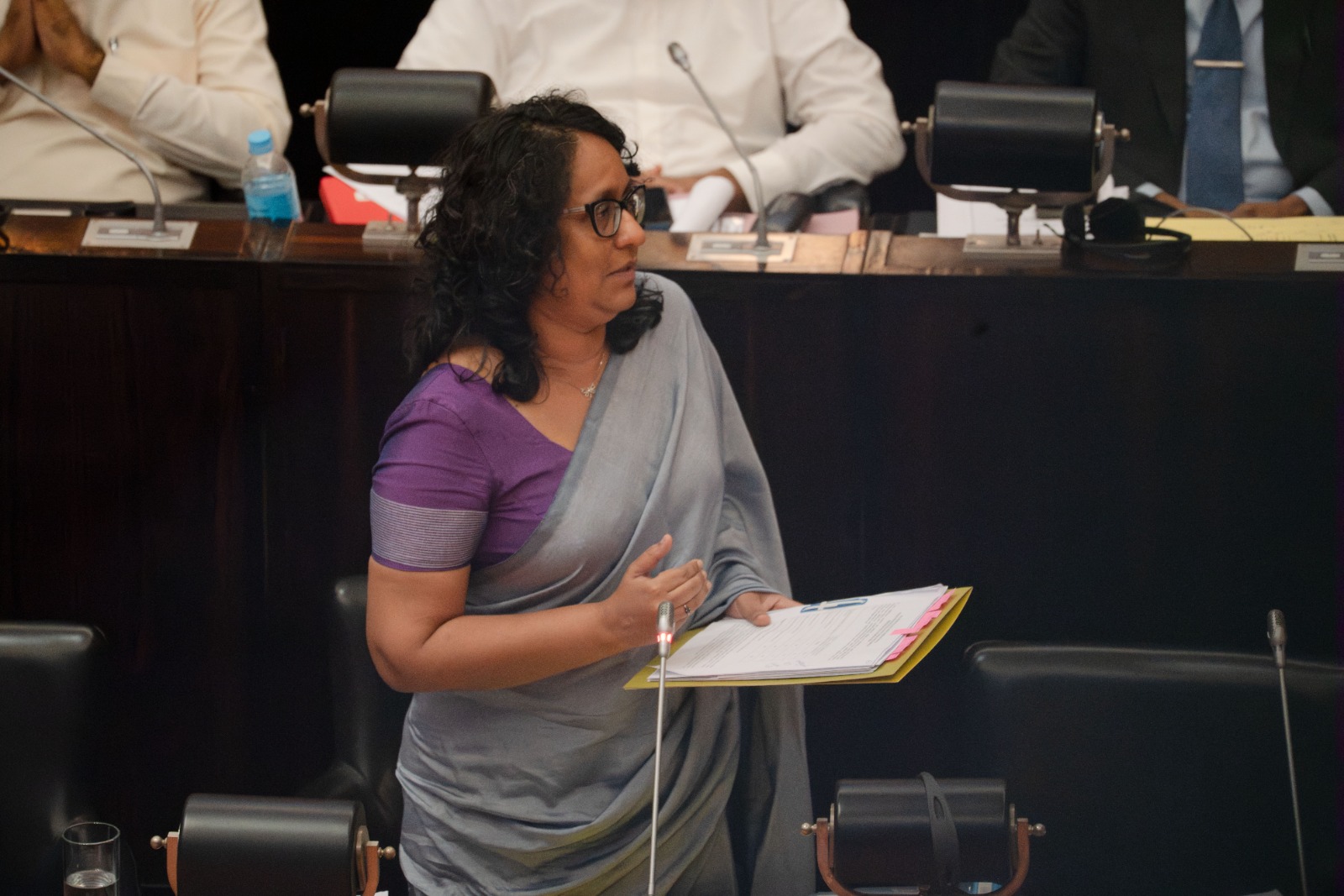
Prime Minister Dr. Harini Amarasuriya stated that the Ministry of Education has already commenced the distribution of Smart Boards required for the new education reforms, and that the collection of funds from parents at school level for this purpose must be stopped immediately. She further emphasized that no decision has been taken to curtail free education or to close the Jayewardenepura Faculty of Dental Sciences.
The Prime Minister made these remarks in response to a question raised in Parliament on Thursday [05th February] by the Leader of the Opposition, Sajith Premadasa.
Elaborating further, the Prime Minister stated,
“Although the Leader of the Opposition has not traditionally upheld free education as a policy, I appreciate your stance on the matter at this juncture. However, I urge that questions should not be raised based on social media content or unverified rumours in Parliament. No decision has been taken to curtail free education or to close the Jayawardenepura Faculty of Dental Sciences. The Medical Faculty of the Wickramarachchi University of Indigenous Medicine had commenced operations without regulatory approval and had introduced course work, resulting in students being placed in a vulnerable situation. Necessary action is currently being taken based on the recommendations of a report submitted by an expert committee appointed to examine the issue. This this is not a political decision, but one guided by expert opinion”.
“Arrangements are underway to distribute the required Smart Boards to schools during this year, and there is no need to collect funds from parents for this purpose. If any such collections are taking place, they must be stopped immediately. The Secretary to the Ministry of Education has already issued a directive instructing schools not to collect funds from parents”.
“The subject Information Technology will not be taught as a separate subject for Grades 1 to 5. However, recognizing the need to prepare students for a globally advancing technological world, discussions have been initiated based on expert advice on how to provide age-appropriate technological awareness to students. Decisions will be made after carefully considering child protection concerns and expert recommendations. The curriculum-related decisions will not be made politically, but by subject experts.
Based on the requests made by the universities and higher education institutions recruitment for essential academic vacancies is currently being carried out under the Cabinet approval. Although thirty years have passed since the establishment of the teacher service, further measures are required to enhance its quality. Existing issues relating to teacher promotions, considering the practical difficulties in evaluation processes and non-compliance with service minute provisions are being addressed alongside other challenges. The government is presently focused on formulating a systematic plan to ensure quality education.”
Responding to a question raised by the Member of Parliament Kader Mastan, the Prime Minister stated,
“Several programmes have been introduced based on government policy decisions to fulfill the basic needs of schoolchildren. These include the provision of school textbooks, uniforms, and the “Suraksha” health insurance scheme. Additionally, voucher schemes have been introduced to support the purchase of sanitary products for girls in Grades 6 to 13. Midday meals are also being provided for primary school students, and financial assistance is extended to students who pass the Grade 5 Scholarship Examination but do not receive bursaries. The Ministry of Education is in the process of gathering further information with the intention of expanding these programmes”.
The Prime Minister also announced that the 2025 G.C.E. Ordinary Level Examination is scheduled to be held from February 17 to 26. Although this period coincides with the observance of Ramadan, relevant authorities have confirmed that it will not pose an obstacle to the conduct of the examination. Furthermore, it has been decided to hold the Grade 5 Scholarship Examination and the G.C.E. Advanced Level Examination before August each year, and the G.C.E. Ordinary Level Examination in December. From 2026 onwards, efforts will be made to conduct examinations in accordance with this revised annual examination calendar.
[Prime Minister’s Media Division]
Hetmyer heroics, Shepherd hat-trick headline West Indies’ opening day win over Scotland

USA bowl, India pick Siraj with Bumrah out unwell

Colorado funeral home director sentenced to 40 years for corpse abuse

Scotland opt to field against West Indies

Faheem Ashraf drags unconvincing Pakistan over the line after big scare

Trump threatens tariffs for countries trading with Iran

‘Dates have the highest sugar content to fight Coronavirus’

Sunday Island 27 December – Headlines

#SundayIsland 17th December – Headlines

Sunday Island – 28th March

Sunday Island Headlines – 21 March

Sunday Island – 21st February – Headlines
-

 Business5 days ago
SLIM-Kantar People’s Awards 2026 to recognise Sri Lanka’s most trusted brands and personalities
-
 Business7 days ago
Altair issues over 100+ title deeds post ownership change
-

 Business7 days ago
Sri Lanka opens first country pavilion at London exhibition
-

 Business6 days ago
All set for Global Synergy Awards 2026 at Waters Edge
-
 Business5 days ago
API-first card issuing and processing platform for Pan Asia Bank
-
 Business7 days ago
ESOFT UNI Kandy leads the charge in promoting rugby among private universities
-

 Business16 hours ago
Zone24x7 enters 2026 with strong momentum, reinforcing its role as an enterprise AI and automation partner
-

 Editorial3 days ago
All’s not well that ends well?