
News
Pathfinder Foundation to develop a blueprint to double Sri Lanka’s growth rate


The Pathfinder Foundation has formed a Study Group of Experts to develop a blueprint and framework aimed at doubling Sri Lanka’s economic growth rate through accelerated economic integration and infrastructural connectivity with India. The framework document is expected to be formally launched in March 2024. Most economic forecasts place Sri Lanka on an average growth trajectory of 3% per annum for the next decade.
Such an anaemic growth rate will not help resolve Sri Lanka’s daunting social and economic challenges by any stretch of the imagination. Sri Lanka needs to think big and shift paradigms if the country is to find a way out of a seemingly hopeless predicament. As growth in the rest of the world including China continues to slowdown, India is expected to grow at above 6% per annum and will remain one of the best-performing economies in the world for the foreseeable future.While foreign investment into many regions is falling, investors are flocking to India due to its large market and emerging middle class.
Through an accelerated economic integration and physical connectivity strategy with India, Sri Lanka could take advantage of this momentum and easily double its economic growth to 6% per annum. India is already the largest source market for Sri Lankan tourism.
For example, at the end of the Second World War, the Netherlands seized the opportunity to develop its air, sea, rail, road, and energy sectors to become Europe’s distribution centre. Today, Rotterdam is the largest port in Europe, and Amsterdam is a principal global aviation hub. In fact, Singapore, too, used the Netherlands as a model for its own planning during its early stages of development. As windows of opportunity open and close quickly, it is essential for Sri Lanka to rapidly move towards becoming the principal gateway to South Asia, the Middle East, the Far East, and beyond before circumstances evolve and Sri Lanka is left behind.
Sri Lanka’s modern historical landscape has been littered with many missed opportunities. During the 1970s, in the heyday of US and European global expansion, Sri Lanka chose to nationalise Western multinationals operating in the country and as a result lost out on potential foreign investment opportunities to East Asia. Subsequently, President J.R. Jayewardene opened the economy and worked with the West and Japan to attract funding and investment for large-scale projects such as the Accelerated Mahaweli programme, port development, export-processing zones, and other infrastructure projects.
Unfortunately, Sri Lanka’s inability to grasp and manage the realpolitik of the Cold War period especially in terms of the Indian relationship, ultimately contributed to an intractable war that lasted nearly thirty years. In the 1980s when Japanese investors started to look abroad to relocate their industries for competitiveness, Sri Lanka was very high on the shortlist.
However, despite the excellent bilateral relationship between the two countries, due to persistent civil unrest during that period, in Sri Lanka, Japanese industries chose to relocate to Malaysia, Thailand, and other East Asian countries instead. In many ways, Sri Lanka also missed the opportunities presented during the early stages of China’s economic rise. Today, China is an important investment partner for Sri Lanka, although geopolitical realities will frame how this relationship can be managed.
India’s dramatic transformation into a fast-growing global economic powerhouse presents Sri Lanka with yet another chance to get the country onto a fast-economic growth trajectory that will integrate it with the global economy on a competitive footing. The Pathfinder Foundation Study Group blueprint and framework will conceptually present the key requirements for infrastructure connectivity between Sri Lanka and India including land, rail, ports/shipping, airports/airlines, electricity, energy/oil, telecommunications, and digital infrastructure. It will also identify other requirements that would facilitate speedy economic integration.
The Study Group will delineate an accelerated programme to achieve physical connectivity between India and Sri Lanka, while ensuring that Sri Lanka’s national security, territorial integrity, sovereignty, and unique cultural identity are safeguarded. It will also advocate an ambitious programme like the Accelerated Mahaweli programme that will seek to mobilise funding on a global level from bilateral, multilateral and international private-sector sources.
There is no doubt that this is a very auspicious time for such an initiative and international support and resources will be available, Sri Lanka must have the political will to seize this rare advantage that would put Sri Lanka on track. Besides the obvious medium and long-term advantages this program will have, there will also be many short-term spin-off benefits to the local economy as well. These will help create employment and opportunities in sectors such as construction.
Once this blueprint is complete, Pathfinder will present it for discussion in Sri Lanka and internationally. Earlier this year, the Pathfinder Foundation launched a report entitled ‘Medium and Long-term Strategy for Indo-Japanese Collaboration to Support the Economic Transformation of Sri Lanka’, which was launched in both Colombo and New Delhi.









By Shamindra Ferdinando
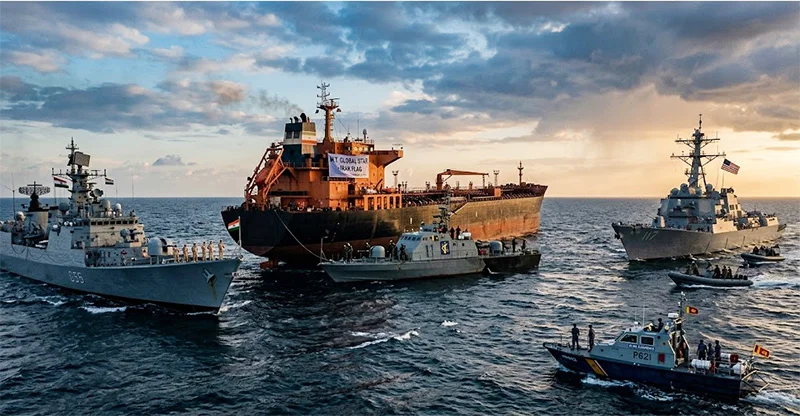
Iran has sought the Indian intervention, at the highest level, to provide lifesaving support to the crews of empty Iranian vessels stranded just outside Sri Lanka’s 12-nautical mile territorial waters off Galle.
Sources familiar with the issue said that Iran had brought the developing situation to the attention of New Delhi as the crews of almost 20 vessels, included Indian nationals. Sources stressed that the group of vessels that unloaded crude oil a couple of months back were now stranded within Sri Lanka’s Exclusive Economic Zone (EEZ).
The US Navy torpedoed an unarmed Iran frigate, returning from India, on 04 March, 2026, about 19 nautical miles off the Galle coast. The unprovoked attack killed nearly 100 Iranians.
The Iranian Embassy in Colombo has inquired from the Indian High Commission of their response to the situation, sources said. The US has issued a global warning against providing food, water, medicine and other services to the Iranian vessels. The outcome of Iran-India talks on the issue at hand was not known, though sources asserted India may not throw its weight behind Iranian efforts to address the issue.
Responding to The Island queries, sources said both Sri Lanka and India were in a dilemma due to the US warning. India couldn’t ignore the plight of the Indian crew members and the Iranian vessels in its backyard.
The Sri Lankan government remains tight-lipped about the vessels stranded in its EEZ. Our efforts to elicit a response from relevant authorities were in vain. In addition to Indians, there are Bangladeshis among the crew members. Iran has explicitly stated the responsibilities of the countries concerned to provide assistance in terms of international law.
The Iranian position was articulated by its Ambassador to Sri Lanka, Dr.Alireza Delkhosh, recently. In a special statement, Ambassador Delkhosh emphasised that in terms of the Convention on the Law of the Sea (Article 98) as well as SOLAS and SAR
Conventions, Sri Lanka couldn’t refrain from providing the needs of the Iranian vessels stranded in its EEZ.
SLMC leader Rauff Hakeem lambasted the NPP government in Parliament for failing to provide assistance to the Iranian ships. The former Minister alleged that the government was simply carrying out dictates of the US. He strongly criticised the way Foreign Minister Vijitha Herath was handling the issue.

MP Namal Rajapaksa, who is in remand custody over the controversial Airbus deal, was further remanded until October 27 by the Colombo Magistrate’s Court yesterday (13).
Colombo Chief Magistrate Asanga S. Bodaragama made the order after considering submissions by officers of the Commission to Investigate Allegations of Bribery or Corruption and lawyers representing Rajapaksa.

Sri Lanka’s economy is expected to sustain its recovery over the next two years, although growth is projected to moderate amid mounting global uncertainties, according to the International Monetary Fund’s (IMF) latest World Economic Outlook.
In its World Economic Outlook 2026: Resilience Under Strain, Urgent Choices, the IMF projects Sri Lanka’s economy to expand by 4% in 2026, slowing to 3.7% in 2027, following estimated growth of 5% in 2025.
Inflation, meanwhile, is forecast to rise to 5.3% in 2026 and 5.4% in 2027, reversing the average deflation rate of 0.5% recorded in 2025.
Unemployment is expected to remain steady at 3.9% throughout the forecast period.
The projections come amid growing pressure on the global economy from the ongoing conflict in the Middle East, elevated energy prices, geopolitical tensions and trade disruptions.
Sri Lanka’s external position is also expected to weaken, with the current account balance projected to shift from a surplus of 1.6% of gross domestic product (GDP) in 2025 to deficits of 0.5% in 2026 and 0.3% in 2027.
The IMF’s outlook points to continued economic expansion in Sri Lanka, but with slower growth, rising inflation and a narrowing external surplus giving way to current account deficits over the forecast period.

Heavy showers above 100 mm are likely at some places in the Western, Sabaragamuwa, Southern, Central, and North-western provinces and in Anuradhapura district.

Sri Lanka, India caught in US-Iran ship crisis

Namal further remanded

IMF projects Lankan economic growth to moderate amidst mounting global uncertainties

Major Gen Pushpakumara assumes command of 56 Infantry Division

Dickwella axed, Bandara earns maiden Test call up

‘Dates have the highest sugar content to fight Coronavirus’

Sunday Island 27 December – Headlines

#SundayIsland 17th December – Headlines

Sunday Island – 28th March

Sunday Island Headlines – 21 March

Sunday Island – 21st February – Headlines
-

 Features6 days ago
The Sri Lankan who made Scottish history
-

 Sports6 days ago
Nissanka absence opens door for Sri Lanka’s young guns
-

 News5 days ago
NDB fraud Rs 60mn more than reported
-

 News5 days ago
Removing monk’s robes matter for Sangha to decide: Mahanayake Theras
-

 News6 days ago
Shiranthi R remanded until 13 Oct.
-

 Features6 days ago
Future of Sri Lanka’s state university system: Should it be shut down and reopened?
-

 News3 days ago
Sri Lanka escalates anti-graft drive with Shiranthi’s jailing
-

 Latest News4 days ago
Farhan, Sadaqat help Pakistan ace 183 chase to go 1-0 up