
News
Aluthgamage and Fernando get mats and pillows at Welikada

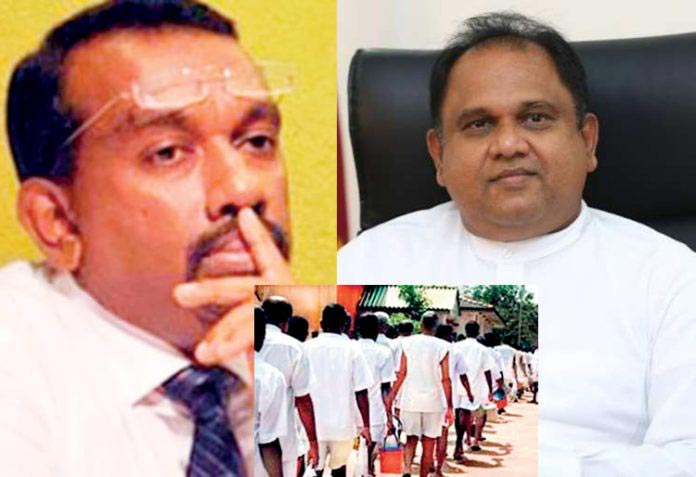
Former ministers Mahindananda Aluthgamage and Nalin Fernando have been assigned to a common ward at the Welikada Prison after being sentenced to rigorous imprisonment over the misuse of state funds.
The Colombo High Court, on Wednesday, sentenced Aluthgamage and Fernando to rigorous imprisonment of 20 years and 25 years, respectively, for irregularities in the procurement of 14,000 carrom boards and 11,000 checkerboards for distribution among sports associations ahead of the 2015 presidential election. The procurement of those items, imported through state-run Lanka Sathosa, resulted in a loss of Rs 53.1 million to the state.
At the time, Fernando was the Chairman of Lanka Sathosa and Aluthgamage served as the Sports Minister.
A three-judge bench of the High Court also imposed fines amounting to Rs. 400,000 and Rs. 200,000 on Fernando and Aluthgamage, respectively.
Prison officers said both politicians had been given prison uniforms and mats and pillows like other inmates. They underwent medical examinations.
Prison Spokesperson Gamini B. Dissanayake said the former ministers were expected to begin prison work on Thursday and they were likely to be assigned to the prison printing division.
By Chaminda Silva and Norman Palihawadane ✍️




Drug controversy:
“Setting up state-of-the-art drug testing facility will cost Rs 5 billion”
Activists call for legal action against politicians, bureaucrats
Serious questions have been raised over Sri Lanka’s drug regulatory system following revelations that the National Medicines Regulatory Authority’s (NMRA) quality control laboratory is not accredited by the Sri Lanka Accreditation Board (SLAB), casting doubt on both the reliability of local test results and the adequacy of oversight of imported medicines.
Medical and civil rights groups warn that the issue points to a systemic regulatory failure rather than an isolated lapse, with potential political and financial consequences for the State.
Chairman of the Federation of Medical and Civil Rights Professional Associations, Specialist Dr. Chamal Sanjeewa, said the controversy surrounding the Ondansetron injection, which was later found to be contaminated, had exposed deep weaknesses in drug regulation and quality assurance.
Dr. Sanjeewa said that the manufacturer had confirmed that the drug had been imported into Sri Lanka on four occasions this year, despite later being temporarily withdrawn from use. The drug was manufactured in India in November 2024 and in May and August 2025, and imported to Sri Lanka in February, July and September. On each occasion, 67,600 phials were procured.
Dr. Sanjeewa said the company had informed the NMRA that the drug was tested in Indian laboratories, prior to shipment, and passed all required quality checks. The manufacturer reportedly tested the injections against 10 parameters, including basic quality standards,
pH value, visual appearance, component composition, quantity per phial, sterility levels, presence of other substances, bacterial toxin levels and spectral variations.
According to documents submitted to the NMRA, no bacterial toxins were detected in the original samples, and the reported toxin levels were within European safety limits of less than 9.9 international units per milligram.
Dr. Sanjeewa said the credibility of local regulatory oversight had come under scrutiny, noting that the NMRA’s quality control laboratory was not SLAB-accredited. He said establishing a fully equipped, internationally accredited laboratory would cost nearly Rs. 5 billion.
He warned that the failure to invest in such a facility could have grave consequences, including continued loss of life due to substandard medicines and the inability of the State to recover large sums of public funds paid to pharmaceutical companies for defective drugs.
“If urgent steps are not taken, public money will continue to be lost and accountability will remain elusive,” Dr. Sanjeewa said.
He added that if it was ultimately confirmed that the drug did not contain bacterial toxins at the time it entered Sri Lanka, the fallout would be even more damaging, severely undermining the credibility of the country’s health system and exposing weaknesses in health administration.
Dr. Sanjeewa said public trust in the health sector had already been eroded and called for legal action against all politicians and public officials responsible for regulatory failures linked to the incident.
by Chaminda Silva ✍️

Air quality in Sri Lanka has deteriorated in recent days, with Air Quality Index (AQI) levels rising, particularly in the Northern, North Central, North Western and Western Provinces, the Central Environmental Authority (CEA) said.
CEA Media Spokesman Dr. Ajith Gunawardena said a noticeable decline in air quality had been recorded, with AQI values ranging between 150 and 200.
Attributing the situation to transboundary air movement, combined with the activation of the Northeast Monsoon, Dr. Gunawardena noted that similar conditions had been observed during the same period in previous years.
The CEA is continuing to closely monitor air quality and atmospheric conditions across the country, he said.
Dr. Gunawardena warned that individuals sensitive to poor air quality might experience adverse health effects and advised them to seek medical attention if necessary.He added that the situation was expected to ease after yesterday.
By Pradeep Prasanna Samarakoon ✍️

Educational Reforms:
Archbishop of Colombo His Eminence Malcolm Cardinal Ranjith on Saturday accused the government of pursuing education reforms undermining parental rights and Sri Lanka’s cultural and religious values.
Speaking at a ceremony at St. Joseph’s Church, in Hanwella, the Cardinal said several programmes, currently being implemented, were weakening key socio-cultural institutions such as marriage and family. He took exception to the government’s decision to introduce sex education to the school curriculum.
Cardinal Ranjith said Sri Lanka’s civilisation had been shaped over generations by religious traditions, including Buddhism, Hinduism, Islam and Christianity, particularly in relation to marriage, child-rearing and sexuality. He warned against abandoning these values in favour of, what he described as, foreign influences tied to external funding.
“No government has the right to interfere with the nation’s cultural heritage,” he said, urging political leaders to act within their mandate.
The Archbishop further alleged that ideas promoted alongside funding from United Nations agencies and other international bodies were eroding cultural and religious foundations, contributing to family breakdown and weakening respect between parents and children.
While affirming that children have human rights, he stressed that such rights should not be interpreted in a way that turned children against their parents. “What should exist between parents and children is a foundation of love,” he said.
by Norman Palihawadane ✍️

NMRA laboratory lacks SLAB accreditation

Air quality deteriorating in Sri Lanka

Cardinal urges govt. not to weaken key socio-cultural institutions

CID probes unauthorised access to PNB’s vessel monitoring system

NBRO identifies landslide risks in 14 districts

Danger of weak drug regulation

‘Dates have the highest sugar content to fight Coronavirus’

Sunday Island 27 December – Headlines

#SundayIsland 17th December – Headlines

Sunday Island – 28th March

Sunday Island Headlines – 21 March

Sunday Island – 21st February – Headlines
-

 Midweek Review5 days ago
How massive Akuregoda defence complex was built with proceeds from sale of Galle Face land to Shangri-La
-
 News4 days ago
Pope fires broadside: ‘The Holy See won’t be a silent bystander to the grave disparities, injustices, and fundamental human rights violations’
-

 News4 days ago
Pakistan hands over 200 tonnes of humanitarian aid to Lanka
-
 News5 days ago
Burnt elephant dies after delayed rescue; activists demand arrests
-

 Business3 days ago
Unlocking Sri Lanka’s hidden wealth: A $2 billion mineral opportunity awaits
-

 Editorial5 days ago
Colombo Port facing strategic neglect
-

 News3 days ago
Army engineers set up new Nayaru emergency bridge
-

 News5 days ago
Sri Lanka, Romania discuss illegal recruitment, etc.