
Foreign News
AI chatbots could be making you stupider

As large language models take over more and more cognitive tasks, researchers are warning this mental outsourcing comes with a cost.
When research scientist Nataliya Kosmyna was looking for interns, she noticed that cover letters she received were suspiciously similar. They were long, polished and after introductions would often jump to an abstract and arbitrary connection to her work.
It was obvious to her that applicants were using large language models (LLMs) – a form of artificial intelligence that powers chatbots such as ChatGPT, Google Gemini and Claude – to write the letters.
At the same time, during lessons on campus at Massachusetts Institute of Technology (MIT), Kosmyna, who studies the interaction between humans and computers, noticed that numerous students were forgetting content more easily compared to a few years ago.
With the increasing reliance on LLMs, she had a hunch that this could be affecting her students’ cognition and sought to understand more.
The concern that researchers like Kosmyna have is that if we become too reliant on AI, it could affect the language we use and even our ability to do basic cognitive tasks. There is now a growing body of research suggesting that this “cognitive offloading” to AI can have a corrosive effect on our mental abilities. The consequences could be alarming and may even contribute to cognitive decline.
“The ChatGPT group showed notably less brain activity – it was reduced by up to 55%”
It’s well known that the tools we use can change how we think. With the advent of the internet for instance, tasks that once required deep research could be found by plugging a simple query into a search box. As the use of search engines increased, research found we became less likely to remember details, something dubbed “the Google effect”. (Some argue, however, the internet also serves as an external memory system that frees up our brain to do other tasks)
But there is now growing alarm that as we offload even more of our thinking to LLMs and other forms of AI, the effects on our memories and ability to solve problems could get worse. Artificial intelligence tools can write convincing poetry, give financial advice and provide companionship. Students are increasingly outsourcing their own work to AI tools as well.
Studies have already shown that young people might be particularly vulnerable to the negative effects that using AI can have on key cognitive skills like critical thinking. Kosmyna, however, wanted to dig deeper into the potential effects.
Reduced mental effort
She and her colleagues at MIT Media Lab recruited 54 students to write short essays and split them into three groups. One was instructed to use ChatGPT. A second could use Google search, with AI-generated summaries turned off. The third didn’t use technology. Each student’s brainwaves were measured while they worked.
The essay topics were deliberately open-ended, meaning little research was needed for the task, with prompts including questions around loyalty, happiness or our daily life choices.
The results haven’t been published in a scientific journal yet, but they were none-the-less eye-opening, according to Kosmyna. Those who used their own minds had a brain that was “on fire”, showing widespread activity across many parts of the brain, she says. The search engine-only group still showed strong activity in the visual parts of the brain, but the ChatGPT group showed notably less brain activity – it was reduced by up to 55%.
“The brain didn’t fall asleep, but there was much less activation in the areas corresponding to creativity and to processing information,” says Kosmyna.
ChatGPT also affected people’s memories. After submitting their essays, people in the AI group were unable to quote from their essays, and several felt they had no ownership over the work. Other studies have also shown that people become less able to retain and recall information when they use AI tools such as ChatGPT.
While the findings are still undergoing peer review, they echo those from other studies. One study by researchers at the University of Pennsylvania suggests that some people undergo something they term “cognitive surrender” when using generative AI chatbots. This means they tend to accept what the AI tells them with minimal scrutiny and even allow it to override their own intuition.
Similar effects can be found outside the world of AI chatbots too – even in life-or-death situations. A recent multinational study team found that medical professionals who used an AI tool to screen for colon cancer for three months were subsequently worse at spotting the tumours without it.

Outsourcing work to AI also risks losing much of the creativity that produces original work, warns Kosmyna. The essays that students in her study wrote with ChatGPT looked very similar and were described by the teachers marking them as “soulless”, lacking originality and depth, Kosmyna says. “One of the teachers asked if students were sitting next to each other because the essays were so similar.”
While studies such as these illustrate the short-term effects LLMs can have on the brain, the long-term impacts are far less clear. The study by Kosmyna and her colleagues provides a glimpse. Four months after the initial study they asked the students to write another essay, but this time those who had used ChatGPT were told to work without LLM support. The neural connectivity in their brains was lower than those who switched the opposite way, perhaps indicating that they had not engaged with the topics properly in the first place.
Cognitive decline
Yet, LLMs can be a positive tool to aid thinking, but only if we don’t rely on them by outsourcing our mental tasks in the process, says computational neuroscientist Vivienne Ming, author of Robot Proof. She’s concerned though that this is not how most people interact with this technology.
Her reasoning comes from research she conducted for her book, during which Ming asked a group of students at the University of Berkeley to predict real-world outcomes, such as the price of oil. She found that the majority of participants simply asked AI and copied the answer.
She measured their brains’ gamma wave activity – a marker of cognitive effort – finding it showed very little activation. Again her research is yet to published, but Ming worries that if her findings are borne out in further studies it could have long-term implications. Other research, for example, has linked weak gamma wave activity to cognitive decline later in life.
“That’s really worrying,” Ming says. “If that is a natural mode for people to interact with these systems – and these are smart kids – that’s bad.” Deep thinking, she says, is our superpower. “If we don’t use it, the long-term implications for cognitive health are pretty strong.”
That’s because when we rely on LLMs it requires very little cognitive effort, Ming adds, which is exactly what’s needed for a healthy brain.
A small subset of participants though – less than 10% – worked differently and used AI as a tool to gather data that they then analysed themselves. These individuals made more accurate predictions than others participants and showed stronger brain activation too.
For long-term brain health we need to continue to challenge ourselves
Almost two decades ago, Ming predicted that within 20 to 30 years we would see a statistically meaningful rise in dementia rates directly related to our overreliance on Google Maps. “I meant it to be provocative,” Ming says. “If you don’t have to think about navigating then there’ll be some detectable effect.”
While we don’t have data on this exact prediction, the increased use of GPS has been linked to worse spatial memory over time, according to one study of 13 people conducted over three years. And poor spatial navigation may be a potential predictor of Alzheimer’s Disease, according to another study.
It’s clear that the more active our brain is, the more protected it is from cognitive decline. LLMs then, Ming says, could not only reduce creativity but could harm cognition and potentially increase the risk of dementia.
As AI tool use increases, we need to work with it in a way that benefits us rather than harms us. Ming suggests that ultimately, the goal could be a form of “hybrid intelligence” where humans and machines “do the hard stuff” together. By this she means we need to think first and use tools to challenge us later, rather than simply letting them answer questions for us. Kosmyna agrees and suggests learning subjects without AI tools first to build a foundation and then think about using LLMs.
Ming recommends using what she calls the “nemesis prompt” to challenge your own thinking. It works by prompting an AI to act as a “lifelong enemy” or nemesis, then ask it to explain in detail why your ideas are wrong and how you can fix them, forcing you to defend and refine your arguments rather than simply accepting the answers it provides.
Another technique she suggest is prioritising “productive friction” and asking the AI to only provide context and ask you questions, rather than supplying answers. When she tested this by fine-tuning an AI bot not to give answers, she found that more individuals were more engaged.
Ultimately, we should all be wary of cognitive shortcuts, which is something “our brains love”, Kosmyna says. Clearly, for long-term brain health we need to continue to challenge ourselves. Our minds, creativity and cognitive health will benefit in the process.
[BBC]


A South Korean court has sentenced former President Yoon Suk Yeol to 30 years in jail for sending drones into North Korea.
Prosecutors argued that Yoon ordered the operation in October 2024 to provoke Pyongyang and create a pretext for his failed martial law bid later that year.
When Yoon declared martial law on 3 December, he had claimed he was protecting the country from “anti-state” forces that sympathised with North Korea. But it soon became clear he was driven by domestic troubles and he rolled back the order in the face of mass protests.
Yoon was impeached and is now serving time in prison after he was sentenced to life for insurrection over his botched martial law attempt.
On Friday, the Seoul District Court found Yoon, as well as his former defense minister Kim Yong-hyun, former head of the Defense Counterintelligence Command Yeo In-hyung and former head of Drone Operations Commands Kim Yong-dae guilty of treason and abuse of power.
Kim was sentenced to 30 years in jail, while Yeo received 15 years and Kim Yong-dae received three years in prison with a five-year suspended sentence.
“The defendants used the guise of a military operation to induce provocations from North Korea with the aim of creating a state of emergency,” the court said.
It added that all three officials had “provoked North Korea”, thus “increasing the risk of a military conflict”, but concluded that Yoon bore the “greatest responsibility” in this event.
Yoon’s lawyers had argued that his actions were a “legitimate” response to North Korea’s “provocations with rubbish balloons”.
This was a reference to North Korea dropping hundreds of balloons in 2024, which were later found to contain “filthy waste and trash”, across the border in the South.
The two countries have used such “propaganda balloons” in their campaigns since the Korean War, where messages are put inside the balloons.
But tensions shot up in 2024 when North Korea accused the South of flying drones into its capital. These drones allegedly scattered propaganda leaflets all over Pyongyang, in what the North described as a provocation that could lead to war.
It was Yoon who sent these drones into the North expecting it to strike back, said a judge in Friday’s ruling.
Apart from insurrection, Yoon has was also sentenced to five years in jail for abuse of power and obstructing his own arrest.
Yoon’s martial law attempt and the protests that followed created months of chaos in the country, ending in an election which saw the opposition Democratic Party’s Lee Jae-myung win a decisive mandate.
[BBC]

US police are investigating a large imprint of the numbers 8-6-4-7 that were apparently drawn in the grass of the National Mall in Washington DC.
“Eighty-six” is a slang term for “get rid of”, and Trump administration officials claim that the numbers are meant to encourage violence against Trump, the 47th president.
US Park Police “responded to a report of vandalism” at around 11:30ET (16:30GMT) on Thursday morning, the agency said in a statement.
“The cause of the discoloration has not yet been determined. Grass samples have been collected for testing. The investigation is ongoing.”
Images of the grass show the numbers 8, 6 and 7, but the number 4 is not clearly visible.
The investigation comes as US prosecutors attempt to jail the former director of the FBI for a social media post in which the numbers were seen written on a beach in sea shells.
James Comey is facing multiple charges related to an alleged threat to kill Trump. He has denied the charges and called the prosecution politically-motivated.
The numbers have been used by opponents of Trump, and have appeared at protests against his administration.
The slogan written in the grass appears somewhat faded, with the number 8 appearing more prominently than the others. It is located close to the World War 2 memorial.
The alleged vandalism comes amid a beautification campaign of US monuments in the city, led by Trump. The campaign includes $13.1m (£9.6m) to repaint the Lincoln Memorial reflecting pool, as well as a plan to build an arch decorated with golden figures including lions and eagles.
[BBC]

A cleaning team was combing Mount Everest’s perilous upper slopes for rubbish last Thursday, after a busy climbing season, when they spotted a man in a bright blue summit suit crawling at the foot of the Khumbu Icefall, widely regarded as one of the most dangerous sections of the world’s highest peak.
It was Hillary Dawa Sherpa, a climbing guide who got separated from his clients when descending the mountain six days earlier. He had been presumed dead – yet another life claimed by Everest’s treacherous slopes. By the time the 57-year-old reappeared, his family had already begun funeral rites for him.
Although frostbitten and thoroughly spent, Hillary Dawa could still sit upright and talk to those who found him, before he was airlifted to a hospital in Kathmandu, Nepal’s capital.
News of his miraculous survival made international headlines and sent shockwaves throughout the mountaineering community.
However, it also raises troubling questions for the booming high-altitude tourism industry, and shines a spotlight on the deadly risks Sherpas who work on Mount Everest face.
Himalayan Traverse Adventure (HTA), the company that Hillary Dawa was working for, maintains that all its processes in handling the incident were above board, and that poor weather hampered rescue efforts
But many are asking whether the company, known for offering packages below market rates, has done enough to look after their guides.
Hillary Dawa was hired as a camp cook – why then was he leading clients up the 8,849m (29,032ft) mountain? Why was a search launched only three days after he disappeared, and would it have begun sooner if he had been a client and not a guide?
The Sherpa’s family has filed a police report accusing HTA of negligence, and Nepal’s tourism department is investigating the incident.
Disaster at 7,500m
HTA had initially employed Hillary Dawa as a cook to be stationed at Camp 2, but ended up using him as a substitute for a guide who “fell sick at Base Camp”, the company said.
He took up the spontaneous change in assignment because he “wanted to earn some extra money”, HTA manager Angfurba Sherpa tells the BBC.
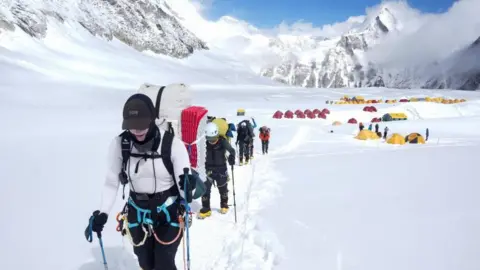
That’s how Hillary Dawa ended up accompanying two clients, British climber Chris Thrall and Polish climber Mariusz Chmielewski on his ill-fated trek up Mount Everest. Also with them was fellow guide Pasang Kaji Sherpa.
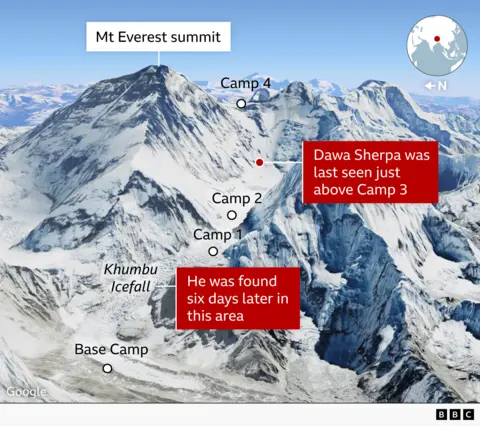
On the southern route to Everest there are four camps established above the main Base Camp, which climbers typically use as resting and acclimatisation points. Camp 4, which sits at 7,920m above sea level, is the highest.
The group started their descent from Camp 4 on 29 May, with Pasang Kaji and Chmielewski going first, as Chmielewski was running out of oxygen.
Thrall, who followed behind with Hillary Dawa, said the Sherpa had stopped to sit on his backpack just above Camp 3, at around 7,500m, “as he had done hundreds of times before to take a short rest”.
“I turned around and said, ‘Hillary, are you okay brother?'” Thrall recounted in a video on Instagram. “He says, ‘Yes, yes, I’m fine Chris, please go.'”
The former British soldier described his dilemma of whether to turn back for Hillary Dawa or catch up with the rest.
“Do I go back for the Sherpa who’s probably going to rock up and be fine as he has done hundreds of times before, or do I help my fellow climber who’s got no oxygen, frostbite in his fingers, and obviously, you’re never far off hypothermia up there?”
Responding to allegations that the team had left Hillary Dawa behind to die, Thrall said: “It’s really different on Everest, folks. I had one tank of oxygen that’s half empty [by then].
“To try to get back up… would have taken pretty much all of my oxygen. I’m not trying to offload my responsibility. I’m just saying you’ve got to be real.”
In a subsequent interview with BBC Newshour, Thrall said he decided to “turn to the weakest member of the trio”, referring to Chmielewski, with whom he shared his dwindling supply of oxygen as they continued down the mountain amid a severe snowstorm.
The conditions were so bad that Thrall and Chmielewski both recorded farewell messages for their loved ones, thinking they may not make it back alive.
The group took some 38 hours to finally arrive at Base Camp. At this point, they had assumed Hillary Dawa was dead.
“It was a complete whiteout,” Thrall said. “All the ropes were a foot under snow… In none of the time when I looked back up the mountain did I see any sign of Hillary.”
Chmielewski, meanwhile, has also accused HTA of negligence.
“Look, Hillary Dawa was left alone; he rescued himself,” Chmielewski tells the BBC. “This shows the sad truth about how Himalayan Traverse regards its employees. Customers are treated similarly.”
Chmielewski claims that Pasang Kaji Sherpa, the other mountain guide in their group, had notified the company on 30 May that Hillary Dawa was missing, but that no search operation was launched until days later.
Chmielewski, who was also admitted to hospital with frostbite, further suggests that decisions were made haphazardly during the expedition, and that the company appeared unprepared.
“I have huge reservations about the agency that organised this expedition,” he says. “I think they should lose their licence.”
Hillary Dawa maintains he was “forced to stay behind” near Camp 3, which sits about 7,200m above sea level, because he had run out of oxygen and could no longer walk.
Without supplemental oxygen, a fully acclimatised climber would typically survive only two to three days at that altitude.
“I couldn’t walk… I didn’t eat anything for the first two days. Then I began chewing ice, but it pained my teeth,” Hillary Dawa told BBC Nepali from HAMS Hospital in Kathmandu. “I didn’t think I would be alive.”
Then he discovered chocolates in his pocket, and managed to get some melted ice to drink.
He made his way down slowly, only to fall into a crevasse, according to two people who spoke to him about his ordeal.
Then, an avalanche that sent snow tumbling into the crevasse gave him the first hope he had had in days.
“Stepping on the snow, I stood up and looked above… It felt like I could get out from there,” he said.
Once he scrambled out, he found ropes nearby that helped him manoeuvre further down. It was there he saw the cleaning team, the first people he had encountered in almost a week.
Hillary Dawa was transferred from the intensive care unit to a general ward early this week and is “recovering well”, his family tells BBC Nepali.
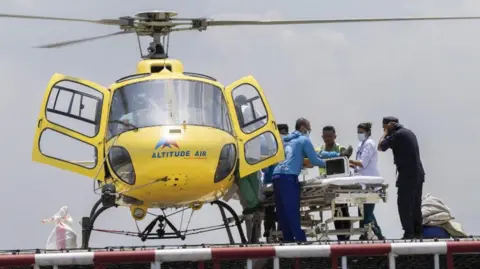
HTA’s founder and president Dawa Sherpa said that when his company had realised on 30 May that Hillary Dawa was uncontactable, it had notified its partner, 8K Expeditions, the larger expedition company that helped issue Thrall and Chmielewski’s climbing permits.
“The search operation was delayed solely due to adverse weather conditions, but it does not mean there was negligence,” he tells the BBC.
“The weather was really bad, it was a whiteout, meaning we had deep snow continually for a few days. It wouldn’t have been possible to send a helicopter immediately. I would have been sending the rescuers to die.”
Dawa adds that 8K Expeditions should be the company executing the rescue, because they were the ones who issued the permits, but 8K Expeditions maintains it was not responsible for providing the logistics or operational services for this particular expedition.
“Nevertheless, as part of our responsibility and commitment to supporting the mountaineering community, we did our best to assist in the search,” the company’s managing director, Lakpa Sherpa, tells the BBC.
Lakpa confirmed that HTA had indeed made first contact on 30 May, but later fell off the radar. HTA did not respond to these claims.
“We attempted multiple times to contact Himalayan Traverse Adventure for further information and co-ordination,” Lakpa says. “However, they were unreachable… On 2 June, we established contact with Hillary’s family and co-ordinated an aerial search operation.”
That search came up empty.
8K Expeditions has called Hillary Dawa’s ordeal a “true self-rescue” and “nothing short of a miracle”.
Everest experts say camp cooks are rarely equipped to scale the mountain.
“Generally, local guides that take clients to the summit of 8,000m peaks are trained specifically for this purpose,” says Ben Ayers, a longtime Everest reporter for Outside Magazine.
“Hillary Dawa had experience working in this capacity in previous years, but he was late in his career.”
Chmielewski, the Polish climber, says HTA told them Hillary Dawa was re-assigned as a climbing guide “because their original guide had drinking problems and a health problem”.
“We weren’t told exactly what it was,” he tells the BBC.
In a second call with the BBC, HTA manager Angfurba claims the two clients did not want to pay the additional cost for a more experienced guide after their original one was removed.
Thrall and Chmielewski each paid about $37,500 (about £28,000) for the expedition, which includes an attempt up Everest and the 6,189m Island Peak, Angfurba explains.
“They paid one of the cheapest prices and yet they expect VIP service,” he says, adding that other companies charge six-figure sums for similar trips.
Chmielewski dismissed this comment as “absurd and outrageous”. The climbers paid an additional “several thousand dollars” expecting a qualified climbing guide, he says, but Hillary Dawa was put on the job “due to a lack of personnel”.
Angfurba also suggests that Hillary Dawa should have established contact to let the company know he was still alive.
“He had a functioning walkie talkie with extra batteries,” Angfurba says. “It would have taken 10 seconds.”
Hillary Dawa’s family and friends, however, argue that the Sherpa was abandoned. As he recovers in hospital, they demand that justice be served to those accountable.
“I believe this problem occurred because they took him as a cook but used him as a guide,” his longtime friend Pasang Dawa Sherpa told BBC Nepali.
“Our main question is: why wasn’t a search initiated right after he got trapped? We want to know why there was such negligence.”
[BBC]

Special Dengue Prevention Week declared in Colombo District from June 15 to 21

The leader of the indigenous Vedda community Uru Warige Wannila Aththo Meets Prime Minister Dr. Harini Amarasuriya

SpaceX IPO debuts in US markets, Musk becomes world’s first trillionaire

Fans on concourses instead of in seats, claims FIFA

Co-hosts Canada begin 2026 World Cup campaign with a draw against Bosnia-Herzegovina.

Showers will occur at times in the Western, Sabaragamuwa and North-western provinces and in Galle, Matara, Kandy and Nuwara-Eliya districts

‘Dates have the highest sugar content to fight Coronavirus’

Sunday Island 27 December – Headlines

#SundayIsland 17th December – Headlines

Sunday Island – 28th March

Sunday Island Headlines – 21 March

Sunday Island – 21st February – Headlines
-

 News6 days ago
Women’s T20 World Cup 2026 warm-up: Chamari Athapaththu’s 94 helps Sri Lanka beat Pakistan
-

 News6 days ago
Lankan-Canadian inducted to Toronto Sports Hall of Fame
-

 Editorial5 days ago
Probe Sallay’s complaint
-
 News3 days ago
Local firms move millions of dollars overseas for phantom imports: Govt.
-

 Editorial6 days ago
Prez in the dock
-

 Features6 days ago
Entering MIT for my Ph.D program, coping with harsh Boston winter and breasting the tape
-

 News1 day ago
CIABOC summons Yoshitha over his participation in British Navy training programme
-
 Midweek Review3 days ago
July 09: An inexcusable overall security failure and exceptional contingency plan