
Opinion
Aflatoxins saga:bitter truth

By Dr Indrajith P Hathurusingha
Lecturer
Department of Applied and Environmental Science CRTAFE, Geraldton Campus, Western Australia
As we know, the entire country is in chaos with food insecurity and associated problems. People often seem to claim that their income is insufficient to manage their day-to-day expenses. Therefore, malnutrition, food of poor quality, and starvation have been hot topics for the past few days in the media and have not yet been finished. News is emerging one after another, and people sometimes can be seen on the streets protesting the rising cost of living. Low income has resulted in the deprivation of balanced diets for the poor. The situation is getting worse daily, and access to affordable and healthy food for low-income earners appears far out of reach. On top of that, contaminated foodstuff with hazardous compounds in the market has been a great concern.
A recent development is the detection of aflatoxin exceeding the maximum allowable limit in Thriposha according to the head of the government’s public health inspectors’ (PHI) union. Thriposha is a nutrient supplement given to pregnant women, breastfeeding mothers and young children who need the most. The key ingredients of Thriposha include maze, soya and milk powder, and people can easily make delicious, nutritious, and simple meals. Even though we have not seen the laboratory test reports or satisfactory evidence to prove their allegation, it is a timely requirement to make the public aware of the health impacts of aflatoxins and how to prevent their ingestion. This is because aflatoxins have created a public health concern and are of great interest.
What is aflatoxin?
People are curious about the speculated news of aflatoxin, and the word ‘aflatoxin’ appears new to the public. It is scientific terminology for a secondary metabolite produced by a kind of fungi known as Aspergillus flavus and Aspergillus parasiticus. The fungus is a type of microorganism that can be seen only through a microscope and is commonly known as mould (puss in Sinhala). However, they are visible to the naked eye when forming colonies. The toxic compounds generated by the fungi are called mycotoxins, and aflatoxin is a kind of those. Therefore, it is not a chemical being added during food processing or storage.
Aflatoxins are biologically active compounds, and the human palate cannot detect them while eating or chewing the foodstuff. Nevertheless, both humans and animals can unintentionally consume contaminated food with aflatoxins. There are different types of aflatoxins, but the four main ones are known to be B1, B2, G1, and G2. However, four of which, B1 has been responsible for high incidence and toxicities.
How foodstuff contaminate with aflatoxins
It is interesting to know how aflatoxins get into the food items. The responsible fungi, Aspergillus spp is reported to be soil-borne and produce aflatoxins under extreme environmental conditions like drought and high humidity. They are well suited to colonising due to their ability to thrive in high temperatures. Besides, they can grow well on many substrates. A high level of aflatoxins in the environment is often linked to insects and the wind. Importantly, Insects can act as carriers of fungal spores from an infected plant to a healthy plant and transfer the spores through minor notches or wounds caused by insects.
Maize is one of the raw materials used to produce Thriposha and is also a staple agricultural crop that is consumed worldwide. More importantly, it is an essential commodity in the world in terms of production and revenue. Notwithstanding, in most regions of the world, maize is infected with aflatoxins, especially in tropical and subtropical areas. The occurrence of aflatoxin contamination is reported to be sporadic and highly reliant on environmental conditions. Even though more news is speculated that maize is suspected to be contaminated with aflatoxins these days, we must not forget that other crops like rice, peanuts, cotton, almond, cashew, soya, spices, and coffee may be contaminated with aflatoxins.
Health risk and implications
Aflatoxin contamination has gained wider attention in food safety concerns. The International Agency for Research in Cancer (IARC) has reported that aflatoxins can cause cancer in both humans and animals and are classified into the Group 1 category of chemical hazards due to their potent nature. According to the US Food and Drug Administration (FDA), the maximum allowable limit for total aflatoxin in food items is 20 ppb (parts per billion) and the levels may vary on the type of food items. For instance, it is 5 ppb for milk. However, aflatoxins are different in their toxicity depending on their chemical composition and molecular structure.
The route of exposure to aflatoxins in humans is mainly via the consumption of infected seeds, meat, poultry, and dairy products. The liver is one of the most important defensive organs in our body as it breakdowns down or destroys harmful substances into less hazardous compounds to reduce the potential risk. Aflatoxins are powerful toxins and can cause acute liver damage by forming free radicals during metabolisation. If human continues to consume contaminated food with aflatoxin, can result in hepatic cancer. Moreover, chronic exposure to very low levels of aflatoxin is cause for concern. Epidemiological studies have also revealed that areas with elevated aflatoxins levels in the world relate to a high occurrence of hepatic cancer.
Apart from being a cancer causative agent, aflatoxins can make various implications in humans depending on their health conditions, age factors, duration of infection, and level of contamination in their bodies. Toxicity due to aflatoxins do not appear quickly but has a cumulative effect over time. Sometimes, it might take around 10 to 20 years to show the symptoms and cannot be easily removed from the body or get rid of them. Notably, there is no identified therapeutic drug to decrease the implications and therefore poses a big threat to human health. In addition, it has been responsible for affecting the human immune system, bone abnormalities and sexual efficiency. Particularly, when the human immune is suppressed, they are highly vulnerable to infect with various diseases. There are several reported cases to confirm that the carcinogenesis of these compounds is through genetic poisoning. The more alarming news is for pregnant women as studies carried out with mice have shown that aflatoxins can affect their embryos during pregnancy. This is evident that aflatoxin can transfer from the mother to the embryo across the placenta causing many problems for newborn babies. However, all these experiments have been conducted with animals and clinical trials with humans are not possible due to ethical issues and impracticality.
Concerns for livestock
Aflatoxins are carcinogenic to animals and their effects vary with species, dosage, period of exposure, and diet or nutritional status. The reported toxicity due to aflatoxin goes back to the 1950s and 1960s in England when Turkey’s mortality increased. When ingested in large doses, these toxins can be lethal or sublethal and can cause chronic toxicities. The toxicity of aflatoxins has been comprehensively identified in cattle farming in which decreased feed intake, dramatic declines in milk production, weight loss, feed refusal, infertility, impaired organ functions and liver damage were the reported clinical symptoms. Therefore, it is important to assess the quality of the feed before feeding the animals. Moreover, studies carried out using various animals like birds, chicken have reported different abnormalities in their bodies due to the consumption of contaminated feed with aflatoxins.
Economic losses
Aflatoxins are one of the major economic concerns in the agriculture and food processing industry all around the globe. They impair the nutrient quality of crops resulting in substantial financial losses for growers and manufacturers, mainly reducing the demand in the local and international markets, the risk of losing their market shares, and rejecting the consignments. If the crop or harvest was found to have contaminated with aflatoxins, the only option is to destroy them to control the further spreading. Since aflatoxins are produced in grains, fruits, and seeds, it is very stable and cannot be eradicated. An infection due to Aspergillus spp could occur pre-harvest, harvest and post-harvest stages and thrive under suitable environmental conditions.
What consumers can do
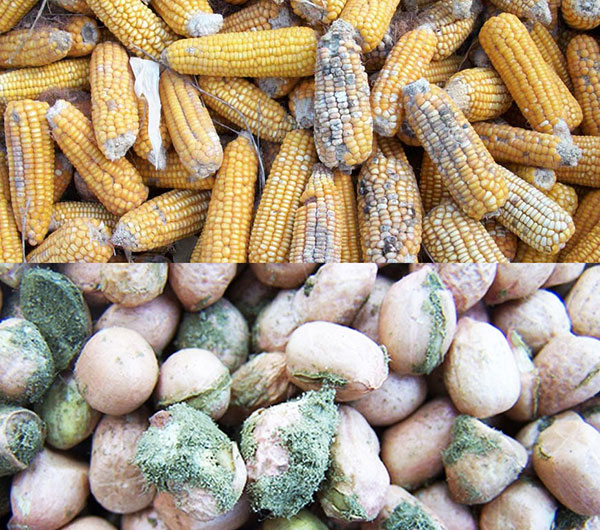
Aflatoxins are heat-resistant compounds and cannot be destroyed in normal cooking conditions. Therefore, the best practice is to select aflatoxins contamination-free edible items. Consumers can visually check the products for quality when purchasing. For instance, you may have seen black-coloured powdery particles or black patches in chillies or maize and these could be possible warning signs for aflatoxins contamination. In addition, consumers can dispose of any damaged, discoloured, shrivelled or infected grains that can be found in the purchased products before consuming them. Before purchasing, it is always advisable to look for fresh foods and check the labels for expiry dates or any damage in the sealed bags or containers. It is not recommended to buy foodstuffs which are about to expire even though they are for lower prices for quick sale. If you intend to keep the dry foodstuff or ingredients for a longer time once opened, keep them in air-tight bags or containers to avoid the growth of fungus.
Considering the carcinogenic nature, early detection of aflatoxin-producing fungi is essential for ensuring food safety. It is worthwhile to add dietary antioxidants such as vitamin E, selenium, and carotenoids to your diet as it helps destroy the generated free radicals in our body including the ones that form during the aflatoxin metabolism in the liver. Food spoilage due to bacteria can be easily noticed with a bad odour. On the contrary, fungi infestation may or may not be visible due to their characteristic nature and therefore more precautions are needed. The greater awareness could help you reduce the chances of possible aflatoxin ingestion.
The roles of farmers
Our farmers can take several measures to protect their crops from aflatoxin contamination. Good agricultural management practices include all the steps taken from plantation to harvest and post-harvest. Pre-harvest strategies aim to protect the crop from fungal infection or reduce the fungal pathogen’s ability to grow or synthesise aflatoxins. These include but are not limited to soil testing for potential pathogens, field conditioning, proper irrigation, crop rotation, the safe disposal of the infected plant, treatment with antifungal chemicals, maintenance of proper planting or growing conditions, use of resistant or adapted crop varieties, and maintenance of functional harvesting equipment. Applying good agricultural practices such as controlling disease carriers; bugs, insects, mites, beetles, and grasshoppers could help immensely control fungi infestation. Introducing genetically modified crops as a solution is suggested but with varying degrees of success. In contrast, even the best management methods cannot eradicate aflatoxin contamination.
Our farmers must carry out the harvesting when the grains are at full maturity stage and have low moisture content. Moisture is one of the characteristics related to the weight of dry matter. Hence, drying the material as dictated by the moisture content of the harvested grain followed by appropriate storage conditions can minimize post-harvest losses due to fungal infestation. It is worth noting that the moisture content requirement varies from one fungus to another, however bringing the moisture content below 13% together with lowering humidity levels in the warehouses can suppress the growth of Aspergillus spp. The fungi grow at varying temperate but the optimal for aflatoxins production is from 25 to 35°C. Therefore, creating unsuitable environmental conditions at the warehouses can minimise the thriving of the fungi and subsequently reduce the production of aflatoxins. Though it is not recommended and economically feasible, some countries use chemical treatments such as fumigation with ammonia and ozone which have proved effective.
Proper management of transport services can prevent seed damage during transportation. Because the damaged grains are highly susceptible to the growth of toxigenic fungi. Even though it is a tedious exercise and laborious process, segregating infected seeds from non-infected ones can be done before storing or packaging them. Scientists are working to develop techniques and technologies to control and manage aflatoxins in preharvest and postharvest stages. However, applying chemical or conventional agricultural methods only cannot prevent the fungi infestation and therefore integrated mechanisms are required to introduce to be able to regulate aflatoxin contamination of foodstuff and feed effectively and economically.
Evidence for aflatoxins contamination
In the scientific world, decisions are made based on conclusive evidence or information. Therefore, to prove the aflatoxin contamination, laboratory test reports must be produced. It is worth noting that these testing are highly expensive as it involves sophisticated advanced instruments to generate results. Several methods or protocols are available to use but the High-Performance Liquid Chromatography is the analytical method widely used for detecting aflatoxins in different food samples. More importantly, the operator must be versatile in the advanced technology and the science behind it to generate accurate and reliable results.
Challengers for PHIs and legal proceedings
There have been a few cases of food toxicity in the recent past and melamine contamination in milk powder, and heavy metals toxicity in rice are two of those. To our understanding, these claims have not yet been proven with satisfactory evidence to date and they appeared to have become merely news. However, irrespective of what has happened in the past, it is important to see how the PHIs are going to prove their claims on aflatoxin contamination in ‘Thriposha’. Nevertheless, they have not yet published the relevant test reports or released them to the media.
The accuracy of the results and the reliability of the laboratory in which they obtained the test reports may be in question in the legal proceedings or possible investigations. They must get test reports or certificates of analysis from an accredited laboratory and the laboratory needs to have that parameter accredited by a nationally or internationally reputed organization. Accreditation is a kind of recognition that a laboratory can have, and the Sri Lanka Accreditation Board for Conformity Assessment (SLAB) is the authorized institute in Sri Lanka. Apart from that PHIs should not depend on the results received from one laboratory but having the same samples analyzed from different laboratories, including one from overseas help them to justify their claims. PHIs must always keep reference samples with them as the defended parties may want to send those to an independent laboratory for their verification. Moreover, they must ensure that the received laboratory reports should contain the traceability of the samples as this is one of the important aspects that can be used to discharge the allegations. However, the chances of taking place legal proceedings or similar investigations are less likely to happen given the records of similar circumstances.
PHIs stand for public health and their roles must be commended and supported instead of criticised for what they have found. Consumers should be well informed of the health consequences of aflatoxin ingestion and more awareness programs must be arranged to educate ordinary people, even at village levels. PHIs must be given continuous training to upgrade their technical know-how and more collaboration between the government and the union must be established for better outcomes. Irrespective of whether the foodstuff is imported or locally produced, they all need to be scrutinized for quality before releasing to the market for the best interest of public health.


In planning a long trip to Sri Lanka from the UK, I was disappointed to see different hotel pricing for foreign visitors when compared to local rates. Like many travellers, I prefer to book directly with hotels, rather than international hotel consolidators, as more money goes to local businesses. But the assumption that foreigners should pay more is simply distasteful. As such, I’ve chosen another long-haul destination that does not follow such practices, and hope that Sri Lanka will change its approach to overseas visitors in the near future.
Neil Roskilly Wetherlee UK

We are living in ‘Trump times’ characterised by never ending craziness but it is not confined to the USA alone. I will come to our part of the world later. As a large part is due to Trump, perhaps, normalcy may return when he ends his second term on 20th January 2029, at 12.00PM Eastern Standard Time. We cannot be sure of that either because the ‘Great man’ may decide to govern the world for ever, after having purchased Greenland and forcing Canada to be the 51st state of the US!
Trump had an unprecedented opportunity, being only the second to be elected to a non-consecutive second term as the US President, the other being Grover Cleveland at the tail end of the nineteenth century. If only he kept to his campaign promises, his name would have been written in history in golden letters but the complete transformation, following the election, is likely to make his name go down as one of the craziest!
It is a moot point whether even Trump knows what he is going to do that day, when he wakes up, considering the illogicality of some actions, best illustrated by the ad-hoc imposition of tariffs without any discussions or negotiations. The adverse effects of these, to the world economy, is yet to be seen compounded, of course, by the continuing war with Iran. He promised to be a ‘Peace-maker’ but turns out to be a war-monger, like many of his predecessors! His excuse was that he went to war because he was denied the Nobel Peace Prize.
Well, he got the FIFA Peace Prize from FIFA President Gianni Infantino, another shameless leader who is ruining the ‘Beautiful Game’. When a US team member was given the red-card, Trump, who claims to know better than referees, decided it was not so, with a successful appeal to Infantino. During the next World Cup match, Belgium, supercharged with this injustice, thrashed the USA team 4-1.
Even the Semiquincentennial celebration of the US was not about the country but about himself! In fact, a cynic may point out that most of what the US has left behind, over the 250 years, is death and destruction. Paradoxically, whilst fighting a war with Iran to prevent it acquiring nuclear capabilities, the US is the only country to have dropped Atom Bombs, not one but two. Even though Japan was on the verge of admitting defeat, ‘Little Boy’, a uranium-based bomb, was dropped over Hiroshima on 6th August, 1945. Not giving time for Japan even to consider surrender, the second ‘Fat Man’, a plutonium implosion bomb, was dropped over Nagasaki, just three days later. Why did the US drop two A-bombs in rapid succession? It was to test the two different types of bombs they had.
Over the past 250 years, the US has started wars in many countries and, in most instances, lost leaving behind a trail of devastation and destruction. In spite of all that, it is continuing its war with Iran, a war that was started with false intelligence supplied by the war-monger Netanyahu who predicted the instantaneous fall of the Clerical regime in Iran. This war has turned out to be a blessing in disguise for Iran, as it realised the economic value of the Strait of Hormuz. The language Trump uses in reference to Iran is despicable. What sane person, nay a world leader, refers to flattening of a country and erasure of a civilisation?
Back in Sri Lanka, we know that most of our modern-day politicians are also self-serving. They are also very good at amassing wealth, when in power, just like the Trump family had done. However, what is of concern is the rapid decline in the standards of some vital professional classes. Special reference has to be made to the Attorney-General’s Department. Perhaps, the present holder is a decent man but some of his predecessors brought the high position into disrepute.
Dappula Livera allegedly concocted a conspiracy theory about the Easter Sunday terror mastermind as President Gotabaya Rajapaksa denied him an extension in service as the Attorney General. If he has any information about such a conspiracy, it is his bounden duty to come out with facts but has not done so.
A remark recently made by Deputy Solicitor General Dileepa Pieris about gallantry medals awarded to military personnel is said to have caused an affront to the dignity of Air Force officer Shantha Jayathilleke, who has received the highest decoration awarded to a living officer and sought to represent the interests of former Director of State Intelligence Service Maj. Gen. (retd.) Suresh Sallay as permitted by the Penal Code.
When political leaders and professionals holding high office behave in this manner, is there any hope for the nation?
By Dr. Upul Wijayawardhana

Education has always been one of the strongest foundations of Sri Lanka’s social and economic development. In today’s rapidly changing world, however, education must prepare students not only for examinations but also for life, employment, innovation, and responsible citizenship. Recognising this need, the government of Sri Lanka has introduced a new programme of education reforms. As Prime Minister and Minister of Education, Higher Education and Vocational Education, Dr. Harini Amarasuriya has played a leading role in guiding and promoting these reforms, with the aim of creating a more inclusive, modern, and student-centered education system.
One of the Prime Minister’s most significant contributions has been providing a clear vision for transforming the education system. Rather than focusing only on examination results, the reforms seek to develop students’ creativity, critical thinking, communication skills, problem-solving abilities, and emotional well-being. This approach recognizes that success in the twenty-first century requires a broad range of skills that go beyond memorisation.
A major feature of the reforms is the introduction of a new curriculum. The Prime Minister has emphasised that revised syllabuses will be introduced in stages, beginning with Grades 1 and 6, before expanding to other grades over the following years. The updated curriculum is designed to make learning more engaging, practical, and relevant to modern society. It encourages inquiry-based learning, teamwork, creativity, and the application of knowledge to real-life situations rather than relying solely on textbook learning.
Teacher development has also been identified as a key priority. The Prime Minister has repeatedly stressed that meaningful reforms cannot succeed without well-trained and motivated teachers. As a result, the government has planned professional development programmes to help teachers understand the new curriculum, adopt modern teaching methods, and integrate digital technology into classroom instruction. Strengthening teachers’ skills ensures that students receive a higher quality education and are better prepared for future challenges.
Improving school infrastructure is another important contribution under the Prime Minister’s leadership. Many schools across Sri Lanka continue to face shortages of classrooms, laboratories, libraries, and digital learning facilities. The reform programme aims to reduce these disparities by giving priority to improving physical infrastructure, upgrading learning environments, and ensuring that children from rural and urban areas have more equal educational opportunities. These investments are expected to create safer, more effective, and more inclusive learning spaces for all students.
The reforms also place strong emphasis on digital education. As technology continues to shape every aspect of modern life, students need digital literacy to succeed in higher education and future careers. The Prime Minister has supported initiatives to expand the use of digital tools in teaching and learning while encouraging schools to make greater use of educational technology. By promoting digital learning, the reforms seek to narrow the technological gap between schools and prepare students for a knowledge-based economy.
Another noteworthy contribution is the promotion of vocational and skills-based education. Traditional education has often placed greater emphasis on academic achievement, while practical skills received less attention. The new reforms aim to change this balance by introducing vocational subjects within the school system and creating clearer pathways for students who wish to pursue technical and vocational careers. This approach helps students develop employable skills while supporting the country’s economic growth and workforce needs.
The Prime Minister has also encouraged a more balanced approach to student assessment. Instead of measuring success only through final examinations, the reforms seek to include continuous assessment, classroom activities, projects, and practical learning experiences. Such an approach recognises different learning styles and provides students with more opportunities to demonstrate their abilities. It also reduces excessive pressure associated with high-stakes examinations and supports the overall development of children.
Inclusivity is another important aspect of the Prime Minister’s contribution. The reform process has involved experts, educators, and advisory committees representing diverse communities. The government has emphasised that curriculum development should reflect fairness, inclusiveness, and respect for Sri Lanka’s multicultural society. By involving different stakeholders in the planning process, the reforms aim to build a national education system that serves all children equally.
Despite these promising initiatives, implementing large-scale education reforms is not without challenges. Teacher training, infrastructure development, adequate funding, and effective monitoring are essential for the long-term success of the programme. Public awareness and cooperation among parents, teachers, school administrators, and policymakers will also play a vital role in ensuring that the reforms achieve their intended outcomes. Sustained commitment from the government and continuous evaluation will be necessary to address emerging issues and improve implementation over time.
The Prime Minister of Sri Lanka has made a significant contribution to the country’s new education reforms by promoting a modern, inclusive, and future-oriented vision for education. Through curriculum modernization, teacher development, improved infrastructure, digital learning, vocational education, and better assessment methods, the reforms seek to prepare students not only for examinations but also for lifelong learning and responsible citizenship. If implemented successfully, these reforms have the potential to strengthen Sri Lanka’s education system, reduce inequalities, and equip future generations with the knowledge, skills, and values needed to contribute positively to national development in an increasingly competitive global environment.
Saumya Aloysius
saumyaaloysius@gmail.com

Trump meets Iraq PM at White House, promises ‘a lot of deals’

A few showers may occur in the Western, Sabaragamuwa and North-western provinces and in Kandy, Nuwara-Eliya, Galle and Matara districts

Negombo Prison riot: No convicts among 21 inmates killed

2026: 128 elephants killed in first four-and-a-half months

Sigiriya Jungles marks 10 years with community medical camp

Protests continue in Valikamam North demanding military-held land

‘Dates have the highest sugar content to fight Coronavirus’

Sunday Island 27 December – Headlines

#SundayIsland 17th December – Headlines

Sunday Island – 28th March

Sunday Island Headlines – 21 March

Sunday Island – 21st February – Headlines
-

 News5 days ago
Herath warns prospective migrant workers not to get fleeced by racketeers
-

 Features3 days ago
Prison riots and politics: NPP’s biggest challenge and Sri Lanka’s biggest opportunity
-

 Editorial4 days ago
What’s the world coming to?
-

 Foreign News5 days ago
Tensions erupt in Indian state after 11-year-old raped and murdered
-

 Features5 days ago
Devanesan Annan – in Memoriam
-

 News6 days ago
Negombo Prison riot: Ensuring protection of prisoners fundamental responsibility of the state – UN
-
Editorial5 days ago
Punishment in hellholes
-

 News6 days ago
Representatives of the Organization of Professional Associations (OPA) of Sri Lanka meet the Prime Minister