
Features
Abrogation of the B-C Pact and what followed


(Excerpted from Render Unto Caesar by Bradman Weerakoon, Secretary to the Prime Minister)
Yet, as was to happen over and over again in the country’s politics, the vocal minority, in this case the hardliners finally won the day (in getting SWRD to abrogate the B-C Pact). In October 1957 the UNP under the leadership of J R Jayewardene set out on a march from Colombo to Kandy to protest against the pact. On the first day they covered 11 miles amidst some obstruction and skirmishes with government sponsored elements.
On the second day after going three miles they were met at Imbulgoda by a blockade of the road led by the local MP for Gampaha, S D Bandaranayake. The MP, a distant relative of the prime minister, was well-known as an eccentric and was referred to as an ‘unguided missile’. Many of us did not believe that Mr Bandaranaike had any responsibility for this. It was regarded as a purely local endeavour in showing opposition to the pact and the police behaved impartially in keeping the marchers and the obstructors apart.
Altogether it was somewhat of an embarrassment to the prime minister who felt that the march would have lost steam on its own as it proceeded up country. J R Jayewardene had no hesitation in calling off the march but went on four days later to the Dalada Maligawa in Kandy to worship the Sacred Tooth relic of the Buddha and offer puja to the gods of the four devales “to stop the pact.”
The attempt of the UNP to undermine the prime minister by mobilizing people with the march to Kandy, palpably failed and the tension over the BC Pact subsided; but not for long. By February 1958, the FP put pressure on the prime minister to move the agreement into legislation which would guarantee regional councils and their powers.
Mr Bandaranaike, whose authority in the Cabinet was being challenged by minister Philip Gunewardene over his proposed reform of the Paddy Lands legislation, now found himself increasingly besieged. Those who were against concessions to the Tamils began to assert themselves and asked not only for details of the regional councils draft legislation but the abrogation of the pact itself. Foremost among Mr Bandaranaike’s critics were the self-same bhikkus who had helped to ensure his victory in 1956.
In March of 1958, the ministry of transport made a decision – in hindsight a major blunder given the fragile situation – to send some nationalized buses to the North with the Sinhala letter `Sri’ on the licence plates. The northern militants began to deface the licence plates and the southern extremists retaliated with a widespread campaign of smearing tar over Tamil name boards wherever they occurred.
I recall that the Tamil lettering of the name board in the prime minister’s office in Senate Square itself and even the Tamil lettering on the prime minister’s official gold-coloured Cadillac, which read ‘left hand drive’, were not spared in this virulent tar-brush campaign. There was much confusion in the city at the time but after police shooting, things were brought under control in a few days.
The Tamil leaders, especially Chelvanayakam, who was always for non-violent protest to win rights, did what they could to restrain the militants but the die had been cast. At the Cabinet meeting held on April 9, 1958, some ministers urged that the pact be scrapped but the prime minister managed to hold them off. What finally undid Mr Bandaranaike’s genuine bid for accommodating with the Tamils was the action of around 150 bhikkus who attempted to march to 65, Rosmead Place and compel the prime minister to withdraw from the pact.
The police had stopped the procession about 100 yards away on McCarthy Road but the group refused to move until they had won their demand. Mr Bandaranaike went down to meet them and tried to explain, but the monks would have none of it. Finally, at noon that day he drove to Radio Ceylon and announced that given the militant behaviour of the Tamils and the popular opposition this had caused, he was unilaterally abrogating the pact. Some political commentators have called this the most ‘grievous blunder of his career’.
The Tamil leaders responded immediately by calling for a civil disobedience mass campaign and planned for a conference on May 23 in Vavuniya to organize the protest. While this was going on serious violence was breaking out between groups of Sinhalese and Tamils in several parts of the country. Reports began to come in to the PM’s office first from Polonnaruwa where G A Derek Aluvihare had to give orders to the police to fire and stop lorry loads of Land Development Department labour from raiding Tamil settlements.
On the 24 May, a former mayor of Nuwara Eliya, Seneviratne, and two friends were waylaid and killed in Eravur. As news of this spread, vehicles and trains were halted and Tamils were searched for, in Polonnaruwa and other towns in the North Central Province. The violence quickly spread to Colombo and the larger towns were fanned by the most fantastic rumours. In Mount Lavinia on Hotel Road, where my mother lived, a Tamil man had petrol thrown on him and was being burnt to death. He was saved only by the most courageous exertions of the Warden of St. Thomas’ College who fought off the miscreants. This, some of my family members personally witnessed.
It became clear that the only way to quell the widespread rioting was to bring in the Emergency and after some consultation with the Governor-General Sir Oliver Goonetilleke Emergency was declared at mid day on May 27, 1958. This meant that the press was censored, night and day curfews imposed; and public meetings, processions and strikes in essential services prohibited.
However, as the news was taken to the north and east by persons fleeing from the violence in the capital, rioting against the small temporary settlements of migrant Sinhalese fishermen from Dondra and Negombo and business establishments in the towns followed. One of the worst incidents was the attack on the Buddhist Naga vihare in Jaffna town sparked by the news of the burning alive of the pusaries in the Panadura kovil.
On May 30 news came in to the small coordinating unit set-up in the prime minister’s office of the destruction of the temple on the island of Nagadipa. This piece of information of the sacking of an important place of Budddhist pilgrimage — by tradition believed to be a site hallowed by a visit of the Buddha to settle a conflict between the Nagas and the original inhabitants of the land — could have led to a massacre of Tamils in the south. The news was deliberately withheld from the public.
Emergency ’58 was undoubtedly the most serious communal outbreak the country had suffered in modern times. I was at the centre of things conveying information to the prime minister as the news came in from the police desk. Having served for a year in Jaffna four years earlier, I was particularly stricken by the turn of the events took. I recalled how on Independence Day in 1955, as the Civil Service Cadet in office, I was chosen by the government agent, the pious and gentle M Sri Kantha, to represent the government and hoist the national flag at the ceremonies on the island of Delft.
It was a small but impressive function with the school children in their starched white uniforms singing the national anthem with great gusto, of course in Tamil. It was a two-hour journey by Navy boat to the island, which boasts a population of 8,000 people and hundreds of wild ponies, introduced by a Dutch governor in the 17th century when the protectorate of Jaffna was under Dutch rule. In British times a Lieutenant Nolan and his men were rumoured to have sown some ‘wild oats’ as well. This was still evident in the fair complexion, blonde hair and blue eyes of some of the village lasses.
It was a full day of pony races, singing and dancing and a tearful farewell procession back to the jetty late in the evening. The journey back to Kayts remains etched in my memory; of the luminescence of the spray as the boat cut through the water, the soft moonlight that bathed the serene night and the quiet chatter of the seamen seated on the gunwale.
Sir Oliver, who was a very able and persuasive administrator with a long track record of crisis management, was given the job of handling the emergency by the prime minister and soon brought things under control.
Tarzie Vittachi who described Emergency ‘58 with minute attention to detail and great perspicacity relates a story of the bluff and bluster with which Sir Oliver managed his difficult role. Sir Oliver apparently invited the press to meet him soon after taking charge. As the pressmen moved into his room at Queens House, now converted into some kind of Command Headquarters, they saw Sir Oliver seated before a battery of telephones.
The phones would ring very often during the press briefing and lifting one phone after the other and without a moment of hesitation Sir Oliver would intone – he always had a slight stammer – “shoot, shoot” and replace the instrument. It was dramatic and very telling and there was no doubt after that as to who was in charge.
There was much for us to do and to think about in the prime minister’s office those days. It was difficult to discern any specific pattern in what had taken place. There were elements of both ethnic rivalry and hate and plain criminality. Most of the looting was indiscriminate with the looters plundering whatever they could lay their hands on. Boutiques and little food outlets – those selling plantains and the Jaffna cigars, seemed to be especially attractive to local thugs who made merry while `law and order’ was busy elsewhere.
In great measure, the police and the army when called out later, acted promptly and equitably. The police in the main did not take sides, as has unfortunately happened in later communal clashes, and sometimes to the great surprise of some militant organizations, shot at Sinhalese looters as well. Perhaps Sir Oliver’s command helped and the more multi-racial make-up of the law enforcers, especially at the higher levels, would have made a difference.
It was different in 1983 when I was directly concerned as commissioner-general of essential services. In 1958, the police and armed forces generally won the respect of the people for their broadly impartial behaviour and there were virtually no attacks on service personnel directly. An unfortunate trend was the incursions into the estate line-rooms, where the Indian Tamil population on estates close to the up-country towns were subject to pillage and harassment. Things on the estates had got particularly bad around the towns of Matale and Badulla.
While Sir Oliver appeared to be the man in charge of the Emergency – a role he was glad to take on at the prime minister’s bidding – there was no doubt that Mr Bandaranaike was always very much in the picture. The Emergency continued to be in force for several months and the Federal Party members were detained, albeit in some comfort, at the Galle Face Hotel. Mr Bandaranaike took a firm stand against the Sinhalese rioters and kept them in jail for as long as possible. This caused resentment among some government supporters.
As the tension subsided, Bandaranaike thought it time to present to the Parliament the legislation which provided for the `reasonable use of Tamil’. This was passed but neither the FP nor the UNP participated in the debate. However, the Act which was intended to permit a wide official use of Tamil in the Northern and Eastern provinces was not implementable without the regulations which the Act provided for being brought into law. It took almost 10 more years before the operative regulations were brought into effect. By this time the FP had become, for the first time, a part of the national government.
Towards the third quarter of 1958, things began to become very difficult for Mr Bandaranaike and there were frequent convulsions in the Cabinet. In addition there erupted a series of strikes especially in the nationalized port and transport sectors, including the post and telecommunication services and the plantations. Organized labour, very much controlled by the LSSP and CP, and on the estates by the CWC and DWC, had been brought into powerful federations.
The Unions were restive, not having yet received the fruits of the ‘socialist’ peoples’ revolution, which they, the workers had brought into being in 1956. Some of the trade union leaders like D A Piyadasa of the All Ceylon Harbour and Dock workers union, D G William of the State Employees Federation and Bala Tampoe were then important and powerful people. Tension between the unions, flexing their muscles, and the bureaucracy were not uncommon.
One morning, Vernon Peiries, a civil service colleague, a few years senior to me who was deputy port commissioner, came rushing into my room holding his jaw and asking for a hot-water compress. Apparently he had been having a heated discussion with D A Piyadasa, whose union was on strike on why a salary increase could not be given. Piyadasa had suddenly jumped up and slapped him across the face. Vernon whose office was also in Senate Square had come to me for treatment, solace and recompense for the indignity, more than to complain of the pain, he had suffered.
The civil service bush telephones began to hum and Shirley Amerasinghe, then a rising star as director of establishments called a confab for the afternoon and the CCS association decided that it was time to take a stand. They would take-up the issue with the prime minister on a non-negotiable condition, that Piyadasa must be both, criminally charged in the courts and suspended from entering the Port. The problem was a complex one for the prime minister since the higher echelons of the bureaucracy had now decided to dig their heels in while the political union leadership including Philip Gunawardene, his minister of agriculture and food, who had connections with Piyadasa, were for settling the matter with an apology or similar face-saving device.
I will never forget a particular high-level meeting called by the prime minister in his Senate Square office when he pleaded and tried to cajole the permanent secretary to the ministry of transport and works, the diminutive and implacable M F de S Jayaratne, under whom the Port then functioned, to step down from the high position that he was taking and agree to some compromise so that the deadlock could be broken.
To emphasize his point Bandaranaike got up and walked round the table, to Jayaratne but the permanent secretary who remained sitting throughout, would not budge. `Not on my life’ was all he did not say. Bandaranaike’s pleas were of no avail and the case against Piyadasa was filed. In this particular contest the prime minister had lost.
Actually, the prime minister and M F de S Jayaratne were good friends and often played billiards against each other at the Orient Club in Colombo 7 where they were both members, but this relationship had nothing to do with the performance of duty. Jayaratne was one of the best officials I have ever seen in that respect.
There were other points of contention developing in the coalition, which Mr Bandaranaike had, with ingenuity and persuasive skill, put together. The fundamental contradictions between right and left, which he had managed with such resourcefulness, were emerging and they burst out into the open with Mr Philip Gunawardene’s Paddy Lands draft legislation.


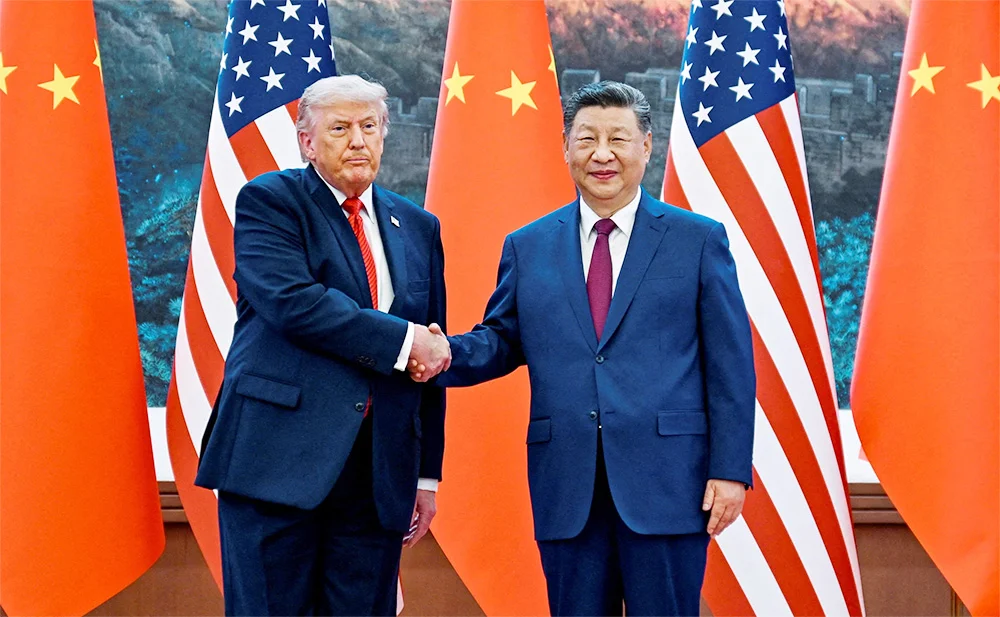
 The fact that some of the US’ topmost figures in business, such as Tesla chief Elon Musk and major US chipmaker Jensen Huang of NVIDIA fame, occupied as nearly a prominent a position as President Donald Trump at the recent ‘historic and landmark’ visit by the latter to China underscores the continuing vital importance of business in US-China ties. Business seemed to outweigh politics to a considerable degree in importance during the visit although the political dimension in US-China ties appeared to be more ‘headline grabbing’.
To be sure, the political dimension cannot be downplayed. For very good reason China could be seen as holding the power balance somewhat evenly between East and West. The international politics commentator couldn’t be seen as overstating the case if he takes the position that China could exercise substantial influence over the East currently; that is Russia and Iran, in the main. The latter powers hold the key in the Eastern hemisphere to shaping international politics in the direction of further war or of influencing it towards a measure of peace.
For example, time and again China has prevented the West from ‘having its own way’, so to speak, in the UN Security Council, for instance, in respect of the ongoing conflicts involving Russia and Iran, by way of abstaining from voting or by vetoing declarations that it sees as deleterious. That is, China has been what could be seen as a ‘moderating influence’ in international politics thus far. It has helped to keep the power balance somewhat intact between East and West.
At present a meet is ongoing between Chinese President Xi Jinping and Russian President Vladimir Putin in Beijing. This happened almost immediately after the Trump visit. Apparently, Beijing is in an effort to project itself as treating the US and Russia even-handedly while underscoring that it is no ‘special friend’ of the US or the West.
This effort at adopting a non-partisan stance on contentious questions in international politics is also seen in Beijing’s policy position on the Hormuz tangle and issues growing out of it. The Chinese authorities are quoted as saying in this regard, for instance, that China is for ‘a comprehensive and lasting ceasefire in the Middle East’.
Such a position has the effect of enhancing the perception that China is even-handed in its handling of divisive foreign policy posers. It is not openly anti-West nor is it weighing in with Iran and other Eastern actors that are opposed to the West in the West Asian theatre. A ‘comprehensive and lasting ceasefire’ implies that a solution needs to be arrived at that would be seen as fair by all quarters concerned.
On the highly sensitive Taiwan issue, President Xi was comparatively forthright during the Trump visit, but here too it was plain to see that Beijing was not intent on introducing a jarring, discordant note into the ongoing, largely cordial discussions with Washington. On the Taiwan question President Xi was quoted saying: ‘If mishandled, the two nations could collide even come into conflict.’ In other words, the US was cautioned that China’s interests need to be always borne in mind in its handling of the Taiwan issue.
The cautioning had the desired result because Trump in turn had reportedly conveyed to Taiwan that the latter’s concerns on the matter of independence had to be handled discreetly. He had told Taiwan plainly not to declare ‘independence.’
Accordingly, neither the US nor China had said or done anything that would have made either party lose face during their interaction. Apparently, both sides were sensitive to each others’ larger or national interests. And the economic interests of both powers were foremost among the latter considerations.
There is no glossing over or ignoring economic interests in the furtherance of ties between states. They are primal shaping forces of foreign policies and the fact that ‘economics drives politics’ is most apparent in US-China ties. That is, economic survival is fundamental.
Among the more memorable quotes from President Xi during the interaction, which also included US business leaders, was the following: ‘China’s doors will be open wider’ and US firms would have ‘broader prospects in the Chinese market.’
Xi went on to say that the sides had agreed to a ‘new positioning for ties’ based on ‘constructive strategic stability’. The implication here is that both sides would do well not to undermine existing, mutually beneficial economic relations in view of the wider national interests of both powers that are served by a continuation of these economic ties. That is, the way forward, in the words of the Chinese authorities, is ‘win-win cooperation.’
It is the above pronouncements by the Chinese authorities that probably led President Trump to gush that the talks were ‘very successful’ and of ‘historic and landmark’ importance. Such sentiments should only be expected of a billionaire US President, bent on economic empire-building.
One of the most important deals that were put through reportedly during the interaction was a Chinese agreement to buy some 200 Boeing jets and a ‘potential commitment to buy an additional 750 planes.’ However, details were not forthcoming on other business deals that may have been hatched.
Accordingly, from the viewpoint of the protagonists the talks went off well and the chances are that the sides would stand to gain substantially from unruffled future economic ties. However, there was no mention of whether the health of the world economy or the ongoing conflicts in West Asia were taken up for discussion.
Such neglect is regretful. Although the veritable economic power houses of the world, the US and China, are likely to thrive in the short and medium terms and their ruling strata could be expected to benefit enormously from these ongoing economic interactions the same could not be said of most of the rest of the world and its populations.
Needless to say, the ongoing oil and gas crisis, for instance, resulting from the conflict situation in West Asia, is taking a heavy toll on the majority of the world’s economies and the relevant publics. While no urgent intervention to ease the lot of the latter could be expected from the Trump administration there is much that China could do on this score.
China could use its good offices with the US to address the negative fallout on the poorer sections of the world from the present global economic crunch and urge the West to help in introducing systemic changes that could facilitate these positive outcomes. After all, China remains a socialist power.
“Everything ever said to me by any Chinese of any station during any visit was part of an intricate design”
— Henry Kissinger
That design may already be complete before this week’s , a meeting that could shape the future balance of global power.
The wind arrives quietly. By the time it is heard, history has already begun to turn. Across Asia, that wind is no longer distant. It carries with it the exhaustion of an old order and the uncertain birth of another. The question now is not whether the world will change. It is whether those who hold power possess the wisdom to guide that change toward something less violent than the century behind us.
Since 1945, the United States has carried the burden of a global order built with its Western allies. To its credit, the world avoided another direct world war between great powers. The conflicts remained contained in distant lands—proxy wars fought in the shadows of ideology, oil, and influence. From Latin America to Asia, the American century expanded not only through prosperity, but through intervention. Yet empires, even democratic ones, grow tired. Fatigue settles slowly into institutions, alliances, and public memory. The role of global policeman no longer inspires certainty in Washington as it once did.
The “rules-based order” now confronts its own contradiction: it was built to be universal, yet it often appeared selective. During my recent visit to , a young researcher asked me quietly, “Does the West itself still believe in the rules-based order?” The question lingered long after the conversation ended. The rising century demands a more inclusive architecture—one that recognises the reality of Asian power, especially China.
My three years of field research across South and Southeast Asia, documented in , revealed a transformation too significant to dismiss as temporary. China has moved beyond being merely a competitor to the United States. In trade, infrastructure, technology, cultural diplomacy, and economic influence, Beijing has established itself as what may be called the world’s “US +1.”
Great powers often search for such a partner. History shows this tendency clearly. When an empire becomes overextended—burdened by wars, alliances, sanctions, tariffs, and crises—it seeks another center of gravity to stabilize the system it can no longer manage alone. The United States today faces disorder stretching from Venezuela to Iran, from Ukraine to the unsettled Middle East. In this landscape, China emerges not simply as a rival, but as a state powerful enough to broker peace where Washington alone no longer can.
Drawing from the lessons of the Nixon–Mao era, warned that “” The United States and China are now engaged in a long-term economic, technological, political, and strategic competition. Managing that competition wisely may become the defining challenge of this century. In such a deeply polarized and unstable world, recognising China as a “US +1” partner is not surrender, but strategic realism.
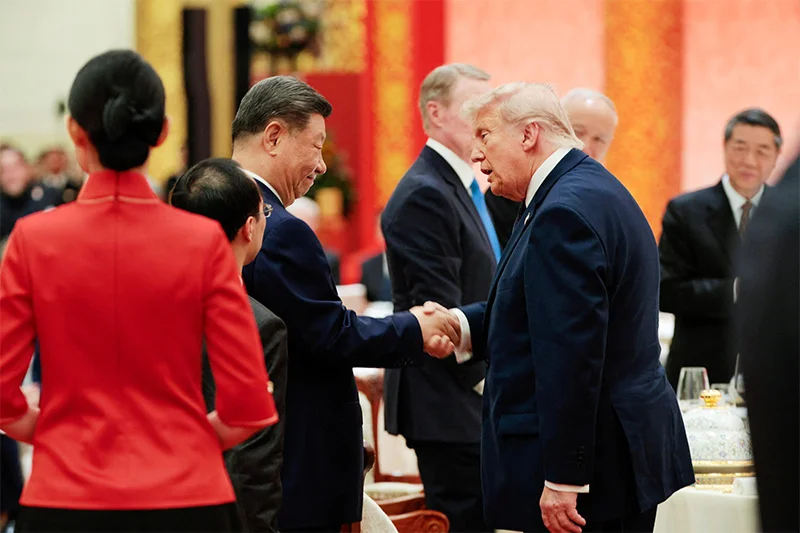
Donald Trump understood this reality before boarding his flight to meet Xi Jinping. Their meeting inside Zhongnanhai—the guarded compound where China’s leadership governs—was never merely ceremonial. It symbolized a deeper recognition already acknowledged quietly within the itself: China is the nearest peer competitor the United States has ever confronted. Before departing Washington, Trump seemed to reassess not only China’s strength, but its unavoidable position as a “” shaping the future global balance.
Yet the significance of a Trump–Xi meeting extends beyond trade wars, tariffs, or diplomatic spectacle. It presents an opportunity to confront two crises shaping the century ahead: global energy insecurity and regional instability. Washington increasingly understands the limits of direct engagement with Tehran. Decades of pressure, sanctions, and confrontation have produced exhaustion rather than resolution. In that vacuum, Beijing now possesses leverage that Washington does not.
For China, this is an opportunity to evolve from a development partner into a security actor. Xi Jinping’s (GSI) was never designed merely as rhetoric. It was intended as the next phase of Chinese influence—transforming economic dependence into strategic trust. The geopolitical spillover from the Iranian conflict now offers Beijing a historic opening to project itself as a stabilising force in the region, not against the United States, but alongside it as a “US +1” partner.
If China succeeds in helping stabilise the Gulf and secure energy corridors vital to Asia, it will reshape perceptions of Chinese power globally. Beijing would no longer be seen only as the builder of ports, railways, and industrial zones, but as a guarantor of regional balance. This transition—from infrastructure diplomacy to security diplomacy—may become one of the defining geopolitical shifts of the coming decade.
Xi Jinping does not seek open confrontation. His strategy is older, more patient, and perhaps more formidable because of its restraint. Beijing speaks not of domination, but of a “,” advanced through three instruments of influence: the Global Development Initiative (GDI), the Global Security Initiative (GSI), and the Global Civilization Initiative (GCI). These are not slogans alone. Across Asia, many governments increasingly trust China as a development partner more than any other power.
India, despite its ambitions, has not matched this scale of regional penetration. In both ASEAN and South Asia, China’s economic gravity is felt more deeply. Ports, railways, technology networks, and financial dependency have altered the geopolitical map quietly, without the spectacle of war.
In , I compared three inward-looking national strategies shaping Asia today: Trump’s MAGA, Modi’s emerging economic nationalism , and Xi’s strategy. Among them, China has demonstrated the greatest structural resilience. Faced with American tariffs and decoupling pressures, Beijing diversified its supply chains across Central Asia, Europe, and Southeast Asia. Rail corridors now connect Chinese industry to European markets through Eurasia. ASEAN has surpassed the United States as China’s largest trading partner, while the European Union follows closely behind. Exports to America have declined sharply, yet China continues to expand. Trump, once defined by confrontation, now arrives seeking a new “” with China—an acknowledgment that economic rivalry alone can no longer define the relationship between the world’s two largest powers.
Unlike Washington, which increasingly retreats from multilateral institutions, Beijing presents itself as the defender of multilateralism. Whether genuine or strategic matters less than perception. In geopolitics, perception often becomes reality.
What emerges, then, is not surrender between rivals, but interdependence between powers too large to isolate one another. The future may not belong to a bipolar Cold War, but to a reluctant coexistence. The United States now recognises that China possesses diversified markets and partnerships capable of reducing dependence on America. China, in turn, understands that its long march toward global primacy still requires strategic engagement with the United States.
This is where the true geopolitical shift begins.
Many analysts continue to frame China solely as a threat. Yet history rarely moves through absolutes. The next world order may not be built through confrontation alone, but through uneasy partnership. Artificial intelligence, technological supremacy, economic stability, and global governance now demand cooperation between Washington and Beijing, whether either side admits it publicly or not.
Trump will likely celebrate his personal relationship with Xi, presenting himself as the American leader capable of negotiating a “better deal” with China than his predecessors. But beneath the rhetoric lies something larger: the gradual acceptance of China’s indispensable role in shaping the future international order.
Even the question of war increasingly returns to Beijing. If Washington seeks an understanding with Tehran, China’s influence becomes unavoidable. Iran listens to Beijing in ways it no longer listens to the West. This alone signals how profoundly the balance of power has shifted. And Xi, careful as always, refuses to openly inherit the mantle of global leadership. He delays, softens, and obscures intention. It is part of a longer strategy: to rise without provoking the final resistance of a declining hegemon too early.
History rarely announces its turning point. Empires fade slowly, while new powers rise quietly beneath the noise of the old order. Washington still holds immense power, but Beijing increasingly holds the patience, reach, and strategic depth to shape what comes after.
The century ahead may not belong to one power alone, but to the uneasy balance between Washington and Beijing. And in that silence, a new world order is already taking shape.
By Asanga Abeyagoonasekera

Chit-Chat Nethali Withanage
 Three months ago, 19-year-old Nethali Withanage, with Brian Kerkoven as her mentor, walked the ramp at Colombo Fashion Week. On 06 June, she’ll walk for Sri Lanka in Hurghada, Egypt, as the country’s delegate to Top Model of the World 2026._
I caught up with Nethali as she prepares to fly out, this weekend, and here’s how our chit-chat went:
1. Tell me something about yourself?
I’m someone who blends creativity with ambition. I’ve always loved expressing myself, whether it’s through fashion, styling, or the way I present myself to the world. At the same time, I’m very driven and disciplined, especially when I was working, as a student counsellor, at Campus One, at a young age, where I’ve learned how to connect with people, understand them, and communicate with confidence. I believe I’m still evolving, and that’s what excites me the most … becoming better every single day.
2. What made you decide to be a model?
Modelling felt natural to me because it combines everything I love – fashion, confidence, and storytelling without words. I realised that modelling isn’t just about appearance, it’s about presence and how you carry your energy. I wanted to be part of an industry where I could express different sides of myself, while inspiring others to feel confident in their own skin.
3. What sets you apart from other models?
I would say my ability to connect. Whether it’s with the camera, a brand, or an audience, I bring authenticity. I also have a strong background in communication and sales, which gives me an edge in understanding how to represent a brand, not just wear it. I don’t want to just model clothes, I want to bring them to life.
4. What clothing do you prefer to model?
I enjoy modelling versatile styles, but I’m especially drawn to elegant and expressive fashion pieces that tells a story. I love looks that allow me to embody confidence and femininity, whether it’s a structured outfit or something soft and flowing.
5. What is the most important aspect of modelling?
Confidence combined with professionalism. Confidence allows you to own the moment, but professionalism ensures that you respect the work, the team, and the brand you represent. Both are equally important.
6. If you could change one thing about yourself, what would it be?
I would say I’m learning to trust myself more and not overthink. I’ve realised that growth comes from embracing who you are, not constantly trying to change it. So instead of changing something, I’m focused on becoming more confident in my own voice.
7. School?
I did my O/Ls at Seventh Day Adventist High School Kandana, and, while at school, I was actively involved in creative activities. I enjoyed participating in English Day events that allowed me to express myself and interact with others. Those experiences helped me build confidence, teamwork, and communication skills, which continue to shape who I am today.
8. Happiest moment?
One of my happiest moments is realising how far I’ve come from being unsure of myself to stepping into opportunities, like modelling, and representing myself with confidence. That feeling of growth is something I truly value, and also a dream come true!
9. Your idea of perfect happiness?
Perfect happiness for me is peace of mind, being surrounded by people I love, doing what I’m passionate about, and feeling proud of who I am becoming.
10. Your ideal guy?
My ideal partner is someone who is respectful, supportive, and confident in himself. Someone who values growth, understands my ambitions, and encourages me to be the best version of myself.
11. Which living person do you most admire?
I admire strong, self-made individuals who have built their identity through hard work and resilience. People who stay true to themselves, despite challenges, inspire me, because they show that success is not just about talent, but also about strength and consistency.
12. Your most treasured possession?
My most treasured possession is my confidence. It’s something I’ve built over time, and it allows me to face challenges, take opportunities, and believe in myself, even when things are uncertain.
13. If you were marooned on a desert island, who would you like as your companion?
I would choose someone who is calm, positive, and resourceful, someone who can turn a difficult situation into an adventure. The right mindset matters more than anything.
14. Your most embarrassing moment?
I’m 19 and still haven’t faced any most embarrassing moment. But I would say I’ve had small moments where things didn’t go as planned, but I’ve learned to laugh at myself. Those moments remind me that perfection isn’t necessary; confidence is about how you recover, not how you avoid mistakes.
15. Done anything daring?
Pursuing modelling and stepping into competitions is something I consider daring. It pushed me out of my comfort zone and challenged me to grow, both personally and professionally.
16. Your ideal vacation?
My ideal vacation would be somewhere peaceful, yet beautiful, like a beach destination where I can relax, reflect, and reconnect with myself, while enjoying nature.
17. What kind of music are you into?
I choose music that matches my mood at that time, whether it’s calm and relaxing or energetic and uplifting. Music is something that helps me express emotions and stay inspired.
18. Favourite radio station?
Usually I don’t listen to radio stations but whenever I get into a car I would search for Yes FM because it has a refined balance of contemporary hits and timeless music. I appreciate how it maintains a vibrant yet sophisticated energy, keeping listeners engaged while creating a consistently uplifting atmosphere. It’s something I enjoy because it adds a sense of positivity and elegance to my day.
19. Favourite TV station?
At the moment, I don’t have a television at home, but growing up, my favourite TV station was ‘Nickelodeon’. I genuinely loved the shows and series it aired; they were fun, creative, and full of personality. It was something I always looked forward to, and those memories still bring a sense of joy and nostalgia, whenever I think about it.
20. Any major plans for the future?
My future plans are to grow in the modelling industry, work with international brands, build a strong personal brand and finish completing a Bachelor’s Degree in Business Studies. At the same time, I want to explore my creative side further, especially in fashion and business, so I can create something of my own one day.

PM meets academic experts from the British Council

Gaby Lewis to lead Ireland at T20 World Cup

PM meets Sri Lankan community living in London

Kapila Wijegunawardena to head SLC’s new selection committee

Afghanistan refugee women’s team set for England tour under ECB initiative

DR Congo cancels World Cup training camp over Ebola outbreak

‘Dates have the highest sugar content to fight Coronavirus’

Sunday Island 27 December – Headlines

#SundayIsland 17th December – Headlines

Sunday Island – 28th March

Sunday Island Headlines – 21 March

Sunday Island – 21st February – Headlines
-
 Features5 days ago
Sri Lankan Airlines Airbus Scandal and the Death of Kapila Chandrasena and my Brother Rajeewa
-
 News6 days ago
Lanka’s eligibility to draw next IMF tranche of USD 700 mn hinges on ‘restoration of cost-recovery pricing for electricity and fuel’
-
 News5 days ago
Kapila Chandrasena case: GN phone records under court scrutiny
-
 News5 days ago
Rupee slide rekindles 2022 crisis fears as inflation risks mount
-
 Features2 days ago
Octopus, Leech, and Snake: How Sri Lanka’s banks feast while the nation starves
-
 Business5 days ago
Expansion of PayPal services in Sri Lanka officially announced
-
 Features7 days ago
Mysterious Death of United Nations Secretary General Hammarskjöld
-

 News5 days ago
Court orders further arrests in alleged USD 42 Mn NDB fraud case