
Features
A singular modern Lankan mentor – Part II

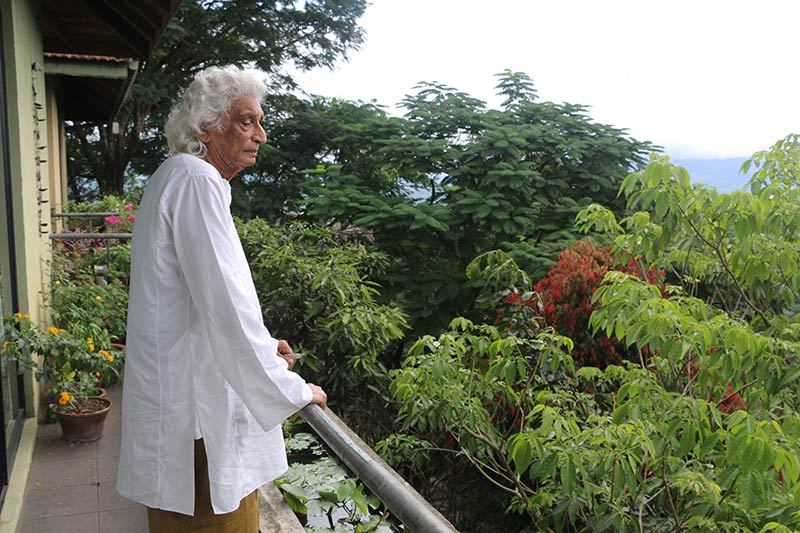
by Laleen Jayamanne and Namika Raby
(Part I of this article appeared in The Island on Friday (31 Jan.)
Women’s Mental Health: Trance/Dance in Folk Rituals
The lecture Namika heard on ‘pregnancy cravings’ (dola duka) among peasant women in a particular village, is one of Gananath’s earliest pieces of research which shows his turn of mind, originality, in taking seriously a compelling female desire which may not have been treated in the scholarly arena with the gravity and seriousness that it warranted. I associate a certain sense of cultural embarrassment on hearing the term ‘dola duka’ in Sinhala back in the day when a pregnant relative of mine craved to eat pieces from a freshly baked (navun) clay pot with its special fragrance. The film shows Gananath’s empathetic ability to pay careful ethnographic attention to a variety of gendered states of mental distress and trauma and their traditional ritualised ecstatic expressions, especially with regard to women, well before some feminist scholars in the West began to be interested in the topic of ‘Women and Madness’ from a Freudian psychoanalytic perspective. Psychoanalytic theory became methodologically important for Feminist Film Theory, which I used in my doctoral thesis on ‘Female Representation in the Lankan cinema’.
A sequence in Dimuthu’s film focuses on the subject of Gananath’s book Medusa’s Hair: An Essay on Personal Symbols and Religious Experience, which is a case history of an old woman called Karunawathi Maniyo (mother). She appears with her thickly matted, long snake-like grey locks which, we are told, were created by her as a mode of existence, entailing a ritualised daily practice of puja at an altar, with images of the fierce Kali with fangs and Durga Ashuramardani (a divine figure of combat capable of violence and great power), to express and assuage her mental distress. However, I did not see an image of Pattini, the ‘good mother’, on her altar.
It is worth noting that both Kali and Durga are not maternal figures and though they were incorporated into the Brahminical Hinduism, they have no consorts and were in origin folk goddesses, according to the historian of ancient India, D. D. Kosambi. It is worth remembering that the first feminist press in English, in India was called ‘Kali for Women’! There is here an evident externalisation of an unusual desire, intelligible within Karunawathi Manio’s social class/group and as such, acceptance of her idiosyncratic behaviour and appearance. It is impossible to imagine such a Medusa-like scary treatment of hair in a middle-class milieu.
Again, there are images of a possessed young woman, Nawala Maniyo, who participates in an exorcist ritual in a trance, eyes glistening between strands of her long tresses masking her face. This reminds me of Gananath’s extraordinarily gripping Case Study, ‘Psycho-Cultural Exegesis of a Case of Spirit Possession in Sri Lanka,’ which we dramatised for the soundtrack of my film A Song of Ceylon (Australian Film Commission, Sydney: 1985). Again, as an ethnographer he demonstrates how the Sinhala-Buddhist folk culture provided symbolic means of collective, public, theatricalised, somatic, expression of profound individual trauma registered in the unconscious of the young possessed woman, Somawathi, and the therapeutic value of these public, social forms of physical expression.
In the early 20th Century Vienna, the Neurologist Sigmund Freud treated young bourgeoise female patients suffering from a new pathology named ‘Hysteria,’ which in turn led him to postulate a theory of the Unconscious and to develop his ‘Talking Cure’ through ‘free-association’, to assuage mental pain. This however was in a privatised and personalised setting in his study; the female patient lying down on a couch speaking in a ‘stream of consciousness’ mode, with Dr Freud as the silent listener, his gaze averted. Freud’s case studies of these patients are also gripping reading, like a 19th Century novel, and they are also ‘ethnographic’ psychoanalytic interpretations of the pathology named Hysteria, a new medical category which entered the Diagnostic Manual.
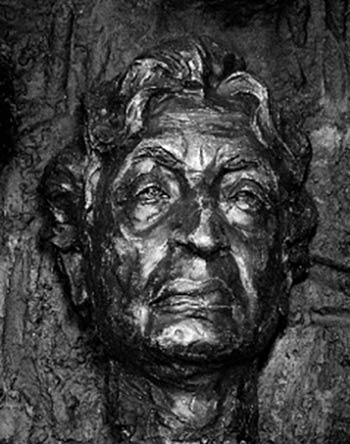
A portrait sculpture of Prof. Gananath Obeysekera by Prof. Sarath Chandrajueewa
In contrast, while deeply interested and trained in psychoanalytic theory and methodology at the University of Washington, Seattle, by European specialists, Gananath appreciated and powerfully theorised the public, social nature of Exorcist Rituals (Bali Thovil) and other such therapeutic practices.
Further, he showed how the rituals, based on folk beliefs, were imaginative, performative public events with an ‘audience’ participating in them and their importance as witnesses, for the cure. In these, the female ‘patient’ or woman possessed of demons danced to drum beats in ecstatic trance, resisting through spirited dialogue, the Exorcist (Kattadirala), who embodied patriarchal authority and even physical violence. In these rituals the possessed woman is given a public arena to play (dance) in, and while the ritual has a familiar cultural ‘script’ so to speak, the possessed woman has every chance to improvise and play as she desires or as the demons (all male) possessing her desire.
It is clear through this work that, contra psychoanalysis, the unconscious is not structured like a language and the repressed is insighted to find expression through trance-dance and vocal expression which go against traditional notions of femininity. In ecstatic states the patient is animated by drum beats that touch her nervous system directly and thus the entire body, revealing deep registers of affective trauma, that a purely static, talking cure (while lying down on, what became, that famous couch, now preserved in the Freud Museum in London) could not possibly do.
Dimuthu brings all this out lucidly, not only with the questions he poses to Gananath but also by placing the relevant photographs or clips within the interview sequences themselves. This montage technique of placing carefully chosen stills and clips from Gananath’s very extensive ethnographic archive, interspersed with the ‘Talking Heads’ interviews, makes the film very lively and watchable. It also teaches us something about the complex theoretical ideas Gananath worked with in an accessible way because of his powers of ‘scientific’ rigorous ethnographic observation, tempered by a Buddhist Humanist empathy and engaging style of writing so rare in scholarship.
Perhaps the film would encourage young scholars to read Gananath’s writing as Dimuthu did even before he entered the University. And I hope it encourages the translation of at least some of his major work. The film is significant in this sense, too, because Gananath did not accept the orthodoxy in his field and questioned received methodologies and theories. His critical mind is truly dazzling in its generosity of spirit and sense of curiosity even so late in his retirement. We hear him say, ‘Even now (then in his 80s, soon to be 95!), I am learning something new every day in the Uva-Wellassa area’ and exhorts us also to make that a goal. Yes, let’s!
Gananath’s use of the idea of the unconscious, via Freudian Psychoanalysis, in his ethnographic theorisation of rituals was enabling methodologically. It provided a key theoretical concept for understanding the actions performed by men and women under immense mental and physical duress, which went against the mandated gender norms of the traditional culture. I remember in the 1980s how Gananath was severely criticised by Marxists for ‘indulging in and validating superstitious folk beliefs and practices’ among the so called, ‘ignorant peasantry’.
The whole nexus of folk beliefs and cultural practices, including aspects of Hinduism, and their integral articulation with Buddhism, practiced as a popular religion with rituals and dramatic enactments by these rural communities was dismissed in a simplistic rationalist critique, as myth, hence false. But what has survived time, as an anthropologically cogent theoretical analysis based on meticulous, imaginative ethnographic work, is Gananath’s central argument about the hybrid, generous, inclusive nature of Buddhism as a religion, practiced in the robust, open folk traditions, by the peasantry. Dinidu gives considerable time to Dr Kumudu Kusum Kumara, who explains Gananath’s very detailed, complex argument and research with clarity and imagination in the film.
Buddhist Humanism or ‘Protestant Buddhism’
Kumudu explains the significance of Gananath’s formulation of the concept of ‘Protestant Buddhism’ introduced by the Theosophist Colonel Olcott in the 19th Century, who schooled the Buddhist revivalist Anagarika Dharmapala in constituting a Sinhala-Buddhist Catechism based on the Thripitakaya (the canonical Buddhist text), fit for school children in Daham Pasal modelled on Sunday School for Christian kids. He explains how this was a rationalising, westernising move, following Max Weber’s thinking here. Gananath’s brilliant coinage ‘Protestant Buddhism’, which was also strongly aligned with the Nationalist Anti-Colonial Movement, rationalised religious practices making them exclusive. A Victorian-English-Protestant-Puritanism thus entered Buddhism in Lanka, making it more akin to Protestantism in Europe which had a very severe moral code. Thereby the inclusive flexibility of the Buddhist folk tradition with its humour and sense of play, is lost along with, crucially, the story-telling tradition based on the Jataka Tales of the Buddha’s many rebirths, parables about ethical behaviour towards all living beings.
With this loss, we are told, the tradition of Buddhist Humanism, with its values of compassion as exemplified in these stories teaming with natural life and animals, too, also disappeared. Further, through this loss the ethical values nurturing and sustaining ‘a Buddhist Conscience’ were also lost, he argues. We are shown (via images), how the painterly folk tradition in Temple Murals and the literary sources, song, poetry (kavi), trance-dance, drumming, dramatic enactments within the folk traditions (as distinct from the official chronicles of the Mahavamsa and Deepawams), offered an alternative vision of Buddhism as practiced by the peasantry.
We learn that in the folk tradition Dutthagamini repented killing Elare the Tamil king and conscience struck, he attempted reparation and contrition, unlike the patricidal king Kashyapa who escaped into a hedonist life in the rock fortress of Sigiriya. Kumudu says that Gananath argued his case by reading the folk archive, of images on Temple walls and anonymous folk texts (Panthis Kolmura, a large corpus of 35 long poems, some of which he translated and also sang, Kadaym poth or Boundry texts and Vitti poth or Event books), which were authorless and title less work of the people, for the people and by the people. The film helps us to understand that it is this folk tradition, cultivating empathy and an ethical conscience, a capacity to be contrite, that has been lost within the post-independent ethno-nationalist version of official Protestant-Sinhala-Buddhism, with state patronage. This imported ideology of the English speaking coloniser is then presented as the ‘pure original Buddhism’ shorn of local superstition, hybrid folk tales and beliefs and rituals, rejected as ‘unBuddhist’. Indologists in turn supported this rationalising move of creating a ‘pure, original Buddhism’.
A Case Study
Kareem, a young Muslim man hangs on hooks (attached to a swing-like structure on wheels in a religious procession), as penance at the Kataragama Hindu festival and is also seen dancing in a trance. Gananath explains in his Case Study of Kareem that he was imprisoned in 1961 for assisting in the Army Coup against the Government. One wonders how a humble young Muslim cook got caught up in and imprisoned for a foolish Coup staged by a select group of English-speaking bourgeois gentlemen of Colombo, who were all high up in the armed forces of that era. Daughters of three of these officials who were arrested and served sentences were close friends of mine in school during this time, which heightens a sense of the absurdity of this poor man’s plight. Gananath’s case study of his childhood revealed an authoritarian paternal figure who instilled fear in him. However, he seemed serene and happy in the photographs taken with Gananath after the ritual and even when swinging from the ritual hooks.
Here, I would like to cite Arjun Appadurai’s review of Gananath’s magnum opus, The Cult of the Goddess Pattini because it is not readily available to those outside the academy.
“This is a book of unusual scope, quality, and scholarly significance. Ostensibly a description and analysis of a single cult in Sri Lanka, it is in fact a major symbolic, psychological, and ethno-historical study of practical religion in Sri Lanka, and of the relationship of that island to Indic culture and society. It is the product of two decades of field research by Sri Lanka’s most distinguished anthropological interpreter, and its combination of textual analysis, ethnographic sensitivity, and methodological catholicity makes it something of a blockbuster”.
Dimuthu informed me that Gananath studied six different traditions of the Pattini Cult, starting in the 1950s. Dimuthu and his research team went looking for the priests of each of these traditions named in his book and found that they had died but they did meet a student of Yahonis Pattini Mahattaya of the Rabaliya tradition and of Podi Mahaththaya, H. D. Edwin Pattini Mahatthaya, who is now the only living informant of Gananath’s Pattini research. Edwin Pattini Mahattaya performed aspects of the Pattini Cult for Gananath at his request for the sake of photo documenting it for his book. His son Tilak is seen dancing as Pattini in the Dimuthu’s film. Seeing him becoming Pattini (after his ritual investiture), even in an all too short clip, is among the high points of this film for me, because we see a profound metamorphosis of this young male ritual dancer into a female archetype, Pattini, the only Mother goddess of Lanka, in an inspired rhythmic play with codes of gender and beyond to reach an ecstatic body and spirit – words fail me. What we can also see is the profound gestural, rhythmic, spiritual transmission of this syncretic tradition across generations, across the abyss of death itself.
Pattini’s origins are in Kannagi, a heroic human figure from the Tamil Epic Silappadikaram, who is worshiped as a mother goddess, Kannagi-Amman, in India and in the East coast of Lanka by Tamils who still observe matrilineal descent (a system of tracing kinship through a person’s female ancestors), according to Gananath. The significance of this for gender and family relationships would be of particular interest to feminists. There is a large modern Bronze statue celebrating Kannagi in Chennai, India and colourful plaster ones and paintings in Hindu temples in Lanka, seen carrying her iconic anklet. (To be concluded)



 Going forward, it is hoped that a reported ceasefire agreement between the US and Iran would provide a basis for a degree of stability in the Middle East and pave the way for substantive peace talks between the powers concerned. The world is compelled to fall back on hope because there is never knowing when President Donald Trump would change his mind and plans on matters of the first importance. So erratic has he been.
Yet, confusion abounds on who has agreed to what. The US President is on record that a number of conditions put forward by him to Iran to deescalate tensions have been accepted by the latter, whereas Iran is yet to state unambiguously that this is so. For instance, the US side claims that Iran has come clear on the point that it would not work towards acquiring a nuclear weapons capability, but there is no official confirmation by Iran that this is so. The same goes for the rest of the conditions.
Accordingly, the peace process between the US and Iran, if such a thing solidly exists, could be said to be mired in uncertainty. Nevertheless, the wider publics of the world are bound to welcome the prospects of some sort of ceasing of hostilities because it would have the effect of improving their economic and material well being which is today under a cloud.
However, questions of the first magnitude would continue to bedevil international politics and provide the breeding ground for continued tensions between East and West. Iran-US hostilities helped highlight some of these divisive issues and a deescalation of these tensions would not inevitably translate into even a temporary resolution of these questions. The world community would have no choice but to take them up and work towards comprehending them better and managing them more effectively.
For example, there are thorny questions arising from the Treaty on the Non-Proliferation of Nuclear Weapons (NPT). Essentially, this treaty bans the processing and use of nuclear weapons by states but some of the foremost powers are not signatories to it.
Moreover, the NPT does not provide for the destroying of nuclear arsenals by those signatory states which are already in possession of these WMDs. Consequently, there would be a glaring power imbalance between the latter nuclear-armed states and others which possess only conventional weapons.
Such a situation has grave implications for Iran’s security, for instance. The latter could argue, in view of the NPT restrictions, that the US poses a security threat to it but that it is debarred by the Treaty from developing a nuclear arms capability of its own to enable it to match the nuclear capability of the US. Moreover, its regional rival Israel is believed to possess a nuclear weapons capability.
Accordingly, a case could be made that the NPT is inherently unfair. The US would need to help resolve this vexatious matter going forward. But if it remains, US-Iran tensions would not prove easy to resolve. The same goes for Iran-Israeli tensions. Consequently, the Middle East would remain the proverbial ‘powder keg’.
Besides the above issues, the world has ample evidence that it could no longer speak in terms of a united NATO or West. Apparently, there could be no guarantee that US-NATO relations would remain untroubled in future, even if the current Iran-US standoff is peacefully resolved. US-NATO ties almost reached breaking point in the current crisis when the US President called on its NATO partners, particularly Britain, to help keep open the Hormuz Straits for easy navigation by commercial vessels, militarily, on seeing that such help was not forthcoming. Such questions are bound to remain sore points in intra-Western ties.
In other words, it would be imperative for the US’ NATO partners to help pull the US’ ‘chestnuts out of the fire’ going ahead. The question is, would NATO be willing to thus toe the US line even at the cost of its best interests.
For the West, these fractious issues are coming to the fore at a most unpropitious moment. The reality that could faze the West at present is the strong opposition shown to its efforts to bolster its power and influence by China and Russia. Right through the present crisis, the latter have stood by Iran, materially and morally. For instance, the most recent Security Council resolution spearheaded by the US which was strongly critical of Iran, was vetoed by China and Russia.
Accordingly, we have in the latter developments some marked polarities in international politics that could stand in the way of the West advancing its interests unchallenged. They point to progressively intensifying East-West tensions in international relations in the absence of consensuality.
It is only to be expected that given the substance of international politics that the West would be opposed by the East, read China and Russia, in any of the former’s efforts to advance its self interests unilaterally in ways that could be seen as illegitimate, but what is sorely needed at present is consensuality among the foremost powers if the world is to be ‘a less dangerous place to live in.’ Minus a focus on the latter, it would be a ‘no-win’ situation for all concerned.
It would be central to world stability for International Law to be upheld by all states and international actors. Military intervention by major powers in the internal affairs of other countries remains a principal cause of international mayhem. Both East and West are obliged to abide scrupulously with this principle.
From the latter viewpoint, not only did the West err in recent times, but the East did so as well. Iran, for instance, acted in gross violation of International Law when it attacked neighbouring Gulf states which are seen as US allies. Neither Iran nor the US-Israel combine have helped in advancing international law and order by thus taking the law into their own hands.
Unfortunately, the UN has been a passive spectator to these disruptive developments. It needs to play a more robust role in promoting world peace and in furthering consensual understanding among the principal powers in particular. The need is also urgent to advance UN reform and render the UN a vital instrument in furthering world peace. The East and West need to think alike and quickly on this urgent undertaking.
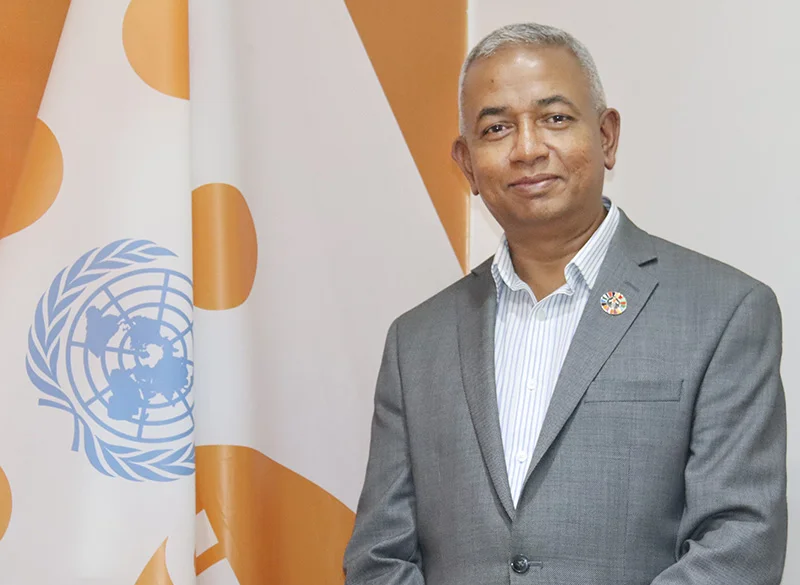
Marking World Health Day on April 7, health experts have called for a stronger commitment to science-based decision-making to address increasingly complex and evolving health challenges in Sri Lanka and beyond.
Dr. Dayanath Ranatunga, Assistant Representative of the United Nations Population Fund, stressed that health is no longer confined to hospitals or traditional medical systems, but is shaped by a broad spectrum of social, environmental, and technological factors.
“This year’s theme, ‘Together for Health. Stand with Science,’ reminds us that science is not only for laboratories or policymakers. It is a way of thinking and a tool that shapes everyday decisions,” he said.
Dr. Ranatunga noted that modern health challenges are increasingly interconnected, ranging from infectious diseases such as COVID-19 to climate-related risks, demographic shifts, and emerging forms of online violence.
He warned that maternal and newborn health continues to demand urgent attention despite progress. Globally, an estimated 260,000 women died from pregnancy and childbirth-related causes in 2023 alone—many of them preventable through timely, science-based interventions.
“In countries like Sri Lanka, where fertility rates are declining and survival rates improving, every pregnancy carries greater significance—not just for families, but for the future of communities and economies,” he said.
The UNFPA official also highlighted the growing threat of Technology Facilitated Gender-Based Violence (TFGBV), including cyber harassment and online abuse, noting that these forms of violence can have deep psychological consequences despite lacking visible physical harm.
He emphasised the need for multidisciplinary, science-informed approaches that integrate mental health, digital safety, and survivor-centered care.
Turning to demographic trends, Dr. Ranatunga pointed out that increasing life expectancy is bringing new challenges, particularly the rise of non-communicable diseases such as diabetes, cardiovascular illnesses, and cancers.
In Sri Lanka, nearly 13.9% of mothers develop diabetes during pregnancy, a trend attributed to obesity and unhealthy lifestyles, underscoring the urgent need for preventive healthcare strategies.
“Are we investing enough in prevention?” he asked, noting that early intervention and healthier lifestyles could significantly reduce long-term healthcare costs, especially in a country with a free public healthcare system.
He underscored the importance of data-driven policymaking, stating that scientific research and analytics enable governments to identify gaps, anticipate future needs, and allocate resources more effectively.
The UNFPA, he said, is already leveraging tools such as Geographic Information Systems (GIS) to improve access to maternal healthcare, including mapping travel times for pregnant women to reach health facilities.
Digital innovation is also transforming healthcare delivery, from telemedicine to real-time data systems, improving efficiency and ensuring continuity of care even during emergencies.
In Sri Lanka, partnerships between the government and development agencies are helping to modernise training institutions, including facilities in Batticaloa, equipping healthcare workers with both clinical and digital skills.
However, Dr. Ranatunga cautioned that technology alone is not a solution.
“It must be guided by evidence and grounded in equity,” he said, pointing out that women’s health remains significantly underfunded, with only about 7% of global healthcare research focusing on conditions specific to women.
He also drew attention to the growing health impacts of climate change, including extreme weather, food insecurity, and displacement, describing it as an emerging public health crisis.
“Health does not begin in hospitals. It is shaped by the environments we live in, the choices we make, and the systems we build,” he said.
Calling for renewed commitment, Dr. Ranatunga urged stakeholders to invest in prevention, embrace innovation, and ensure that science remains central to policy and practice.
“Science is not just about knowledge—it is about ensuring that everyone has the opportunity to live healthy, dignified lives, and that no one is left behind,” he added.
By Ifham Nizam

 Melantha Perera is well known as a very versatile musician.
He was involved with the band Mirage, as their keyboardist/vocalist, and was also seen in action with other outfits, as well, before embarking on a trip to Australia, as a solo artiste.
I now hear that he has plans to operate as a trio.
However, what has got many talking about Melantha, these days, is his awesome work with the visually impaired Bright Light Band.
They have worked out a special song for the Sinhala and Tamil New Year, aptly titled ‘Awurudu Kaale.’
Says Melantha: “This song has been created to celebrate the spirit of the Sinhala and Tamil New Year and to share the joy of the Awurudu season with all Sri Lankans”.
Yes, of course, Melantha composed the song, with the lyrics written collaboratively by Melantha, Badra, and the parents of the talented performers, whose creative input brought the song to life during moments of inspiration.
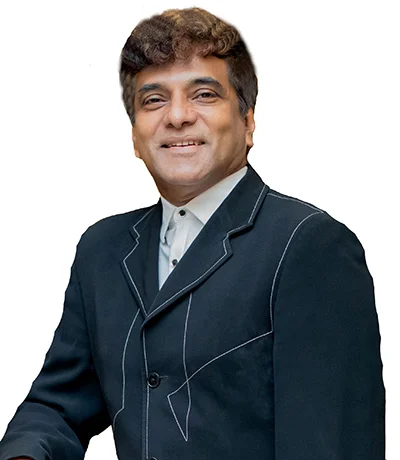
Melantha Perera: Awesome work with Bright Light Band
This meaningful collaboration reflects the strong community behind the Bright Light Band.
According to Melantha, accompaning the song is a vibrant video production that also features the involvement of the parents, highlighting unity, joy, and togetherness.
Beyond showcasing their musical talents, the visually impaired members of Bright Light Band deliver a powerful message, through this project, that their abilities extend beyond singing, as they also express themselves through movement and dance.
Melantha expressed his satisfaction with the outcome of the project and looks forward to sharing it with audiences across the country during this festive season.
He went on to say that Bright Light Band extends its sincere gratitude to Bcert Australia for their generous Mian sponsorship, the CEO of the company, Samath Fernando, for his continuous support in making such initiatives possible, and Rukshan Perera for his personal support and encouragement in bringing this project to completion.
The band also acknowledges Udara Fernando for his invaluable contribution, generously providing studio space and accommodating extended recording sessions to suit the children’s availability.
Appreciation is warmly extended to the parents, whose unwavering commitment from ensuring attendance at rehearsals to supporting the video production has been instrumental in the success of this project.
Through ‘Awurudu Kaale’, Bright Light Band hopes to spread festive cheer and inspire audiences, proving that passion and talent know no boundaries.

BCCI curbs movement of benched IPL players in latest rules

Prasidh trumps Miller in last-ball finish as Gujarat Titans clinch thriller

Greece to ban social media for under-15s from next year

Showers will occur at a few places in the Western, Sabaragamuwa and North-western provinces and in Galle, Matara, Kandy, Nuwara-Eliya and Mannar districts after 2.00 p.m.

Sun directly overhead Chilaw, Bingiriya, Halmillawewa, Panduwasnuwara, Gokarella, Kawudupelella, Koppaveli and Kirankulam about 12:12 noon. today (09)

Heat Index at Caution Level in the Western, Sabaragamuwa, Southern, Eastern, North-western, Northern and North-central provinces and in Monaragala district

‘Dates have the highest sugar content to fight Coronavirus’

Sunday Island 27 December – Headlines

#SundayIsland 17th December – Headlines

Sunday Island – 28th March

Sunday Island Headlines – 21 March

Sunday Island – 21st February – Headlines
-

 Features4 days ago
Ranjith Siyambalapitiya turns custodian of a rare living collection
-

 News4 days ago
Global ‘Walk for Peace’ to be held in Lanka
-

 News2 days ago
Lankan-origin actress Subashini found dead in India
-
 Opinion6 days ago
Hidden truth of Sri Lanka’s debt story: The untold narrative behind the report
-

 Features4 days ago
Beyond the Blue Skies: A Tribute to Captain Elmo Jayawardena
-

 Features4 days ago
Aspects of Ceylon/Sri Lanka Foreign Relations – 1948 to 1976
-
 Features6 days ago
The Ramadan War
-

 Editorial5 days ago
Brouhaha over a book