
Politics
A march, a tweet, some angst and mild sabre-rattling

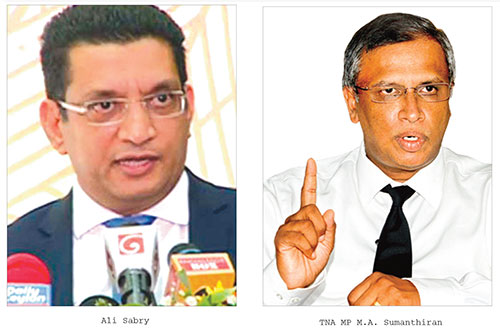
by Malinda Seneviratne
If something deserves to be called ‘Event of the Week’ it would be the ‘Pothuvil to Poligandy (P2P) March’ which ended on Sunday, February 7. At the end of the march there were around 2,000 people. Most significantly, it was an event that saw the participation of both Tamils and Muslims. The basic differences in grievances were obviously negated by a felt need to be united against, let’s say, a perceived common enemy, the Government to some, ‘Sinhala Chauvinism’ to others.
It marked also, as D B S Jeyaraj has mentioned in his weekly column, a return of sorts to non-violent protests. Now it is not that all Tamil and Political action was violent. There have been all kinds of non-violent protests even during the conflict. However, this was a sustained, determined and even colorful affirmation of a politics that harked back to a different time. ‘The Satyagraha of 1961,’ is what Jeyaraj was reminded of. There are two interesting statements that are related to this march. First we had the government withdrawing STF security assigned to TNA MP M.A. Sumanthiran. Sumanthiran retorted, ‘if something happens to me the Government will be held responsible.’ Now the agitation of the man does seem misplaced considering that he was involved in a five-day march (ok, he may not have be ‘on the moving spot’ all five days, but still! Was he not worried about security? Also, Sumanthiran has openly supported the LTTE, indulged heavily in Eelam-speak as well as celebration of the terrorists. He would do well to reflect on the fate of others who came before who did the very same thing, especially the leader of the TULF, Appapillai Amirthalingam. Amirthalingam spouted rhetoric which was like an endless nutritional feed to extremism. The beast, in his insatiable hunger, at one point did much more than bite the hand that fed it. One hopes that things don’t snowball to a repeat of all that, but Sumanthiran, having seen what happens to hands thrust into fires ought to keep his in his pockets. Nevertheless, withdrawing security granted on a threat perception is an overreaction.The second is a hilarious tweet from the tweet-happiest diplomat in Colombo, Alaina B Teplitz: ‘#Peacefulprotests is an important right in any #democracy and significant, legitimate concerns should be heard. I saw Tamil media coverage of the march from Pottuvil to Point Pedro and wondered why it was not more widely covered by Colombo-based media?’She has a point. The English, Sinhala and Tamil media have different preferences that have little to do with newsworthiness. Perhaps it is all about the target audience; after all there’s a reason why entertainment value has framed reporting and presentation, why sensationalism has become an important driver and so on. This holds for different media houses as well; owners have agendas. Nevertheless, there is a serious problem if matters of political significance are down-played or ignored altogether, one has to question the sense of responsibility of the particular media institutions.On the other hand, we cannot ignore the ‘Season of Vexatious Persecution’ (i.e. the annual human rights circus in Geneva) which is all about whipping things up from December to February. Now it could be a coincidence that P2P was organized at this particular moment, but few will buy it considering the personalities involved and their political history. The Teplitz tweet only serves to add credence to the view that this was just another side show of the above mentioned circus. The tweet also indicates an important fact: Teplitz is running out of slogans. Before we get to that, let’s have a say on the key words — the hash tagged ‘peaceful protests,’ ‘democracy’ and ‘legitimate concerns.’ It is downright laughable for a US diplomat to talk about such things given that country’s absolute rubbishing of such things, domestically and internationally. That aside, there’s the fact that Teplitz has been pained to the point that she has to whine about media coverage. Is it that a pet project directly or indirectly sponsored, planned and executed, didn’t move as many Tamils and Muslims as was envisaged? We didn’t hear Muslim and Tamil leaders complaining about news coverage. Have they deferred that kind of task to Teplitz? If that’s the case, who is the pawn or who are the pawns here? Is it Teplitz? Are they Tamil and Muslim leaders who in their wisdom believe that the best bet to get grievances, real or imagined, sorted and aspirations, reasonable or outrageous, fulfilled is to support the US in securing strategic objectives in Sri Lanka? If such happens (not a certainty, certainly) do they believe they’ll get some crumbs off the table? And what does all this have to say about the agency of Tamil and Muslim citizens? Are they too pawns? Indeed, are all peoples of all communities pawns in games where they are sacrificed at will? Jeyaraj sees in P2P ‘a remarkable show of solidarity and unity’ between the Tamil and Muslim communities. He does exaggerate about the numbers (tens of thousands, he says) and deliberately introduces the ‘Tamil-speaking’ qualifier which Tamil nationalists have often used to rope in rhetorically ‘The Muslims’ to their various political projects. Jeyaraj remembers 1961 but has forgotten the late eighties when M H M Ashraff (in)famously stated that even if Prabhakaran abandons Eelam, he would not. He dialed down the rhetoric over the next decade, but what did Prabhakaran do to the (Tamil-speaking) Muslims, has Jeyaraj forgotten? The LTTE ethnically cleansed the Jaffna Peninsula of Muslims. The LTTE turned one in ten Muslims into refugees, slaughtering dozens, driving them off their homes, seizing properties etc. Muslim leaders cannot pretend to be unaware of that history. Muslim Affairs, if you will, featured in other ways over the week. Recently returned to Parliament, Ven Athureliye Rathana Thero presented a private member’s bill to repeal the Muslim Marriage and Divorce Act. Justice Minister Ali Sabry who prior to entering Parliament championed the notion ‘One Country, One Law,’ responded by saying ‘steps are being taken to amend the Muslim Laws and that a Cabinet Paper had already been presented in that regard.’Elaborating, Sabry said that the Cabinet Paper sought to amend the minimum marriageable age of Muslim girls to 18, to permit women to act as Kathis and also to make it necessary to get the consent of Muslim women when they get married.That’s it? That makes it ‘One Country, One Law’? Sabry must do a serious rethink on what he says and does and the meaning of the terms he uses (so loosely!).
 He is correct when he says that ‘if the personal laws were to be abolished, all the personal laws such as Muslim Laws, Kandyan law and Thesawalamai Law should be abolished altogether.’ ‘Through a social discussion,’ he adds. There’s been enough social discussion, he knows this. One-country-one-law would certainly call for abolishing all customary laws. His concern seems to be limited to correcting existing laws that privilege Muslim men over Muslim women. That’s not even scratching the surface of the problem though!
Here are a question for Sabry: Are there plans to abolish polygamy (can’t have it for some and not others, no?)? Here’s another: The Special Parliamentary Committee on Extremism appointed by the previous administration presented a report in February 2020 recommending extensive measures with respect to Muslim laws as well as ‘educational’ institutions — have you read it? Are you in agreement? If so, what have you done so far? Are you planning to defer everything to the experts tasked to draft a new constitution? What are those experts doing by the way? When will we see a draft? And finally, what exactly do you understand by ‘One country, one law’? Let’s have some answers, please.
This week also saw Wimal Weerawansa making some news. He openly advocated a prominent and even principal role for Gotabaya Rajapaksa in the SLPP leadership. He was taken on by the General Secretary of the SLPP, Sagara Kariyawasam who questioned Wimal’s rights to talk of the SLPP since he’s not a member. Wimal retorted that people in the SLPP talk of other parties. Sagara wondered what Wimal’s fate would be had he and his party contested independently. Wimal pointed out that Sagara, a national list MP, hadn’t even contested.
Light banter at best. Some sections of the Opposition have salivated, naturally. They believe and talk of ‘a rift!’ in the Rajapaksa camp, friction between the brothers (Wimal’s antipathies to Basil being well known).Too early to conclude such of course, but as debating points go, both Wimal and Sagara have scored. What this ‘scoring’ says about the future of the SLPP is of course left to be seen. There’s bound to be differences of opinion in any political coalition. If everyone was on the same page there wouldn’t be a coalition in the first place. You win some, you lose some — this is something that junior or weaker partners know very well (ask Prof Tissa Vitarana of the LSSP).
The so-called ‘smaller parties’ did make a lot of noise regarding the East Container Terminal issue. It seems, as of now, that the ‘big party’ listened. Whether they’ll still have the ‘big ear’ regarding the West Container Terminal is left to be seen. On the other hand, we know the story about the dog and the tail, no offense to canines or tails.
Politicians and political parties are about power and about elections. If, for example, Champika Ranawaka and the Jathika Hela Urumaya, having broken ranks with the UPFA decided to go it alone and not join the UNP-led coalition as they did, where would Ranawaka be today, one might ask. Indeed is it not such questions that persuaded him to resign from the JHU and become a 100% SJBer, one could also ask. There are no elections in sight, but when they do come around, all parties big and small will revisit ‘coalition’ and calculate the impact of decisions (and rhetoric) on electability.
For now, though, noises can and will be made. The likes of Wimal would have to pick their battles and select decibel levels. That said, his point about the distance between president and parliament on account of political sway within the party is valid. It goes without saying that the effectiveness of a program sometimes comes down to parliamentary weight which of course can be deployed best if the executive has a degree of control. The President either doesn’t have it or cannot count on it or imagines he doesn’t need it. He could ask his brothers, both veterans in this respect. That however might mean give-and-take, if we were to believe the notion that the brothers are bound by blood but not about vision.
India, meanwhile, is not happy, going by statements issued regarding the East Container Terminal. India cannot be happy about the ‘Chinese Footprint’ whose size was considerably expanded by the previous government by virtually handing over the Hambantota Port to China. India cannot be happy about energy projects given to the Chinese. India cannot be happy about the scheduled visit by Pakistan Prime Minister Imran Khan and MoUs that are said to be signed and/or renewed.
India speaks of Sri Lanka ‘reneging’ on an MoU. However, India forgets that MoUs are not exactly agreements, signed after crossing the t’s and dotting the i’s. They are by definition non-binding and amenable to change. Circumstances can change and changing circumstances have to be taken into account.
If an agreement causes political instability it would be foolish for a government to go ahead with it. If, prior to inking an agreement, one party (India in this case) stands with a country that seems hell bent on bullying Sri Lanka (the USA in this case), then it would be silly for that party to assume that the counterpart be oblivious to such developments. If one party has in the part ‘reneged’ (as India has with respect to the Indo-Lanka Accord which from the get-go was a product of shamelessness bullying and moreover was heavily slanted in India’s favor), then that party should be careful before using the word.
And on the subject of ‘foreign affairs,’ we have Dinesh Gunawardena claiming that Sri Lanka is not afraid of the soon to be tabled resolution in Geneva. There are 47 members in the Human Rights Council (HRC). The Minister of Foreign Affairs cannot be saying ‘the majority are with us.’ The brave words could probably mean ‘we expect this, we know the consequences, we know it’s the work of nations wallowing in a cesspool of bias, we know that they’re hinting at sanctions, we know what the UN itself has found out about the impact of sanctions in other countries, especially Venezuela in recent times, we know there’s talk of taking things to the General Assembly and then the Security Council, we know who our friends are and more importantly who our enemies are, and we know what it takes to secure sovereignty to the extent possible.’ Dinesh Gunawardena might not elaborate in the above manner. After all, he is required to be ‘diplomatic’ although he is not averse to calling a spade a spade. ‘Geneva’ is just over a week from now. A resolution is likely to be tabled. It is likely that it will be passed. Most importantly, it will show us what India’s ‘neighborhood first’ foreign policy is really about.
malindasenevi@gmail.com. www.malindawords.blogspot.com.



On Monday, April 28, Canadians gave the Liberal Party its fourth successive mandate, albeit as another Minority Government but much stronger than in the last two elections, and, more importantly, with a different Prime Minister. Justin Trudeau who had been Prime Minister from 2015 was forced to resign in January 2025 on account of his perceived electoral unpopularity. Trudeau was succeeded by Marc Carney, 60 year old former Governor of the Bank of Canada and later the Bank of England, who dramatically revived the falling fortunes of the Liberal Party and secured its fourth mandate in 10 years.
The Liberal Party and Prime Minister Mark Carney owe their good fortunes to the presidential madness that is going on south of the border, in the United States of America. With his mercurial obsession over tariff’s and recurrent musings about making Canada America’s 51st State, President Trump painted the backdrop to the Canadian election. Trump’s antics did not go down well with the Canadian public and in a rare burst of patriotism the people of Canada overarched their diversities of geography, language, culture, religion and ethnicity, and rallied round the Maple Leaf national flag with utmost determination to stick it to Trump and other Ugly Americans of his ilk.
People and businesses in Canada shunned American products, stopped travelling to US holiday destinations and even took to booing the US national anthem at sporting events involving US and Canadian teams. The threat of economic pain due to a tariff war is real, but Canadians are daring to suffer pain rather than become a part of the US. And Justin Trudeau showed his best leadership in his last days as Prime Minister. Combining diplomatic skill and splendid teamwork with eloquent defiance, Trudeau succeeded in forcing Trump into what has since become Trump’s modus operandi in implementing his idiosyncratic tariff policy: tariff, one day; pause, the next day; and uncertainty, extended indefinitely.
100 Days of Disaster
What he began with Canada and Mexico, Trump has since writ large upon the whole world. His second term is already a term of chaos not only for America but also for the whole world economy. The US economy is officially in first quarter contraction. Another four months, it could be a man made recession of what was in January an economy that was humming sound and was easily the best performing one in the world. It’s only 100 days of the second term, and what is left of it is looming as eternity. “Only 1,361 Days to Go,” is the cover page heading of the latest issue of the Economist. That sums up America’s current state of affairs and their global spillover effects.
Americans are beginning to sour on Trump but there is no way for them to channel their frustrations and anger to force an immediate executive retreat. Trump has reduced the Republican Party to be his personal poodle and with Republics holding slender majorities in both the Congress and the Senate, the Legislative Branch of the US is now wholly beholden its Executive. The traditional wait is for the midterm Congress elections in two years. But Trump has no respect for traditions and conventions, and it would be two years too much before a Democratic majority in the two houses could bestir the Congress to check and balance the runway president.
The Judicial Branch is now playing catch up after the Supreme Court had given Trump near absolute immunity and enabled his second coming. The lower courts are applying the law as they should and stymieing Trump’s palpably illegal orders on everything from deporting immigrants, to downsizing government, and gutting the country’s university system. The tariff cases are slowly making their way to courts and they will add more confusion to the running of the economy before some kind of sanity is restored. Overall, by upending a system of government that has been constitutionally evolving over 200 years, Trump is providing a negatively sobering demonstration that no system is foolproof if a capable fool is elected to take over the reins of government.
Fortunately for the world, other governments and polities have been quick in drawing the right lessons from the demonstration effects of Trump on their American cousins. Trump’s excesses have had a dampening effect on right wing populism in other countries. The Canadian elections are one such demonstration. Another is expected in Australia where national elections are scheduled for Saturday, May 3. In Europe, right wing populist parties are scaling down their rhetoric to avoid facing local backlashes to Trump’s American excesses.
No populist leader anywhere wants to go where Trump is blindly heading, and no one is mad enough like him to think that imposing tariffs is the way to grow a national economy. In Hungary, its strongman Viktor Orbán after securing super majorities in four elections since 2010, is facing the real possibility of defeat in the national elections next year. Orban is regressively anti-Eu while 86% of Hungarians want to strengthen their EU ties, and they are naturally getting tired of Orban’s smearing of the EU just like all Europeans are getting tired of Trump’s and his VP Vance’s anti-European rhetoric.
Canada Holds its Own
Canada, despite its proximity to the US, has never been a haven for Trump’s right wing populism. Yet there have always been and continue to be pockets of support for Trumpism in Canada, and they have found their sanctuary within the Conservative Party of Canada and behind its leader Pierre Poilievre, a 45-year old career politician who entered parliament in 2005 at the age of 25 and became Leader of the Conservative Party and Leader of the Opposition 18 years later, in 2023.
Clever and articulate with an ability to spin rhyming simplistic slogans, Poilievre cultivated his political base by feeding it on a diet of vitriolic and vulgar personal attacks and advertisements denigrating then Prime Minister Justin Trudeau. Poilievre identified himself with the 2022 truck convoy protest that stormed Ottawa, cheered on by MAGA America, and he came to be seen as Canada’s Trump-lite (not unlike Peter Dutton, the Leader of the Opposition in Australia). Nonetheless, Poilievre’s attacks on Trudeau worked in the post-Covid climate of economic hardships and Trudeau’s popularity sank to the point that his own MP’s started calling for his resignation.
Alas for Poilievre, Trudeau’s resignation in January took away the one political foil or bogeyman on whom he had built his whole campaign. In addition, while his attacks on Trudeau diminished Trudeau’s popularity, it did not help enhance Mr. Poilievre’s image among Canadians in general. In fact, he was quite unpopular outside his base of devotees. More people viewed him unfavourably than those who viewed him favourably. Outside his base, he became a drag on his party. He would even go down to defeat in his own electorate and lose his seat in parliament that he had held for 20 years.
Mr. Poilievre’s troubles began with the emergence of Mark Carney as the new Liberal Leader and Prime Minister – looking calm, competent and carrying the ideal resume of experience in dealing with the 2008 financial crisis as Governor of the Bank of Canada, and calming market nerves after the 2016 Brexit referendum as Governor of the Bank of England. Carnie, who had never been in formal politics before, seemed the perfect man to be Prime Minister to weather the economic uncertainties that President Trump was spewing from Washington. Almost overnight Liberal fortunes shot up and after resigning themselves to face a crushing defeat with Trudeau at the helm, Liberals were suddenly facing real prospects of forming a majority after two terms of minority government.
In the end, thanks to the quirky genius of the electorate, Liberals ended with 168 seats with 43.7% of the vote, and four seats short of a majority in the 343 seat national parliament, while the Conservative Party garnered 144 seats with 41.3% vote share. Both parties gained seats from their last election tallies, 15 new seats for Liberals and 16 for Tories, and, unusual in recent elections, the two parties garnered 85% of the total vote. The increases came at the expense of the two smaller but significant parties, the left leaning New Democratic Party (reduced from 24 to seven seats); and the Bloc Québécois (reduced from 45 to 23 seats) that contests only in the French majority Province of Quebec. The Green Party that had two MPs lost one of them in the election.
In the last parliament, the New Democrats gave parliamentary support to the minority Trudeau government in return for launching three significant social welfare initiatives – a national childcare program, an income-based universal dental care program, and a pharmacare program to subsidize the cost of prescription drugs. These are in addition to the system of universal public health insurance for hospitals and physician services that has been in place from 1966, thanks again to the programmatic insistence of the New Democratic Party (NDP).
But the NDP could not reap any electoral reward for its progressive conscience and even its leader Jagmeet Singh, a Sikh Canadian, lost his seat in the election. The misfortune of the NDP and the Bloc Québécois came about because even their supporters like many other Canadians wanted to entrust Mark Carney, and not Pierre Poilievre, with the responsibility to protect the Canadian economy from the reckless onslaughts of Donald Trump.
Yet, despite initial indications of a majority government, the Liberals fell agonizingly short of the target by a mere four seats. The Tories, while totally deprived of what seemed in January to be the chance of a landslide victory, managed to stave off a Liberal sweep under Mark Carney. The answers to these paradoxes are manifold and are part of the of reasonably positive functioning of Canadian federalism. The system enables political energies and conflicts to be dispersed at multiple levels of government and spatial jurisdictions, and to be addressed with minimal antagonism between contending forces. The proximity to the US helps inasmuch as it provides a demonstration of the American pitfalls that others should avoid.
by Rajan Philips

During the course of the Second World War, while defending her extensive empire in Asia, the British government sought to come to terms with nationalist forces in her dependencies of South Asia. Attempts were made in both India and Ceylon to negotiate a settlement of the constitutional problem with nationalist leaders and to give stability to the administration and strengthen the war effort. In India these protracted negotiations were a failure, because there was little common ground between the demands of the nationalists and the concessions proposed by the British. Disagreement between the two sections of the nationalist movement – the National Congress and the Muslim League – complicated matters further.
Similar efforts in Ceylon fared better, for the demands and attitudes of the nationalist leaders were more moderate, and the proposals of the British government were accepted without much ado. Both parties were agreed in principle as to the next step; the Ceylonese leaders, who were holding ministerial office, drafted a constitution along lines which were known to be agreeable to the colonial government. The process of reform was set in motion even while the war was on, and in July 1944 a commission was appointed, with Lord Soulbury as chairman, to examine the draft of the Ceylonese ministers, to receive other representations, and to recommend a constitution for Ceylon. The Soulbury Commission drafted a constitution that gave the island self-government in all matters of internal jurisdiction, retaining some safeguards to the British government in defense and the conduct of external affairs.
By the time the commission reported, the war had ended, and there was opportunity for a more concentrated attack on the problem. The Labour government, which was in power in Britain, decided to initiate a process of liberating those dependencies that were politically in a relatively advanced stage of development. India was to be given independence at whatever price. Political advance in Ceylon had been so closely connected with that of India that the decision to free India meant it was but a question of time before a similar decision would be applied to Ceylon.
At this moment the Ceylonese leaders urged politely but firmly that the last few restrictions to independence imposed by the Soulbury Constitution be done away with. The British government was receptive to these requests. It was convinced that the leaders with whom it negotiated and who were likely to hold power in Ceylon for some time to come would be friendly to British interests. A decision was taken to confer dominion status on Ceylon. The few powers reserved in the Soulbury Constitution for the imperial government were also transferred to the Ceylonese legislature. These changes were incorporated in the Ceylon Independence Act of 1947.
The constitution of independent Ceylon was modelled largely on the British constitution. It introduced the system of parliamentary government as evolved in Britain and extended to the other self-governing dominions. It was rather different from the experimental system of government by executive committees introduced by the Donoughmore Constitution of 1931. By that constitution executive and legislative functions had been vested in a single body. In the British system executive power rests in the hands of a body chosen from and responsible to the legislature, the two functions are kept separate.
The legislature of independent Ceylon was bicameral and comprised the House of Representatives and the Senate. The House of Representatives was directly elected by popular vote, and the Senate was in part elected by members of the popular House and in part nominated by the governor-general. The only restrictions to the power of lawmaking were the safeguards written into the constitution against discriminatory laws against particular religious or communal groups. The governor-general occupied a position akin to that of the British monarch and exercised similar constitutional functions. He was appointed by the British sovereign on the advice of the prime minister of Ceylon. His chief constitutional function was the appointment of the prime minister, who was called upon to form a government on the basis of the electoral results as reflected in the House of Representatives.
The governor-general summoned, prorogued, and dissolved Parliament. All executive acts performed by the ministers were done in his name. In a country where the party system had not been defined with the clarity and precision it had in Britain, the governor-general had some measure of influence in the appointment of the prime minister and in the general conduct of affairs. After the prime minister was appointed from the largest political grouping in the lower house, he selected his ministers, who were then officially appointed to their positions by the governor-general. These ministers together formed the Cabinet, which was collectively responsible for the government of the country. Their power was sustained by a majority in Parliament; if they lost that majority, they would have to resign their offices.
The conventions observed in the conduct of affairs within the Cabinet and in the relation between Cabinet and Parliament were those of the United Kingdom. Proposals put forward by a minister were scrutinized and passed by the Cabinet and became the collective decision of the government. Legislation to give effect to these proposals was drafted by officials and presented to Parliament, where the government majority ensured its passage. On assent by the governor-general, it was enacted as law.
As in the United Kingdom, both by convention and by law, the attempt was made to separate the political section of the government from the administrative. The appointment, promotion, and dismissal of government officers of a higher grade was under a Public Service Commission which was directly responsible to the governor general. It was thus theoretically impossible for the ministers to interfere with appointments to the public service. A similar Judicial Services Commission functioned in relation to officers in the country’s judiciary.
The constitutional structure set up was thus a ready-made and comprehensive one and provided the machinery for a smooth transition from colonial rule to independence, It was a structure with which the Ceylonese leadership was familiar, if only through the pages of textbooks on the British constitution. Though the previous constitution operating in Ceylon had not been quite so closely modelled on these principles, some of the elements of the parliamentary system were already there. Most of the politicians who were preening themselves to take power in the new dispensation had already acquired considerable experience in political affairs.
The political institutions being Western, and the conduct of affairs mainly through the medium of English, it was the English-educated intelligentsia that produced the political leaders from the time that these representative institutions were introduced. Electoral results show that even the most remote rural districts chose members of this class to represent them in the legislature. The largely illiterate or semi-literate peasantry that formed the bulk of the population were not in a position to put up leaders of their own class and therefore had necessarily to choose members of the urban middle class who came forward and offered themselves as leaders.
Some of these men had the added advantage of having previously functioned as ministers under the old constitution and thus had already grappled with problems of government. A few of the leaders at the top had handled the delicate negotiations with the imperial government and had so impressed the latter by their qualities of statesmanship that even without popular clamour for independence the British government was persuaded that the Ceylonese could now manage their own destiny. All this experience was to be a great asset in the process of working out the new constitution and the fully self-governing status it conferred.
These new leaders had a common background of English education, though they came from widely different walks of life. Some of them belonged to the old landowning aristocracy and still held considerable land in their constituencies. They thus enjoyed the influence that went with their traditional family connections and had equipped themselves for leadership in the new age by imbibing the new ideas that the Westerner had brought. A totally different group was the “new rich,” those who had benefited from the economic opportunities opened by the British and had emerged as a native entrepreneur class with varying degrees of success. The rest belonged to the different professions, all of which had involved study of the English language. Predominant among these were the lawyers, who, as in contemporary India, provided more than their share of recruits for political leadership.
The common educational background and the values and ideals they shared gave homogeneity to this new leadership. Fundamentally, Ceylonese society was divided into a plurality of communal and religious units. These units were certainly not, at this stage, hostile to each other, nor did they have very much in common with each other. One could talk fruitfully of a Ceylonese nation only in terms of the English-educated intelligentsia. At this level, both socially and intellectually, took place the mixing of communal groups and the merging of communal differences. This westernized elite rose above the divisive factors in society and indeed gradually presented themselves as yet another of its many component groups. The one advantage was that its members were drawn from all parts of the island, all language groups, and all religions. They ran the administrative services of the country, taught in its schools, and strongly supported the political leadership of their English-speaking compatriots. Together they would ensure the smooth working of the new political institutions and the pursuit of certain ideals which they would seek to impart to the mass of the people.
In the process of making the constitution, a separate organization was formed to represent the interests of the Tamils. This demanded a formula of balanced representation to safeguard minority communities against domination by the Sinhalese majority. This organization, the Tamil Congress, was popular in North Ceylon, where the Tamils were concentrated. But many members of the English-educated section of the Tamils dissociated themselves from the Tamil Congress and grasped the hand of friendship offered by the Sinhalese. Furthermore, leaders of other minority communities willingly offered their cooperation to the Sinhalese. In the first Cabinet of in dependent Ceylon, all the major communities were represented.
Compared to the other countries that secured release from British tutelage at about the same time – India, Pakistan, and Burma – Ceylon’s economic situation may be described as sound. The average income of about 300 rupees per person per annum at this period compared favourably with that of most other Asian countries except Japan. The plantation sector of the country’s agriculture was doing well ell and fetching good prices in world markets. Tea, rubber, and coconut – all in good demand in world markets at that time – were the major exports and provided about 90 per cent of the country’s earnings of foreign exchange. No doubt, during the war much of the rubber had been slaughter-tapped to meet immediate needs, but there were great possibilities for future development. Tea estates were being managed excellently by British firms and by those few Ceylonese capitalists who had of late been investing in tea. During the war Ceylon had earned a lot of sterling – over a thousand million rupees – which, if managed carefully, could be utilized for the country’s economic development. There would be no lack of foreign exchange to undertake and finance long-term developmental projects.
The war had also been a disguised blessing in the matter of the production of food grains in the country. Earlier, the emphasis had been decidedly on cash crops; over 50 per cent of the rice consumed in the country had to be imported. Because of the interruption of the usual sources of supply and the difficulties of overseas trade, a great effort was made during the war to produce rice and other subsidiary crops. The increase in food prices gave added incentive to such activity, which was enthusiastically undertaken in the villages. The new government could make use of this enthusiasm and lend its strong support to this neglected aspect of the country’s economy.
There had also been a great improvement in the country’s health services during wartime. When Ceylon became the seat of the South East Asia Command, a large number of troops were stationed in all parts of the country. Thus, remote and inaccessible villages received attention they had not had before, and diverse modern amenities were made available to them. Among the most valuable of these was the concentrated fight against malaria, which had been the scourge of the Ceylonese peasant. The success of this campaign was seen in a significant drop in the incidence of this disease by 1947.
Nor was the educational level of the people at the time of independence discouraging. Roughly 60 per cent of the people were literate, if literacy in given its broadest definition. The school system was well organized, and, by an act of 1944, the state undertook the full cost of education in the country. Tuition fees were waived for all students from the kindergarten to the university. Though this was only a part of the costs incurred by a student for his education, it was no doubt a great blessing in a country of low incomes and large families. Teachers in all schools, government and private, were paid by the state.
It thus seemed that the outlook was bright when Ceylon was launched as an independent state in February 1948. There was every prospect that the democratic tradition would take root and that the country would progress toward material prosperity and contentment. Ceylon seemed to represent the ideal of advance from colonial status to a free nation. A closer look at the scene, however, showed some ominous portents.
It is an important feature of the political scene in Ceylon that its independence was achieved by negotiation and amicable discussions. The conference room and the council chamber were the scenes of activity, in contrast to the public demonstrations and civil disturbances of India. There was no occasion to associate and involve the masses in the struggle and to infuse in them the nationalistic emotion that would encourage them to make sacrifices in the cause of independence. The nationalist parties that were in existence toward the end of British rule spent more of their time fighting each other than fighting the colonial government and therefore did not see the need to enlist the active support of the masses on nationalist issues. Electoral battles of these years were mainly personal affairs fought on parochial lines. None of the parties had grass roots organizations on the village level. One has only to compare the two National Congresses, the Indian and the Ceylonese, to see the way in which the former towered over Indian politics from the date of its formation and the latter competed weakly with numerous other parties and died a natural death when independence was declared.
The manner in which the political negotiations for independence were carried out has given the impression that what happened in February 1948, was a private transfer of control from colonial rule into the hands of an oligarchy. The power elite at this time consisted of a few families from the dominant sectors of society. No doubt this oligarchy was confirmed in power by popular vote in 1947, but it was still an oligarchy in the sense that no outsiders could get into it. People who held the highest offices were connected by family ties, and the structure of politics resembled somewhat the politics of England under George III.
An even more important drawback arose from the fact that, by the very nature of politics and the political institutions, only the English-educated could aspire to power. Parliamentary government, freedom of the individual, and the whole structure of new ideas were comprehensible to them and them alone. With universal adult suffrage, every individual of the country had been emancipated and brought within the ambit of political power. Yet 95 per cent of the population could not aspire to positions of power because they were not equipped to acquire power and use it. They had been content since 1931, when adult franchise was introduced, to select their leaders from a class which was alien to them. How long they would remain so was another matter. When they comprehended the democratic process and saw to what use they might put it, they would no longer want to rely on the English-educated elite to represent them and manage their affairs.
The westernized elite was not different from the masses only in that they read, wrote, and spoke English. What was more disturbing was the cultural cleavage that separated them from the majority of the people. They had become a separate caste with some of the characteristics that separated traditional castes from each other. Their way of life, their dress, their speech, their cultural interests were different from those of the rest of the country. Most members of this clan had uprooted themselves from their traditional milieu and suffered the little that remained to tie them to traditional society like millstones stound their necks. Some of them had adopted Western culture and found satisfaction and happiness in it. Others were cultural “mongrels” or, at best, cosmopolitans indecisively trying to fuse aspects of diverse and often conflicting cultures.
Society was thus deeply divided in two: the English-educated and the others. Those not educated in English were condemned to subordinate roles in society. This was satisfactory so long as the mass of the people selected as their leaders members of the westernized oligarchy who were, after all, better equipped to administer the country’s affairs. This is what happened for a decade after independence, and it was found to work well. But it is useful here to recognize the malaise of Ceylon’s democracy at the time it was launched and to understand this source of discontent in the subsequent developments of the island’s history.
The westernized power elite that took over the leadership of the country was naturally oriented toward the West and looked to Britain for its lead in many matters. Its leaders could describe the island as a “little bit of England” and take pride in this description. British interests continued to dominate the country’s economy. A large part of the plantation sector was owned and managed by British companies, as was also a major share of the country’s trade and industry. The presence of British armed forces was insured by a defense agreement between the governments of the United Kingdom and Ceylon permitting the British to maintain their forces in Ceylon for its defense. This meant, among other things, that the large airfield at Katunayake and the beautiful natural harbour of Trincomalee continued to be under British control.
If the new leadership felt that it could ignore these factors, it was making a serious miscalculation. It was true that anti-British nationalism had never been born as a mass phenomenon in Ceylon. The absence of mass involvement in nationalist policies was both a cause and a symptom of this factor. Yet the continued physical presence of the British could become a source of irritation to nationalist sentiment. Unless the new government concentrated pressure for the gradual removal of the British, the latter’s presence was likely to be used by nationalist politicians as a weapon of attack against the whole new structure.
Indeed, there was already a point of view being voiced that the independence granted in 1948 was “fake”, that “real” independence could only be won with the removal of the Commonwealth links, as Burma had chosen to do. All British troops should quit the country, and no bases and other facilities should be granted to them. No doubt this was as yet a minority viewpoint and was limited in its circulation. The masses were neither overenthusiastic nor terribly disappointed at the tum of events.
For the successful working of the new constitution, a healthy party system had to develop. This was just beginning, all too shakily. The splinter groups that gathered around influential personalities in the Donoughmore era would not do now. Strong, vigorous political parties with firm and identifiable policies and leadership were required. No doubt the elite, as seen earlier, was familiar with the functioning of the parliamentary system in Britain. But in the actual task of making this system work there were found other difficulties inherent in Ceylonese society. In this respect, the effect of the whole Donoughmore structure had been against the growth of strong parties. Under the executive committee system, it had been unnecessary to attach oneself to a political party – in fact it might have been a handicap to do so. The spirit of compromise so essential to the formation of a party had not developed. It was impossible to produce this overnight.
A significant step was taken when the legatees of political power organised themselves into the United National Party (UNP) under the leadership of Mr. D. S. Senanayake. Into this party came members of many groups, communal and otherwise, of the Donoughmore era. Its major constituent units were the Ceylon National Congress, the Sinhala Maha Sabha, and the Muslim League. Most of the other non-party politicians from all sectors of society decided to join this party also. Being assured of a tenure of political power, it assumed the aspect of a bandwagon; drawing to it people of diverse political origin, some of whom had no idea that politics had anything to do with principles, this coalition still had to be shaped into a meaningful political grouping. Being the governing party, it had to acquire a political philosophy, a policy, and a sense of disciplined behaviour.
Outside the UNP were a number of smaller parties unrelated to each other. On the far left were three Marxist parties – the Lanka Sama Samajist Party (LSSP), the Bolshevik Leninist Party, and the Communist Party – divided among themselves on both ideological and personal grounds. Quite different from these parties of the left were two communal organizations representing two of the island’s minority communities. The Tamil Congress sought to represent those Tamils who had been domiciled in Ceylon for centuries. This party was dissatisfied with the weight given to minorities under the new constitution. Its aim was to unite the Tamils under one flag so that they could put pressure on the Sinhalese and resist any encroachment on their rights. The Ceylon Indian Congress represented the interests of the Tamils who had immigrated to Ceylon within the last hundred years. The bulk of them were plantation workers, from whom the main strength of this party was drawn.
Thus, on the eve of independence there was available a political party to take up the reins of office. But for the efficient working of parliamentary government it is not sufficient that there be a party in office; there should also be a strong party in opposition. The idea of an alternative government is crucial to the British type of representative rule that was being introduced into Ceylon. The distressing factor on the Ceylonese political scene was the absence of such an alternate party wedded to the idea of a democratic alternative to the government in power.
The communal parties were all too restricted in their scope and aims to have any effect on a national level. The leftist parties were committed to revolutionary action in diverse forms and would not take the parliamentary scene very seriously. There were a large number of independent politicians not attached to any party, but they were only waiting to make up their minds after they knew which party would form the government. The absence of a national democratic alternative in the first post-war elections of 1947 was a serious drawback in the democratic process. The resultant absence of constructive criticism of government policy was bound to produce an attitude of smugness among governing circles.
The Marxist left, both communist and non-communist, is an interesting phenomenon of this period. It was a by-product of the study and understanding of Western political thought and institutions that had been introduced under British rule. Its leadership was drawn from the very same English-educated class that produced the ruling oligarchy. Some of these intellectuals had come under the influence of Marxian socialist ideas while studying in British universities. When they returned home they collected a following of young men with left-wing political views. They formed the LSSP in 1935 as a socialist party professing the Marxist approach. When Leon Trotsky was expelled from the Soviet Union after his differences with the Soviet Communists, the Ceylon socialists of the LSSP chose to follow his interpretation of Marxism and become Trotskyite in their orientation.
This divided the party into two factions, and with the Nazi Soviet Pact of 1939 this split was brought to a head. The faction which followed the official Soviet line faithfully through every change and turn broke away to become the Communist Party associated with the Comintern. The LSSP continued as an independent socialist party and developed connections with the Trotskyite Fourth International formed, with its headquarters in Paris, as a rival to the Comintern. In 1945 it divided again when a faction left to form the Bolshevik-Leninist Party. Thus, the brief history of the left movement has been dogged by disunity on both theoretical and personal issues. None of these parties was individually of such strength as to challenge the ruling party. Their influence was restricted to urban areas of the western coast and working-class concentrations. They lacked the organization and the appeal to expand their activities on a nation-wide basis.
The leftist parties, if they could not provide a constructive alternative to the ruling party, could always be of nuisance value. Their strength and energies were concentrated among the urban working classes. Though these were still a small minority of the total population, their role in the country’s economy was an important one. From its inception, the Marxist movement worked among these people and sought to win them over. Workers in industry, commerce, and transport were organised into labour unions under the aegis of one of the three leftist parties. Thus, trade unionism in Ceylon became politically oriented, and this remained an important factor in the development of independent Ceylon.
It also meant the introduction of rival unions in the same trade affiliated to different parties of the left. It paved the way for the use of trade union strength for political purposes. The strike of government clerks for full trade union rights in 1947 was an indication of an awareness of this strength. The support of the working classes, including the “white collar” workers, was alienated from the new government and distributed among parties that were wedded to a program of revolutionary action and denial of the constitutional structure. It was an ill omen for the young demoсrасу.
The elections of 1947 resulted in the formation of a government led by Senanayake. Though the party he headed won only 42 seats in a house of 101, with the support of some of the 21 “independent” members elected and the six nominated by the Governor, he was able to secure a working majority. On the 4th of February 4, 1948, the independent constitution was inaugurated by the Duke of Gloucester acting on behalf of the Queen of Great Britain, and Ceylon became a dominion. Thus began a 10-year period of rule by the United National Party. These years are a distinct phase of the island’s history and must be discussed separately.
by S. Arasaratnam
(to be continued next week)

 It affected academia and bereaved many while a considerable number of Sri Lankans were greatly saddened by the premature death of Prof Harshana Rambukwella in his late forties on April 21 in Dubai. Was his departure to hopefully greener pastures of greater remuneration due to the taxes levied on Sri Lankan professionals among others increased two years ago. This was due to government mismanagement of previous regimes throwing the country to bankruptcy.
Sri Lanka has from long ago suffered brain drains but an year or two ago saw an unprecedented number of professionally qualified young persons moving overseas, not able to live here at least reasonably well on heavily taxed salaries. These migrating brains included doctors in large numbers and university lecturers.
Perhaps Harshana was one of them, driven to Dubai having difficulty supporting adequately his wife and two daughters. Prashani Wijesinghe Rambukwella is a corporate communications professional and author too, winning the Gratiaen Prize with her first book Mythil’s Secret in 2009, with follow up novel Asiri’s Quest. Harshana was Director, Post Graduate Institute of English, Open University, who received his PhD from the University of Hong Kong where he was Hony Asst Prof at the School of English. He was a researcher in literary history, post colonial literature and socio-linguistics.
US brain drain
This is hard to believe – that professionally qualified persons are leaving the US of America and going forth to other countries: Canada and the Middle East particularly. Europe is doing its best to attract such migratory brains. Laurie Udeshey and Jack Leeming wrote the article titled Exclusive: Nature analysis signals the beginning s of a US science brain drain in a recent issue of Nature. The crux of the article is that US researchers in science and medicine are seeking research opportunities abroad.
And why? A direct fallout of Trump’s policies of cutting back on funding to universities and institutes engaged in research such as on HIV AIDS and Covid 19. Trumps administration suddenly cut funding. Another example of such a drastic cut is a US$ 100m research grant to Columbia University, New York, because of campus protests supporting Palestine.
This is such skewed reasoning: students protest the genocide in Gaza by Israel, as university students all over the world protest. Due to this government funding is curtailed, even for essential medical research. The article carried many graphs to substantiate its premise. It added that 75% US researchers were keen to leave the US and move to labs, research institutes and universities overseas. A reduction in grants offered resulted in research almost halved in 2024. And thus the turned around statement quoted by the two authors: “Bring your muddled masses” to Europe, Canada and elsewhere!
In mid April, the world witnessed Harvard University, one of the oldest and most prestigious universities in the US and the world, rejecting Trump’s threatened curtailment of its independence. A headline read “Harvard won’t comply with demands from Trump administration… unmoored from the law. The university will not surrender its independence or relinquish its constitutional rights.”

The Trump administration threatened to withhold $9 m in research funding. Harvard argued that the changes demanded by the government exceed its lawful authority and infringe on both the Universities independence and its constitutional rights. This was categorically stated by Harvard’s President, Alan Garber. The government demanded Harvard audit academic programs and departments, along with the viewpoints of students, faculty and staff; and change the University’s governance structure and hiring practices
All this again to cut spending and punish due to Palestinian protests on campus against Israel. Added was that Jewish students had to be adequately protected. Hence the deserved backlash to Trump himself with Harvard President’s refusal to tolerate interference by government.
Canada gives resounding slap
A direct political fallout of Trump’s outlandish and obstreperous plan to annexe Canada as a part of the US is the unity obviously shown and expressed among all Canadians. None of them will allow their homeland to become the 51st State of the US. The Liberal Party which had a very slim chance of winning the recent Canadian recent general elections, almost swept the boards with victory under leader, Mark Carney as Prime Minister. Here is another resounding refusal, nay slap, to Trump
DOGE and Musk on the vane
DOGE, the Department of Government Efficiency created by Donald Trump for Elon Musk is losing its menace and power, it looks like. Its head, Musk, has pledged to significantly cut back his role in it. It is due to Musk and his intrusion into government’s working, that boomeranged. He was also losing heavily on his Tesla sales in which profits plummeted.
So he has decided to spend less time leading the non-governmental department tasked with reducing government spending and cutting jobs. It has faced legal challenges over the scope of its work. Musk and his men have been criticized for a lack of transparency. He was even accused o f a ‘hostile takeover’ of the US government itself.
Musk announced his role in DOGE was as an outside volunteer but White House staff later confirmed he would operate as an unpaid special government employee, covering working for the government for no more than 130 days in a year. His time is almost up for this year. But it is not these factors that show him less prominent, dimmed really. It’s the backlashes Trump, he and the Republican government that have been made to feel.
The Roving Second Family
Heat, kids dressed Indian style, PM Modi and India in all its historic glory. I refer here to the state visit of Veep J D Vance, Usha Vance and their three children to India, landing in New Delhi, being received with fair pageantry. They toured Jaipur and Jaiselmer, spent time in Agra at the Taj Mahal, and of course attended receptions. Ewan, Vivek and very young daughter Mirabel, dressed in Indian kurtas, trousers and the girl in Indian skirts charmed all. Modi was seen to be much the loving grandpa.
But behind the happy façade what was present? Why send his assistant president to India in the height of its heat of 41 degrees Celsius? Even Buddhist pilgrims do not venture to north India in their summer. Why the Vances, saying they were visiting Usha’s home country, ventured forth in a thinly veiled spot of Trumpian diplomacy.
It seems to be a calculated move on the part of Trump’s simplified thinking. State visit to India to shake up China, cause consternation that the US was very much with India. China and its strong leader Xi Jinping would not have cared a jot. This great economy is meeting head to head with the US and its tariffs. And most certainly signs are that Trump’s tariff war is harming the Americans themselves most.
The Vance’s visit to Greenland in March was another misstep, one feels. Originally Usha Vance was to make a friendly visit, then it was decided her husband, the Vice Prez, accompany her. It was internationally highlighted because of Trump’s intention to own Greenland by buying it from Belgium and making it a part of the US.
In the end egg was on the US Presidential face and that of his Veep. Protests erupted in Greenland and the American couple had to limit their visit to just a couple of hours in the American military base in Nuuk, capital of Greenland.
This story with a strong innuendo went viral: J D Vance visited Pope Francis and the Pope died.

Delay in govt. response to UK sanctions on ex-military chiefs, and others causes concern

Sri Lanka outlines seven key vectors of international cooperation at Moscow forum

Sri Lanka third most preferred destination for Indians

Ondansetron controversy: Health Minister explores interim measures to address growing concerns

Post-Ditwah tourism: Govt. to retain UK interest in SL as key destination

Gurusinha’s Boxing Day hundred celebrated in Melbourne

‘Dates have the highest sugar content to fight Coronavirus’

Sunday Island 27 December – Headlines

#SundayIsland 17th December – Headlines

Sunday Island – 28th March

Sunday Island Headlines – 21 March

Sunday Island – 21st February – Headlines
-

 News6 days ago
Members of Lankan Community in Washington D.C. donates to ‘Rebuilding Sri Lanka’ Flood Relief Fund
-

 News4 days ago
British MP calls on Foreign Secretary to expand sanction package against ‘Sri Lankan war criminals’
-

 Features6 days ago
General education reforms: What about language and ethnicity?
-
 News6 days ago
Suspension of Indian drug part of cover-up by NMRA: Academy of Health Professionals
-
 Sports4 days ago
Chief selector’s remarks disappointing says Mickey Arthur
-
 News3 days ago
Street vendors banned from Kandy City
-

 News6 days ago
US Ambassador to Sri Lanka among 29 career diplomats recalled
-

 Editorial6 days ago
A very sad day for the rule of law