
Editorial
A man of the people departs


Monday 30th September, 2024
Death of anyone diminishes us, we say with apologies to the verse virtuoso, John Donne, but the demise of good people diminishes us even more. It was with shock and sorrow that we received the news about the untimely death of veteran political leader, Kumara Welgama, on Saturday.
Welgama lived up to his first name, enjoying as he did his life to the fullest—at his own expense, unlike many other politicians—but without losing the common touch. Positions sat lightly on him, and he treated the rich and the poor alike. He was everyone’s friend.
Welgama harboured no grudge against anyone and carried no baggage, political or otherwise. However, never did he hesitate to take on the high and mighty with might and main and bring them down a peg or two. An otherwise dull Parliament would become lively suddenly when he was on his feet. One wonders whether there is anyone else who is capable of turning the searchlight inwards and laughing at himself or herself the way Welgama did. He owned up to his mistakes and even wrongs unhesitatingly. He was very open about what he did.
Welgama remained a rebel to the last. He feared none. And, none feared him, for he was so gentle and affable. He was fearlessly truthful and would tell even the Heads of State some home truths. He was the first to declare that President Gotabaya Rajapaksa was a total misfit and the latter’s rule was doomed to fail.
In fact, he insisted that Gotabaya must not be allowed to run for President in the first place. He warned that it would be a fatal mistake for the people to elect Gotabaya as President. Unfortunately, his warning went unheeded and his predictions came true; the country was plunged into chaos.
Welgama voted with his feet whenever he could not agree with his party leaders, and proved that the people were with him by contesting general elections; he remained undefeated. At the time of his death, he was the leader of the New Lanka Freedom Party, which he formed after being disillusioned with the parties he had been in since 1982, when he entered active politics as the SLFP organiser for Agalawatte. He cut his teeth on politics under the tutelage of legendary Prime Minister Sirimavo Bandaranaike.
Sadly, Welgama, who fought fearlessly against dark forces in politics, became a victim of mob violence, which nearly snuffed out his life during the May 2022 retaliatory attacks following an assault by SLPP goons on Aragalaya protesters earlier in the day. A group of attackers set upon him in a Colombo suburb, while he was returning home; they menacingly chanted that he was one of the 225 MPs, who, they claimed, did not deserve to live.
Welgama would have been burnt alive in his own vehicle unless an intrepid youth pulled him out in the nick of time. However, that savage attack had a lasting impact on his health, which continued to deteriorate. Little did those attackers care that he was a bitter critic of the Rajapaksa regime and had been the first to ask ‘Gota to go home’.
Welgama made a memorable speech in Parliament, after returning from hospital, where he had received ICU treatment. Of his attackers who were mostly youth, he said, “I have lived long enough, but they have many more years ahead of them.” There was nary a tinge of anger or animosity in his voice. He said he did not want any action taken against them.
Some sinister forces seeking a shortcut to power took over Aragalaya, which began as a genuine protest by ordinary people venting their pent-up anger against the failed Gotabaya Rajapaksa administration, which, having promised prosperity, made their lives unbearably miserable. They unleashed mindless violence in the name of retaliation. First, they pursued, surrounded and killed SLPP MP Amarakeerthi Athukorale, one of the most harmless politicians this country has ever seen. They unleashed mobs on their political enemies.
They let the genie out of the bottle by triggering a tsunami of anti-politics against the mainstream politics and the practitioners thereof, whom they tarred with the same brush as crooks and thugs. Let them be told that they run the risk of being hoist with their own petard.
Welgama has departed, leaving a huge void in politics, which only another man of the people will be able to fill. But such leaders are hard to come by.


The 120th birth anniversary of President J. R. Jayewardene (JRJ) was commemorated in Colombo on Thursday. The well-attended event, with a representative audience, brought the UNP and its offshoot, the SJB, together, with their leaders, former President Ranil Wickremesinghe and Opposition Leader Sajith Premadasa, respectively, stressing the need for their parties to unite and fight what they described as the JVP-led NPP government’s dictatorial rule. Ironically, about four decades ago the JVP itself used the same allegation in a bid to justify its violent campaign against the JRJ government.
JRJ or the Old Fox, as he was popularly known, achieved what many considered impossible; he rebuilt the UNP from a mere 17 seats, which it was reduced to in the 1970 general election, and steered it to a mammoth victory with a five-sixths majority just seven years later. He not only opened up Sri Lanka’s economy but also reoriented the country’s geopolitical alignment in a bipolar world. He was pejoratively dubbed “Yankee Dickie” because of his pro-American stance. His rule was a Dickensian paradox, characterised by both progress and decline. It ushered in economic growth and infrastructural development but upended Sri Lanka’s political culture, paving the way for the institutionalisation of corruption, abuse of power, political violence, electoral malpractice, and political interference with the judiciary on an unprecedented scale; the debilitation of state-owned enterprises, particularly the bus service, also began under the JRJ rule. The 1978 Constitution, which entrenched the executive presidential system, is one of the most enduring features of the JRJ’s political legacy.
On watching the commemoration of Yankee Dickie’s birth anniversary, one may have recalled an American Civil War marching song, ‘John Brown Body’. The missions of Brown and JRJ bear little resemblance to each other; the former is a rebel and martyred abolitionist and the latter is remembered mostly as a self-seeking, conservative political leader, but their causes continue to advance long after their deaths. So, on Thursday, one may have sung under one’s breath, parodying the John Brown song:
JRJ’s Constitution is strapped upon his back,His soul is marching on.
About half a century has elapsed since JRJ introduced the current Constitution to achieve his presidential dream. All his successors, except Ranasinghe Premadasa and Gotabaya Rajapaksa, contested presidential elections, promising to abolish the executive presidency and restore the Westminster system, but they have followed the Machiavellian maxim on promises and considered ‘the word broken is the necessity of the present’.
JRJ may be blamed for many wrongs, but it may be argued that he was less hypocritical than his successors. He made no bones about his autocratic disposition, and had the courage to stand up for what he believed in. He yearned for absolute power, and blatantly undermined the separation of powers and reduced the legislature to a mere appendage of the Executive. He also sought to keep the judiciary under his thumb, but with little success, thanks to some upright judges who had the courage to act without fear or favour. It was not without reason that he bragged that the only thing he could not do with his executive powers was to make a man a woman and vice versa. He brooked neither criticism nor dissent and bulldozed his way through. He did not scruple to amend the Constitution to advance his political agenda. All his successors have emulated him.
It may not be too cynical a view that the JVP should replace Rohana Wijeweera’s portrait at its Pelawatte office, if any, with that of JRJ, for its current policies are more closely aligned with JRJ’s capitalist ideology than its founder’s. The JVP-led NPP government is apparently pursuing open market policies more vigorously than its predecessors. Whoever would have thought that the JVP would ever embrace capitalist policies, much less pursue them with missionary zeal and capitulate to the Bretton Woods twins. The JVP’s 36-page Revolutionary Policy Declaration with Wijeweera’s imprimatur, ends with the Communist revolutionary slogan, Death to imperialism––Liberation to the People and Death to Capitalism––Victory to Socialism. But the present-day JVP leaders have embraced capitalism. They sought to kill JRJ for what they described as his capitulation to India. Today, they themselves stand accused of touching their forelocks to Indian leaders.
The SLFP also denounced JRJ’s economic policies vehemently while in the political wilderness, but unflinchingly adopted them after its return to power. So, the SLFP, too, should have JRJ’s portrait hung at its Darley Road office. The SLPP should also consider hanging a portrait of JRJ at its Nelum Mawatha office, for it also follows his policies.
The leaders of the JVP, the SLFP and the SLPP are no admirers of JRJ, but imitation is said to be the sincerest form of flattery. The Old Fox must be guffawing wherever he may be.

Saturday 19th September, 2026
The US has refused to grant Palestinian President Mahmoud Abbas a visa to attend the UN General Assembly in New York next week, according to a BBC report. Washington claims that it has denied visas to Palestinian representatives, including Abbas, for their failure to live up to peace process commitments. Sanctions were initially imposed in August last year, when 80 Palestinian officials were denied visas for the annual UN meeting in New York, BBC report says.
The US has accused the Palestinian Authority and the Palestine Liberation Organisation of “glorifying terrorism” and attempting to “internationalise” the Israeli-Palestinian conflict. It is laughable that such concerns about peace have been raised by the US, which has made six major military interventions commonly known as wars since 1945, namely, Korean War (1950–53), Vietnam War (major US combat involvement, 1964–73), Gulf War (1990–91), Afghanistan War (2001–21), Iraq Invasion (2003–11), War against ISIS in Iraq and Syria (from 2014), Libya engagement and the ongoing Iran war.
Interestingly, the Trump administration has granted Iranian leaders visas to attend the UN summit. A State Department Spokesman is reported to have said that a core delegation from Iran will be allowed to attend the summit in line with the United States’ obligations as the UN host country. Iranian President Masoud Pezeshkian and Foreign Minister Abbas Araghchi are expected to be granted US visas.
Aren’t the US obligations as the UN host country applicable to Palestine? The Palestinian Foreign Ministry has called the visa sanctions “an unjustified measure that runs counter to efforts to rebuild trust, develop Palestinian-US relations, and create the necessary political climate for implementing the two-state solution and achieving peace and stability”. It has vehemently rejected the long-held accusations by the Trump government and Israel, noting that Palestine has a right to seek accountability against an occupying force under international law.
One may recall that the UN had to contend with a similar issue in 1988; over a statement concerning Yasser Arafat’s visa, the UN Legal Counsel stated that the 1947 UN-US Headquarters Agreement gives persons, covered by Section 11, an “unrestricted right” to enter the US for the purpose of UN proceedings. The US maintained that its law preserved its authority to exclude persons on national security grounds. The UN Legal Counsel responded that there was a difference of opinion between the UN and the US concerning the legal character and validity of that US security reservation.
The Headquarters Agreement has created a special treaty-based obligation concerning the entry and transit of accredited representatives of UN member states attending official UN business. It establishes the protection against impediments to transit, and its Section 13(a) specifically says immigration laws must not interfere with that protection and requires US visas, where necessary, to be issued promptly and free of charge. Section 12 of the Agreement specifically states that the US authorities must provide necessary protection to such persons while they are travelling to or from the UN Headquarters district, and this provision applies regardless of the relationship between the person’s government and the US. The Agreement however does not give UN representatives unrestricted freedom to visit other parts of the US unless such travel is for official UN meetings or official UN business.
There have been only half-hearted attempts to address the issue of access restrictions imposed by the US on some accredited representatives of UN member states, seeking to attend UN proceedings. It is time the UN stopped dilly-dallying and grasped the nettle. It should ensure that UN representatives attending the UN General Assembly and other official events of the world body are not left at the mercy of Washington. But who will bell the cat?
The Colombo District Development Committee (CDDC), at a recent meeting chaired by Prime Minister Dr. Harini Amarasuriya, has stressed the need for a comprehensive public parking plan and proposed multi-storey parking structures to ease severe congestion, exacerbated by the proliferation of commercial establishments in areas, such as Nugegoda. The committee has also discussed the issue of congestion near schools in Colombo city. Parking facilities are vital to any traffic management plan, but they alone do not help tackle congestion, which mainly results from the way existing road space is used and the interaction among through traffic, local traffic, pedestrians, parking and public transport, as experts have pointed out.
Traffic congestion in urban centres continues to worsen as successive governments have failed to implement a holistic approach to tackling the problem. There have been only piecemeal solutions.
Traffic congestion is multifactorial, and several key causative factors that have been identified and solutions proposed by experts over the years. The World Bank has pointed out that the growth of private vehicle ownership is a principal cause of congestion in Colombo. Deficiencies in public transport are driving the public towards private transport. Buses and trains are unreliable, uncomfortable or poorly coordinated.
Major roads carry both through traffic as well as traffic whose destination is somewhere along them, creating unnecessary interaction between different types of vehicular movement. A World Bank assessment identifies the lack of orbital links and secondary roads as a weakness in Colombo’s road infrastructure. This holds true for other urban centres as well.
Too many intersections are another problem. At every junction, vehicles entering from side roads, particularly those turning right across the main traffic stream, interrupt through traffic. Closely spaced intersections can therefore turn an otherwise adequate road into a sequence of bottlenecks. This problem has been tackled in the Kalutara town to a considerable extent; an uninterrupted central route runs through the town, with parallel roads providing local access. Local turning and stopping movements are prevented from repeatedly disrupting through traffic. There is a need to redesign junctions, coordinate signals, improve lane discipline and use modern traffic-management systems.
On-street parking and vehicles stopping on the carriageway also contribute to congestion. This is a particularly avoidable cause of congestion, as the CDDC has rightly observed at the aforementioned meeting. The World Bank has specifically identified “inadequate parking facilities” as a contributor to street congestion, noting that traffic lanes are blocked by double parking. Roadside commercial activity and encroachment have also been identified as one of the main causes of congestion. Shops, vendors, loading and unloading, parking, etc., effectively reduce the usable width of a road in a busy urban area.
Weak enforcement has resulted in illegal parking, stopping, turning and other violations that reduce the capacity of any road. Experts have called for consistent enforcement of traffic regulations, supported, where appropriate, by cameras. Lack of discipline among all road users, especially heavy vehicle and trishaw drivers and motorcyclists, is responsible for ever-worsening road chaos. This aspect of the problem too needs to be addressed.
Haphazard, large developments generate enormous additional traffic if they are concentrated around already congested roads or junctions. Nugegoda is a case in point. High-rise apartment complexes are mushrooming in Colombo even on narrow lanes. How such building plans pass muster with municipal and urban development authorities defies comprehension.
There have been several major transport studies and master plans to tackle congestion and related transport issues. If the incumbent government is keen to make roads less chaotic and prevent avoidable waste of fuel and manhours, it can commission a follow-up study to review and update the findings of the previous ones and formulate a comprehensive strategy to ease congestion.
It is believed that congestion costs Sri Lanka tens of billions of rupees a year and wastes millions of productive man-hours, with estimates ranging from about Rs. 32 billion in Greater Colombo in 2009 to more than Rs. 200 billion annually in a more recent estimate.
Expressways have benefited the country, and the current government has unveiled an ambitious plan to build some more. New expressways may be built, but the government ought not to lose sight of the need to develop the other roads characterised by congestion and delays.

Flood warning issued to the Divisional Secretariat Divisions of Ganga Ihala Korale, Udapalatha, Doluwa, Udunuwara, Yatinuwara, Gangawata Korale, Harispattuwa, and Pathadumbara

Landslide Red Alerts issued to the districts of Kandy, Kegalle and Nuwara Eliya

Shafali dazzles with 49-ball unbeaten 100 and India march into Asian Games final

Development projects can deliver results to the people more quickly when the political authority and the public service work together towards a common goal – PM

Landslide Early Warnings issued to the Districts of Colombo, Galle, Kalutara, Kandy, Kegalle, Matara, Nuwara Eliya and Ratnapura

Chamari Athapaththu’s unbeaten 83 leads Sri Lanka into final

‘Dates have the highest sugar content to fight Coronavirus’

Sunday Island 27 December – Headlines

#SundayIsland 17th December – Headlines

Sunday Island – 28th March

Sunday Island Headlines – 21 March

Sunday Island – 21st February – Headlines
-

 Opinion6 days ago
From Galkissa (Mount Lavinia) to Tambuttegama
-

 News3 days ago
US embassy won’t comment on IGP’s probe into joint drug raid
-
 Features5 days ago
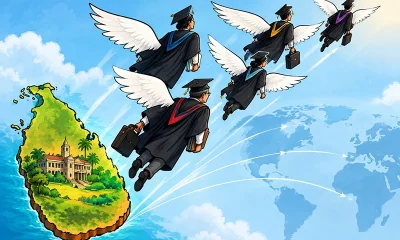
The emptying university: why are academics leaving?
-

 Features6 days ago
Sri Lanka’s university crisis: Brain drain and union action demand urgent reform
-

 Business3 days ago
All-new Bolero MaXX unveiled in Sri Lanka
-

 News2 days ago
Bid for Basil’s extradition nears final stage: Police
-

 Opinion6 days ago
Ashraff: From the SLMC towards the National Unity Alliance
-

 Editorial6 days ago
Muscle flexing, astroturfing and dog-and-pony shows