
Foreign News
Zelensky heads to US in bid to rescue $60bn military aid

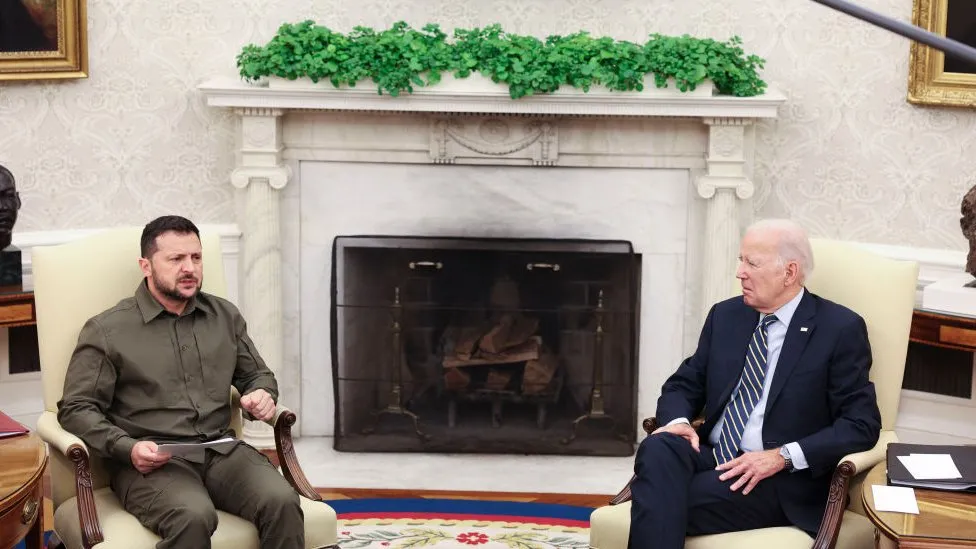
Ukrainian President Volodymyr Zelensky has arrived in Washington DC to try to rescue an imperilled US defence package to Kyiv worth billions of dollars.
The aid has become embroiled in US domestic, partisan politics, with Republicans demanding concessions on border funding in exchange.
It marks Mr Zelensky’s third visit to the US since Russia’s 2022 invasion.
The week is a crucial one for Ukraine, with the EU also deciding whether to open accession talks to the bloc. Hungarian Prime Minister Viktor Orban has signalled that he opposes the move, and has the power to block such a decision.
Mr Orban and Mr Zelensky had an apparently intense conversation when they met on Sunday at the inauguration of Argentina’s new president. The details of their discussion have not been revealed.
The Ukrainian president will arrive in Washington on Monday. As well as holding meetings with US President Joe Biden and Republican House Speaker Mike Johnson, he will address the Senate on Tuesday morning.
The White House said in a statement on Sunday that Mr Zelensky’s visit was meant “to underscore the United States’ unshakeable commitment to supporting the people of Ukraine as they defend themselves against Russia’s brutal invasion”.
The US military aid package, worth $60bn (£47.9bn; €55bn), is currently stalled in Congress, facing pushback from Republicans who argue that more money should be going to domestic security at the US-Mexico border. A vote in the Senate last week saw a package, which included the funding but no border measures, blocked by Republicans.
In addition to more funds for border enforcement, Republicans are seeking reforms to the way in which undocumented migrants seeking political asylum in the US are processed. “We’ve got to be able to have a change in policy on this,” Senator James Lankford of Oklahoma, one of the lead Republican negotiators, said in an interview on Sunday. “All we’re trying to do is to say what tools are needed to be able to get this back in control, so we don’t have the chaos on our southern border.”
Mr Lankford said that Americans don’t want US national security on the border to be ignored while Congress focuses on Ukraine’s interests.
Although the Biden administration has expressed a willingness to accept some asylum policy changes, such concessions risk angering liberal lawmakers and further dividing a party that has already been fractured by the president’s support of Israel in the Gaza War.
“We are concerned about reports of harmful changes to our asylum system that will potentially deny lifesaving humanitarian protection for vulnerable people, including children, and fail to deliver any meaningful improvement to the situation at the border,” a group of 11 Democratic senators wrote in a statement issued on 30 November.
Democratic Senator Chris Murphy of Connecticut, an ally of Mr Biden’s, has said that the White House is becoming “more engaged” in the ongoing negotiations, seeking a comprehensive funding agreement that includes money for Ukraine before Congress leaves for its holiday recess on Friday.
Even if the Senate can strike a deal, however, the package would have to also be approved by the House of Representatives, where opposition to more Ukraine aid is even more intense.
Mr Biden has been urging lawmakers to approve the funds. In an impassioned televised address last Wednesday, he said the package could not wait and warned that Russia would not stop at victory over Ukraine. Though Ukraine fended off Russia’s original attack, its much-vaunted counter-attack this year has stalled and there have been signs of fatigue from some of the Western nations which have stepped up to support it militarily.
After the Senate vote, Ukrainian First Lady Olena Zelenska told the BBC’s Sunday with Laura Kuenssberg programme that Ukranians would be ‘in mortal danger’ if Western countries did not continue their support.
“We really need the help. In simple words, we cannot get tired of this situation, because if we do, we die,” she said. “And if the world gets tired, they will simply let us die.”
(BBC)



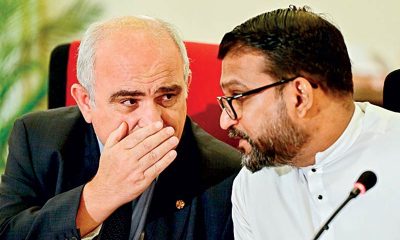









Thousands of prisoners in Myanmar have been granted amnesty or had their sentences reduced. The pardon order by Min Aung Hlaing is one of his first official acts since the coup leader became president this month.
The move comes as the lawyer for jailed former leader Aung San Suu Kyi told the Reuters news agency that her sentence has been reduced. Former president Win Myint, detained since the 2021 coup, was also pardoned of his convictions, a statement from the presidency said.
Min Aung Hlaing approved an amnesty for 4,335 prisoners, Myanmar’s state television MRTV reported.
A communique on behalf of Min Aung Hlaing said “those serving death sentences shall have their sentences commuted to life imprisonment”, without naming specific prisoners.
“The President has pardoned Win Myint,” said another statement from Min Aung Hlaing’s office. Win Myint was “granted a pardon and the reduction of his remaining sentences under specified conditions”, MRTV said.
Suu Kyi, 80, is serving a 27-year sentence on charges her allies describe as politically motivated. Her sentence was cut by one-sixth, her lawyer told Reuters, but it remains unclear whether the Nobel Peace Prize winner will be allowed to serve the rest of her sentence under house arrest. Min Aung Hlaing placed Suu Kyi under arrest after the coup.
Amnesties typically happen as Myanmar marks Independence Day in January and its New Year in April.
Among those to be released are 179 foreign nationals, who will be deported. The amnesty also includes the commutation of all death sentences to life imprisonment, life sentences reduced to 40 years, and a one-sixth reduction in term lengths for all other prisoners.
[Aljazeera]

Several armed men robbed a bank in broad daylight in Naples, holding 25 people hostage before making their escape via a tunnel.
Police surrounded a branch of Crédit Agricole in the southern Italian city shortly after the robbery began around midday local time (10:00 GMT).
Local outlets reported that they negotiated with the robbers before the hostages could be released, about two hours into the robbery.
Firemen could be seen smashing in a window with battering rams and helping people climb out from inside in videos shared on social media.
Some hostages simply shook off the shards of glass and walked on.
But others looked visibly shaken, crying and hugging their relatives. Six people, who were in a state of shock, were offered medical assistance.
One man later told local news site Fanpage.it that the robbers had locked them into a room and that, while they were armed, “they did not use violence”.
Nobody was seriously injured. “Thanks to the swift response… all the hostages were freed shortly after 13:30 without serious injuries,” regional official Michele di Bari said in a statement.
A large crowd of bystanders, local residents and firefighters gathered in the square waiting for developments, while ten of thousands of people tuned into a livestream from the scene of the crime.
Members of the special forces of the carabinieri armed police were urgently flown in from Tuscany.
It was not until several hours later that they stormed the bank by breaking a window.
Several shots and the loud noises of stun grenades could be heard on the live feed shortly after.
But by then, the robbers had reportedly escaped through a tunnel, local media reported. It was thought they could have vanished into the sewer system.
The video feed later showed a number of carabinieri and firefighters peering into a manhole nearby as a crowd continued to mill about the square.
Fanpage.it reported that it was not yet possibly to quantify the value of the loot taken because the robbers had seized personal safety deposit boxes rather than cash.
(BBC)

Iran has demanded that it receive compensation for the destruction caused by the United States and Israel’s attacks, as the country remains defiant and regional powers continue their attempts to mediate an end to the conflict.
Tehran’s envoy to the United Nations said on Tuesday that five regional countries must pay compensation, based on his accusation that their territories were used for launching attacks on Iran.
Iran has also raised the idea of compensation for damages to come through a Strait of Hormuz protocol, which would include a tax on ships passing through the waterway.
An early estimate indicates that Iran has suffered about $270bn in direct and indirect damages since the start of the US-Israel war on February 28, Iranian government spokeswoman Fatemeh Mohajerani said during an interview with Russia’s RIA Novosti news agency, published on Tuesday.
She did not provide further information, such as a breakdown of the damages, but said the issue of compensation was discussed in last week’s negotiations between Tehran and Washington in Pakistan, and will be raised in any potential future talks with the US and mediators.
The government has said it is still assessing the extensive damage dealt to Iran’s critical infrastructure, after oil and gas facilities, petrochemical companies, steel plants, and aluminium factories were repeatedly targeted, in addition to military complexes. These will take years to fully rebuild.
Bridges, ports and railway networks, universities and research centres, and several power plants and water desalination plants were also directly hit, while a large number of hospitals, schools and civilian homes were damaged or destroyed.
(Aljazeera)

Myanmar pardons over 4,000 prisoners, including deposed president

Hormuz Strait shut down again over US ‘piracy’, says Tehran

Gill’s silken 86 keeps Kolkata Knight Riders winless after six games

Showers expected in the Western, Sabaragamuwa and Southern provinces and in Nuwara-Eliya district after 1.00 pm.

Ex-lawmakers group calls for IPU’s intervention to check “irregularities” in Parliament

Power and Energy Minister, Ministry Secy resign over coal probe

‘Dates have the highest sugar content to fight Coronavirus’

Sunday Island 27 December – Headlines

#SundayIsland 17th December – Headlines

Sunday Island – 28th March

Sunday Island Headlines – 21 March

Sunday Island – 21st February – Headlines
-

 News7 days ago
CEB orders temporary shutdown of large rooftop solar systems
-

 Features7 days ago
From Royal College Platoon to National Cadet Corps: 145 years of discipline, leadership, and modern challenges
-

 Latest News6 days ago
PNS TAIMUR & ASLAT arrive in Colombo
-

 Features7 days ago
CIA’s hidden weapon in Iran
-

 Latest News6 days ago
Prasidh, Buttler set up comfortable win for Gujarat Titans
-

 News3 days ago
PNS TAIMUR & ASLAT set sail from Colombo
-

 Features7 days ago
A Fragile Ceasefire: Pakistan’s Glory and Israel’s Sabotage
-

 Latest News7 days ago
Heat index likely to increase up to ‘Caution level’ at some places in the Northern, North-central, North-western, Western, Sabaragamuwa, Southern and Eastern provinces and Monaragala district