
Latest News
Yastika Bhatia returns as India name tried and tested 15 for Women’s T20 World Cup


India have named a familiar-looking squad for the women’s T20 World Cup 2024 retaining the bulk of the side that qualified for the final of the women’s T20 Asia Cup in July this year.
Fourteen of the 15 players in the World Cup squad were also part of the Asia Cup side, with only Uma Chetry missing out. India have instead picked Yastika Bhatia , but her inclusion is subject to fitness, and so is Shreyanka Patil’s , after she suffered a fractured finger in her left hand during an Asia Cup game against Pakistan.
Bhatia, the wicketkeeper-batter, was Mumbai Indians’ third-highest run-scorer in WPL 2024 with 204 runs in in eight outings. She played the first T20I against Bangladesh in Sylhet in April but has been out of action since. She is currently recuperating at the BCCI’s National Cricket Academy in Bengaluru for an injury in her left knee.
Tanuja Kanwar, who replaced Patil in the India squad for the Asia Cup, has not been included, but has been named among the travelling reserves. Along with Kanwar, Chetry, also a wicketkeeper-batter, and fast bowler Saima Thakor have been named in the reserves. Batter Raghvi Bist and legspinner Priya Mishra, who were both part of the India A squad that travelled to Australia recently, have been named non-travelling reserves.
Harmanpreet Kaur will continue leading the side, with Smriti Mandhana the vice-captain. Along with the two, Shafali Verma, Jemimah Rodrigues and Deepti Sharma are expected to form the spine of the batting. Renuka Singh will lead the fast-bowling unit alongside Pooja Vastrakar. Deepti, Radha Yadav and Patil are the main spinners.
India are placed in Group A at the World Cup along with Australia, New Zealand, Pakistan and Sri Lanka, and are targeting their first women’s T20 World Cup title.
The tournament was originally set to be played in Bangladesh, but was shifted to the UAE last week in the aftermath of the countrywide anti-government agitations in Bangladesh, with a number of countries issuing travel advisories to their citizens against travelling to the country..
The tournament gets underway on October 3 in Sharjah with the final slotted for October 20 in Dubai. India begin their campaign against New Zealand in Dubai on October 4 in an evening game and will play Pakistan on October 6 at the same venue.
India squad for Women’s T20 World Cup
Harmanpreet Kaur (capt), Smriti Mandhana (vice-capt), Yastika Bhatia* (wk), Shafali Verma, Deepti Sharma, Jemimah Rodrigues, Richa Ghosh (wk), Pooja Vastrakar, Arundhati Reddy, Renuka Singh, D Hemalatha, Asha Sobhana, Radha Yadav, Shreyanka Patil*, Sajeevan Sajana
Travelling reserves: Tanuja Kanwar, Uma Chetry, Saima Thakor.
Non-travelling reserves: Raghvi Bist, Priya Mishra
* Subject to fitness
(Cricinfo)

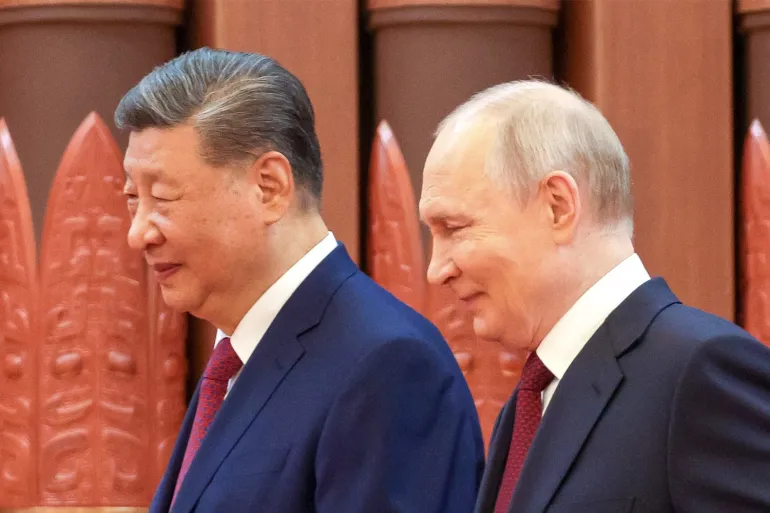
A meeting between Chinese leader Xi Jinping and visiting Russian President Vladimir Putin has started in Beijing, Chinese state media report.
Xi welcomed Putin to the Chinese capital on Wednesday, shaking hands with the Russian leader outside the Great Hall of the People before their talks, video by Russian media showed.
Before entering the Great Hall, Putin and Xi walked down a red carpet, rolled out to greet the Russian leader, and stood as a military band played both their countries’ national anthems.
Putin began the talks by hailing the “strong, positive” momentum in cooperation between Russia and China, according to Russian media.
“Even amid unfavourable external factors, our cooperation and economic cooperation is showing strong, positive momentum,” Putin told Xi.
Addressing Putin, Xi lauded the “unyielding relationship” between China and Russia.
“We have been able to continuously deepen our political mutual trust and strategic coordination with a resilience that remains unyielding despite trials and tribulations,” Xi told Putin, according to China’s Xinhua news agency.
The Chinese leader also addressed the US-Israel war on Iran, telling his Russian counterpart that further conflict was “inadvisable” and a ceasefire was necessary.
“A comprehensive ceasefire is of utmost urgency, resuming hostilities is even more inadvisable and maintaining negotiations is particularly important,” Xi said, according to Xinhua.

Al Jazeera’s Katrina Yu, reporting from Beijing, noted that Putin’s visit and that of the recently concluded trip by US President Donald Trump to China were very different.
Putin, she said, is marking 25 years of the Sino-Russian friendship, has visited China dozens of times, and met with Xi on more than 40 other occasions.
“So this visit will really be about deepening existing coordination and cooperation,” Yu said.
“We are expecting that the two sides will update each other on the situation in the Middle East, as well as Ukraine. No doubt, Xi Jinping will also talk to Putin about what was discussed with Donald Trump last week,” Yu said.
Putin is being accompanied by a large delegation of Russian businesspeople and government leaders, and the Kremlin has announced that the two leaders will sign some 40 different agreements, Yu said, covering everything from the economy and tourism to education.
“But I think for Putin, the main topic of discussion with Xi Jinping is going to be on energy security,” Yu said.
“Since the war in Ukraine, any gas sales that were previously heading to Europe – that is all dried up – and Russia is in desperate need of revenue to replace that, especially since we are in the fifth year of the Ukraine war,” she added.
In a video address released before meeting Xi, Putin said Russia and China were prepared to cooperate with each other on the “core interests of the two countries, including the protection of sovereignty and national unity”, the Reuters news agency reports.
Both countries are actively expanding ties in economy, politics and defence, Putin said, adding that “a close” and “strategic” connection between Moscow and Beijing was playing “a stabilising role” in global relations.
“We are not aligning against anyone, but working for the cause of peace and universal prosperity,” Putin said.
[Aljazeera]

Bangladesh overcame one hour of nerves on the fifth morning to beat Pakistan by 78 runs in the Sylhet Test and complete a consecutive 2-0 sweep over them. For the first time in their history, Bangladesh have won four successive Test series. Taijul Islam led the way with a six-wicket haul in the fourth innings, but the credit will also go to Litton Das for his 126, which resurrected Bangladesh from the dead on the first day.
It is a landmark moment for Bangladesh cricket. They played solid cricket across ten days in the Test series. While their pace attack got rave reviews, their spinners too stepped up as the experienced Taijul took two of the last three wickets on the final morning.
Before that, Mohammad Rizwan held Bangladesh at bay for nearly an hour, until Sajid Khan edged Taijul for 28. In the next over, Rizwan guided Shoriful Islam to Mehidy Hasan Miraz at gully for 94. Mehidy had earlier dropped a tough chance at gully when Rizwan had tried a similar shot in the day’s first over, while a Sajid top edge had dropped in front of wicketkeeper Litton.
Taijul took the final wicket when Khurram Shahzad swung him towards deep midwicket, where debutant Tanzid Hasan held a high catch.
Chasing 437, Pakistan started the day on 316 for 7. It was a spirited response from the under-fire visitors, who were bumped by two decent partnerships. Shan Masood and Babar Azam added 92 for the third wicket, which mitigated their early losses of openers Azan Awais and Abdullah Fazal. The partnership ended when Mehidy nabbed Babar down the leg side for 47. Masood scored 71 before Taijul had him caught at short leg.
Rizwan and Salman Agha staved off any further batting collapse with a 134-run partnership for the sixth wicket. The pair batted at a fair clip, frustrating the home side who, in their attacking mindset, hardly bowled a maiden over during that period.
With the second new ball, Taijul finally breached Agha’s defence with an arm-ball. The batter made 71. Rizwan kept the fight on but the task proved to be too monumental.
Brief scores:
Bangladesh 278 in 77 overs (Litton Das 126; Mohammed Abbas 3-45, Khurram Shahzad 4-81) and 390 in 102.2 overs (Mushfiqur Rahim 137, Litton Das 69; Khurram Shahzad 4-86, Sajid Khan 3-126) beat Pakistan 232 in 57.4 overs (Babar Azam 68; Nahid Rana 3-60, Taijul Islam 3-67) and 358 in 97.2 overs (Mohammad Rizwan 94, Shan Masood 71, Salman Agha 71; Taijul Islam 6-120) by 78 runs
[Cricinfo]
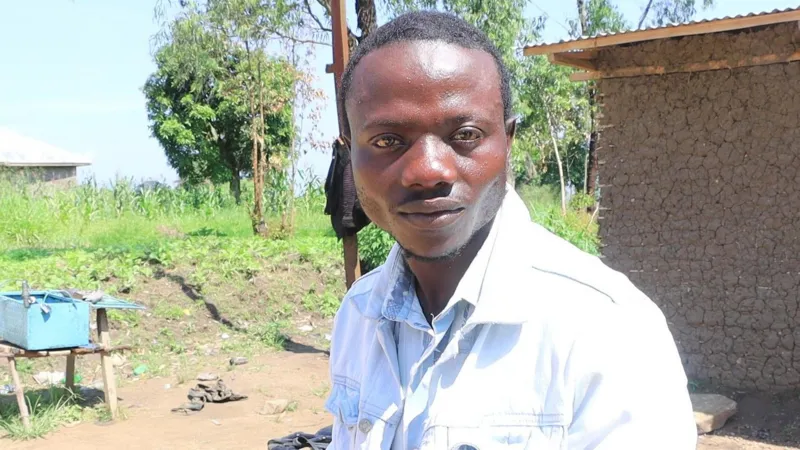
People living close to the epicentre of a deadly Ebola outbreak have told the BBC of their fear, as the World Health Organization (WHO) warned cases may be spreading faster than originally thought.
One man in the Democratic Republic of Congo’s northeastern Ituri province said infected people were dying “very fast”, adding: “Ebola has tortured us.”
The virus is believed to have killed 136 people in the DR Congo, officials say, with more than 514 cases now suspected in the country. One person has died in neighbouring Uganda.
The WHO’s Dr Anne Ancia told the BBC that the more the UN agency investigates the outbreak, the clearer it becomes cases have spread to other areas.
Modelling by the London-based MRC Centre for Global Infectious Disease Analysis released on Monday suggested there had been “substantial” under-detection, and that it could not rule out there had already been more than 1,000 cases.
The study suggested that the current outbreak is “larger than currently ascertained” and that its “true magnitude remains uncertain”.
A man who spoke to BBC News and identified himself as Bigboy said people are “really scared” and doing what they can to protect themselves.
He said locals are taking precautions such as washing hands with clean water, but added that he wished they could get access to other protective supplies such as face masks.
Another Ituri local, Alfred Giza, said people in the community are aware of the threat and waiting to receive face masks to protect themselves, but that he would not know what to do if a family member or friend contracted the disease.
The Red Cross warned that Ebola can escalate quickly if cases are not identified early, communities lack information and health systems are overwhelmed, adding “we are seeing all those conditions” in the current outbreak.
On Tuesday, DR Congo President Félix Tshisekedi called for “calm” and urged Congolese citizens to remain vigilant, after holding a crisis meeting on Monday evening.
WHO chief Tedros Adhanom Ghebreyesus, who declared the outbreak an international emergency last week, said he was “deeply concerned about the scale and speed of the epidemic”.
He declared the emergency late on Saturday night – before the WHO’s emergency committee met to assess the situation and recommend priority medical interventions, which it is due to do soon.
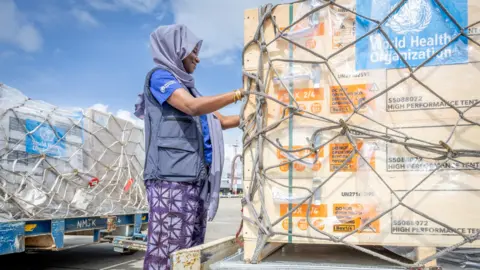
The cash-strapped organisation has already released almost $4m (£3m) to combat the outbreak – but much more may be needed.
The outbreak is taking place in a region which has suffered years of conflict, with hospitals and clinics damaged or destroyed, and millions fleeing their homes. Most are living in unsanitary conditions.
There are also more than 11,000 refugees who have fled fighting in South Sudan, and big population movements among people seeking work in local gold mines.
It is feared the outbreak may have been ongoing for several weeks before it was first detected on 24 April.
There is no vaccine for the strain of Ebola virus fuelling the latest rise in cases, but the WHO is evaluating whether other drugs may provide protection.
Speaking to BBC Newsday, Ancia said DR Congo’s Ituri province was a “very unsecured area with lots of movement of population”, making it difficult for the agency to investigate and help control the disease.
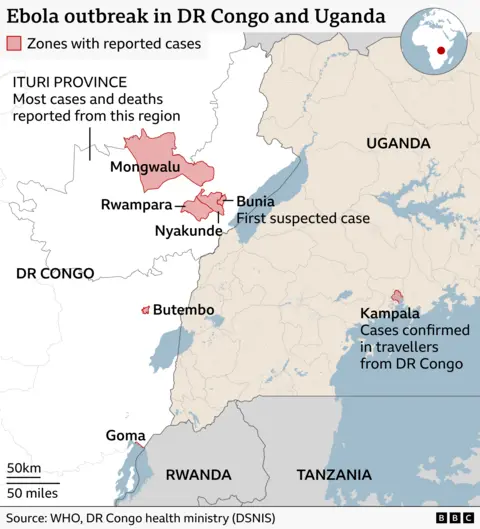
She continued: “The more we are investigating this outbreak, the more we realise that it has already disseminated at least a little bit across border and also in other provinces.”
The outbreak has spread to the province of South Kivu, where the population has been affected by a humanitarian crisis for many years, she added.
There has also been a case in eastern DR Congo’s biggest city, Goma, which has a population of around 850,000 people and is under the control of Rwandan-backed rebels.
High levels of insecurity in several provinces mean people move around often, increasing the risk and spread of the virus, she said.
Several African countries are taking precautions by tightening border screenings and preparing health facilities. Neighbouring Rwanda has also closed its borders with the DR Congo. Uganda has told people to avoid hugging and shaking hands.
An American citizen, belived to be missionary group doctor Peter Stafford, was evacuated from the DR Congo after developing symptoms over the weekend.
Germany’s health ministry told the BBC a US citizen was taken to the country for treatment.
The US Centers for Disease Control and Prevention (CDC) said at least six other Americans who were exposed were also being evacuated. On Tuesday, the agency said it was in the process of moving the Americans to Germany and the Czech Republic, where they would be monitored for symptoms in quarantine.
The WHO and other agencies are working with governments and communities to try to stop the spread of the virus, urging residents to follow preventative measures and report to the nearest health facility if they experience any symptoms.
What is Ebola and how does it spread?
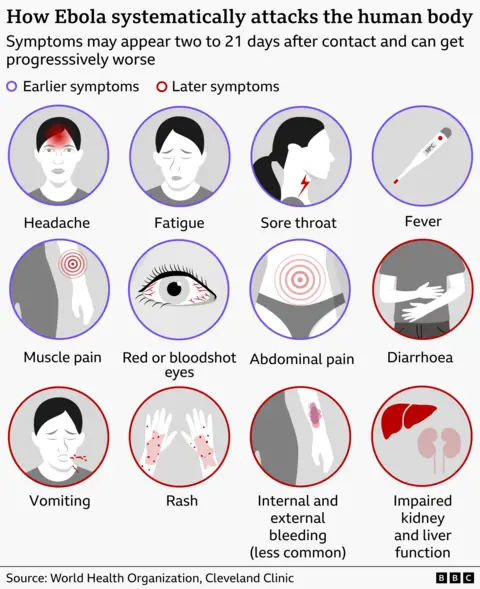
Ebola is caused by a virus and initially causes symptoms similar to the flu, with fever, headache and tiredness.
As the disease progresses, vomiting and diarrhoea develop and it can lead to organ failure. Some, but not all, patients develop internal and external bleeding.
The virus spreads from one person to another by contact with infected bodily fluids such as blood or vomit.
The Bundibugyo strain fuelling this rise in cases is rare, and has previously only caused two outbreaks, when it killed about a third of those infected.
Between 2014 and 2016, more than 28,600 people were infected by Ebola in West Africa, the largest outbreak of the virus since its discovery in 1976.
It was caused by the Zaire strain, for which there is an approved vaccine.
The disease spread to a number of countries in West Africa and beyond, including Guinea, Sierra Leone, the US, UK and Italy, killing 11,325 people.
[BBC]

China’s Xi Jinping, Russian President Vladimir Putin hold talks in Beijing

Politics is not something separate from development. It shapes every choice we make in governance – PM

Taijul takes six as Bangladesh complete 2-0 sweep

At least 10 dead as huge floods sweep southern and central China

Ebola outbreak may be spreading faster than first thought, WHO doctor warns

Sooryavanshi’s stunning 93 takes Rajasthan Royals closer to IPL playoffs

‘Dates have the highest sugar content to fight Coronavirus’

Sunday Island 27 December – Headlines

#SundayIsland 17th December – Headlines

Sunday Island – 28th March

Sunday Island Headlines – 21 March

Sunday Island – 21st February – Headlines
-
 Features4 days ago
Sri Lankan Airlines Airbus Scandal and the Death of Kapila Chandrasena and my Brother Rajeewa
-
 News5 days ago
Lanka’s eligibility to draw next IMF tranche of USD 700 mn hinges on ‘restoration of cost-recovery pricing for electricity and fuel’
-

 News4 days ago
Kapila Chandrasena case: GN phone records under court scrutiny
-

 News4 days ago
Rupee slide rekindles 2022 crisis fears as inflation risks mount
-
 Opinion7 days ago
Electricity tariffs have skyrocketed: Can further increases be prevented?
-
 Business4 days ago
Expansion of PayPal services in Sri Lanka officially announced
-
 Features6 days ago
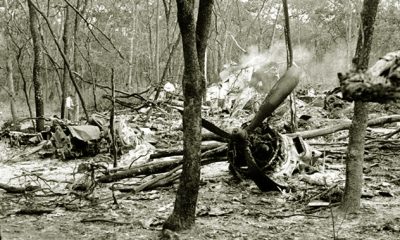
Mysterious Death of United Nations Secretary General Hammarskjöld
-

 News4 days ago
Court orders further arrests in alleged USD 42 Mn NDB fraud case