
Latest News
WWC 2025: South Africa eye NRR boost against Bangladesh


It’s been a change of fortunes for both sides since their respective opening games at the Women’s World Cup 2025. After a crushing defeat in their opener, where they were bowled out for 69 against England, South Africa have turned things around in style, edging past New Zealand before putting themselves back as strong contenders by beating hosts India in an epic chase.
Bangladesh began with a statement win over Pakistan but have since faltered. They pushed England close and were thoroughly outplayed by New Zealand, leaving their campaign teetering.
South Africa’s resurgence has been powered by individual brilliance. Tanzim Britts stood tall against New Zealand, while Nadine de Klerk delivered a game-changing performance against India, with Chloe Tryon playing a supporting role. Captain Laura Wolvaardt, too, found form at the top of the order. South Africa will hope their core batters can fire in unison as the tournament enters its crunch phase.
It’s not just their batting that South Africa will be pleased with. Nonkululeko Mlaba has been the standout among bowlers, her left-arm spin proving decisive in the middle overs. South Africa’s next fixtures are against Bangladesh, Pakistan and Sri Lanka, teams currently occupying the bottom three spots on the points table. With their net run-rate still in the negative (-0.888), South Africa will want more than just wins to stay in the hunt for the top four berth.
For Bangladesh, their bowlers have performed well so far in the tournament, boasting the second-best team average (23.26) behind only England, but the batting remains a concern. While two different players have registered fifties in the tournament, the lack of consistency has held them back. If Bangladesh are to challenge South Africa, they’ll need their top and middle order to click.
After a quiet start to the tournament, Chloe Tryon chose the right moment to shine, showcasing her all-round skills against India. She first dented India’s batting with a clinical spell of 3 for 23 by removing key players in Jemimah Rodrigues, Harmanpreet Kaur, and Amanjot Kaur. Then she walked in with South Africa 81 for 5 in their 252-run chase, and helped script one of their most memorable wins. She managed all of this while nursing a calf niggle.
While Bangladesh captain Nigar Sultana has led energetically on the field, her form with the bat has been a concern. Scores of 23, 0, and 4 in her last three outings, each ending with a soft dismissal, have left a void in Bangladesh’s top order. She was full of praise for her bowling unit after the loss to New Zealand, but called out the team’s shortcomings with the bat, stressing the need to build partnerships and show composure when chasing targets over 200.
With batting being a concern, will Bangladesh look to bring back the experienced Fargana Hoque at the top of the order?
Bangladesh (probable): Rubya Haider, Sharmin Akhter, Nigar Sultana (capt & wk), Sobhana Mostary, Sumaiya Akter, Shorna Akter, Fahima Khatun, Nahida Akter, Rabeya Khan, Marufa Akter, Nishita Akter Nishi
South Africa will want to keep their winning XI. Tryon, whose calf required heavy strapping when she was batting against India, is fit and available to play.
South Africa (probable): Laura Wolvaardt (capt), Tazmin Brits, Sune Luus, Marizanne Kapp, Anneke Bosch/Annerie Dercksen, Sinalo Jafta (wk), Chloe Tryon, Nadine de Klerk, Tumi Sekhukhune, Ayabonga Khaka, Nonkululeko Mlaba
[Cricinfo]

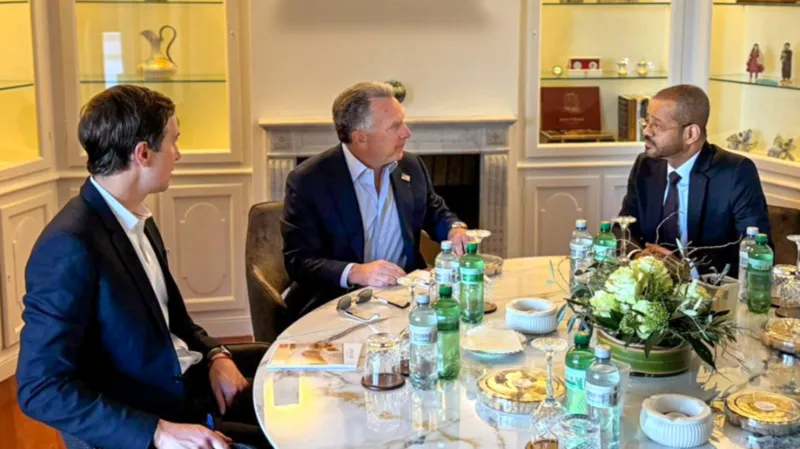
US and Iranian officials have met in Geneva for a third round of indirect talks seen as crucial to averting conflict, with President Donald Trump threatening to strike Iran if a nuclear deal is not reached.
The discussions come amid the largest US military build-up in the Middle East since the US-led invasion of Iraq in 2003, and with Iran vowing to respond to an attack with force.
Thursday’s talks were adjourned after three hours. Oman’s Foreign Minister Badr Albusaidi, who is acting as the mediator, said negotiators had exchanged “creative and positive ideas” and would return after taking a break. “We hope to make more progress,” he added.
But the chances of an agreement remain unclear.
While Trump has said he prefers to solve the crisis through diplomacy, he has also said he is considering a limited strike on Iran to pressure its leaders to accept a deal.
The president, however, has done little to explain what he is demanding in the negotiations and why there could be the need to take military action now, eight months after the US bombed Iranian nuclear facilities during a war between Israel and Iran.
Iran has rejected the US demand to stop the enrichment of uranium in its territory, but there have been indications that it is prepared to offer some concessions about its nuclear programme.
As in the previous two rounds of discussions earlier this month, the Iranian delegation is being led by Foreign Minister Abbas Araghchi, while the US is represented by special envoy Steve Witkoff and Trump’s son-in-law, Jared Kushner.
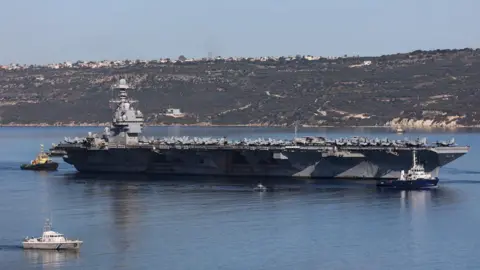
In recent weeks, the US has sent thousands of troops and what Trump has described as an “armada” to the region, including two aircraft carriers along with other warships, as well as fighter jets and refuelling aircraft.
Trump first threatened to bomb Iran last month as security forces brutally repressed anti-government protests, killing thousands of people. But since then, his focus has turned to Iran’s nuclear programme, which has been at the centre of a long-running dispute with the West.
For decades, the US and Israel have accused Iran of trying to secretly develop a nuclear weapon. Iran insists its programme is only for peaceful purposes, though the country is the only non-nuclear-armed state to have enriched uranium at near weapons-grade level.
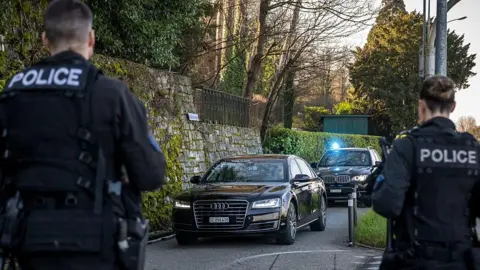
In his State of the Union speech to Congress on Tuesday, Trump briefly and vaguely talked about the tensions with Iran, without clearly laying out the case for strikes.
He said Iran was working to build missiles that would “soon” be capable of reaching the US, without giving details. He also accused the country of trying to “start all over again” with a nuclear weapons programme following last year’s strikes, and said he could not allow the “world’s number one sponsor of terror… to have a nuclear weapon”.
The US struck three nuclear sites in Iran last June, as it joined Israel in its bombing campaign. At the time, Trump said the facilities had been “obliterated”.
Iran says its enrichment activity stopped after the attacks, although it has not allowed the International Atomic Energy Agency’s inspectors to access the damaged sites.
“They want to make a deal,” Trump said, “but we haven’t heard those secret words: ‘We will never have a nuclear weapon’.”
Hours before the speech, however, the Iranian foreign minister posted on social media that Iran would “under no circumstances ever develop a nuclear weapon”. Araghchi also said there was an “historic opportunity to strike an unprecedented agreement that addresses mutual concerns and achieves mutual interests”.
Reacting to Trump’s address, an Iranian foreign ministry spokesman accused the US of repeating “big lies” regarding its nuclear programme, ballistic missiles and the number of protesters killed in the crackdown.
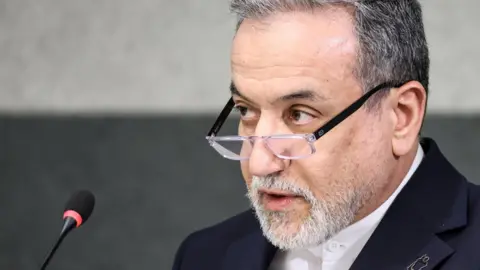
Iran’s proposals have not been made public, but the discussions in Geneva could include the creation of a regional consortium for uranium enrichment, which has been raised in previous negotiations, as well as ideas about what to do with Iran’s roughly 400kg (880lb) stockpile of highly enriched uranium and verification and monitoring mechanisms.
In return, Iran expects the lifting of sanctions that have crippled its economy. Opponents of the regime say any relief would give the clerical rulers a lifeline.
But it remains unclear which conditions Trump could find acceptable for a deal. Iran has already rejected discussing limits to the country’s ballistic missile programme and ending its support for proxies in the region – an alliance Tehran calls the “Axis of Resistance” that includes Hamas in Gaza, Hezbollah in Lebanon, militias in Iraq, and the Houthis in Yemen.
Reports in US media, quoting unnamed administration officials, have suggested that Trump was considering an initial strike in the coming days on Iran’s Revolutionary Guards or nuclear sites to pressure the country’s leaders. If negotiations failed, according to the reports, the president might go as far as ordering a campaign with the aim of toppling the Iranian Supreme Leader, Ayatollah Ali Khamenei.
The Chairman of the Joint Chiefs of Staff is also said to have warned that strikes against Iran could be risky, potentially drawing the US into a prolonged conflict, although Trump has insisted that Gen Dan Caine believes it would be “easily won”.
Iran, meanwhile, has threatened to respond to any attack by striking American military assets in the Middle East and Israel.
US-allied countries in the region are concerned that an attack on Iran could lead to a wider conflict, and have warned that air power alone will not be able to change the country’s leadership.
Israeli Prime Minister Benjamin Netanyahu, however, has warned against a deal that does not include Iran’s ballistic missiles and its proxies. Netanyahu has long described Iran as a key threat for Israel, and a source of instability in the region.
Analysts believe that the prime minister, who visited the White House earlier this month, may be pushing for a campaign with the goal of toppling the Iranian regime.
The US has the world’s second-largest nuclear arsenal. Israel is also believed to have nuclear weapons, although it neither confirms nor denies this.
Ahead of the State of the Union, Secretary of State Marco Rubio delivered a classified briefing to the so-called “gang of eight”, composed of the leaders of both parties in the Senate and House of Representatives and the chairs and ranking members of the intelligence committees of both chambers.
Following the briefing, Chuck Schumer, the Senate minority leader, gave a brief statement, saying: “This is serious, and the administration has to make its case to the American people.”
[BBC]
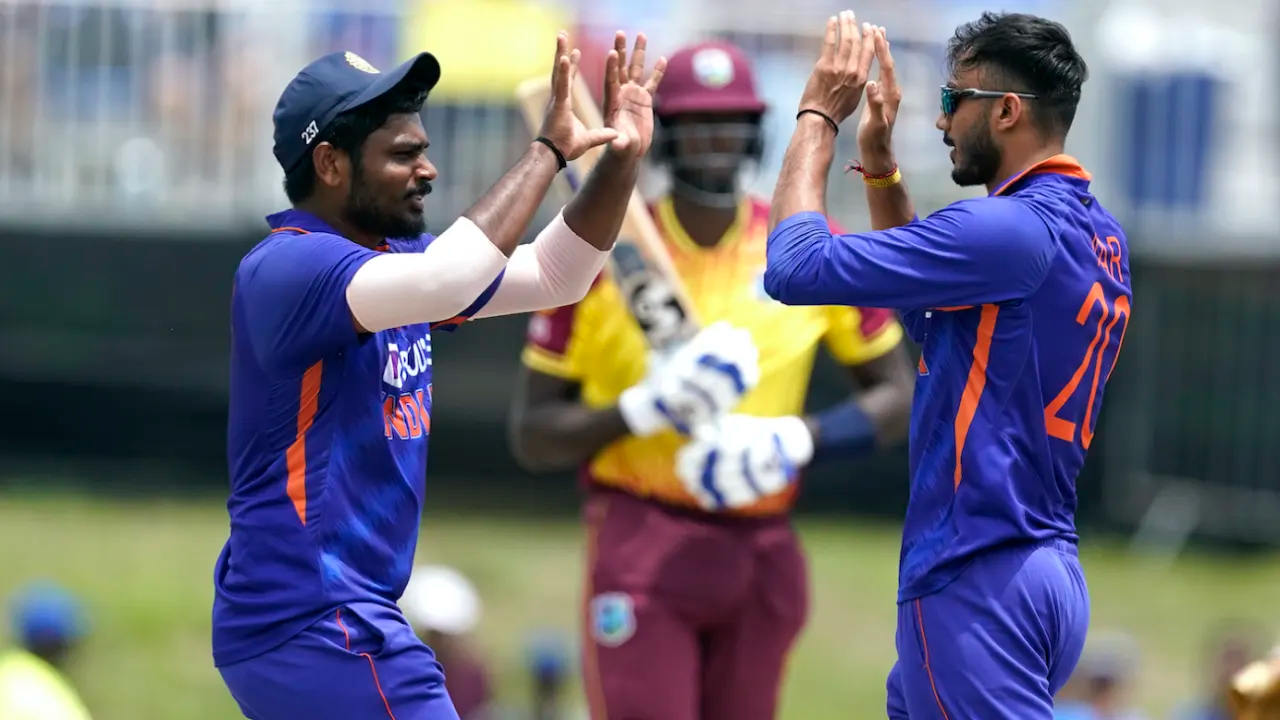
Zimbabwe won the toss and asked India to bat first in what was practically a must-win match for both sides. Thanks to South Africa’s win over Weszt Indies minutes before the toss, India now need to just win. Zimbabwe, though, need to win big.
Sikandar Raza, the Zimbabwe captain, said there was grass and moisture on the surface, and that he wanted his seamers to use it early. Raza didn’t even go for an X-ray on his injured hand lest it show a fracture and force him out of the big match.
Thanks to Raza’s call to field, we were to soon find out the batting position of SanjunSamson, whose inclusion brought about a huge cheer from the stands in Chennai, which will now be his home during the IPL. A Chennai boy, though, went out. Washington Sundar made way for the vice-captain Axar Patel, who had been left out for tactical reasons against South Africa.
Samson replaced a lower middle-order hitter Rinku Singh, who might or might not have his mind on other things. He made a quick visit to Delhi with his ailing father before rejoining the squad on the eve of this match. How Samson would fit in the batting was intriguing, but one thing was made clear: he was going to take the big gloves behind the wicket later in the night.
Zimbabwe made one change to go with their reading of the conditions. Legspinner Graeme Cremer went out for fast bowler Tinotenda Maposa.
India: Abhishek Sharma, Sanju Samson (wk), Ishan Kishan, Suryakumar Yadav (capt.), Tilak Varma, Hardik Pandya, Shivam Dube, Axar Patel, Arshdeep Singh, Varun Chakravarthy, Jasprit Bumrah
Zimbabwe: Tadiwanashe Marumani (wk), Brian Bennett, Dion Myers, Ryan Burl, Sikandar Raza (capt.), Tony Munyonga, Tashinga Musekiwa, Brad Evans, Tinotenda Maposa, Blessing Muzarabani, Richard Ngarava
[Cricinfo]
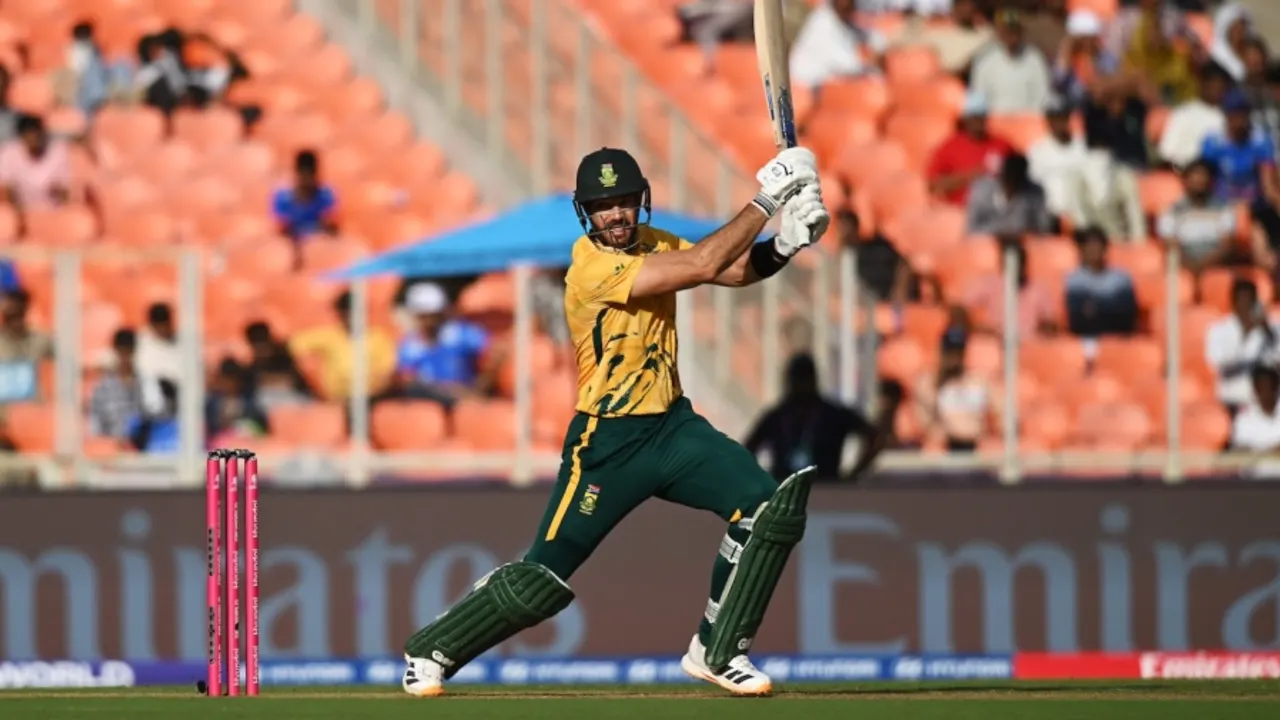
Aiden Markram’s 82 not out led South Africa to a nine wicket victory over West Indies that, while not confirming his side’s semi-final place just yet, underlined why many believe the Proteas could finally lift the T20 World Cup. In this meeting of the last two unbeaten sides at this tournament, South Africa were ruthless, maintaining their 100 per cent record with 23 balls to spare.
Markram’s third half-century of the tournament – his 22nd fifty-plus score in T20Is – made light work of a 177 chase. He and Quinton de Kock put on 95, their highest opening stand of the tournament, skewering whatever belief West Indies had picked up at the back end of a first innings that started disastrously.
Inserted on a tacky-looking Ahmedabad surface, West Indies were 83 for 7 in the 11th over, before a record T20I stand of 89 for the eighth wicket between Jason Holder and Romario Shepherd.
Lungi Ngidi (3 for 30) and Kagiso Rabada’s (2 for 22) were the chief architects of the early stages of that collapse, with Corbin Bosch (2 for 31) also chiming in, profiting from batters’ unrelenting pursuit of boundaries.
Shepherd’s unbeaten 52 – a maiden T20I half-century, sealed with an inside edge for four off the final ball of the innings – and a well-managed 49 from Holder was a part change of tact. But even they focused on finding the fence throughout their 57 deliveries together rather than ticking over to bat time, even if West Indies were able to use all 20 overs.
South Africa were far from perfect, dropping four catches and being a little passive in the field. But they took it to West Indies’s bowlers. All six used by Shai Hope ended up wearing economy rates in double figures, as de Kock’s 47 off 24) and then Ryan Rickleton’s unbeaten 45 off 28 dovetailed neatly as left-handed foils to Markram’s belligerent march to the finish line.
Brief scores:
South Africa 177 for 1 in 16.1 overs (Aiden Markram 82*, Quinton de Kock 47, Ryan Rickelton 45*; Roston Chase 1-46) beat West Indies 176 for 8 in 20 overs (Brandon King 21, Shai Hope 16, Sherfane Rutherford 12, Romario Shepherd 52, Jason Holder 49, Mathew Forde 11; Lungi Ngidi 3-20, Kagiso Rabada 2-22, Corbin Bosch 2-31) by nine wickets
[Cricinfo]

US and Iran hold talks seen as crucial to prevent conflict

Zimbabwe opt to bowl, include Maposa; Samson, Axar back for India

Markram, bowlers lead South Africa’s rout of West Indies

Samra, Airee headline Associates’ team of the tournament

Maharoof expects ‘some hard decisions’ after Sri Lanka’s T20 World Cup exit

Matthews’ century leads West Indies to six-wicket victory

‘Dates have the highest sugar content to fight Coronavirus’

Sunday Island 27 December – Headlines

#SundayIsland 17th December – Headlines

Sunday Island – 28th March

Sunday Island Headlines – 21 March

Sunday Island – 21st February – Headlines
-

 Features5 days ago
Why does the state threaten Its people with yet another anti-terror law?
-
 Features5 days ago
Reconciliation, Mood of the Nation and the NPP Government
-

 Features5 days ago
Victor Melder turns 90: Railwayman and bibliophile extraordinary
-

 Features4 days ago
LOVEABLE BUT LETHAL: When four-legged stars remind us of a silent killer
-
 Features5 days ago
Victor, the Friend of the Foreign Press
-
 Latest News6 days ago
New Zealand meet familiar opponents Pakistan at spin-friendly Premadasa
-
 Latest News6 days ago
Tariffs ruling is major blow to Trump’s second-term agenda
-

 Latest News6 days ago
ECB push back at Pakistan ‘shadow-ban’ reports ahead of Hundred auction