
Sports
World Cup 2022: British officers sent to the tournament will act as ‘buffers’ between fans and local police


British police officers deployed in Qatar for the World Cup will act as “cultural interpreters” between fans and local law enforcement, says Chief Constable Mark Roberts.Roberts, the national lead on football policing, said British police are not there to tell fans how to behave.
“The focus is to try and prevent unfortunate misunderstandings where fans inadvertently cause offence,” he said.
The World Cup starts on 20 November.Those “unfortunate misunderstandings” could stem from fans drinking alcohol, taking shirts off, waving flags, gathering in large numbers and other stereotypes that come with football fan culture.The UK police delegation includes a team of 15 engagement officers, who will act as a “buffer” between supporters and Qatari law enforcement.
“We’re really keen that the British officers who go are a buffer and cultural interpreter so that we can have the first conversation with our fans before anyone else is deployed,” added Roberts.
“Their primary focus is to liaise with the supporters and the police forces just to say ‘look we’re not saying you’re wrong, but it’s causing offence so you might want to moderate your behaviour before anyone else has to intervene’.”
Around 3,000 to 4,000 England fans are expected to travel to Qatar for the group stages, with numbers set to increase should Gareth Southgate’s side reach the knockout stages. An estimated 2,000 to 3,000 Wales fans also expected to fly out to the tournament, which concludes on 18 December.
“We’re not there to tell people how to behave, we don’t have powers, we’re not there to enforce local laws,” Roberts said.
“What we are there to do is have a conversation with supporters. We’re not going to lecture the fans on their behaviour – the advice would be to be a good guest.
“Our officers are there and if we do think there’s any problems we’ll look to intervene at a lower level and make sure that everyone stays safe.
A “significant” number of UK police officers will be on the ground acting as spotters to gather information to feed back to the Qatari commanders and act as community officers to support fans.
Turkey will send more than 3,000 riot police to Qatar as part of the security operation for the tournament. There will also be 100 special operations police sent from Turkey to Qatar, along with 50 bomb specialists and 80 sniffer dogs and riot dogs.Last month Pakistan’s cabinet approved a draft agreement allowing the government to offer troops for security at the tournament. It did not say how many personnel would be sent, and neither country has said that a final agreement has been reached.
“There may be perceptions on the part of the Qatari police or the supporting Turkish police, or any of the other agencies, about what supporters are doing,” added Roberts.
“Just because people are noisy, bouncing up and down and chanting in a different language does not mean they’re being aggressive.”
Statistics provided by the police show there were three arrests among more than 5,000 England fans who travelled to Russia for the 2018 World Cup, 15 arrests four years earlier in Brazil where more than 9,000 fans travelled, and seven arrests from more than 14,000 fans at South Africa in 2010.
Roberts said: “You can see from the stats of previous World Cups, when people have to go to that effort and expense to get there, generally fans are going to go, watch the games and enjoy them.”
The Fifa event will be taking place in a Muslim country in the Middle East for the first time, and the consumption of alcohol is prohibited in Islam.Fans will only be permitted to drink in the designated fan areas, one of which is a fan park which can hold up to 40,000 people and will show matches on big screens.
The other is a paid ticket event with DJ’s which may not attract fans in numbers as the cheapest tickets are said to start from £75.Ashley Brown from the Football Supporters Association (FSA) said many fans have been “priced out” of the World Cup with concerns also around the lack of accommodation available to supporters.
“There’s a combination of reasons why people are being deterred,” Brown said.
“For a lot of people Qatar doesn’t sound like an exciting place to go, it’s not a typical holiday destination, lack of alcohol availability, cost of getting there, cost when you’re there, it’s put a lot of people off.”
The World Cup is expected to attract more than one million visitors, but by March Qatar only had 30,000 hotel rooms, 80% of which had already been booked by Fifa for football teams, officials, and sponsors.
Organisers are offering shared rooms in empty apartments, villas, fan villages and traditional-style tents in the desert with two cruise ships being converted into floating hotels that will be moored at Doha’s port.Some fans are even opting to travel in from neighbouring Emirates country Dubai.Another point of contention for travelling fans has been the fact that homosexuality is illegal in Qatar and many gay fans have opted to boycott the tournament.
“It’s very sad,” said Brown. “Three Lions Pride who represent that community as travelling England fans – I don’t think any are going.
“They don’t feel safe, they don’t feel comfortable and they don’t feel reassured and that is incredibly disappointing that Fifa can put a tournament in a country that won’t welcome those people.”
(BBC Sports)




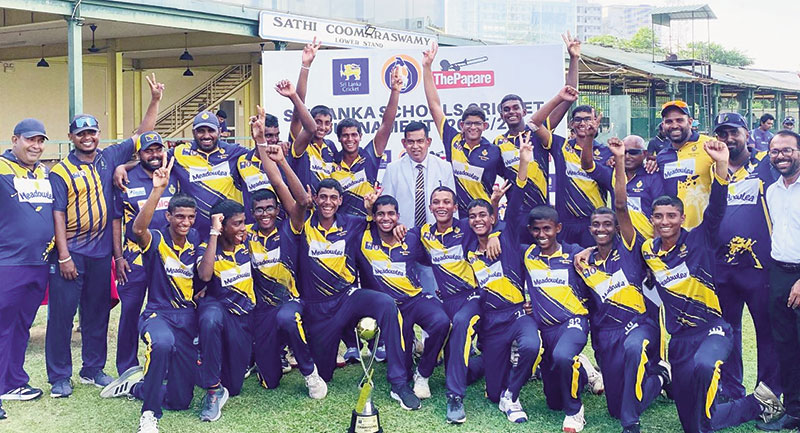
A five-wicket haul by Mahiru Kodituwakku and a fighting unbeaten knock of 92 runs by Manuth Dasanayake were the highlights as Royal College Colombo beat arch-rivals S. Thomas’ College, Mount Lavinia, to win the Under-17 Division I cricket title at P. Sara Stadium on Friday.
Chasing 206 runs for victory, S. Thomas’ lost wickets at regular intervals as Mahiru Kodituwakku led the bowling attack with a five-wicket haul to dismiss them for 133 runs.
Kodituwakku demoralized the Thomian batting lineup by taking early wickets. They lost their first four wickets for 31 runs inside seven overs, before being bowled out in the 33rd over.
Kodituwakku completed impressive figures of 7.5-0-32-5.
The victory looked a distant possibility halfway through Royal’s first innings. Tharul Jayasuriya struck early blows, removing Savain Gamage and Nithesh Jayasinghe cheaply, before Shenuk Fernando accounted for Mudith Gunasekara and skipper Dushen Udawela to leave Royal struggling at 73 for four wickets. However, after being five wickets down at 86 at one stage, Royal recovered to post a competitive total, thanks to an unbeaten 92 from Manuth Dasanayake.
Manuth held the batting lineup together with his dogged knock, which came off 87 balls. He cracked eight fours and five sixes in an entertaining performance.
Scores
Royal 205 for 9 in 50 overs
(Mudith Gunasekara 38, Manuth Dasanayake 92n.o.; Shenuk Fernando 2/20, Tharul Jayasuriya 2/61)
S. Thomas’ 133 all out in 36.5 overs
(Reshon Solomans 38, Tharul Jayasuriya 29; Mahiru Kodituwakku 5/32, Gagan Gamage 2/42) (RF)


Sri Lanka survived an all-time all-round display from Fatima Sana to triumph over a spirited Pakistan and seal a second-straight Asia Cup final berth against India.
Sana, a rare Player of the Match from the losing side, struck 47 off 36 to drag Pakistan to 130 for 5, and then finished with figures of 4 for 38 – inclusive of two double-wicket overs – but Sri Lanka’s all-round excellence eventually overcame Sana’s bloody mindedness.
In their chase, Sri Lanka were reduced to 5 for 2, and then 33 for 4, but a match-defining partnership of 67 off 59 between Harshitha Samarawickrema (36 off 31) and Kavisha Dilhari (33 off 33) turned the tide in Sri Lanka’s favours.
Sana’s second double-wicket intervention saw the backs of both Samarawickrama and Dilhari, but Sri Lanka’s batting depth came to the fore as Nilakshi Silva and Kaushini Nuthyangana saw the game off with eight balls to spare.
As Sri Lanka’s players celebrated on the sidelines as Nilakshika ramped Sana for one final, definitive boundary, the Pakistan skipper was on her haunches, tears streaming down her face. It’s not been an uncommon sight with Sana, but it was yet another example of just how much of herself she had put into the game – just that in this instance, it was simply not enough.
Run-scoring hasn’t been easy in Dubai this Asia Cup, with spinners in particular thriving. And that narrative was not about to change as Sri Lanka put Pakistan into bat – even as the data suggested the team batting first had won nine of the previous 13 games at the venue.
It proved to be the right call as the tournament’s unlikely leading wicket-taker, Chamari Athapaththu, struck early once more, getting Shawaal Zulfiqar and Ayesha Zafar in each of her first two overs. Left-arm spinner Sugandika Kumari meanwhile had removed Muneeba Ali in her first over as well. Seventeen-year-old left-arm spinner Chamudi Prabodha continued the pattern when she completely did an advancing Sadaf Shamas in the flight to have her stumped in the 10th over.
At the halfway point of the innings, Sri Lanka’s plan was going just as envisioned. Pakistan were reeling on 52 for 4 and they would need a minor miracle to post a respectable, if not challenging, target.
The calls for Sana to bat higher up the order seem to grow with every passing day, and when you watch innings like the one she produced on Friday it’s not hard to see why.
For her first six deliveries, she sought to get her eye in – even in a semifinal where her side had nearly lost half the batting – and played out six dot deliveries. With most other players, you might assume this would build pressure. But Sana is made of sterner stuff, a ball of self-belief and willpower.
The seventh ball she faced, she drilled four down through, hard to Chamudi’s left – the youngster perhaps saved some pain by not getting a hand on it. On her 10th she swept Dilhari for four, and then on her 11th she skipped out and launched a maximum over square leg.
And just like that Sana was on her way, and the momentum was shifting.
When Gull Feroza fell at the end of the 16th over, it wasn’t ideal. Feroza had clawed her way to a 32-ball 21, but with the death overs approaching Sana would have been hoping for Feroza to finally unleash. Sana however adjusted her plans and made the most of what was on offer; after a quiet 16th over, she managed a boundary in two of the final three overs, while Tuba Hasan also chipped in with a valuable 12 off 10 to push Pakistan to 130 for 5 with 78 runs coming off the final 10 overs.
An above waist-high no-ball, a first six of her career for Kaushini Nuthyangana, the equation suddenly down to 5 needed off 11. It was cruel irony that that moment had occurred off Sana’s bowling, because up until then she had been the almost solitary barrier between Sri Lanka and a second successive Asia Cup final.
She had removed two of Sri Lanka’s top three – including Athapaththu – in her first spell, and then returned late in the chase to get rid of the set pair of Samarawickrama and Dilhari. But in between Sri Lanka had done just about enough to get across the line in a hard-fought semi-final.
Losing four wickets inside the opening 10 overs is never ideal, and there would have been a time when Sri Lanka would have folded quite easily in such a scenario. But this Sri Lanka side is one with a growing belief that there will always be someone to step up.
Samarawickrama had been the one against Bangladesh, and here she was there again – this time flanked by the always involved Dilhari. With the required rate reaching about eight an over midway through the chase, the pair took to heart the words offered by coach Jamie Siddons during the drinks break and came out with a plan.
With boundaries in front of square not forthcoming, the pair looked behind. Two quick boundaries got the ball rolling, and the indefatigable pair also ran hard between the wickets.
It was a low target, and in that sense only a few good overs were required to keep the rate within touching distance, but Pakistan were bowling well. Sri Lanka however proved once again that they have the wherewithal to weather tough in-game situations and shift pressure back on to their opponents – a skill that will likely come very handy against India on Sunday.
Scores:
Sri Lanka Women 134 for 6 in 18.4 overs (Imesha Dulani 24, Harshitha Samarawickrama 36, Kavisha Dilhari 33, Nilakshika Silva 18*, Kaushini Nuthyangana 10*; Sadia Iqbal 1-21, Fatima Sana 4-38, Umm-e-Hani 1-19) beat Pakistan Women 130 for 5 in 20 overs (Shawal Zulfiqar 24, Gull Feroza 21, Fatima Sana 47*, Tuba Hassan 12*; Sugandika Kumari 1-20, Chamari Athapaththu 2-24, Chamudi Praboda 2-25) by four wickets
[Cricinfo]

Mohammad Rizwan and Imam ul Haq were questioned by Pakistan’s National Cyber Crimes Investigation Agency (NCCIA) in Lahore, as the fallout from Pakistan’s disastrous Test tour of England continued.
The two, who were in the group of seven players who were dropped from the Pakistan squad and sent back home after the defeat in the second Test at Lord’s, were sent summons to appear before the NCCIA. They appeared on Thursday. At least one of the players is believed to have been there for several hours.
It is not clear yet what the questioning was about, or whether it is related to the PCB’s own inquiry, which they announced earlier this week. The board did not name any players then but said it had “initiated an internal disciplinary inquiry following media reports concerning discipline and conduct, which are currently being reviewed internally”. That process, the board said, was being “conducted under PCB regulations”.
Cricinfo understands that at least one of the players has been given a questionnaire to respond to and return to the NCCIA next week.
At the end of the Lord’s Test, which Pakistan lost by 194 runs after losing the first by an innings and 103 runs, seven players as well as the head coach Sarfaraz Ahmed and bowling coach Umar Gul were removed from the squad. In their place, seven other players travelled to England, five of whom were uncapped at international level.
Rizwan’s form with the bat on this tour had been poor, with scores of 12, 41, 7 and 1, following low returns in two Tests in the Caribbean as well. His glovework, however, has been exemplary on both tours and until the West Indies series, he had been Pakistan’s leading Test run scorer since January 2024. But an ungainly hoick to be dismissed for 1 in the second innings at Lord’s attracted plenty of criticism.
Imam, meanwhile, was diagnosed with a grade-1 tear in his left calf after the conclusion of the first day’s play at Lord’s and did not appear on the field during either of Pakistan’s innings. On the final morning, during pre-game warm-ups, he came out to attempt some gentle knockdowns but struggled physically. Aaqib Javed, the PCB’s chief selector and director of high performance publicly questioned Imam’s injury and warned then of an inquiry into it.
In defending the squad changes, the PCB chairman Mohsin Naqvi alluded to wider factors at play, without expanding. “We have had a discussion to ascertain the reasons behind it. They include factors beyond performance and we will get to the bottom of it.”
The selection of both the players for the West Indies and England tours was also the subject of a notice sent by the PCB to selectors after the Lord’s Test. The notice asked for a written explanation outlining the reasons for their selection and the process through which it was arrived at, within 24 hours of the receipt of notice. Misbah-ul-Haq, one of the selectors, resigned from the post following the changes to the squad.
[Cricinfo]

ITS Giuseppe Garibaldi’ departs Colombo

Green Climate Fund (GCF) Regional Dialogue for East and South Asia will be held from 14 to 17 September 2026 at Cinnamon Life at City of Dreams Hotel, Colombo

Showers will occur in the Western, North-western and Sabaragamuwa provinces and in Kandy, Nuwara-Eliya, Galle and Matara districts

Prof. Pieris says Buddha Dhamma recognised as source of law under Constitution

GR leaves FCID after making statement over MiG deal

Dengue cases top 97,000 in 2026

‘Dates have the highest sugar content to fight Coronavirus’

Sunday Island 27 December – Headlines

#SundayIsland 17th December – Headlines

Sunday Island – 28th March

Sunday Island Headlines – 21 March

Sunday Island – 21st February – Headlines
-

 Sports2 days ago
DDS set to lose Test captaincy
-

 Latest News7 days ago
Tharanga creates history with Diamond League crown in Brussels
-

 Features6 days ago
After the parade: What a traffic OIC’s walk-out tells us
-

 News7 days ago
Dispute which triggered listed company director being detained at BIA resolved
-

 Editorial6 days ago
Arrests as theatre
-
 News5 days ago
Thailand shuts door on undesirables from Sri Lanka
-

 Latest News6 days ago
Harshitha’s composed knock seals Sri Lanka’s semi-final berth
-

 News6 days ago
‘Choka Malli’ slips out of country before travel ban