
News
Workplace violence, harassment costs Lankan businesses millions: IFC Study

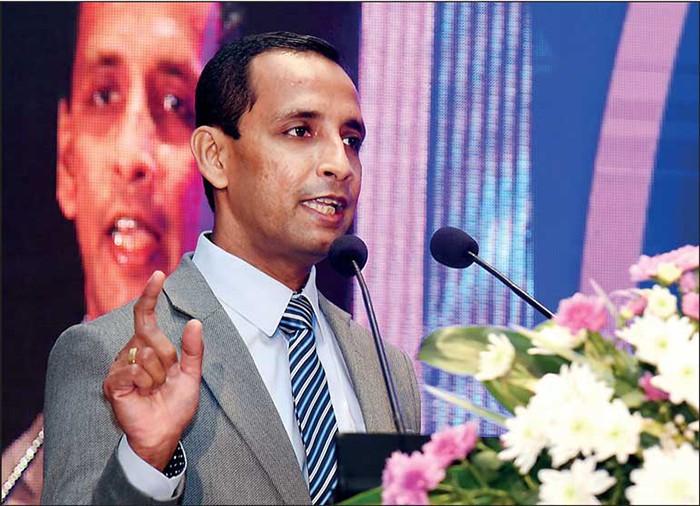
Workplace violence and harassment has cost nine Sri Lankan businesses surveyed 1.7 million US dollars in work hours lost, the International Finance Corporation (IFC) said.
“The impacts of workplace violence and harassment has led to the loss of six working days per employee every year, costing the nine Sri Lankan companies surveyed at least $1.7 million, according to a new report by IFC,” the orgainsation said in a statement on Thursday(15).
The study ‘Business Case for Creating Respectful Workplaces in Sri Lanka’—under the Women in Work partnership between IFC and the Australian government—highlights that three out of every five people surveyed experienced some form of workplace violence or harassment, while nearly one out of five people felt unsafe at work.
Employees of the nine companies surveyed across genders and age groups reported they were impacted by bullying, sexual harassment, or online violence. Employees with a disability were more likely to experience all forms of workplace violence. The study found that sexual harassment and online violence tended to be underreported forms of workplace violence, the IFC said.
“Workplace violence and harassment is universal, affecting all countries, occupations, and work arrangements. For businesses to successfully deliver their missions and goals, an inclusive workplace culture is a must,” the statement quoted Acting Country Manager for IFC in Sri Lanka and Maldives Victor Antonypillai as saying.
“The IFC report clearly spells out the economic impacts of workplace violence and harassment. Given the present economic context, Sri Lankan businesses cannot ignore them. We hope that the recommendations from the report will promote Sri Lankan companies to create safe and respectful workplaces,” he said.
According to the IFC statement, the report recommends the need for Sri Lankan businesses to adopt policies and implement good practices to proactively address workplace violence and harassment. The importance of managing risks of online violence—an emerging workplace issue—as well as encouraging staff to use available support in the community has also been highlighted. The report also recommends steps to improve workplace diversity and inclusion, the statement said.
Over 1,600 employees from nine Sri Lankan companies representing different industries, including manufacturing, banking and finance, fast-moving consumer goods, and tourism, were surveyed for the report. Extensive discussions were also held with business stakeholders, trade unions, employee rights’ activists, and the Sri Lanka police.
Australian High Commissioner to Sri Lanka Paul Stephens was quoted as saying: “With this latest study, we want to encourage more Sri Lankan businesses to introduce better workplace practices that support employees affected by violence and harassment. Creating respectful workplaces that are free from all forms of violence and harassment is vital for Sri Lanka to achieve inclusive and sustainable growth.”
The findings have been used to develop tools and resources to help companies prevent and address violence and harassment in workplaces. The report also reiterates the importance of employers’ measures to tackle these issues, including through implementing measures which are consistent with International Labour Organization Convention 190 on Violence and Harassment.

Latest News
Heat Index likely to increase up to ‘Caution level’ at some places in the Western, Sabaragamuwa, Southern and North-western provinces and in Anuradhapura, Monaragala, Mannar and Vavuniya districts


Warm Weather Advisory
Issued by the Natural Hazards Early Warning Centre of the Department of Meteorology
at 3.30 p.m. on 21 March 2026, valid for 22 March 2026.
Heat index, the temperature felt on human body is likely to increase up to ‘Caution level’ at some places in the Western, Sabaragamuwa, Southern and North-western provinces and in
Anuradhapura, Monaragala, Mannar and Vavuniya districts.
The Heat Index Forecast is calculated by using relative humidity and maximum temperature and this is the condition that is felt on your body. This is not the forecast of maximum temperature. It is generated by the Department of Meteorology for the next day period and prepared by using global numerical weather prediction model data.

Effect of the heat index on human body is mentioned in the above table and it is prepared on the advice of the Ministry of Health and Indigenous Medical Services.
ACTION REQUIRED
Job sites: Stay hydrated and takes breaks in the shade as often as possible.
Indoors: Check up on the elderly and the sick.
Vehicles: Never leave children unattended.
Outdoors: Limit strenuous outdoor activities, find shade and stay hydrated.
Dress: Wear lightweight and white or light-colored clothing.
Note:
In addition, please refer to advisories issued by the Disaster Preparedness & Response Division, Ministry of Health in this regard as well. For further clarifications please contact 011-7446491.
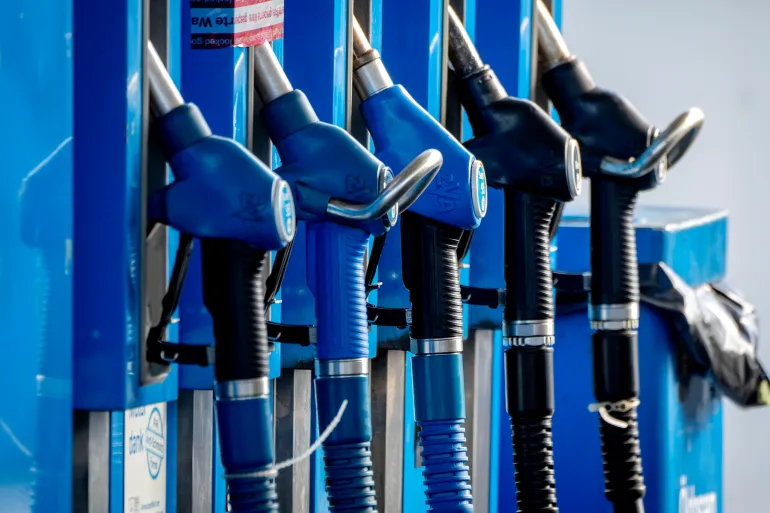
The Ceylon Petroleum Corporation (Ceypetco) has announced a revision of fuel prices, effective from midnight today (21).
Accordingly,
Auto Diesel – Rs. 382 (increased by Rs. 79)
Super Diesel – Rs. 443 (increased by Rs. 90)
Petrol 92 Octane – Rs. 398 (increased by Rs. 81)
Kerosene – Rs. 255. (increased by Rs. 60)
Petrol 95 Octane – Rs. 455 (increased by Rs. 90)

Latest News
Advisory for Severe Lightning issued for Galle, Matara, Kaluthara and Rathnapura districts
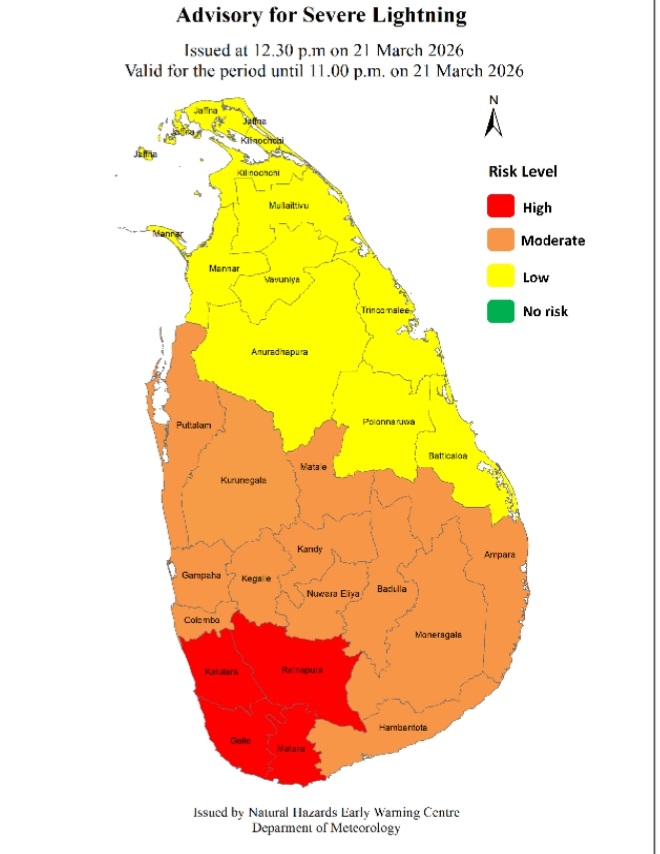
Advisory for Severe Lightning Issued by the Natural Hazards Early Warning Centre Issued at 12.30 p.m. 21 March 2026, valid for the period until 11.00 p.m. 21 March 2026
Thundershowers accompanied with severe lightning are likely to occur at some places in the Galle, Matara, Kaluthara and Rathnapura districts after 1.00 p.m.
There may be temporary localized strong winds during thundershowers. General public is kindly requested to take adequate precautions to minimize damages caused by lightning activity.
ACTION REQUIRED:
The Department of Meteorology advises that people should:
Seek shelter, preferably indoors and never under trees.
Avoid open areas such as paddy fields, tea plantations and open water bodies during thunderstorms.
Avoid using wired telephones and connected electric appliances during thunderstorms.
Avoid using open vehicles, such as bicycles, tractors and boats etc.
Beware of fallen trees and power lines.
For emergency assistance contact the local disaster management authorities.

Heat Index likely to increase up to ‘Caution level’ at some places in the Western, Sabaragamuwa, Southern and North-western provinces and in Anuradhapura, Monaragala, Mannar and Vavuniya districts

CEYPETCO Fuel prices increased from midnight today (21)

Advisory for Severe Lightning issued for Galle, Matara, Kaluthara and Rathnapura districts

Sri Lanka says it denied US request to land two aircraft at Mattala airport

Eid celebrations dimmed by war and displacement across Middle East

Showers may occur at several places in the Western, Sabaragamuwa, Northwestern and Uva provinces and in Galle, Matara, Kandy and Nuwara-Eliya districts after 1.00 pm.

‘Dates have the highest sugar content to fight Coronavirus’

Sunday Island 27 December – Headlines

#SundayIsland 17th December – Headlines

Sunday Island – 28th March

Sunday Island Headlines – 21 March

Sunday Island – 21st February – Headlines
-

 Business6 days ago
Browns EV launches fast-charging BAW E7 Pro at Rs. 5.8 million
-

 Life style7 days ago
From culture to empowerment: Indonesia’s vision for Sri Lanka
-

 News4 days ago
CIABOC questions Ex-President GR on house for CJ’s maid
-

 Life style7 days ago
Ranjith Fernando celebrates cricketing journey with Hob Nails to Spikes
-

 News5 days ago
Sri Lankan marine scientist Asha de Vos honoured at UNGA opening
-

 Features6 days ago
Achievements of the Hunduwa!
-

 Latest News7 days ago
QR code system will be implemented for fuel with effect from 06.00 a.m. today (15th)
-

 News5 days ago
Australian HC debunks misleading travel risk claims for Sri Lanka