
Business
WISDOM IN THE LEAF


A generation of Tea Inspired Knowledge From Dilmah Tea & its History of Ceylon Tea initiative
Teamaking is an ancient art, framed in science, yet equally demanding of passion and expertise. The Wisdom in the Leaf is a publication that aims to harness the art, science, and knowledge that will inspire tea drinkers and guide Teamakers, through a unique collaboration with the men and women whose passion is a significant component in the reputation of Ceylon Tea. The project was initiated as a tribute to Sri Lanka’s global ‘Teamaker’, Merrill J. Fernando, and to the tea planters who make Ceylon Tea. It is published by Dilmah Tea in celebration of its Founder’s 70th year in tea.
Curated by a committee of tea industry veterans and scientists, ‘Wisdom in the Leaf’ captures the tacit knowledge that is only acquired through experience. The contributors each share their expertise in a seminal work that is an invaluable resource for tea planters of the present and future.
The History of Ceylon Tea project was launched in August 2003 with the objective of sharing ‘One of the greatest stories that has ever been told.’ Dilmah Founder Merrill J. Fernando explained his family’s vision in undertaking the project, “‘Dilmah gained consumer recognition globally on the strength of the finest Ceylon Tea, and it is only logical therefore that we should reciprocate, by giving future generations of Sri Lankans the opportunity to study and understand the heritage of one of the world’s greatest plantation industries. The Sri Lanka Tea Industry is today the lifeblood of this nation and Sri Lanka is best known in many countries for ‘Ceylon Tea’.”
Received with great acclaim by scientists and authors including Dr. S. D. G. Jayawardena (former Chairman of the Tea Research Institute), Jane Pettigrew (tea historian and author of 17 books on tea), Dr Nalini C. Gnanapragasam Sivapalan (former Deputy Director Research at the TRI) amongst others, Wisdom in the Leaf is the most comprehensive compendium of knowledge of Ceylon Tea that has been produced in the past five decades.
20 veteran planters with a collective experience of more than 500 years, contributed their knowledge while eminent scientists including Dr. Tanuja Ariyananda, Dr. Rohan Pethiyagoda, Dr. Tissa Amarakoon, and Daya Wickramatunga add critical scientific context.
The content spans agricultural, factory and manufacturing practices, the fundamentals of plantation management and important sustainability themes including rainwater harvesting, climate change and the environment. These topics are presented in an engaging style to make the book as readable for tea drinkers with an interest in the provenance of their cuppa, as for researchers and tea planters.
Topics covered include Personnel Development, Human Resources, Forestry and Conservation, Water Resource Management, Diversification, Buildings and Housing, Financial Accounting and Control, Transport, and Climate Change Adaptation.
The final chapter – “From the World of Science” – comprises contributions from reputed names in the scientific community, and cover topics such as Climate Change and Tea, Rainwater Harvesting, Mechanised Harvesting, Biochar, and the Health Benefits of Tea.
The concept for this publication was conceived by Dilhan C. Fernando, CEO of Dilmah Tea, and with his father Merrill J. Fernando’s blessing, this idea evolved into a tribute to tea planters and workers, the stewards of Ceylon Tea. The entire proceeds from the sale of each book will go to the MJF Foundation’s Vocational Training Scholarships for Plantation Youth.
The publication is a by-product of Dilmah’s History of Ceylon Tea (HOCT) project, whose Editor David Colin-Thomé was the Project Leader and Editor-in-Chief of ‘Wisdom of the Leaf’. The 336-page, hard-cover book is a mix of easy-to-read information interspersed with technical data and contemporary and historical photography. The latter includes a selection of never-before published historical images received from private family collections.
The Publication Committee comprised Jayantissa Ratwatte, Vernon Tissera, Bhatiya Jayaratne, Jivaka Atapattu, Kavi Seneviratne, Anura Gunasekera, and Monte Holsinger as the Technical Editor, with David Colin-Thomé as Editor-in-Chief. The contributors are Monte Holsinger, Vige Bede-Johnpillai, Dyan Seneviratne, Vernon Tissera, Jivaka Atapattu, Bhatiya Jayaratne, S.K. Seneviratne, Ernie Daniels, Bernard Holsinger, Saman Munasinghe, Jayantha Jayawardene, Anura Gunasekera, Malin Goonetileke, Sarath Imbuldeniya, Russell Tennekoon, Ryle Perera, Steve Morrell and Nimal Amerasekera. From the world of science, the contributors are Dr. Tanuja Ariyananda Ph.D, Dr. Rohan Pethiyagoda B.Sc, Dr. Tissa Amarakoon Ph.D, and Daya Wickramatunga M.Sc.
I am confident that this book is destined to become the Bible of the future planters, University students and many others.
Dr. S.D.G. Jayawardena – Former Chairman Tea Research Institute (2006 to 2015) and former Director General, Department of Agriculture.
I was pleased to see the names of veteran planters, many of whom I have had a close association with at some time or other during the time I was at the Tea Research Institute of Sri Lanka. Who else other than such experienced men are suited to write a compendium of this sort? Interacting with men of such calibre and imbibing their practical knowledge had helped many of us scientists in designing our field experiments to suit different agro-climatic zones.
Dr Nalini C. Gnanapragasam Sivapalan – Agricultural Consultant & Research Adviser and former Deputy Director, Research at the Tea Research Institute of Sri Lanka
What is truly remarkable is that information which might appear rather dry and academic in an ordinary textbook is brought to life on these pages through the clever use of typeface, page layout, the division of the text into manageable paragraphs, and illustrations that bring the story to life.
Jane Pettigrew – Tea specialist, historian, writer and consultant. Since 1983, she has been working in the UK and around the world to explain and share the fascinating world of tea.









Ceylinco Life’s Ambalantota branch agent AIP Manjula has been named one of three global finalists for the prestigious Insurance Agent of the Year award at the 11th Asia Trusted Life Agents & Advisers Awards (ATLAA) 2026.
The recognition places a Sri Lankan insurance professional among the finalists in a regional field spanning South Asia, Southeast Asia, East Asia and the wider Asia-Pacific region.
Ceylinco Life said the achievement reflected the calibre and customer-focused approach of its agency force, while recognising Manjula’s professionalism and commitment to policyholders.
The award evaluates insurance agents on criteria extending beyond sales performance, including ethical conduct, client service, policy persistency, digital adoption, innovative practices and contributions to the insurance industry and community.
The awards are organised by Asia Advisers Network and Asia Insurance Review, with LIMRA as co-organiser. An independent judging and balloting process is monitored by KPMG as the official scrutineer. The judging panel comprises senior insurance executives, association presidents and industry experts from across the Asia-Pacific region.
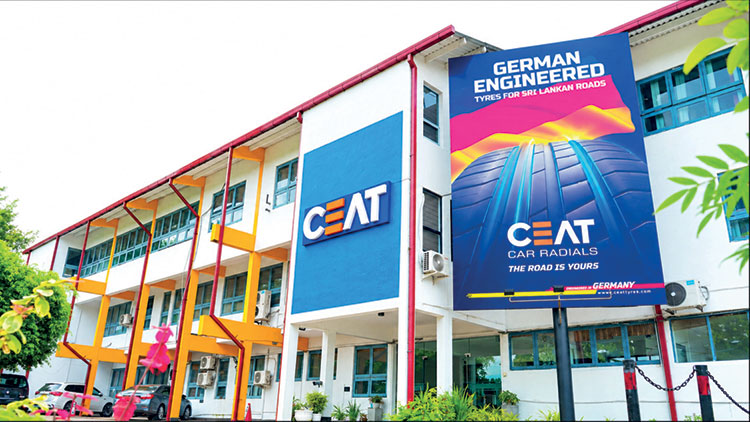
CEAT Kelani Holdings (CKH) has retained its National Long-Term Rating of ‘AA+(lka)’ with a Stable Outlook from Fitch Ratings for the sixth consecutive year, reflecting the company’s financial resilience and leading position in Sri Lanka’s pneumatic tyre market.
The ‘AA+(lka)’ rating, the second-highest on Fitch’s national scale, indicates a very strong capacity to meet financial commitments.
Fitch said CKH’s established market leadership and resilient financial profile remained key strengths, while noting its exposure to price-sensitive, cyclical and highly competitive markets.
The Stable Outlook reflects expectations that the company will maintain its market position despite rising input costs and increasing competition from imported tyres, while preserving adequate credit metrics during periods of weaker earnings and higher investment.
Fitch expects CKH’s established brand, extensive dealer network and adaptive pricing strategies to support its market position. Planned production facility upgrades are also expected to improve product quality, particularly in the radial tyre segment.
The rating agency expects near-term pressure on margins from higher raw material and energy costs but said the company’s low leverage and sound liquidity would provide a cushion.
CKH Chairman Chanaka De Silva said the rating reinforced the company’s focus on disciplined financial management, operational adaptability and long-term investment.

SLT-MOBITEL Enterprise, the enterprise services arm of Sri Lanka Telecom PLC, has launched its Premium Cloud service powered by Nutanix, aimed at helping Sri Lankan businesses modernise their IT infrastructure and accelerate digital transformation.
The service was unveiled at the Lanka Tech Summit 2026 held recently at ITC Ratnadipa, Colombo.
The Premium Cloud combines hybrid multi-cloud capabilities with enterprise-grade performance, enabling businesses to run mission-critical workloads, scale cloud deployments and strengthen business continuity through disaster recovery capabilities.
Hosted on SLT-MOBITEL’s Tier III data centre infrastructure, the platform is designed to provide enhanced security, reliability and flexibility while supporting the growing technology requirements of enterprises.
SLT-MOBITEL Enterprise said the platform would also support organisations seeking to adopt AI-ready capabilities and improve the management and performance of IT workloads.
A key feature of the launch was SLT-MOBITEL Enterprise joining the Nutanix Elevate Service Provider Program (NESPP), which the company said made it the first service provider in the region to join the programme.
Powered by Nutanix’s hybrid multicloud platform, the service enables application and data mobility across on-premises environments, public clouds and edge locations.
The company said the partnership combined Nutanix’s cloud technology with SLT-MOBITEL’s local expertise and support, strengthening its multi-cloud portfolio.

Buttler out of Oval decider as Lawrence earns ODI call-up

Showers will occur in the Western, Eastern, Uva and Sabaragamuwa provinces and in Galle, Matara, Kandy and Nuwara-Eliya districts.

Nor’easter brings flooding as New York and New Jersey declare emergency 2 hours ago

Trump rejects Iran deal to reopen Strait of Hormuz in seven days

Govt plans to hire 121,000 state workers, redistribute tax revenue

Parliament clears 22A amid protests

‘Dates have the highest sugar content to fight Coronavirus’

Sunday Island 27 December – Headlines

#SundayIsland 17th December – Headlines

Sunday Island – 28th March

Sunday Island Headlines – 21 March

Sunday Island – 21st February – Headlines
-

 News4 days ago
Mastermind Naufer Moulavi among 15 found guilty
-

 News6 days ago
Hatton youth protest against reported death sentence for Lankan in Saudi Arabia
-
 News5 days ago
Protest against setting up of cement factory in highly populated area near BIA
-
 News6 days ago
Mahaweli rises as heavy rain triggers flood, landslide fears
-

 Latest News7 days ago
Landslide Red Alerts issued to the districts of Kandy, Kegalle and Nuwara Eliya
-
 Midweek Review4 days ago
Thileepan’s fast unto death: An authentic narrative that many missed
-

 Editorial4 days ago
Big Bad Bills
-
Editorial5 days ago
Trouble beginning in earnest