
Features
Wisdom in Political Insights: My talk with Mahathir Mohamad


by Nilantha Ilangamuwa
Before we dived into the world of politics, I was eager to learn how he managed his style and which fundamentals he followed to pursue the goal of the common good. I had the privilege of talking via zoom with none other than Mahathir Mohamad, a major force behind Malaysia’s take-off. Before he became an icon in the political arena, Mahathir was a physician, a graduate of the reputed King Edward VII College of Medicine in Singapore. I sought his wisdom on the enduring principles that guide a life and a profession.
As he leaned forward, his eyes reflecting the wisdom of a life well-lived, he shared, ‘If I may speak of my calling as a medical doctor, there is one cardinal principle that reigns supreme – the patient’s well-being. It’s not about profiting from others’ misfortunes but about tirelessly working towards healing. In my practice, I encountered countless individuals grappling with life’s myriad challenges.’
Dr. Mahathir bin Mohamad, a towering figure in Asian politics, held the office of Prime Minister for an astounding 24 years, from 1981 to 2003 and later from 2018 to 2020. He revealed the philosophy that has been his compass throughout this remarkable journey.
‘I lead a life of moderation, avoiding the extremes. For instance, when I eat, I do so in moderation, sufficient for sustenance. My mother’s wisdom echoes in my ears – when food becomes overly delightful, it’s time to stop. Moderation, in all aspects of life, is key. Never veer to the extremes,’ he advised.
Explaining his longevity, he shared, ‘I abstain from smoking and drinking, and I refrain from overindulgence in food. I consume just what is necessary for my vitality.’
Turning to the subject of knowledge, he harked back to his foundational beliefs. ‘Knowledge has eternally held sway. The ancient Egyptians didn’t erect pyramids through divine incantations, nor did the waters flow in the irrigation canals of the Indus Civilization by the ignorance of their laws. Knowledge has perpetually been the font of power and prosperity.’
Mahathir stands as one of the senior-most active politicians in Asia, if not the world, having seen the ascents and declines of countless leaders. When I asked about those whom he admired and those who presented challenges, he said:
‘There are leaders I greatly admire and tried to emulate in problem-solving. Take Nelson Mandela, who endured over 27 years in captivity yet emerged without a trace of bitterness, working hand in hand with his former captors to rebuild South Africa. He exemplified selflessness, prioritizing society over self. Leaders of this caliber endure suffering for the greater good of humanity.’
As for the more trying encounters he encountered during his tenure, he gracefully refrained from singling them out, understanding the potential consequences it could have on individuals and their families.
Q: ‘What, in your view, are the defining qualities of a true statesperson? How does one distinguish a genuine leader from someone who exploits racial or religious elements for power?’
A: ‘A true statesperson is one who places the world and society above personal interests. Even when faced with personal hurt, they remain committed to what is right and beneficial for the common citizen.’
Delving into the impact of nationalism on the process of nation-building, I sought Mahathir’s insights on the pivotal role of nationalism and how he harnessed this concept during his tenure as Malaysia’s leader, even in the face of contentious allegations regarding anti-Semitic rhetoric, favoritism towards the ethnic Malay majority, and the treatment of political opponents.
‘First and foremost, one must cultivate a deep love for one’s country. It’s the place where you were born, raised, and achieved your aspirations; essentially, it’s where your roots lie. This genuine love for one’s nation fosters a sincere desire to contribute to its development. When you hold authentic affection for your country, the thought of causing harm or tarnishing its reputation becomes inconceivable.
‘When individuals feel that their nation is capable of self-sustenance, it instills a sense of pride and responsibility. This sentiment, at its core, embodies the essence of true nationalism. Once a common goal is attained, there arises no inclination to harm the country.’
We then moved to Malaysia’s remarkable economic transformation during his leadership. In 1981, when he assumed office, Malaysia’s GDP stood at approximately 25 billion USD. Under his visionary stewardship, the nation’s GDP burgeoned to a staggering 110.2 billion USD. Many attribute this success to his leadership, despite its association with contentious policies. I asked what underlay this economic triumph.
‘To foster a nation’s growth, stability and peace are imperative. A nation beset by instability and racial tensions cannot thrive. In Malaysia, a diverse and multicultural country, my foremost task was to unite people from various ethnic and religious backgrounds to work together, thereby establishing social stability and peace. Once this foundation is laid, the path is paved for economic growth, attracting new investments, and enabling individuals from diverse fields to flourish professionally.’
On his interactions with Sri Lanka, a country he had visited many times, I couldn’t help but pose a question about how we went wrong compared to Malaysia and Singapore.
Q: ‘You’ve made several visits to Sri Lanka, with your last visit in 2014, when you launched various development projects. At one point, you and your political rival, the late Lee Kuan Yew, emphasized the importance of learning from Sri Lanka’s successes. However, today, Sri Lanka’s path diverges significantly from that of Malaysia and Singapore. What, in your opinion, went wrong in Sri Lanka?’
A: A country’s progress is greatly contingent on its leadership. If the leader is inept, unfocused on authentic national development, or lacks an understanding of what development model suits their nation, regression is inevitable. History is replete with examples of countries that once shone brightly but have since faded.
‘Some nations falter when leaders prioritize personal gain and well-being over the welfare of the nation. Consequently, regression becomes their destiny. The history of every country exhibits cycles of ups and downs, and change is an intrinsic part of a nation’s journey.’
Mahathir’s spirited political debates with the late Lee Kuan Yew of Singapore remain indelibly etched in the annals of history. In a book titled ‘Conversations with Mahathir Mohamad,’ he offered a glimpse into the subject saying, ‘The fact remains that he is a mayor of Singapore. This is something he doesn’t like. He wants to be big, you see, and he feels that we took away his opportunity to lead a real country.’ Conversely, Lee Kuan Yew referred to Mahathir as ‘a thoroughly destructive force. He is a very smart man, but his mentality is still stuck in the 1970s.’
I probed him on those years of political rivalry and the intricacies of their relationship. he recounted, ‘When Singapore merged with Malaysia, it was a nation struggling to find its feet. Emerging from British rule, it had encountered its share of challenges during that period. Lee Kuan Yew saw this merger as his chance to become the Prime Minister of Malaysia. In Malaysia, he believed he could hold a substantial role, akin to a real Prime Minister, whereas in Singapore, he would be more like a mayor.
‘However, he soon discovered that Malaysia was not as welcoming as he had hoped. Ultimately, Malaysia expelled Singapore due to the disruptive political climate he had introduced. The then Prime Minister, Tunku Abdul Rahman, decided that Singapore should no longer be part of Malaysia. Singapore, of course, thrived after its expulsion, but at that moment, Lee Kuan Yew believed he had lost a significant opportunity to become a Prime Minister, which is why he shed tears.’
Responding to Lee Kuan Yew’s characterization of him, he countered, ‘Well, everyone is entitled to their perspective. He viewed me as orthodox, and perhaps he wasn’t entirely wrong. I was deeply concerned about racial relations in Malaysia. We have three major ethnic groups, but their achievements were not on par. The Chinese community had made significant strides and seized opportunities post-independence, while the Malays struggled in business, despite being afforded similar opportunities. This disparity was a persistent obstacle to our nation’s development. My aim was to eliminate these disparities and drive the country toward true development. To some, my methods might have seemed orthodox, but my focus was squarely on bridging the ethnic divides.’
I inquired about reports suggesting that during his tenure as Prime Minister of Malaysia, he had made efforts to secure ASEAN membership for Sri Lanka but faced opposition from certain political quarters in other countries. I asked him to confirm the accuracy of these reports.
‘Indeed, ASEAN is a remarkable success story in the realm of regional cooperation, notably for its ability to reject war in the region for over six decades. While many other nations expressed interest in joining ASEAN, certain factors, such as geographical location, posed obstacles to their inclusion. The organization’s concern was that if it expanded too rapidly, it might become unwieldy. I believed Sri Lanka was a suitable candidate for ASEAN membership, transcending geographical differences. However, other member nations were hesitant to extend the invitation.’
Next we got on to his thoughts on the development of secondary leadership. Often, exceptional leaders, when they depart, leave a void that can lead to political polarization and division. I queried how he, drawing from his decades of political experience and wisdom, fostered secondary leadership in Malaysia and navigated the challenges along the way.
‘When you assume the role of Prime Minister, you wield immense power, and that power can be either a tool for personal gain or an instrument for national progress. I was acutely aware that if I used that power for personal purposes, I would tarnish my legacy and leave a stain on the nation’s history. Instead, I chose to focus on the nation’s development. For me, the enduring satisfaction came from witnessing the country’s growth. That was the only reward I sought, and it was the reward I received from the world through recognition of Malaysia’s development.’
‘During my first term as Prime Minister, which lasted for over 20 years, I realized that it was a lengthy tenure, and I was already in my seventies. I firmly believed that the key to our nation’s progress lay in nurturing a new generation of leaders. I advocated the notion that developing the nation was a prerequisite for individual growth. I encouraged my successors to follow the same path, with the aim of propelling Malaysia to developed nation status. However, once I stepped down from office, subsequent leaders pursued different agendas. They wrongly believed that during my tenure, I had misappropriated government funds, despite the facts pointing to the contrary. Consequently, they began to wield their power for personal interests, derailing the path we had charted since the early ’80s. This regression halted Malaysia’s growth.
This prompted me to re-enter politics. Subsequently, I once again assumed the role of Prime Minister. However, the political landscape had transformed. Certain political parties resorted to exploiting religious and ethnic divisions to disrupt the newly formed government, triggering a series of political crises and eroding political stability. In the past 60 years, we had experienced only four changes in government. However, after my departure in 2020, four different governments came to power, further exacerbating political and social instability.’
Curious about external influences, I asked if external parties played a role in perpetuating this instability. Dr. Mahathir acknowledged the possibility of some external elements but characterized the situation as a complex political crisis that would require time and effort to resolve.
Finally, I posed the question: What he considered to be his biggest mistake during his tenure as the longest-serving ruler in modern Malaysian history. He contemplated deeply and replied, ‘I believe that stepping down from the position of Prime Minister was a significant mistake. However, had I not done so, people would not have had the opportunity to see what kind of government they would get in my absence. It’s often during challenging times that we truly appreciate the value of a nation’s well-being. We must undergo difficult periods to realize that the prosperity of a country is not a permanent state.’
I finally sought Dr. Mahathir’s thoughts on the pressing issues that confront our world today. In this era of multiple crises – from global health emergencies to supply chain disruptions, debates surrounding multi-polarism versus Western hegemony, the rise of the Global South, and China’s aspirations to superpower status – I asked him to convey a message to the global community, one that promotes equity and dignity for all of humanity.
‘In the past, when conflicts arose among small principalities, strong leaders would unite these territories into larger nations, steering them towards development. That was the historical narrative. However, our world has changed significantly. Today, due to the ease of communication, we are not just neighbors with our immediate neighboring countries but with the entire world. This closeness brings with it shared challenges that demand a collective approach. In essence, we require a form of global governance.
‘We have seen attempts at this before, such as the League of Nations, which ultimately faltered. Then came the era of the United Nations, which, unfortunately, is also facing challenges. The United Nations, with its five veto-wielding powers, can sometimes be stymied by the interests of a few. Therefore, it is imperative for the world to forge a unified movement to tackle common global issues, including pandemics, the consequences of climate change, the growing global population, and more. Just as small principalities once came together to form nation-states, now nation-states must unite to create a global governance structure capable of addressing these shared problems.’
As a parting thought, Dr. Mahathir turned his attention to the ongoing conflict in Ukraine. He observed, ‘Europeans still seem to contemplate resolving international conflicts through wars. They had allied with the Russians during World War II to combat Germany, and together they defeated Germany. However, immediately after victory, they designated Russia as a new enemy, leading to the establishment of NATO, focused squarely on Russia.
In response, Russia formed the Warsaw Pact, sparking a prolonged Cold War, which was a considerable waste of resources and time. When Russia eventually decided to dissolve the Warsaw Pact, NATO took a different path. Instead of dismantling itself, it bolstered its capabilities and invited former Warsaw Pact members to join, all directed against Russia. This inevitably fueled a series of conflicts, with the Ukraine conflict being a part of this larger narrative.’
He concluded with a resounding call for change, stating, ‘While NATO nations provide support to the war in Ukraine, it is the Ukrainian people who are fighting and suffering. Allowing Ukrainians to endure this conflict, with lives lost and their nation in ruins, is untenable. The mindset of resolving disputes through warfare must come to an end.’








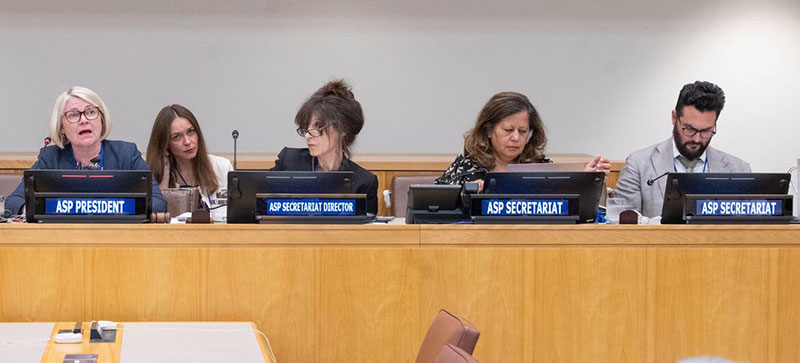
 US Secretary of State Marco Rubio’s warning to the International Criminal Court (ICC) was stark: ‘Either the ICC will end its threats, or we will end the ICC.’ It followed US central administration accusations that the court was unfairly targeting Americans on the basis of trumped-up war crimes charges.
However, a new plethora of sanctions has been clamped on the ICC by the US, which in turn has spurred accusations by sections of the world that the latter has unleashed an ‘assault’ on the international legal order.
What some of the sanctions would mean for the ICC was outlined by Rubio: ‘We will ban transactions with this rogue court, cutting off their resources and crippling their ability to operate against us.’
The ICC has shown consistency of purpose over the years. Despite some operational constraints it has indicted a large number of political strongmen from around the world, accused of war crimes and other governance excesses that come under its purview. Two such recent figures are: Russian President Vladimir Putin and Israeli Prime Minister Benjamin Netanyahu.
Rather than enjoy a mere nominal presence in the world community, the ICC has proved its effectiveness by detaining and bringing to justice scores of VIP politicians and others of their ilk who have been found guilty of human rights abuses and kindred excesses that come within the terms of reference of the ICC.
Accordingly, the international justice system would be stymied considerably as a result of the ICC being dis-empowered, particularly financially. Needless to say, potential and real perpetrators of the species of crime coming under the jurisdiction of the ICC would stand to gain most from such anarchic tendencies. That is, political repression globally would be enabled to enjoy a new lease of life.
A detailing of the types of crime coming under the purview of the ICC provides an idea of what it would cost the international community if the ICC’s operations are gravely hampered. They are mainly: genocide, war crimes, crimes against humanity and the crime of aggression.
That is, the part of the world to be worst affected would be the global South, since the latter is awash with the mentioned crimes. Needless to say, a chronically-disaffected South will sooner rather than later undermine the well being of the world dangerously. The world is already being put through these paces.
At the time of writing, ‘illegal migrants’ from the South, for example, are aggravating many a Western economy’s woes, besides creating for them acute law and order issues. The fact that these migrants’ presence goes on to become a virtual test of the migrant receiving states’ ability to forge domestic social inclusion in the face of jingoistic protests by mainly white supremacist groups is evidence of the latter. As is known, the US, to take just one example, has been up against this crisis for quite a while.
Accordingly, it will be in the best interests of the West if ‘illegal’ migrant arrivals on their shores are stemmed. If the socio-political and economic problems assailing the South are effectively managed through North-South collaborative, ‘trouble-shooting’ efforts the causes leading to ‘illegal’ migration and connected issues could be resolved at source as it were. For, it is the aggravation of the South’s material questions that lays the basis for the emergence of repressive and anti-democratic regimes in the hemisphere.
Until such time that the aforementioned issues in North-South relations are visited afresh and addressed urgently, a vibrantly functioning ICC would be needed. For, the latter would prove a deterrent to Southern political and military strongmen, highly prone to power abuse and like excesses, from coming into being in the wake of the South’s chronic material woes and the wars and conflicts that result from them.
It stands to reason then that the US would be acting in its own interests by enabling the ICC to perpetuate its mandate without hindrance. For a crop of issues that impinges negatively on internal law and order would be defused.
Meanwhile, there needs to be a meeting of minds among the rest of the West to put back in place a North-South dialogue process aimed at reducing some of the economic pressures that are weighing on the South.
Since economics usually drives politics it will be in the interests of the world community to scrutinizingly re-visit North-South issues of the past and put in place economic relief packages for Southern publics that would enable them to tide over their material hardships rather than permit the latter to aggravate into social disaffection and eventually armed militancy. It is the latter juncture that paves the way for the emergence of authoritarian rulers in the South who then go on to be a blight on their publics.
Accordingly, the Southern-based global development thinking of the past that envisaged a more equitable world economic order needs to be seen as an urgent need. That is, NAM’s international development paradigms need to be resuscitated to the extent possible.
It is unlikely that rightist governments of the West, such as the current Republican administration in the US, would find these projects feasible, but democratic states of Europe, led by perhaps the UK, are likely to think otherwise. For it would not be beneficial for the democratic world to be having on their hands repressive governments in the South who would be gravitating towards the major military and economic actors of the South, such as Iran and North Korea, who tend to be in constant power struggles with the West.
However, until such time that the mentioned, pro-people initiatives are given serious thought the ICC would need to be enabled by the international community to be in place comfortably and carry on with its mandate of bringing repressive rulers to book. Besides the ICC should pave the way for the peoples of the developing world to enjoy some substantial respite from the political repression and even terror which tend to be their lot.
Meanwhile, the wars of West Asia are relentlessly aggravating the economic hardships of people everywhere, driving the point home to enlightened sections that there is no alternative to peacemaking. A challenge is to convert the US under President Trump to this line of thinking.

 This week, I give you five simple, time-tested homemade remedies that help reduce the appearance of blemishes, control excess shine and leave your skin feeling softer and smoother.
The Honey and Lemon Brightening Dab:
For stubborn blemish marks, this is a classic. Mix one teaspoon of pure bee honey with three to four drops of fresh lemon juice. Apply gently, only on the affected spots, and leave for 10 minutes before rinsing with lukewarm water. While honey soothes and softens, lemon helps to brighten naturally. Use twice a week in the evening.
Besan and Rose Water Oil-Control Pack:
An ideal remedy to combat shine, especially on the T-zone. Take two teaspoons of besan (gram flour) and mix with sufficient rose water to form a smooth paste. Add a pinch of turmeric for its antiseptic goodness. Apply evenly, keep for 15 minutes and wash off. It absorbs excess oil without over-drying, leaving a beautiful matte finish.
Aloe Vera and Cucumber Ice Soother:
Blend fresh aloe vera gel with the juice of a grated cucumber and freeze the mixture in an ice tray. Each morning, wrap one cube in a soft muslin cloth and gently rub over a cleansed face for 30 seconds. It calms, tightens pores and imparts a baby-soft smoothness.
Oatmeal and Curd Gentle Polish:
Roughness and old blemish marks need gentle exfoliation. Combine one tablespoon of finely powdered oatmeal with one tablespoon of fresh curd (yoghurt). Massage very gently, in circular motions, for one minute, leave for five minutes and rinse. It removes dead cells and unveils softer, clearer skin.
Multani Mitti and Green Tea Magic Mask:
Brew some green tea and allow it to cool completely. Mix one and a half teaspoons of Multani Mitti (Fuller’s Earth) with the tea water to make a fine paste. Apply for 10 to 12 minutes – do not let it dry and crack completely – and wash off. It draws out impurities, fades blemishes and bestows a fresh, shine-free glow.
A Gentle Reminder:
As with any natural remedy, always do a patch test on your inner arm first. For those with oily or combination skin, avoid heavy coconut oil application and harsh scrubbing, as they tend to aggravate shine and blemishes.

 Dream of performing on a world stage? Well, here is your unique, golden opportunity!
The World Championships of Performing Arts (WCOPA) — the one and only official “Talent Olympics” — is the world’s premier global platform for aspiring singers, dancers, actors, models, instrumentalists, etc., to compete, shine and be discovered!
And, yes, this world stage is open to YOU, Sri Lankans living in Sri Lanka and overseas!
Held annually in glittering Las Vegas, WCOPA brings together over 70 countries, all competing for Gold, Silver and Bronze Medals, just like the traditional Olympics.

Lakisha Bernard: Will represent Team Sri Lanka at WCOPA 2027
Outstanding performers vie for the coveted titles of Junior and Senior Grand Champion Performer of the World, with winners and standout participants awarded over $500,000 in scholarships, cash awards and prizes to catapult their education and careers!
Sri Lanka is already making waves! At WCOPA 2026, Natharie Wickramasinghe, representing Team Sri Lanka, made the nation proud by winning a Bronze Medal in the Ethnic/Folklore Dance category!

Lakisha: Accomplished freelance Model and Fashion Design graduate
Recruitment for this prestigious competition is handled through a system of scouts and licensed National Directors — and this is where our very own Chris Rajendra, now based in Las Vegas, and National Director for Team Sri Lanka, comes into the scene.
If you are a singer, dancer, actor, model, instrumentalist — if you have talent burning inside you — contact Chris Rajendra today for registration and, who knows, you may find yourself in Las Vegas, and proudly draped in the Sri Lankan flag, at WCOPA 2027!
The contact address is: Chris Rajendra, wcopa.nationaldirector.sl@gmail.com
or chris.rajendra@gmail.com
Meanwhile, a star is born for 2027, in the form of Lakisha Bernard who is all set to represent Team Sri Lanka at WCOPA 2027.
Originally hailing from the sun-drenched coastal city of Colombo and now carving out her creative career in Canada, 22-year-old Lakisha is stepping into the international spotlight.
This accomplished freelance Model and Fashion Design graduate has officially been appointed as the Team Sri Lanka Promoter for Canada as she prepares to represent Team Sri Lanka at WCOPA in Las Vegas.
Lakisha brings a unique blend of high-fashion sensibility, captivating camera presence and expert garment design to the Team.
Having built her career, from local college shoots to high-glamour concepts, Lakisha’s inspiring journey embodies the true spirit of cultural bridge-building and creative resilience, bringing immense pride and recognition to Sri Lanka on the global stage.
WCOPA 2027 will be held at the legendary Westgate Hotel & Casino, Las Vegas, from 12th to 20th July – the very same iconic arena where the late, great Elvis Presley himself performed!
Your moment is now. Your stage is Las Vegas, so hurry and contact Chris Rajendra.

AgriConnect Sri Lanka’ to be launched on 30 October to Modernise the Agricultural Sector Through Digitalisation

57th Annual Saints’ Quadrangular Tournament on Saturday and Sunday

Showers or thundershowers will occur at most parts of the island

Prison rules to be revised over monks’ attire

AC President recuses himself from hearing prison attire case pertaining to Gnanasara Thera

Court orders steps to obtain INTERPOL Red Notice against Basil

‘Dates have the highest sugar content to fight Coronavirus’

Sunday Island 27 December – Headlines

#SundayIsland 17th December – Headlines

Sunday Island – 28th March

Sunday Island Headlines – 21 March

Sunday Island – 21st February – Headlines
-

 News7 days ago
NDB fraud Rs 60mn more than reported
-

 News7 days ago
Removing monk’s robes matter for Sangha to decide: Mahanayake Theras
-

 News6 days ago
NPP govt. reminded of its responsibilities as US warship leaves Colombo
-

 News5 days ago
Sri Lanka escalates anti-graft drive with Shiranthi’s jailing
-
 Latest News6 days ago
Farhan, Sadaqat help Pakistan ace 183 chase to go 1-0 up
-
 News7 days ago
BHC, Colombo: “LTTE remains a proscribed org. in the UK”
-

 Latest News4 days ago
Farhan and Sadaqat help Pakistan seal series in style
-

 News5 days ago
Iranian ships stranded, Lanka fears US sanctions