
Life style
Amphibians going extinct in SL at a record pace


by Ifham Nizam
Sri Lanka holds the record for nearly 14 per cent of the amphibian extinctions in the world. In other words, of the 130 amphibian extinctions known to have occurred across the globe, 18 extinctions (14 per cent) have occurred in Sri Lanka, says Dr. Anslem de Silva, widely regarded as the father of Herpetology in the country. Speaking to The Sunday Island, the authors of a news book on amphibians, said that this is one of the highest number of amphibian extinctions known from a single country. Some consider this unusual extinction rate to be largely the result of the loss of nearly 70 per cent of the island’s forest cover. Dr. Anslem de Silva, Co-Chairman, Amphibian Specialist Group, International Union for the Conservation of Nature/Species Survival Commission (IUCN/SSC), together with two academics, Dr. Kanishka Ukuwela, Senior Lecture at Rajarata University, Mihintale who is 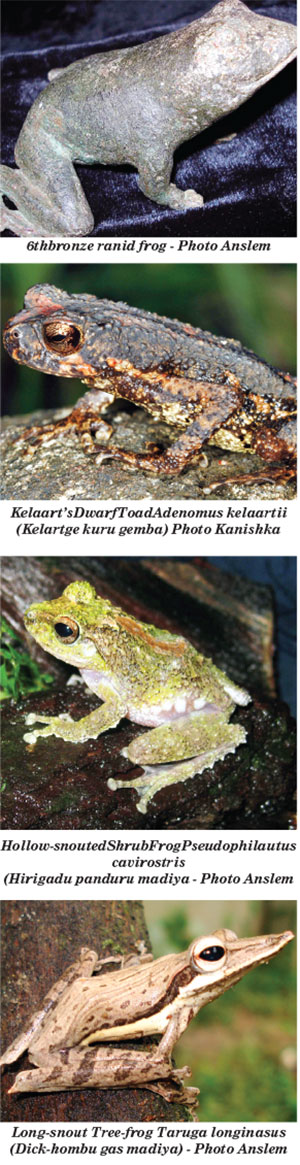 also associated with IUCN/SSC and Dr. Dillan Chaturanga, Lecture at Ruhuna University, Matara had authored this most comprehensive book on amphibians running to nearly 250 pages released last week. The prevalent levels of application of agrochemicals up to few months back, especially in rice fields, and vegetable and tea plantations, have increased over the past three decades. Similarly, the release of untreated industrial wastewater to natural water bodies has intensified. As a consequence, many streams and canals have become highly polluted, they say. The use of pesticides directly decreases the insect population, an important source of food for amphibians. Furthermore, these pollutants can easily make the water in paddy fields and the insects on which the amphibians feed toxic or increase the nitrogen content of the water. The highly permeable skins of amphibians would certainly cause them to be directly affected by these, they add. Amphibian mortality due to road traffic is a widespread problem globally that has been known to be responsible for population reductions and even local extinction in certaininstances. In Sri Lanka, amphibian mortalities due to road traffic are highly prevalent on roads that serve paddy fields, wetlands and forests. Further, they are especially intensified on rainy days when amphibian activity is high, the book explains. Recent studies indicate that amphibian road kills are exacerbated in certain national parks in the country due to increased visitation. According to recent estimates, several thousand amphibians are killed annually due to road traffic.
Professor W. A. Priyanka, PhD (USA), Professor in Zoology, Faculty of Science, University of Peradeniya says the need for a guide to the amphibian fauna of Sri Lanka is obvious, given the currently critical conditions endangering them. Amphibians are an attractive group of animals whose diversity has always sparked interest among the scientific community, creating a vast body of unanswered questions.However, the identification of amphibians has been a challenge due to the lack of a complete and informative guide. The comprehensive pictorial guide provided by the new book should thus be of great benefit to a better understanding of the unique and intriguing nature of these fascinating living beings.The authors have done an outstanding job in compiling this book. An introduction to the guide briefly describes the history, current status, threats and conservation information, along with interesting folklore associated with amphibians. With the clear and informative images, distribution maps and updated status of each species, this guide can easily be comprehended by experts and beginners in the field alike.”I firmly believe that this book will be very useful to undergraduate and postgraduate students in the fields of zoology, biology and environmental science, as well as researchers, wildlife managers and visitors,” Professor Priyanka added.The authors said that like their previous guide to the reptiles of Sri Lanka, A Naturalist’s Guide to the Reptiles of Sri Lanka (de Silva & Ukuwela, 2017, 2020), this book is intended for both naturalists and visitors to Sri Lanka, providing an introduction to the amphibians found here. It features all the extant species of amphibian in this country with colour photographs and quick and easy tips for identification. At the time of writing, 120 species have been recorded within the country and ongoing taxonomic work is certain to add more to this impressive list in the next few years.This guide provides a general introduction to the amphibians of Sri Lanka, a profile of the physiographic, climatic, and vegetation features of the island, key characteristics that can be used in the identification of amphibians and descriptions of each extant amphibian species.Additionally, it presents information on amphibian conservation here and a brief introduction to folklore and traditional treatment methods for combating poisoning due to amphibians in this country. The species descriptions are arranged under their higher taxonomic groups(orders and families), and further grouped in their respective genera.The descriptions are organized in alphabetical order by their scientific names. Every species covered is accompanied by one or more colour photograph of the animal. Each account includes the vernacular name in English, the current scientific name, the vernacular name in Sinhala, a brief history of the species, a description with identification features, and details of habitat, habits and distribution (both here and outside the country).Key external identification features of the species, such as body form, skin texture and coloration, are provided, to help in the quick identification of an animal in the field.It must be noted that according to Sri Lanka’s wildlife laws, amphibians cannot be captured or removed from their natural habitats without official permits, which must be obtained in advance from the Department of Wildlife Conservation.Sri Lanka is home to an exceptional diversity of amphibians. Currently, the island nation boasts of 112 species of amphibians of which 98 are restricted to the country. However, nearly 60 per cent of this magnificent diversity is threatened with extinction. To make matters worse, very little attention is paid by the conservation authorities or the public. The last treatise on the subject was published 15 years ago. However, many changes have taken place since then and hence an updated compilation was a major necessity. This book by the three authors intends to popularize the study of amphibians by the general public by filling this large void. Historical aspects
Sri Lanka is one of the few countries in the world where conservation and protection of its fauna and flora has been practiced since pre-Christian times. There is much archaeological, historical and literary evidence to show that from ancient times amphibians have attracted the attention of the people of this island.
This is evident by the discovery of an ancient bronze cast of a frog (see photo) discovered during excavations conducted by the Department of Archaeology and the Central Cultural Fund. Strati-graphic evidence from the excavation sites indicate that these objects belong to the sixth to eighth centuries AD (Anuradhapura and Jetavanārāma museum records). Beliefs that feature the ‘good’ qualities of frogs and association with nature. These beliefs have some positive effects on the conservation of amphibians, perhaps one reason that Sri Lanka harbours a diverse assemblage of frogs. Absence of frogs and toads in agricultural fields indicates impending crop failure, it is believed.
The authors have specially thanked Managing Director John Beaufoy of John Beaufoy Publishing Ltd, for publishing many books promoting Sri Lanka diversity.



Sri Lanka is rising on the world’s travel radar – a jewel of the sun, drenched beaches, misty tea estates, and hidden waterfalls. Although Thailand dazzles with scale neon lights, bustling party islands and luxury resorts designed to impress, Sri Lanka offers something different, intimacy, authenticity and a luxury that doesn’t shout, it seduces.
As global travel surges and destinations vie for attention, the Deputy Minister of Tourism for Sri Lanka, Professor Ruwan Ranasinghe with deep roots in tourism studies, speaks about elevating Sri Lanka beyond its beautifully raw landscapes into a world class destination that embraces sustainability, technology and community empowerment. We spoke to him and asked what’s next for Sri Lanka and how the island envisions its tourism renaissance over the next few years.
 (Q) How do you foresee the tourism strategy direction for the next five years?
(A) Sri Lanka’s future tourism strategy is firmly anchored in sustainable and inclusive tourism. The focus is on balancing growth with responsibility: protecting natural and cultural assets while ensuring that communities across the island benefit directly. Diversification into wellness, eco-tourism, heritage, adventure, and rural experiences will be guided by evidence-based planning and inclusivity.
(Q) The key priorities for post pandemic recovery?
(A) Rebuilding trust with clear safety standards and transparent communication.
Inclusive growth by empowering small entrepreneurs and rural communities.
Sustainable practices in site management, energy use, and conservation.
Diversified demand targeting wellness, eco-travel, and long-stay visitors.
Digital transformation to modernize marketing and expand reach.
(Q) With Tourism booming in Thailand and Maldives, what is Sri Lanka’s position in the tourism landscape?
(A) Sri Lanka’s edge lies in offering a compact, diverse, and authentic experience— heritage, wildlife, tea, beaches, spa and wellness—all within short travel times. By positioning itself as a sustainable and inclusive destination, Sri Lanka appeals to travellers who value responsible tourism and meaningful cultural engagement, setting it apart from regional competitors.
(Q) What are your plans for sustainable and responsible growth for tourism?
(A) Sustainability is non-negotiable. Policies include carrying-capacity management, eco-certification, renewable energy incentives, and climate adaptation in coastal and hill-country zones. Inclusivity ensures that local communities share in tourism’s benefits, reinforcing resilience and equity.
(Q) How do we promote ecotourism, protect wildlife and marine ecosystems?
(A) Eco-tourism is being advanced through responsible visitor management, conservation partnerships, and community guardianship. Wildlife parks, marine ecosystems, and coastal zones are protected with stricter codes of conduct, while local communities are empowered as custodians and beneficiaries.
(Q) How can Sri Lanka showcase its position as a tourist destination?
(A) Sri Lanka presents itself as a sustainable, inclusive, and authentic destination. Live craft, cuisine, Ayurveda, and cultural showcases highlight the island’s unique identity, while digital tools ensure global buyers can connect directly with local providers.
(Q) How do we support small tourism entrepreneurs and rural communities?
(A) Inclusive tourism means empowering SMEs and rural communities with finance, skills, and market access. Homestays, village experiences, and community-based tourism routes are promoted to ensure equitable growth and authentic visitor experiences.
(Q) How do you predict the outlook for Sri Lanka’s tourism by 2030?
(A) By 2030, Sri Lanka envisions a tourism industry that is globally recognized for sustainability and inclusivity. Success will be measured not only in arrivals and revenue, but in conservation outcomes, community empowerment, and equitable regional development.
(Q) How will the role of technology and digital marketing help the tourist sector?
(A) Digital platforms and data insights will modernize Sri Lanka’s tourism, ensuring inclusive access for SMEs and smarter targeting of global markets. Technology supports transparency, efficiency, and sustainability, making tourism more resilient and competitive.
(Q) The impact of recent adverse weather and national disaster on tourism?
(A) Sri Lanka faced severe weather and a national disaster in the past months which inevitably disrupted parts of the tourism industry. Some destinations experienced temporary closures, and travel plans were affected. However, the government has acted swiftly: through the national budget and special allocations, resources are being directed to restore infrastructure, support affected communities, and stabilize the tourism sector.
Importantly, the industry’s resilience is evident. Stakeholders across government, private sector, and communities worked together with peaceful and strong dedication to minimize the damage. Recovery measures include targeted promotions to reassure international markets, rebuilding trust in Sri Lanka as a safe destination, and accelerating necessary upgrades.
This collective response demonstrates that Sri Lanka’s tourism is not only recovering, but doing so in a way that is sustainable, inclusive, and future-focused. The adversity has reinforced our commitment to building a sector that can withstand challenges while continuing to deliver authentic, safe, and memorable experiences for visitors.

The Prism story
 Tiesh is a luxury Sri Lankan jewellery house known for its high-end handcrafted pieces that combine contemporary design with traditional craftsmanship.
Recently Tiesh unveiled a fresh vision for contemporary luxury called the Prism Collection.
The Prism Collection is a jewellery line launched by Tiesh that draws its inspiration from the way light refracts and splits into rich, vibrant colours when passing through a prism.
The idea behind this collection is to capture the spectrum of light and translate it into wearable art -jewellery that highlights brilliance, colour and dynamic form.
This is an era where jewellery is more than mere ornamentation – where every piece tells a story. Launched to great acclaim at the brand’s elegant Colombo showroom, this collection is a radiant celebration of light, colour and refined artistry – a body of work that doesn’t just adorn but transforms.
Renowned for its dedication to excellence, Tiesh continues to uphold its legacy of producing jewellery that epitomises luxury, elegance and meticulous craftsmanship. Each Prism creation is thoughtfully designed and expertly crafted using the finest precious stones and the skill of master local artisans, reflecting the brand’s unwavering commitment to quality and detail.
Launched as a festive yet fashion-forward collection, Prism presents a curated selection of jewellery that aligns seamlessly with today’s modern aesthetic. Available in yellow gold, rose gold and white gold; the Prism Collection features an extensive range of designs, including rings, earrings, pendants, necklaces, bracelets, bangles and chains. Each piece is crafted to highlight colour, balance and wearability, appealing to the modern, trend-conscious jewellery lover.
With a proud legacy spanning almost three decades Staying true to this ethos, the Prism Collection places
Sri Lankan sapphires in the spotlight, celebrating their natural colours, textures and rarity. Speaking of the collection, Tiesh Co-Director Ayesh de Fonseka stated, “Prism was created in keeping with the times, contemporary yet timeless. In a time when the nation looks towards renewal, this Collection emerges as a symbol of hope and positive transformation. Reflecting light, colour and clarity, the collection embodies a sense of resilience and betterment. As proud Sri Lankans, we wanted
this collection to showcase the exceptional beauty of our local sapphires alongside other precious stones. These are statement pieces designed for modern lifestyles.”
The collection also embraces customisation, a signature element of the Tiesh experience. Clients are invited to select their preferred gemstones and personalise designs, resulting in truly one-of-a-kind creations that reflect individual style and expression.
With global gold prices reaching historic highs, fine jewellery has inevitably become heavier on the wallet Yet for discerning clients, the conversation is no longer about grams alone
Here customers can adjust stone size, setting style and medal choice to suit their budget. At Tiesh, you’ll notice another surprise – the after-care service such as polishing and maintenance.
The gold at Tiesh remains genuine and hallmarked. In collections such as the Prism line, gemstones and design architecture do most of the talking, while gold becomes the elegant framework rather than the bulk of the piece. In their collections the gemstones carry much of the visual richness. Instead of purchasing a heavy block of gold, the client invests in design, craftsmanship and beauty. So, when gold prices rise globally our jewellery doesn’t escalate at the same pace because gold is not the sole component defining the piece Ayesh pointed out
We create jewellery meant to live with the heavier, not just sit in a vault. At its heart, Tiesh remains more than a jewellery house; it is a family legacy shared by vision, trust and affinity with craftsmanship. And within every shimmering facet of Prism lies that story: a family craft containing to shine, generation after generation.
The Prism collection is now available at the Tiesh showrooms R A de Mel Mawatha Colombo 3.

Cinema, courage and conversation:
Renowned Indian actress Shabana Azmi brought candour, conviction and a lifetime of cinematic wisdom to the stage recently, in conversation with Sri Lankan author Ashok Ferrey at the HSBC Ceylon Literary and Arts Festival recently at Cinnamon Lakeside Colombo.
In a wide-ranging discussion that traversed five decades of cinema, feminism, censorship and cross-border politics, Azmi reflected on a career spanning over 140 films — dismissing the debate over whether the figure stands at 140 or 160 with characteristic wit. “One hundred and forty is good enough,” she quipped, setting the tone for an evening that blended humour with hard truths.
Ferrey opened the conversation with Ankur, the 1974 classic directed by Shyam Benegal, which marked Azmi’s debut and helped pioneer India’s parallel cinema movement. Azmi credited her formative years at the Film and Television Institute of India for shaping her craft, emphasising that acting is both talent and technique.
“Training polishes the diamond,” she said, rejecting the notion that acting can be mastered in a matter of months. Exposure to international cinema — from Japanese to French and Swedish films — deeply influenced her aesthetic choices, she noted, adding that her upbringing in a household steeped in theatre and poetry further shaped her artistic sensibilities.
Azmi spoke passionately about the delicate balance between emotion and technical precision required of an actor.
“You are in the moment, but you are also watching yourself,” she observed, describing the psychological demands of the profession. “Civilised behaviour expects you to control emotion. Acting demands the opposite.”
The discussion moved to Arth (1982), directed by Mahesh Bhatt, a landmark film in which Azmi portrayed a woman who refuses to reconcile with an unfaithful husband. The decision to let her character walk away — radical at the time — drew scepticism from distributors who doubted Indian audiences would accept such defiance.
“They said it wouldn’t run a single day,” Azmi recalled. Instead, it became both critically acclaimed and commercially successful, resonating deeply with women across India. She described how women began approaching her not as a star but in solidarity, seeking guidance.
“That’s when I realised I have a voice,” she said, marking the beginning of her active involvement in the women’s movement.
Azmi was unequivocal in her stance on patriarchy, describing it as deeply entrenched in South Asian society. While acknowledging that conversations have begun, she warned that social conditioning — including women’s acceptance of domestic violence — remains troubling.
The conversation turned to Fire (1996), directed by Deepa Mehta, a film that sparked controversy for its portrayal of a same-sex relationship between two sisters-in-law. Azmi admitted she took time to consider the role, anticipating backlash.
Encouraged by her husband, lyricist and writer Javed Akhtar, Azmi chose to proceed. The film was initially screened without incident before political groups vandalised theatres in protest. Yet she remains proud of her decision.
“If you can feel empathy for these two women, you can extend that empathy to others — another nation, race, religion or sexuality,” she said, underscoring her belief that art creates a climate of sensitivity where change becomes possible.
On ageing in cinema, Azmi expressed optimism. Unlike earlier decades when actresses were relegated to peripheral roles after 30, today’s industry offers space for senior actors.
She credited contemporaries such as Amitabh Bachchan — whose sustained presence in leading character roles has reshaped industry norms — for broadening opportunities.
The session concluded with reflections on cross-border tensions, prompted by a question about an India–Pakistan cricket match taking place concurrently.
Azmi offered a nuanced perspective, suggesting that while cricket fuels adrenaline, cultural collaborations — particularly film co-productions — could serve as stronger bridges between nations.
“People don’t have a problem with each other. Politics does,” she remarked, advocating for artistic exchange as a means of fostering understanding.
Throughout the evening, Azmi’s words echoed her lifelong belief: that cinema is not merely entertainment but a powerful vehicle for social transformation.
By Ifham Nizam

England limp to 146-9 against Sri Lanka

Advisory for Heavy Rain issued for the Central, Uva, Sabaragamuwa, Eastern and North-central provinces and in Galle and Matara districts

Sri Lanka opt to chase against England in Pallekele

More than 1,500 Venezuelan political prisoners apply for amnesty

Six races, six golds – Klaebo’s historic Olympics

India, South Africa meet in the final before the final

‘Dates have the highest sugar content to fight Coronavirus’

Sunday Island 27 December – Headlines

#SundayIsland 17th December – Headlines

Sunday Island – 28th March

Sunday Island Headlines – 21 March

Sunday Island – 21st February – Headlines
-

 Business7 days ago
Ministry of Brands to launch Sri Lanka’s first off-price retail destination
-
 Features14 hours ago
Why does the state threaten Its people with yet another anti-terror law?
-

 Features14 hours ago
Victor Melder turns 90: Railwayman and bibliophile extraordinary
-

 Latest News2 days ago
New Zealand meet familiar opponents Pakistan at spin-friendly Premadasa
-

 Features13 hours ago
Reconciliation, Mood of the Nation and the NPP Government
-

 Latest News2 days ago
Tariffs ruling is major blow to Trump’s second-term agenda
-

 Latest News2 days ago
ECB push back at Pakistan ‘shadow-ban’ reports ahead of Hundred auction
-
 Features7 days ago
Giants in our backyard: Why Sri Lanka’s Blue Whales matter to the world