
Opinion
What’s next for the James Webb Space Telescope?

By Quamrul Haider
Modern astronomy is a trip of the human intellect through two inseparable abstract entities: space and time. It is also a “history of receding horizons,” as noted by famous American astronomer Edwin Hubble. Indeed, the recently launched James Webb Space Telescope (JWST) has expanded the horizon by piercing through the hitherto “dark curtain” of the early universe and presented us with a treasure trove of information about the cosmos, both present and way back almost to the beginning of time.
So, what’s next for Webb? With more than 5,000 exoplanets – planets moving around other stars in our galaxy, the Milky Way – discovered so far, it is quite natural to ask the question: Can Webb find habitable exoplanets with alien life? The habitable zone is the area surrounding a star where it is neither too hot for life-giving liquid water to exist, nor too cold for the planet to be anything but a giant snowball.
Yes, the JWST can surely find habitable exoplanets, but it is not specifically designed to search for alien life. It already found the distinct signature of water, along with evidence for clouds and haze, in the atmosphere surrounding a hot, puffy, giant gaseous planet named WASP-96b, orbiting a distant Sun-like star 1,000 light years away from Earth.
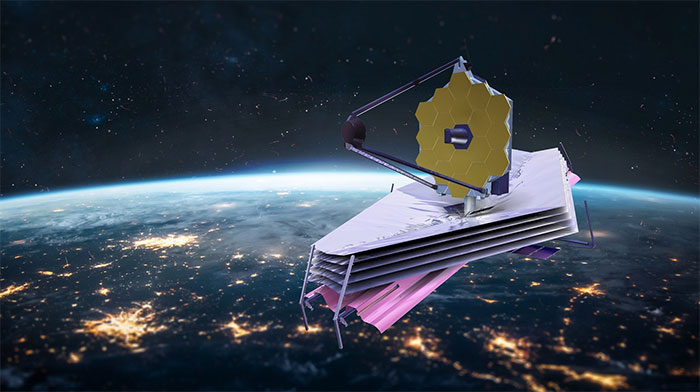
An artist’s visualisation of the James Webb Space Telescope in space. Launched in December 2021, the telescope has already provided a treasure trove of information about the early stage of the universe. SOURCE: NASA
Keeping this in mind, astronomers are directing their attention on red dwarfs because the sheer number of these stars – at least 75 billion in the Milky Way – statistically increases the probability that there might exist habitable planets that are orbiting some of them. Although red dwarfs with masses that are about 0.08-0.60 times that of the Sun are important targets to search for alien life, they are difficult to observe because they are too faint, shining with only 0.05 percent the luminosity of the Sun. They are, however, relatively bright in the infrared region. This is where the JWST swings into action, because it is primarily designed to capture infrared light.
Webb has already started peering as a matter of priority at the most tantalising candidates for life elsewhere in the universe – seven rocky, Earth-sized planets orbiting about an ultra-cool red dwarf star known as TRAPPIST-1 (acronym for Transiting Planets and Planetesimals Small Telescope). Discovered in 2017 by the Spitzer Space Telescope, the star is roughly 40 light years away and is slightly larger than Planet Jupiter, with a mass of about nine percent of the Sun’s. Three of the planets orbit in their star’s habitable zone.
Analysis of data taken by Spitzer suggests, albeit not with certainty, that most of the planets orbiting TRAPPIST-1 may have atmospheres. Having an atmosphere is a prerequisite for life as we know it. Thus, a major focus of Webb’s observations of TRAPPIST-1 will be “atmospheric reconnaissance” – detecting subtleties in the atmosphere enveloping the star’s planets.
Measuring a planet’s atmosphere is not a daunting task for Webb. Whenever a planet passes in front of its star, its atmosphere will absorb some of the star’s light. Webb can capture the filtered starlight to observe the tell-tale signatures for the existence of an atmosphere.
What about alien life? The search for extraterrestrial life began in earnest in 1984 with the establishment of SETI Institute (acronym for Search for Extraterrestrial Intelligence) in Mountain View, California. Scientists at the institute monitor signals from outer space, using ground-based radio telescopes in California, Hawaii, Puerto Rico and Chile. To date, the SETI programme has scanned about 20,000 objects, mostly Sun-like stars. Unfortunately, nothing interesting has been discovered so far. The institute is still functioning, but after the Arecibo radio telescope in Puerto Rico collapsed in 2020, it has been limited in its ability to collect new data.
A recent study suggests that the JWST may be able to spot extraterrestrial life based on air pollution from their planets. The study claims that if the telescope can detect atmospheric pollution, particularly climate-warming gases, as well as industrial gases, such as chlorofluorocarbons and nitrogen dioxide, it could be a signature for an alien life – much in the same way we are identifiable here on Earth based on our environment-degrading emissions.
However, they caution that there are limitations to Webb’s ability to spot pollutants in the atmosphere. For example, if a planet’s host star is too bright, it will drown out the signal from its atmosphere. Or if a planet orbits close to its star, then violent outbursts of high-energy radiation from the star will blast the atmosphere away over time.
The strongest signal for life is free (unbonded) oxygen that much of life on Earth needs to survive. Besides, oxygen cannot be produced without some kind of life. It will be difficult for Webb to detect oxygen in an exoplanet’s atmosphere because it was not originally designed to scan distant planets for their oxygen concentrations. To put it simply, while Webb will be able to tell us if an exoplanet is potentially habitable for humans and/or contains the building blocks of life, it is by no means the smoking gun for the presence of life.
That being said, astronomers are hoping that out of the billions of stars in our galaxy alone, Webb might provide the first compelling evidence for life on one or more in their planetary system. But they don’t expect a “eureka” moment. Nevertheless, with an estimated lifespan of 20 years, Webb has plenty of time to look for alien life.
Finally, on the astronomical scale, the 4.55-billion-year-old Earth is in its early middle age. Hence, even if Webb cannot make a breakthrough discovery, we have another five billion years or so to find life somewhere in the unfathomably big cosmos before the Sun devours Earth and vaporises it. We should not give up hope of shaking hands with aliens – unless anthropogenic climate change or a nuclear war annihilates the human civilisation in the next few decades.
Dr Quamrul Haider is a professor of physics at Fordham University in New York, US.

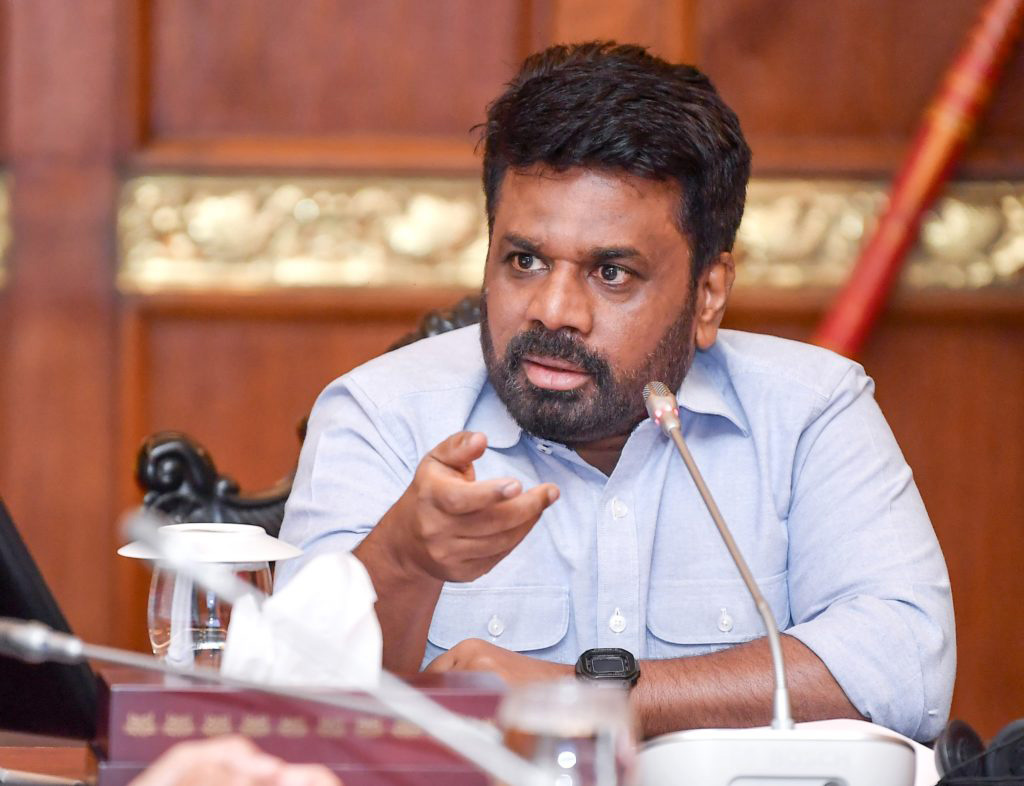
President Anura Kumara Dissanayake should listen at least to the views of the Mothers’ Front on proposed educational reforms.
I was listening to the apolitical views expressed by the mothers’ front criticising the proposed educational reforms of the government and I found that their views were addressing some of the core questionable issues relevant to the schoolchildren, and their parents, too.
They were critical of the way the educational reforms were formulated. The absence of any consultation with the stakeholders or any accredited professional organisation about the terms and the scope of education was one of the key criticisms of the Mothers’ Front and it is critically important to comprehend the validity of their opposition to the proposed reforms. Further, the proposals do include ideas and designs borrowed from some of the foreign countries which they are now re-evaluating in view of the various shortcomings which they themselves have encountered. On the subject, History, it is indeed unfortunate that it has been included as an optional, whereas in many developed countries it is a compulsory subject; further, in the module the subject is practically limited to pre-historic periods whereas Sri Lanka can proudly claim a longer recorded history which is important to be studied for the students to understand what happened in the past and comprehend the present.
Another important criticism of the Mothers’ Front was the attempted promotion of sexuality in place of sex education. Further there is a visible effort to promote trans-gender concepts as an example when considering the module on family unit which is drawn with two males and a child and two females and a child which are nor representative of Sri Lankan family unit.
Ranjith Soysa
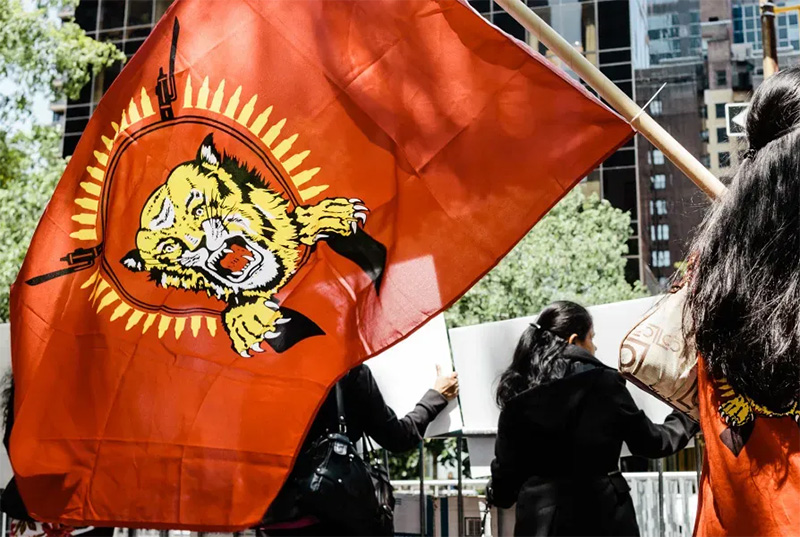
When the LTTE massacred people, mostly Sinhalese Buddhists, government leaders never claimed that the Tamil community, which the LTTE claimed to represent, was driven by hatred. That restraint mattered. That is why it was outrageous to hear President Anura Kumara Dissanayake tell Tamils that Buddhists visiting the North to worship were doing so out of spite. If reports are accurate, the President also declared that we needed a prosperous nation free of racism and united in spirit. Yet, in the same breath he sowed seeds of division recklessly.
Had he spoken in Tamil or English, some might have dismissed it as a slip of the tongue. But in Sinhala, the words carried unmistakable intent. Who could have expected such divisive rhetoric to come from the head of a nation now enjoying fragile coexistence, after enduring a 30‑year war and two insurrections that devastated the economy?
A Ratnayake

The Island editorial, dated 22 January, 2026, under the title ‘Conspiracy to subvert constitutional order,’ is an eye-opener to those who supported the so-called Äragalaya in July 2022 and those who voted to bring the current regime into power with various positive expectations, including ‘ a system change’. ( https://island.lk/conspiracy-to-subvert-constitutional-order/ )
The editorial highlighted, with irrefutable evidence, how a foreign diplomat and a group of Sri Lankans, consisting of some religious leaders (a Buddhist monk, some Catholic priests) and a trade unionist, made a blatantly illegal bid to pressure the then Speaker Mahinda Yapa Abeywardena to take over the executive presidency in violation of the Constitution. The intention of the intimidator tactics was said to be to create in Sri Lanka a situation similar to that in Libya.
The editorial also mentioned how Minister K.D. Lal Kantha and his JVP attempted to lead the Aragalaya protestors to capture Parliament, but without success. Addressing a public rally, under the title ‘Let’s read Lenin’, a few days ago, Minister Lal Kantha has revealed that their planning was to follow what Lenin had said and done during the Russian revolution. Minister Lal Kantha said: “We do not have the power of the State although we managed to obtain the power of the Government. Hence, we are now engaged in the struggle to win the power of the State’’.
In a democratic society, there is a need to ensure maintaining Law and Order without any state interference. It looks like the intention of the Minister is to bring the Police, Armed Forces and the Judiciary, including all the State Services, under direct control of the ruling party, by filling those positions with JVP loyalists to suppress the opponents of the government.
There is also an attempt by the JVP-led forces to remove the Attorney General by making unsubstantiated allegations against him. As per a latest news item in The Island, under the title “Opposition slams sitting HC judge’s appointment as Justice Ministry additional Secretary”, is alleging President Anura Kumara Dissanayake of trying to control the judiciary by appointing a sitting High Court judge as Additional Secretary to the Justice and National Integration Ministry. (https://island.lk/opposition-slams-sitting-hc-judges-appointment-as-justice-ministry-additional-secretary/)
On the other hand, the ruling party is trying to appoint one of their cronies as Auditor General, possibly, to cover up a number of questionable deals made during the year they ruled and to ensure achieving the so-called power of the State.
Unless the people, especially those who naively dreamt of ‘a system change’, have a clear understanding of the ultimate goal and motives of the ongoing changes and take appropriate actions to protect their own democratic rights, they will be left with no other alternative but to live under a repressive government.
Sangadasa Akurugoda

Nipah virus outbreak in India triggers Asia airport screenings

India and EU announce landmark trade deal

Sri Lanka women to tour West Indies for ODI and T20I series in February-March 2026

Scotland bank on ICC assurances over Sharif visa after naming T20 World Cup squad

England bat, Sri Lanka bring back Wanindu Hasaranga

Don Bradman baggy green sold for AU$460,000

‘Dates have the highest sugar content to fight Coronavirus’

Sunday Island 27 December – Headlines

#SundayIsland 17th December – Headlines

Sunday Island – 28th March

Sunday Island Headlines – 21 March

Sunday Island – 21st February – Headlines
-
 Business2 days ago
ComBank, UnionPay launch SplendorPlus Card for travelers to China
-
 Business3 days ago
ComBank advances ForwardTogether agenda with event on sustainable business transformation
-

 Opinion6 days ago
Remembering Cedric, who helped neutralise LTTE terrorism
-
 Business6 days ago
CORALL Conservation Trust Fund – a historic first for SL
-
 Opinion3 days ago
Conference “Microfinance and Credit Regulatory Authority Bill: Neither Here, Nor There”
-

 Opinion5 days ago
A puppet show?
-

 Opinion2 days ago
Luck knocks at your door every day
-

 Features7 days ago
The middle-class money trap: Why looking rich keeps Sri Lankans poor