
Latest News
India and EU announce landmark trade deal

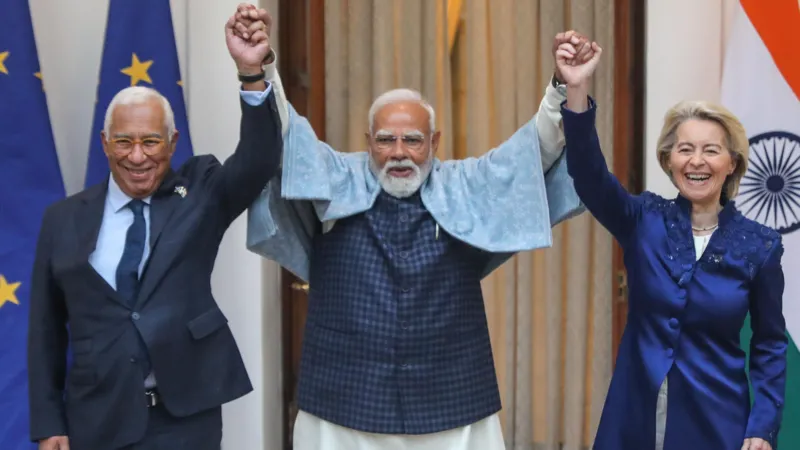
The European Union and India have announced a landmark trade deal after nearly two decades of on-off talks, as both sides aim to deepen ties amid tensions with the US.
“We did it, we delivered the mother of all deals,” European Commission President Ursula von der Leyen said at a media briefing in Delhi. Indian Prime Minister Narendra Modi called the deal “historic”.
It will allow free trade of goods between the bloc of 27 European states and the world’s most populous country, which together make up nearly 25% of global gross domestic product and a market of two billion people.
The pact is expected to significantly reduce tariffs and expand market access for both sides.
Von der Leyen and European Council President António Costa are in Delhi, where they met Modi at a bilateral summit.
The European Commission said the agreement would eliminate tariffs on most exports of chemicals, machinery and electrical equipment, as well as aircraft and spacecraft, following phased reductions. Significantly, duties on motor vehicles, currently as high as 110%, would be cut to 10% under a quota of 250,000 vehicles. That is six times larger than the 37,000-unit quota India granted to the UK in a deal signed last July, Bloomberg reported.
India’s deal with the EU is set to lower costs for European products entering the country – such as cars, machinery and agricultural food items, after import duties are reduced.
Brussels said the agreement would support investment flows, improve access to European markets and deepen supply-chain integration.
Delhi said almost all of its exports would get “preferential access” into the EU, with textiles, leather, marine products, handicrafts, gems and jewellery set to see a reduction or elimination of tariffs.
While commodities such as tea, coffee, spices and processed foods will benefit from the agreement, Delhi “has prudently safeguarded sensitive sectors, including dairy, cereals, poultry, soy meal, certain fruits and vegetables, balancing export growth with domestic priorities”, it said.
Delhi and Brussels have also agreed on a mobility framework that eases restrictions for professionals to travel between India and the EU in the short term.
“This is India’s biggest free trade agreement,” Modi said. “It will make access to European markets easier for India’s farmers and small business. It will also boost manufacturing and services sectors. It will boost innovative partnerships.”
The trade deal comes as both India and the EU contend with economic and geopolitical pressure from the US.
Delhi is grappling with 50% tariffs imposed by President Donald Trump last year amid talks aimed at securing a trade deal between India and the US that are still dragging on.
Last week, Trump threatened to escalate his trade war with European allies for opposing a US takeover of Greenland, before backing off.
That larger geopolitical context was evident in statements made by leaders.
On Tuesday, von der Leyen said: “This is the tale of two giants – the world’s second and fourth largest economies. Two giants which chose partnership in a true win-win fashion. A strong message that co-operation is the best answer to global challenges.”
A day before that Costa had said, without naming the US, that the trade deal would send an “important political message to the world that India and the EU believe more in trade agreements than in tariffs” at a time when protectionism is on the rise and “some countries have decided to increase tariffs”.
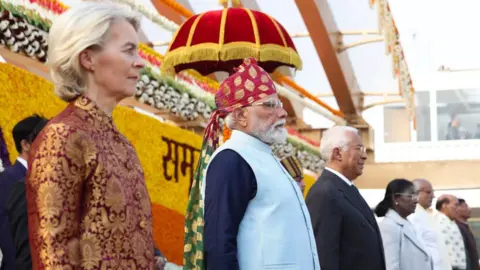
Von der Leyen and Costa arrived in Delhi over the weekend and were the chief guests at India’s colourful Republic Day celebrations on Monday.
On Tuesday, the leaders posed for photos with Modi, with the bonhomie between them evident.
The formal signing is likely to take place only later this year, after the agreement is approved by the European Parliament and the European Council.
Alongside the trade agreement, India and the European Union are also advancing separate talks on security and defence co-operation, and climate action.
On Tuesday, India’s Defence Minister Rajnath Singh said he had discussed a range of bilateral security and defence issues with the European Commission’s vice-president Kaja Kallas, including opportunities to integrate supply chains to build trusted defence ecosystems and develop future-ready capabilities.
The two sides are working on a draft security and defence partnership covering areas such as maritime security, cyber threats and defence dialogue, Reuters news agency reported.
The EU is India’s largest trading partner in goods, with bilateral merchandise trade reaching $136bn (£99.4bn) in 2024-25, nearly doubling over a decade.
Talks for a deal between them started in 2007 but stalled in 2013 over roadblocks in market access and regulatory demands. Discussions were formally restarted in July 2022.
Officials from both sides worked hard over the past few days to finalise outstanding chapters of the agreement, aiming to wrap it up before the EU leaders’ visit.
The agreement comes as pressure grows on Delhi and Brussels to secure alternative markets for exporters.
In the past seven months, India signed major trade agreements with the UK, Oman and New Zealand, and a 2024 pact signed with the four-nation European Free Trade Association bloc of Switzerland, Norway, Iceland and Liechtenstein has come into effect. It signed a trade pact with Australia in 2023.
The EU, meanwhile, signed a trade deal with South American trade bloc Mercosur earlier this month after 25 years of negotiation.
[BBC]


Ireland Women 118/9 in 20 overs (Alana Dalzelle 14, Orla Prendergast 26, Leah Paul 10, Alice Tector 10, Louise Little 26*; Lauren Bell 1-39, Linsey Smith 1-20, Sophie Ecclestone 3-22, Charlie Dean 2-11, Dani Gibson 2-10) lost to England Women 119/6 in 17.3 overs (Dani Wyatt Hodge 16, Nat Sciver-Brunt 48, Heather Knight 26; Aimee Maguire 2-23, Orla Prendergast 2-17) by 4 wickets
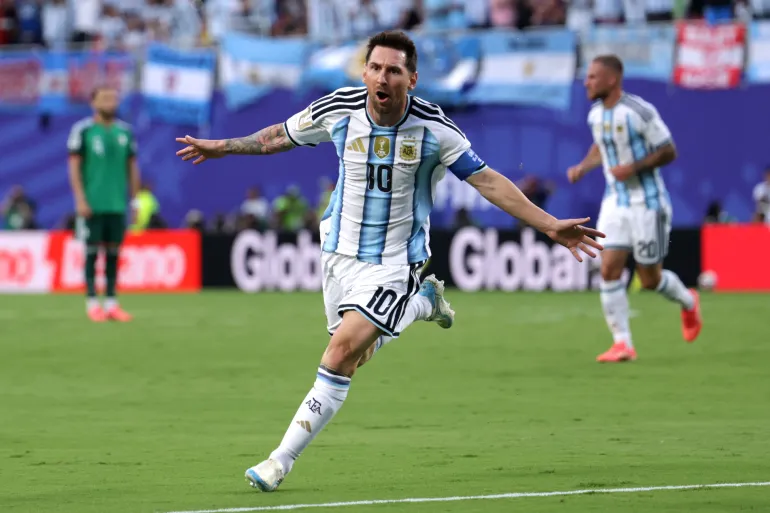
Lionel Messi marked his record sixth World Cup appearance with his first hat-trick at a FIFA tournament as Argentina beat Algeria 3-0 to open the defence of their global crown, he also became the joint highest scorer at World Cups with the feat.
The former 38-year-old forward thought he had opened the scoring in the eighth minute in Kansas City on Tuesday when he slotted home from close range, but the offside flag was raised.
The dream start to his record-setting appearance, which will be matched by Cristiano Ronaldo for Portugal against DR Congo on Wednesday, was not to be denied for long though.
A trademark, mazy run was capped by a drive on the edge of the box from that famed left foot. The power too much for Algeria keeper Luca Zidane, son of World Cup winner with France, Zinidine.
Messi doubled his tally on the hour mark with a simple tap in from a rebound off the keeper following a drive from Alexis Mac Allister.
The moment that even a player as decorated as Messi came in the 76th minute when he drilled low past the keeper from just outside the box.
The strike took Messi level with former Germany striker Miroslav Klose on 16 World Cup goals.
His substitution came just three minutes later to a standard ovation, even old maestro seemed disappointed to be removed – and most likely rested for Argentina’s tilt at becoming only the third side to defend a World Cup title.
Algeria – the 2019 Africa Cup of Nations winners – offered little, but were themselves denied an early goal when Fares Chaibi’s ninth minute strike was ruled out for offside.
Messi saw to it that there was no opening game upset to be had tat this edition, having lost their opening game at Qatar 2022 to Saudi Arabia.
Messi, who spent the majority of his club career in Spain with Barcelona before moving to French giants Paris-Saint Germain, plys his trade in US football’s Major League Soccer with Inter Miami.
Jordan and Austria open their account in the group later on Tuesday in San Francisco.
[Aljazeera]
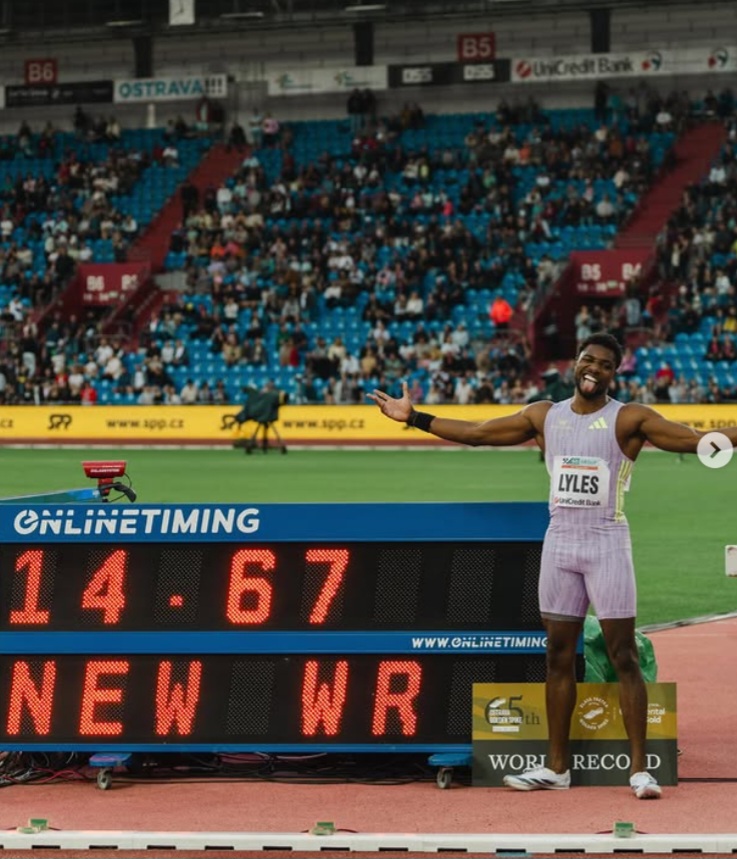
United States sprinter Noah Lyles has set the world’s best-ever time over the rarely-run 150 metres race, clocking 14.67 seconds at the Golden Spike meet in the eastern Czech city of Ostrava.
The 28-year-old Lyles on Tuesday beat the previous best of 14.72 set by Kishane Thompson of Jamaica in Florida in April.
At Ostrava, Lyles beat Sinesipho Dambile of South Africa with 14.78, while Australian teenager Gout Gout finished third in 14.96.
“Was there ever any doubt? Was there ever any doubt? We came for a show,” an elated Lyles told Czech TV.
Earlier this month, Lyles took a comfortable win at the Wanda Diamond League meet in Rome with a 9.88 in the 100m, his fastest since clinching gold at the Paris 2024 Olympics.
The high-energy, anime-loving showman has had strong indoor and outdoor performances throughout the year so far, and was named on this year’s Time100 list of the most influential people.
Dutch star Femke Broeders-Bol had to bow to in-form Swiss Audrey Werro in her outdoor debut in the 800m.
The 26-year-old Broeders-Bol has switched from 400m hurdles, in which she had won two world gold medals, and clocked an impressive 1 minute 57.13 seconds for second place.
“It was so cool, I love racing in Ostrava. It was tough, but I enjoyed it,” she said.
Broeders-Bol has also claimed multiple medals as the anchor leg in 4x400m relay teams, notably a gold in the mixed event in the Paris Olympics.
She ran her first 800m since 2017 in February, clocking a national record of 1 minute 59.07 seconds before withdrawing from the rest of the indoor season to nurse a foot injury.
The 22-year-old Werro won in 1 minute 54.45 seconds, half a second behind her personal best from March, after shedding Broeders-Bol with 200 metres to run.
“It was a really crazy run, but the time is very good, so I’m really happy,” Werro said.
Having set the eighth best time ever, she stayed over a second behind the oldest world record in athletics of 1:53.28 set in 1983 by Jarmila Kratochvilova of then-Czechoslovakia, who watched the race from the stands.
South Africa’s 20-year-old Bayanda Walaza won the men’s 100m as he equalled his personal best of 9.94 seconds, beating Emmanuel Eseme of Cameroon with 9.99 seconds.
US favourites Ronnie Baker and Jordan Anthony were demoted to the fourth and fifth spots, respectively, with times well over 10 seconds.
[Aljazeera]

Spinners make it two in two for England

Messi hat-trick fires holders Argentina to win over Algeria at World Cup

UNDP, Central Bank deepen financial literacy drive to build economic resilience

‘Dancing girl’s’ bare torso restored in Indian textbook after backlash

Tehran selling deal with US as victory – but for Iranians it was necessity

Plans to open underutilised state land for new investment opportunities

‘Dates have the highest sugar content to fight Coronavirus’

Sunday Island 27 December – Headlines

#SundayIsland 17th December – Headlines

Sunday Island – 28th March

Sunday Island Headlines – 21 March

Sunday Island – 21st February – Headlines
-
 News5 days ago
CIABOC summons Yoshitha over his participation in British Navy training programme
-

 Sports2 days ago
Tharanga set for high-profile javelin clash in Ostrava
-

 News5 days ago
Justice Minister responds to social media claims he represented Easter Sunday ringleader
-

 Features3 days ago
Politics of protected species
-

 News4 days ago
Commonwealth lawyers urge Lanka to uphold rule of law
-

 News2 days ago
Theft of USD 2.5 mn from Treasury: CoPF accused of complicity in NPP cover-up
-

 News2 days ago
Release of 2025 O/L results likely to be delayed
-

 News1 day ago
Beijing Capital Airlines to resume flights to Colombo signalling boost to tourism