
Foreign News
What just happened in France’s shock election?

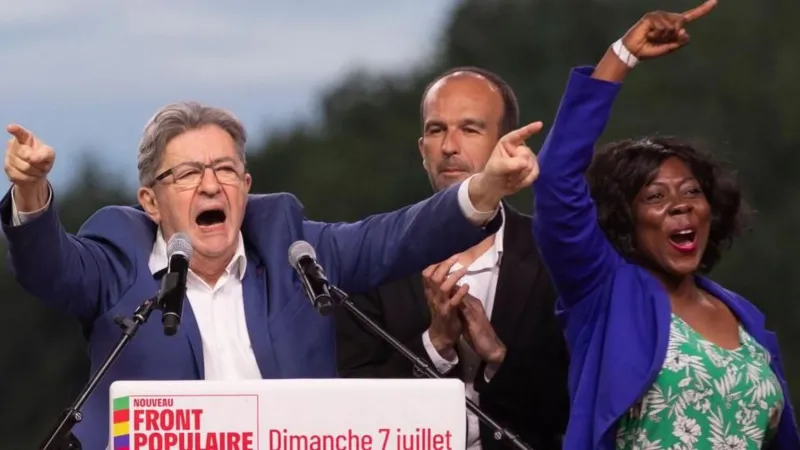
Nobody expected this. High drama, for sure, but this was a shock.
When the graphics flashed up on all the big French channels, it was not the far right of Marine Le Pen and her young prime minister-in-waiting Jordan Bardella who were on course for victory.
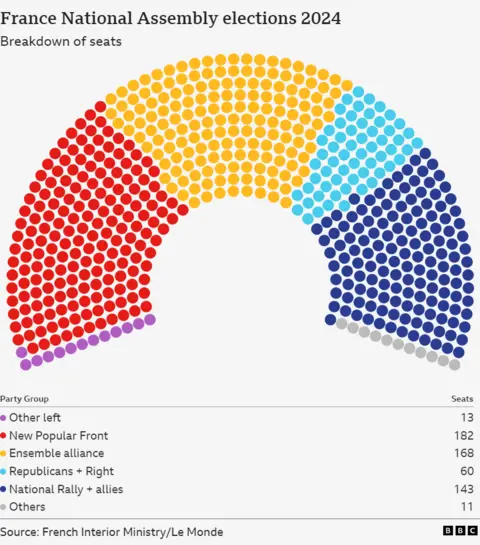
It was the left who had clinched it, and Emmanuel Macron’s centrists had staged an unexpected comeback, pushing the far-right National Rally (RN) into third.
Jean-Luc Mélenchon, the veteran left-wing firebrand seen by his critics as an extremist, wasted no time in proclaiming victory. “The president must call on the New Popular Front to govern,” he told supporters in Stalingrad square, insisting Mr Macron had to recognise that he and his coalition had lost.
His alliance, drawn up in a hurry for President Macron’s surprise election, includes his own radical France Unbowed, along with Greens, Socialists and Communists and even Trotskyists. But their victory is nowhere big enough to govern.
France is going to have a hung parliament. None of the three blocs can form an outright majority by themselves of 289 seats in the 577-seat parliament.
As soon as he had spoken, Mr Mélenchon went off to a much bigger square, Place de la République, to celebrate his success with a crowd of 8,000 people, according to police numbers.
For National Rally’s supporters the champagne was fast turning flat at their celebration-gone-wrong in the Bois de Vincennes forest to the south-west of Paris.
Only a week ago all the talk had been of a possible absolute majority, and Marine Le Pen and Jordan Bardella were still talking up their chances a couple of days before the vote.
Marine Le Pen put a brave face on it. “Two years ago we had just seven MPs. Tonight RN is the first party in France in terms of MP numbers.” In the last parliament they had 88 MPs and now more than 140, so she was right. And no other party has more than 100 MPs, because the Macronists and the Popular Front are both coalitions.
Jordan Bardella complained that his party had been foiled by unnatural “alliances of dishonour”, forged by a “single party” made up of the Macron camp and the left. He wasn’t wrong about the unnatural alliance, but it is only a temporary one of convenience.
More than 200 candidates who saw themselves as part of a “republican front”, pulled out of the second round so that a better-placed rival could stop RN winning.
Not even Marine Le Pen’s younger sister, Marie-Caroline, was able to offer a glimmer of good news from her own election battle around Le Mans. Her bid to get into parliament failed by just 225 votes, defeated by Mr Mélenchon’s candidate, Elise Leboucher, after the Macron candidate dropped out.
Turnout, at 66.63%, was the highest in a parliamentary second round since 1997. Even if RN’s vote held up, this time it was having to contend with non-RN votes often being used tactically to create a “barrage” or block against them.
All over France, RN was losing run-offs it needed to win.

Some of their candidates were less than appealing.
There was the woman who promised to stop making racist jokes if she was elected in Puy-de-Dôme; and then there was the ill-equipped young man in Haute-Savoie in the south-east who took part in a TV debate with his centrist rival and made barely any sense on anything.
They both lost, but they reflected RN’s big advance in rural areas.
RN scored 32% of the vote – 37% with their right-wing allies – and for more than 10 million voters a taboo has been broken.
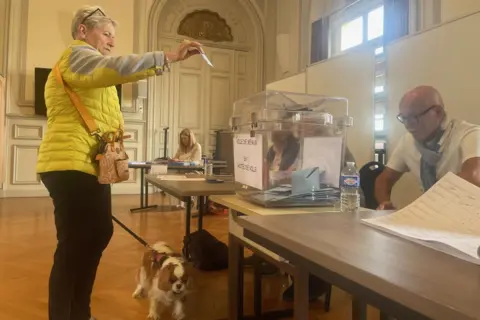
In Meaux, east of Paris, RN won but not by much.
After casting her vote, Claudine said people she knew tended not to admit to voting RN, unless they were with close friends.
Before the projected result at 8pm, there was fevered speculation about whether President Macron would come out and speak. Word spread that he had gone into a meeting 90 minutes earlier.
Gabriel Attal, his beleaguered prime minister, eventually appeared to give the government’s response.
Four weeks ago, he had sat stony-faced and arms folded opposite the president as Mr Macron revealed his election plan.
Now he announced he would be handing his boss his resignation in the morning, but he would stay on as long as duty called.
Mr Attal is supposed to fly off on Tuesday evening to a Nato meeting in Washington. It’s hard to imagine him being replaced just yet.
France has entered a period of political instability with no obvious way out. There had been talk of unrest on the streets, but only a handful of incidents were reported in Paris and cities including Nantes and Lyon,
All eyes are now on the president, who will have to navigate a way out of this deadlock.
The new National Assembly is due to convene in 10 days’ time, but the Paris Olympics starts on 26 July and France could do with a period of calm.
Left-leaning newspaper Libération summed up the whole night with the headline C’est Ouf.
“It’s crazy,” in colloquial French, but for them it’s also a relief that voters brought RN’s bid for power to a halt.
[BBC]

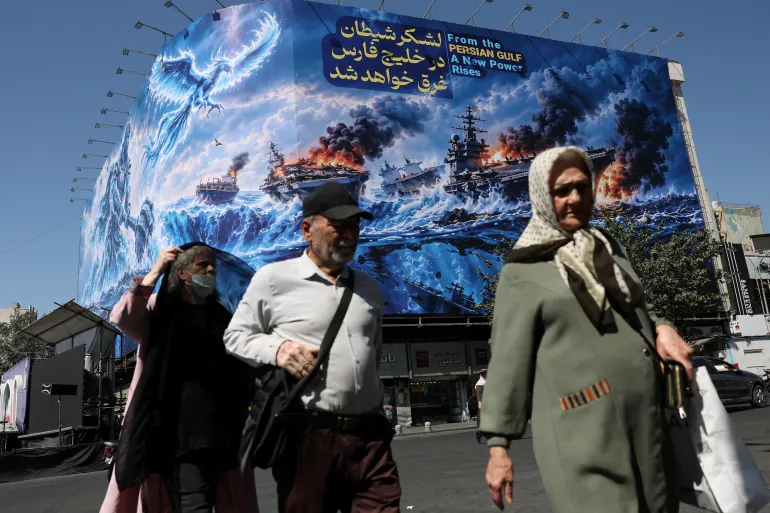
Hours after US President Donald Trump rejected a diplomatic solution put forward by Iran to reopen the Strait of Hormuz, explosions were heard in the waterway, according to Iranian media.
Reports of blasts near southern Iran’s Qeshm Island in the Strait of Hormuz suggested that multiple antiship missiles and drones were fired at vessels transiting the waterway against Tehran’s wishes.
While Iranian authorities did not confirm any attacks in the Strait of Hormuz that day, shipping continues to be attacked in the waters, including an Indian cargo ship last week which killed a sailor.
The Islamic Revolutionary Guard Corps (IRGC) maintains that the strait is closed to any ship that does not coordinate with Iranian authorities. On Sunday afternoon, it released video of what it said was a second US underwater drone seizd this month.
Tehran has issued instructions to shipping companies transiting the Strait of Hormuz to use a temporary route approved by Iranian authorities and pay relevant fees. But it has also said the strait will not fully reopen until the US blockade on Iranian ports ends.
Iran’s Persian Gulf Strait Authority announced on Saturday that it would blacklist any shipping charterer company which orders crews to use routes it considers to be unauthorised.
It also published what it described as an apology from an unnamed shipowner blaming commercial pressure from its charterer for trying to pass through the strait.
(Aljazeera
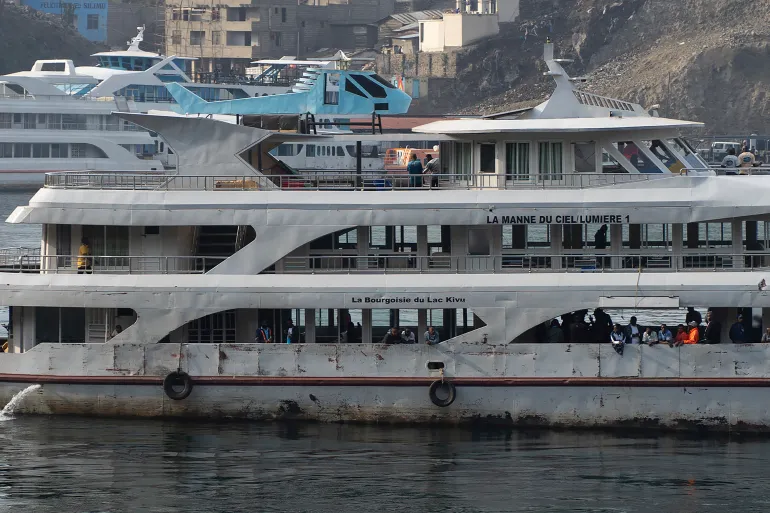
At least 41 people have died, and 49 others have been rescued, after a boat capsized on Lake Tanganyika in the Democratic Republic of the Congo (DRC).
Norris Mulongoyi, the provincial transport minister for DRC’s Tanganyika province, told The Associated Press news agency that search operations were under way to locate the remaining passengers
The boat was reportedly carrying about 100 people and cargo when it capsized near the Congolese village of Mapera.
The vessel was travelling from the port of Kigoma in Tanzania to the city of Kalemie in DRC when it sank on Thursday.
A survivor identified as Annie Moyoni told Radio Okapi, a UN-backed Congolese broadcaster, that passengers were awakened at about 1am and found the boat tilting to one side.
It is unclear what caused the vessel to capsize, but hundreds of people have been killed in boat disasters in the DRC in recent years, according to the AP. Vessels are often overloaded and lack life jackets.
For many in the DRC, travelling by boat is the cheapest and most affordable way to get around. The country is one of the poorest in the world and lacks sufficient infrastructure for its more than 100 million people.
The sinking was the second loss of a Congolese vessel on the Kigoma-Kalemie route in less than a month.
On August 28, the Congolese vessel MV Pacifique caught fire and exploded at the port of Kigoma while loading fuel, according to Radio Okapi.
Six crew members were killed, and a seventh was reported missing, Radio Okapi said, citing port authorities. The vessel operated between Kigoma and Kalemie and was used to transport fuel.
At least 20 people also died when a wooden boat carrying students returning from state exams sank in central DRC in July.
(Aljazeera)
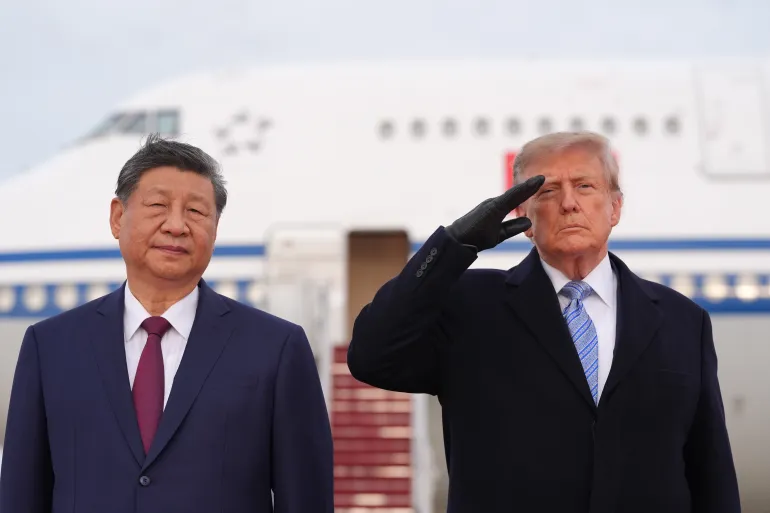
United States President Donald Trump has welcomed Chinese President Xi Jinping as he arrived in the US for a three-day trip focused on issues such as security, trade and technology.
Trump took the rare step of meeting the Chinese leader in person at Joint Base Andrews in the state of Maryland on Wednesday, the first president to do so in recent memory.
The US president and First Lady Melania Trump greeted Xi and his wife on the tarmac during a welcoming ceremony, where a red carpet was rolled out and the couples exchanged handshakes. Trump and Xi then walked side by side, flanked by US soldiers, before standing for a gunfire salute and the US national anthem
The in-person greeting is a sign of the significance that Washington ascribes to its relationship with Beijing, whose meteoric economic rise over the last several decades has transformed it into a global superpower capable of rivalling the United States.
Despite tense relations that worsened after the Trump administration placed high tariffs on Chinese goods – a move that was met with retaliatory measures from Beijing – Trump has expressed personal affinity for Xi and his desire for strong ties with China.
The Chinese president’s trip to the US will include a state dinner, attended by leaders of the country’s powerful tech industry, a military ceremony at the White House, and a visit to the National Archives, home to documents of historical and cultural significance such as the US Constitution and the Declaration of Independence
But both countries remain wary of the other as they compete for political and economic influence. The trip is likely to include discussion of issues such as the US war on Iran, trade, technology, rare-earth minerals and US ties to Taiwan, the self-governing island that China claims as part of its territory
(Aljazeera)

Tharanga wins highly anticipated Asian Games gold

Tharanga on cusp of Asian Games Gold

Rain threat looms over lopsided India vs Afghanistan quarter-final

Out, not-out, out: England secure bizarre run-out in Oval victory

Strait of Hormuz tensions linger as Iran and US move further from a deal

Showers will occur in the Western, Eastern, Uva and Sabaragamuwa provinces and in Galle, Matara, Kandy, Nuwara-Eliya, Polonnaruwa and Mullativu districts

‘Dates have the highest sugar content to fight Coronavirus’

Sunday Island 27 December – Headlines

#SundayIsland 17th December – Headlines

Sunday Island – 28th March

Sunday Island Headlines – 21 March

Sunday Island – 21st February – Headlines
-

 News6 days ago
Mastermind Naufer Moulavi among 15 found guilty
-

 Midweek Review6 days ago
Thileepan’s fast unto death: An authentic narrative that many missed
-
 News7 days ago
Protest against setting up of cement factory in highly populated area near BIA
-
 Latest News5 days ago
Showers above 100 mm are likely at some places in the Western, Sabaragamuwa, Central and North-western provinces and in Galle and Matara Districts
-

 Editorial7 days ago
Trouble beginning in earnest
-
Editorial6 days ago
Big Bad Bills
-
 News7 days ago
Police may seek clarification from US
-
 News7 days ago
Govt. confident of 2/3 majority despite NPP split speculation