
Midweek Review
What does it mean to be ill? Philosophy of Disease and Corona Crisis

Illness is never entirely ‘mental’ or entirely ‘somatic’; illness is unhomelike being-in-the-world of Dasein including both aspects as inter-nested.
(Fredrik Svenaeus, Med Healthcare, and Philosophy, 2011)
By Saumya Liyanage
The COVID-19 outbreak has already brought about a myriad of medical, political and military procedures. Efforts are being made by national health institutions to curb the virus under the guidance of the World Health Organization (WHO). In this country, a Presidential Task Force has been set up to adopt measures to control the transmission of the virus.
The corona outbreak has led to racial and anthropocentric sentiments among communities and some social groups. The racial sentiment has been developing as humans are the carriers of the disease, and people who are infected, or are suspected to be infected, are required to undergo self-quarantine for the protection of society. Anthropocentric sentiment has developed among people because this viral infection has germinated through bats or other animals that humans have come into contact with.
This negative feeling towards nature and anthropocentrism further reflects how we think of the natural world and our sharing of it with other animals. This viral outbreak has gradually given rise to the idea that human existence is detached from the environment; the coronavirus infection has heightened this anthropocentric mentality that we are superior to all other species in the world. Humans have not only alienated themselves from the environments, mainly others species but separated the sick from the healthy. Social distancing has come to stay.
The distancing of humans from the environment due to the corona outbreak further reflects other suppressive apparatuses at work. As the form of anthropocentrism operates through the government regulations, this patriarchal domination suppresses women, children and old people in the community. My observation is that this dominant ideology is operated through medical and military structures through which the government is trying to battle against the viral infection. For the patriarchy, the coronavirus appears as the other, and their battle is to fight it. Countries like Sri Lanka, India, and many African nations have failed to practise social distancing due to diverse social stratifications. It is evident how the elite and bourgeoisie gather around supermarkets one-metre apart in keeping with medical and military procedures. As expressed in social media, social distancing and waiting hours at supermarkets reflect the apolitical sentiment of the bourgeoisie and their subordination, whereas the poo rush to other markets and try to grab anything they can find. However, this anthropocentric sentiment is othering not only the nature in which we live in but other marginalised communities who are weak and vulnerable to the pandemic. Under these circumstances, measures such as ‘social distancing’ are what only the bourgeoisie can practise.
Descartes’s Body and illness
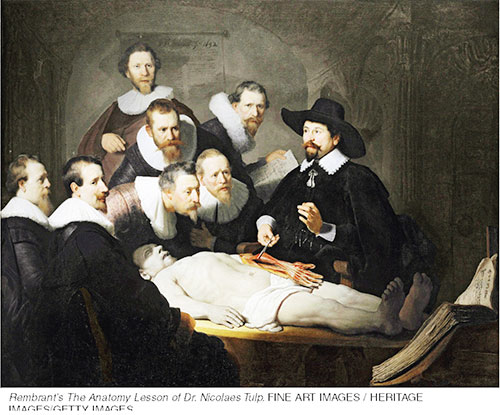
In the traditional Cartesian philosophy, the human body is defined as something similar to a machine, and the spirit or the soul is defined as something separated from this mechanical body. This philosophical assumption is reflected through western medicine and the problem with the current medicinal practices is that the human body and its functionalities are defined and understood as a mechanical body that consists of certain parts and organs. According to this conception, the body organs and other body parts such as limbs are mere mechanical parts of the body that can be dissected, replaced or repaired (Kibbe 2014, Goldenberg 2010). This long historical problem of conceptualising the human body as a biomechanical entity has serious medical circumstances when it comes to how we understand the meaning of patient–health care worker relationship in the current medical care settings. James A. Marcum argues: ‘Working from the biomechanical model of the body, today’s physician operates primarily as a mechanic or technician, whose clinical gaze is focused neither on the patient as a whole nor on the patient’s lived context but exclusively on the diseased body or body part’ (Marcum. J. A., 2004, p. 311).
The dominant medical discourse in the world is thus focused on the human corpus as a place for performing dissections and replacements. This corpus can be opened, removed, replaced or have organs transplanted due to certain illnesses. The problem with these biomechanical approaches to the human body is that the medical world has forgotten the fact that the human body is not merely flesh or a collection of organs or limbs. The phenomenological understanding of the body in contrast to the biomechanical understanding of the body is somewhat different as phenomenology understands the human body as a sentient being or a ‘lived body’ that is already and always attuned to the world. The body thus has its own ways of being-in-the-world and the body also understands the world better than we rationally think of it. Hence, the phenomenal body challenges the biomechanical body in contemporary medical discourse. Writing about current medical practices and patient care, Goldenberg argues that, modern medical technology such as stethoscope, ophthalmoscope, and X-ray have conceptualized the human body as a mechanical object and this conceptualization has permitted us to dissect the lived body (Goldenberg M. J., 2010 p. 51).
First, I would like to briefly discuss why phenomenology is vital for us to understand the nature of illness in contrast to wellbeing. The coronavirus infection has brought up certain assumptions of the human body and its existence as something decayed through illness and death. The daily death tolls in the US, Italy and elsewhere have gradually created the sentiment that the human body is merely a physical entity that can be infected by a viral pandemic or it is a body that can be saved through mechanical manipulation of medical and political discourses. It is true that amidst this pandemic crisis, human beings have to abide by government regulations and medical procedures in such a way that they can deal with the viral pandemic.
However, in this catalytic situation, the human body becomes a mere object of medical and political manipulation. As seen in many of the international news channels, the human body is becoming a canvas for medical procedures as well as torture and violence. Web channels and Facebook circulate how the human body is being diseased and also being tortured by the military because of noncompliance with the rules and regulations amidst this coronavirus pandemic. One cannot contemplate these paradoxical reactions of law enforcement and medical institutions. The body is treated as a surface of violence, torture, diseased to establish its beauty, wellbeing, and immortality. In this respect, bodies’ presence in the current social milieu is somewhat controversial and fragmented. The ruling government and medical institutions need people to be healthy and adopt preventive measures. On the other hand, bodies are being threatened, beaten, isolated and further imprisoned or left behind amid corona warfare.
Phenomenology and the lived body
A new discussion about the human body has come to the fore because our bodies have been continually threatened by both the viral infection and law enforcement. As seen so far, whether it is medical or military discourses, the human body is being manipulated and treated in many forceful ways. The coronavirus infects the internality of the body while the government is policing the flesh of the body. But what it means to have a body and what the role of the body is in human existence are vital questions to be discussed in this difficult time. Hence, I turn to Edmund Husserl (1859-1938) known as the founder of phenomenology; he provides two sets of words to denote the existential natures of the body. The German word körper uses for the physical body or body as an object. The term Leib is used for the lived or living body. That is the body we perceive as a subject. Here, Husserl distinguishes two aspects of the human body. This means that in some situations, we tend to experience our bodies as objects; solid, physical like nature of the body; whereas, in some situations, we experience our body as a transcendental or a living entity which is known as the lived body. Generally, the word ‘lived body’ presents the body as a non-dualistic, sentient being in contrast to the Cartesian split of the body as a machine and the mind as an extended rational soul. The main difference between the lived body and the physical body is that this lived or animate body is always given as my own body (Crisis §2) and I experience myself as ‘holding sway’ over this body. The lived body is not just a centre of the experience, but a centre for action and self-directed movement (Luft and Overgaard 2014, ).
In this discussion of illness and disease, the German philosopher Martin Heidegger’s key concepts of phenomenology will also help to shed light to understand what it means to be diseased or what it means to be healthy. In this regard, concepts such as ‘being-in-the-world’ can be elaborated as to how a person is attuned to her/his environment and how this attunement is disrupted when the illness is invaded into a healthy body (Svenaeus 2011). Further, the French phenomenologist Maurice Merleau-Ponty developed the idea of ‘body-subject’ where he explains the power and expression of the human body not just as a corpus but as a consciousness establishing its ‘intentional arc’ as the power of attuning with the world. In this sense, I am motivated to write about the current illness caused by the coronavirus and understand the conundrum of being ill and not being ill in the light of phenomenology.
Alienation
When a person is ill and feeling unwell, one’s conscious experience is directly focused on her/his body, and the functionality and the smooth flow or the attunement of the body with its environment is primarily fractured or ceased. When one’s intentionality is directed towards her/his body, the autonomous nature of the body is paralyzed and ill-treated. This uncanny mood creates a disjuncture of our being-in-the-world which means our natural flow of being-with- other.
When someone is diseased, our natural flow of coping with the world and our emotional engagement with the world is disrupted. In a phenomenological sense, this can be understood as something similar to ‘unhomelike’ being-in-the-world (Svenaeus 2011). As Heidegger speculates in his Being and Time (1927), our natural attitude is that our body is thrown into the world where the body and the world are intertwined and bound together through its practicalities. The practicalities here refer to our bodily engagements with certain projects through tools and equipment. When we feel sick, that means our natural engagement with certain projects through the equipment is disrupted and disturbed. Our homelike being-in-the-world is fragmented or disrupted. Heidegger calls this ‘authentic anxiety’.
In this illness situation, our bodies experience the ‘otherness’ within oneself or alienation from oneself from her/his self. The idea of alienation is very familiar in theatre theory and especially Bertolt Brecht’s conceptualization of the actor’s disengagement with the character. In German, it is known as the verfremdung, which means the alienation or defamiliarizing of the familiar (Liyanage 2016). But the otherness that one may experience during illness is something that is to do with the duality of self and the experience of being self while possessing the dual existence. (the otherness of one’s own body comes to the fore). When the illness occurs the patient feels disengaged with her daily projects and she may feel pain, anxiety, dizzy and many other ailments. In such a situation, in a phenomenological sense what we experience is unhomelike being-in-the-world. This ‘unhomelikeness’ is the ‘otherness’ that one may experience during illness. In a healthy situation, a person’s projects are operated through bodily actions that are intertwined with the outer world. These activities always function with ease because the body is always absent in the delivery of human action. Yet the diseased body is not operated in this manner. When the body is diseased, it is not operated behind the curtain or in other words, the body is not absent. The body always comes to the fore. In contrast to this unhomelikeness, when the person is fully operative and engaged in projects in the world, these healthy engagements are characterized by the mood that one possesses in engaging ‘life-world’ activities (Nagatomo 1992). For instance, if I am not yet infected by the virus, my daily routine activities are not disturbed by the illness and my full operation as a healthy person is manifested by the emotional engagement and the expression that I have during my activities. This is vital for us to understand the ‘mood’ of the person who is fully being-in-the-world.
Gaze and Illness
In the recent discussion on the corona outbreak and the battle against the disease, one of the major social psychological factors that have developed in recent weeks is that people are afraid of being identified as COVID-19 infectious individuals. The problem of this phenomenon is that whether you are infected or not, people have a great fear of being identified as a diseased person. How can we understand this mental condition? As I discussed earlier, it is a fear of being alienated from our selfhood. Jean-Paul Sartre, in his book Being and Nothingness (1943) articulates this concept through the gaze of the other. The fear of being ill encapsulates the individual’s experience of her/his objectification of the body as an ‘unhomelike being-in-the-world in the wake of a disease. In Sartre’s lexicon, there are other ways that one’s body can be gazed at by others and alienated from her/his self. For instance, seeing a doctor check whether I have been infected by a disease demonstrates that in the confrontation of the doctor’s gaze, my body is becoming an object to me. However, this alienation of my own body from my own conscious experiences is the moment that I experience the discomfort and further the shame of being ill. In Sartre’s philosophy, ‘the gaze of another person has the power of objectification of my own body. Therefore, I experience the ‘otherness’ or the alienation of my own body as if someone who is a conscious person looking at me and makes my conscious attention towards my body’ (Svenaeus 2009).
Conclusion
The human body is an unprecedented creation of nature that is always being in the world as a living and sentient being. It is a sentient being because it always demonstrates to the world of its ‘becoming’ rather than being a final product. ‘The human body is a unique aesthetic material; it is a living organism, always in a state of becoming; that is, in a continual process of transformation’ (Fischer-Lichte 2014, p. 25). We need to understand the living nature of our bodies in this difficult time because, as argued in the foregoing, the human body is not merely a collection of organs or an assemblage of outer and inner materials combined to develop a physical body. As Merleau-Ponty speculates, the human body is a living entity and it is already anchored in the world before we rationally think of our outer world and environment. This is why medical doctors and health workers need to rethink how they should interact with or treat patients. Especially at this difficult time of the coronavirus outbreak, we further need to change our perspectives towards those who are affected with COVID-19, and how we understand their illness and how we take care of the diseased.
Acknowledgments
The author wishes to thank Himansi Dehigama and Sachini Senevirathne, PGIE, Open University Colombo who have proof read this paper.
Saumya Liyanage
(PhD) is an actor and a Professor of theatre and drama, at the Faculty of Dance and Drama, University of Visual and Performing Arts Colombo.
Email:
Reference list
Dermot Moran and Cohen, J. (2012). The Husserl dictionary. London ; New York: Continuum, Cop.
Dreyfus, H.L. (1991). Being-in-the-world : a commentary on Heidegger’s Being and time, division I. Cambridge, Massachusetts: MIT Press.
Fischer-Lichte, E. (2014). The Routledge introduction to theatre and performance studies. London: Routledge.
Goldenberg, M.J. (2010). Clinical evidence and the absent body in medical phenomenology: On the need for a new phenomenology of medicine. IJFAB: International Journal of Feminist Approaches to Bioethics, 3(1), 43–71.
Heidegger, M. (2013). Being and time. United States: Stellar Books.
Jean-Paul Sartre, Richmond, S. and Moran, R. (2018). Being and nothingness : an essay in phenomenological ontology. Abingdon, Oxon, UK: Routledge.
Kibbe, B. (2016). Feminist phenomenology and medicine, edited by Kristin Zeiler and Lisa Folkmarson Käll. Albany: State University of New York Press, 2014. IJFAB: International Journal of Feminist Approaches to Bioethics, 9(2), 219–223.
Luft, S. and Overgaard, S. (2014). The Routledge companion to phenomenology. London: Routledge.
Marcum, J.A. (2005). Biomechanical and phenomenological models of the body, the meaning of illness and quality of care. Medicine, Health Care and Philosophy, 7(3), 311–320.
Merleau-Ponty, M. and Smith, C. (2015). Phenomenology of perception. London: Forgotten Books.
S Kay Toombs (2001). Handbook of phenomenology and medicine. Dordrecht ; Boston: Kluwer Academic.
Saumya Liyanage (2016). Meditations on acting : essays on theory, practice and performance. Mount Lavinia, Sri Lanka: Dev Publishing.
Shigenori Nagatomo (1992). Attunement through the body. Albany, NY: State University Of New York Press.
Svenaeus, F. (2011a). Illness as unhomelike being-in-the-world: Heidegger and the phenomenology of medicine. Medicine, Health Care, and Philosophy, [online] 14(3), pp.333–343. Available at: https://www.ncbi.nlm.nih.gov/pubmed/21107913 [Accessed 21 Mar. 2020].
Svenaeus, F. (2011b). Illness as unhomelike being-in-the-world: Heidegger and the phenomenology of medicine. Medicine, Health Care, and Philosophy, [online] 14(3), pp.333–343. Available at: https://www.ncbi.nlm.nih.gov/pubmed/21107913 [Accessed 21 Mar. 2020].
Thomson, lain (1999). Can I die? Derrida on Heidegger on death. Philosophy Today, 43(1), pp.29–42.

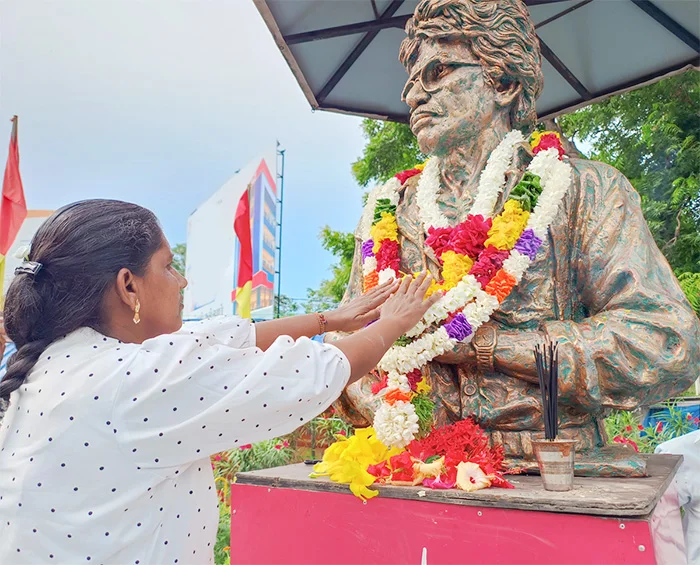
Tamil political parties and politicians are seeking political advantage over the death of Thileepan. Last year, organisers of Thileepan commemoration prevented Fisheries, Aquatic and Ocean Resources Minister Ramalingham Chandrasekaran from entering the Thileepan memorial in Nallur. In spite of being a Minister, Chandrasekaran couldn’t enter the premises. The NPP National List lawmaker made the abortive bid on 17 Sept., 2025, the third day of the 12-day commemoration.
Would he risk being snubbed for a second consecutive year? At the time the Thilipeen commemoration started, on 15 Sept., Chandrasekeran had been away in China and he returned to the country over the weekend.
By Shamindra Ferdinando
Commemorative events held at the newly installed bronze statue of the late Rasiah Parthipan, alias ‘Lt. Colonel’ Thileepan at Nallur, Jaffna, caused controversy. A section of the Opposition accused the NPP government of encouraging separatist movement by turning a blind eye to the growing hero worship of an LTTEer.
The unveiling of the statue took place on 15 Sept., the day the Tiger launched his fast unto death, in 1987, to become a hero in the eyes of his equally misled community. At the time of his death, at the Nallur Hindu Temple, on 26 Sept.,1987, Thileepan was 23-years-old.
The controversial commemoration will continue till 26 September, 2026. The SLPP led the attack against the backdrop of accusations that the former ruling party promoted the LTTE ideology, by accommodating maverick Jaffna District Independent lawmaker Dr. Ramanathan Archchuna, a truly qualified medical doctor on its political platform. Dr. Archchuna also never shies away from calling a spade a spade, irrespective of any consequences.
Almost four decades after his death, controversy still surrounds the circumstances leading to the former Jaffna Hindu College student, and Jaffna University undergraduate, launching the fast unto death.
Jaffna Monitor, in a story headlined ‘Jaffna Begins 39th Commemoration of Thileepan’s Fast,’ posted this month, dealt with Thileepan’s fast. Let me reproduce the relevant section: “His fast followed the Indo-Lanka Accord of July 1987, under which Indian troops were deployed to the north as a peacekeeping force. On Sept. 13, 1987, the LTTE handed the Indian High Commission a letter setting out five demands: the release of Tamils held under the Prevention of Terrorism Act and emergency regulations; an end to Sinhalese settlement in Tamil areas carried out in the name of rehabilitation; a halt to all such rehabilitation work until an interim administrative council is established; an end to the construction of police stations in the Northern and Eastern Provinces; and the disarming of government-armed home guards, together with the withdrawal of the army and police from schools. The demands were addressed to New Delhi on the reasoning that India alone could compel Colombo to act. No reply came.” https://www.jaffnamonitor.com/featured/jaffna-begins-39th-commemoration-of-thileepans-fast/
But, ex-LTTE combatant Niromi de Soyza (not her real name) in her internationally acclaimed ‘Tamil Tigress’ disclosed what transpired at a meeting (p 142) chaired by Thileepan himself at a place called Freedom Birds’ head office where he declared the LTTE’s determination to force the Indian Army to leave Sri Lanka. Declaring that those who served the group’s political wing didn’t get an opportunity to show their commitment to the organisation, he had vowed to go ahead with fast unto deaths, regardless of the consequences. Soyza, who had been assigned to the group responsible for crowd control at the fast unto death site, quoted Thileepan as having said at the previously mentioned meeting: “This is my chance. I’m optimistic it will achieve something, whether I live or die. We must force the Indians out of our land.”
The author of “Tamil Tigress’ who had been among those who received her first assault rifle and cyanide capsule from Thileepan questioned the (Chapter 9: There’s still time to change your mind) as to why Velupillai Prabhakaran chose physically fragile Thileepan to undertake the fast unto death.
According to Soyza’s narrative, the fast unto death had been directed at the Indian Army. Referring to the Nallur hunger strike 39 years ago, Soyza said that lyrics of all songs played therein expressed the same sentiments. In her own words, Thilpeepan’s dying wish was to see the foreign army, the IPKF (Indian Peace Keeping Force) defeated.
Sri Lanka never really examined at least key events that shaped the war in the North-East. Successive governments lacked political will to meticulously scrutinise events thereby setting the record straight. Over the years various interested parties have been successful in promoting false narratives, pertaining to key events. Thileepan’s fast unto death is a case in point.
A memorial for IPKF
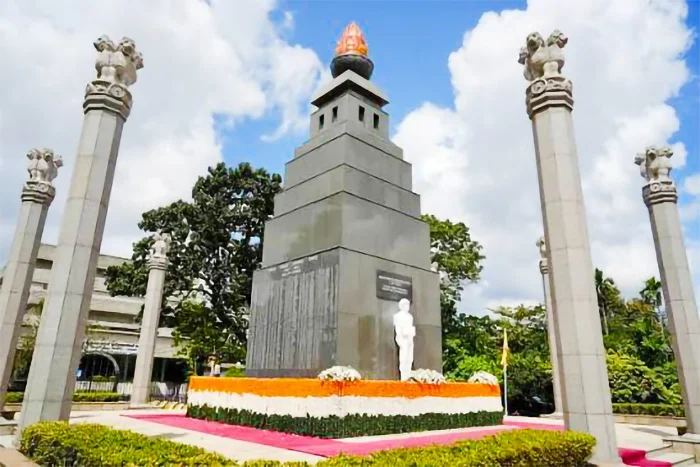
IPKF memorial
Thileepan’s fast unto death, or slow suicide, created the background for the LTTE-IPKF war. The war erupted just two weeks after Thileepan’s death. Those propagating false narratives have conveniently forgotten that the crux of the matter is the fact that the LTTE didn’t hand over its weapons as envisaged in the Peace Accord signed on 29 July 1987. All Tamil terrorist groups were to be disarmed within 72 hours after the signing of the accord. India failed in one of its primary responsibilities.
The much publicised weapons handover that took place in Jaffna was a farce. Perhaps, the top IPKF command knew of the LTTE strategy but chose to turn a blind eye. The consequences were devastating. The memorial put up by Sri Lanka, in 2008, for the IPKF, at Battaramulla, is a stark reminder of the war caused by the LTTE. Had it accepted the Indo-Lanka Peace Accord, as previously agreed, there wouldn’t have been the fast unto death undertaken by Thileepan and a bronze statue or a memorial for the IPKF.
The LTTE had been hell-bent on eradicating other Indian-sponsored former Tamil terrorist groups, as well as taking on the Indian Army. Prabhakaran had been so over confident of his group’s military prowess, he created an extremely hostile environment conducive for war. Having deceived the governments of India and Sri Lanka regarding the surrendering of armaments in line with the peace accord, Prabhakaran, apparently engineered Thileepan’s slow suicide. ‘Tamil Tigress’ author who personally knew Prabhakaran and Thileepan emphasised that point quite clearly. The bottom line is that Thileepan’s demise had been a tool in Prabhakaran’s hands who brazenly manipulated the Jaffna community. Prabhakaran used Thileepan’s needless agonising death to maximise the overall LTTE strategy. The LTTE wanted an excuse to resume hostilities. Obviously, he was quite successful in creating an environment conducive for war. Don’t forget that Thileepan launched his fast unto death six weeks after the deployment of the Indian Army in Northern and Eastern Sri Lanka.
The surrender of arms, arranged at Suthumalai sportsground on 4 August, 1987, with the presence of the media, was meant to underscore the end of the conflict. But the ‘Tamil Tigress’ author, who had been present at the arms surrender, revealed in her memoirs how Prabhakaran expressed suspicion of the peace accord. According to her, on the night of 4 August, 1987, she was among those addressed by Prabhakaran, his first interaction with LTTE cadres following his Suthumalai sham weapons surrender to fool the fools. Soyza quoted Prabhakaran as having told them: “All our good ammunition was stashed prior to the surrender. We’ll continue to hand over the rest.” She also quoted Prabhakaran as having declared: “War will resume in a month or two.”
Close on the heels of a group of LTTE cadres taking their lives after being apprehended by the Navy in the first week of Oct., 1987, the author of ‘Tamil Tigress’ quoted Prabhakaran as having alleged India engineered the peace process as a plot to gradually eliminate them. The LTTE leader had obviously forgotten if not for India they wouldn’t have achieved powerful military status. India not only armed the Tamil terrorists, but also granted them freedom to conduct operations across the Palk Strait. The Indian Navy looked the other way when terrorists, wounded in combat with the Sri Lankan military, were moved across the short passage to receive treatment in Tamil Nadu hospitals.
The suicide of LTTE cadres, including the then Jaffna commander ‘Lt. Col.’ Kumarappa, and Trincomalee commander ‘Lt. Col’ Pulendran, boosted Prabhakaran’s strategy. Those propagating false narratives tend to forget that Prabhakaran smuggled in cyanide capsules into Palaly air base where the 17 personnel were held. In a way, the slow death of Thileepan, and mass suicide of LTTE cadres, all were engineered by Prabhakaran himself. Those demanding accountability on the part of Sri Lanka never bothered to examine Prabhakaran’s murderous plots.
Sri Lanka’s dilemma
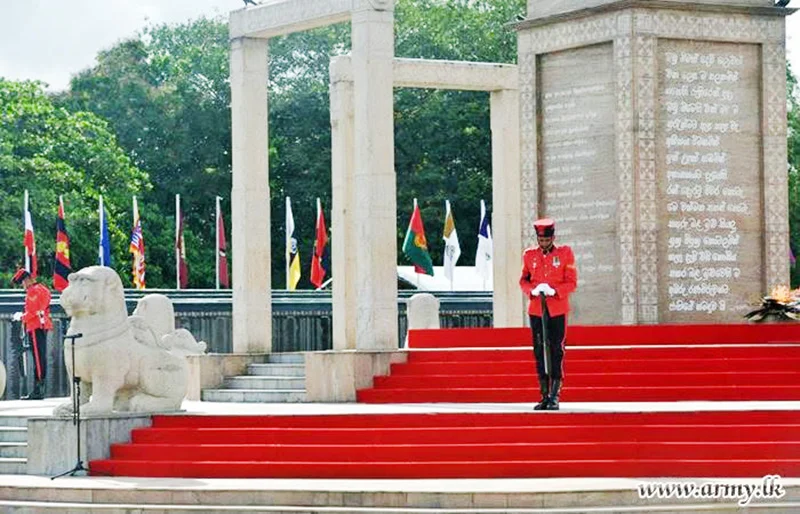
Sri Lanka memorial
Indian Defence Minister Rajnath Singh, during his recent visit here, paid a floral tribute to the IPKF memorial, at Pelawatte, Battaramulla. It would be pertinent to mention that the construction of the memorial was completed in 2008. The late General Lionel Balagalle, in his capacity as the Commander of the Army and Chief of Defence Staff, proposed a memorial for IPKF, following a visit to New Delhi in Dec., 2003. What made Balagalle propose a memorial for the IPKF, knowing very well India destabilised Sri Lanka and the introduction of the foreign Army by way of arm twisting the then government, headed by JRJ, was not appreciated, under any circumstances. He, like many of us, however realised we had to make peace with our giant overbearing neighbour, irrespective of whether we liked it or not, in order to co-exist.
The destabilisation of a friendly country had been in line with their overall strategy to deploy its Army to ensure the installation of an administration loyal to New Delhi. India went to the extent of forming a force called Tamil National Army (TNA) during the period leading to the withdrawal of the IPKF in March 1990. Having joined The Island editorial as a novice, in June 1987, the writer had the opportunity to cover the last Indian troop carrying vessel leaving Trincomalee port on the afternoon of 24 March, 1990 (The IPKF is off, The Sunday Island, 25 March, 1990). India violated Sri Lanka airspace on 4 June to air drop 25 tonnes of food and medicine over Jaffna peninsula without anyone’s permission here, which came to be sarcastically termed the ‘parippu drop’, just three days after I joined The Island.
While honouring the IPK with a memorial in which 1069 names of its officers and men killed in the Lankan misadventure inscribed, since the end of the war, in May 2009, Sri Lanka played politics with the defeated LTTE. The Thileepan’s statue is a case in point. The installation of a new bronze statue of Thileepan, who died in a fast unto death against India demanding the withdrawal of the IPKF, soon after the Indian Defence Minister paid floral tribute to the IPKF memorial, highlighted Sri Lanka’s continuing dilemma.
The ruling NPP under any circumstances cannot risk antagonising the Tamil electorate, or the Tamils living overseas, by clamping down on events, such as the Thileepan commemoration. Having won all electoral districts in the predominantly Tamil speaking Northern and Eastern Provinces at the presidential and parliamentary polls, in 2024, and done well at the Local Government polls of May 2025, in the same regions, the NPP may have bent backwards to avoid confronting organisers of such events.
The intervention made by police at Nallur, on 18 Sept., 2026 .should be considered as a measure to counter accusations that the government promoted separatist sentiments. Police disrupted the public address system claiming that the organisers didn’t obtain permission to use speakers. But, the commemorations continued not only in Nallur but in Batticaloa as well.
The undeniable truth is all political parties, represented in Parliament, played ball with the LTTE, during the conflict and after, hence the song and dance will continue. The reality is Prabhakaran staged Thileepan’s slow death and engineered mass suicide at the Palaly air base in Sept. and Oct. 1987 to plunge the country back into war. Therefore, the country should be wary of those propagating and promoting false narratives in support of their despicable political agendas. The issue is whether Thileepan willingly sacrificed his life to help Prabhakaran implement his strategy or was used as a tool. If Soyza’s narrative is accurate Thileepan had been chosen from among a large group of volunteers who accepted the challenge. There is no doubt fast unto death must have been Prabhakaran’s brainchild as much as the Palaly mass suicide was. What made Prabhakaran believe that he could overwhelm the Indian Army, at that time numbering over 1.1 mn and was considered the fourth largest with the Soviet Union, China and the US maintaining far bigger land forces?
During the Indian Army deployment that began in July/August, 1987, the strength was around 10,000 officers and men. Their mission was to ensure implementation of the ceasefire and disarming of terrorist groups. But, when Prabhakaran executed a group of Sri Lankan soldiers in their custody following the mass suicide at Palaly airbase on Oct. 5, 1987, and fighting erupted a week later, India had no option but to bring in additional forces. At the peak of their deployment here the total strength including the Navy and Air Force units, reached 100,000.
Thileepan insulted
It is a paradox that a section of the Tamil community commemorated Thileepan after having voted for warwinning Army Commander General (retd.) Sarath Fonseka at the 2010 presidential election. In spite of Fonseka suffering a humiliating defeat, he won all predominantly Tamil speaking districts. Tamils, including recipients of foreign citizenship, annually commemorate various LTTE events. ‘Black Tiger Day’ on 5 July, the day Vallipuram Vasanthan, known by the nom de guerre Captain Miller, mounted a suicide attack on troops of ‘Operation Liberation,’ based at the Nelliady Central College, is one such event. That was the time between the infamous Indian airdrop and the signing of the so-called Indo-Lanka peace accord that was done under the threat of direct Indian military intervention.
What made the community that still considered Thileepan as a hero to vote for Fonseka who mercilessly brought the war to an end? What made lawmaker Archchuna, who still venerated Prabhakaran, to join Mahinda Rajapaksa on the SLPP platform? Thileepan would have turned in his grave if he saw how the community behaved. Nothing could have offended him or Prabhakaran than the Illankai Thamil Arasu Kadchi (ITAK)-led Tamil National Alliance (TNA) joining hands with the UNP and the JVP to field Fonseka as the common candidate at the 2010 presidential election.
The TNA consisted of former Indian funded terrorist groups TELO, PLOTE and EPRLF, in addition to the ITAK, had no qualms in promoting Fonseka’s candidature after having accused his Army of gross human rights violations. The Tamil electorate had no qualms in choosing Fonseka over Mahinda Rajapaksa, who sought political consensus with the LTTE as a last bid to end bloodshed before unleashing the armed forces on an all-out assault, within our limited means, to defeat uncompromising Tiger terrorists.
Sri Lanka pathetically failed to set the record straight. The worst offender is President Rajapaksa himself. His administration could have done much more to explain the developments leading to all-out war. Instead, the first post-war Rajapaksa government squandered that opportunity. Its pathetic failure helped those who couldn’t stomach the LTTE’s defeat to propagate war crimes accusations with the help of the conniving West, which, unfortunately, included the United Nations organs like the UNHRC, controlled by them.
While the top Sri Lankan military and political leaderships were held accountable for unsubstantiated war crimes allegations, with the US, the UK and Canada declaring targeted sanctions against former Presidents Mahinda Rajapaksa and Gotabaya Rajapaksa as well as Admiral of the Fleet Wasantha Karannagoda, General Shavendra Silva et al. Australia found fault with strategist Maj. Gen. Chagie Gallage for taking command, post-war command, of 59 Division that played a significant role in eradicating the LTTE. Gallage was denied a visa during the Yahapalana administration. When this writer raised the relentless Western attacks on wartime Sri Lankan leadership at a media briefing called by the Foreign Ministry in Sept., 2022, the then Foreign Minister Ali Sabry, PC, said that entire divisions deployed on the northern front had been blacklisted.
While Indian dignitaries paying their respects at the IPKF memorial seemed to have received public acceptance, last year the NPP government created unprecedented controversy ahead of the May 2025 commemoration when the Defence Ministry announced President Anura Kumara Dissanayake wouldn’t attend the 16th ‘War Heroes’ commemoration ceremony. The declaration triggered a massive political backlash. President Dissanayake was compelled to reverse his decision. The JVP and NPP leader, who also holds the Defence portfolio and the post of Commander-in-Chief of the armed forces, attended the event. This year there was no controversy. Whatever the JVP/NPP political stand, the President cannot, under any circumstances, shun the annual war heroes’ commemoration.
The armed forces eradicated JVP terrorism twice in 1971 and 1986/87 to 1990. They defeated the conventional military and terrorist challenge posed by the LTTE. Whatever the ungrateful opportunists and Western-funded NGO hacks write, the armed forces triumph over the LTTE is the single most important post-independence achievement. The eradication of the JVP challenge that almost overwhelmed the UNP government in the late 80s, too, is equally important and had the armed forces failed at the time, the country could have ended up in far worse chaos. The bottom line is that the eradication of the LTTE couldn’t have been achieved if the UNP didn’t triumph over the second JVP-inspired terror campaign. That is the undeniable truth. It would be unfair by the JVP if we didn’t mention that the UNP too drove the JVP to take up arms in the 80s by proscribing the party over the 1983 anti-Tamil violence, though it was not responsible for the breakdown of law and order, countrywide, when UNP goons went on the rampage against innocent Tamils, especially in Colombo. The postponement of scheduled parliamentary elections by six years to 1989, after holding a sham referendum by the JRJ government, too, contributed to the war in the North, and terrorism in the South.

By Chandre Dharmawardana
chandre.dharma@yahoo.ca)
(Continued from 22 Sept. 2026)
Other well-recognised fault lines
In discussing Sri Lanka’s political trajectory since 1948, many writers relish a narrative where its current impasse and its ethnic conflict are traced back to the “curse of partisan politics” (e.g., This curse of partisan politics in Sri Lanka, Island 2026/09/4, by Brig. Ranjan de Silva [10]). A more sophisticated narrative is based on the negative impact of Sinhala Only nationalist policies introduced by SWRD Bandaranaike after defeating the pro-business UNP in 1956. In fact, many social scientists (e.g., H. L. Seneviratne [11]) have analysed Sri Lanka’s post-Independence trajectory in dystopian terms within this paradigm equated to the negative impact of a majoritarian “Sinhala-Buddhist-dominance” politics.
H. L. Seneviratne explicitly positions the 1956 election of S. W. R. D. Bandaranaike and the subsequent “Sinhala Only” Act as the foundational missteps that set Sri Lanka on a tragic path. He argues that this political turn institutionalised majoritarian chauvinism to secure electoral victories. Seneviratne analyses the post-1956 era in stark, structural terms. He argues that by allowing Buddhist monks (the Sangha) to morph from spiritual renunciates into a highly politicised, corporate pressure group, the state birthed a toxic political culture. In his evaluation, this “New Buddhism” fostered ethnic polarisation, institutionalised corruption, and ultimately laid the structural groundwork for the devastating Sri Lankan Civil War.
These authors have claimed that the increasingly jingoistic policies of many politicians of the majority community, as well as the ultra-nationalist politics of the Ilankai Thamil Arasu Kadchi (ITAK) established in 1949 dictated an irrevocable path to armed conflict that sapped Sri Lanka for over three decades. Majoritarian “Sinhala-Buddhist domination” is frequently cited by Tamil opinion writers as a major cause hindering Sri Lanka. In contrast, Sinhalese opinion writers point to the “excessive” set of demands of the 12% Tamil minority that began with their rejection of the Donoughmore constitution and the Eelamist demands for an exclusive Tamil homeland that grew out of the political platform of the ITAK.
The 1972 republican constitution of the SLFP-LSSP government became a pivotal juncture when the Tamil youth, inflamed by the violent propaganda, e.g., the poetry of Kasi Anathan, firmly embraced militant separatism. This was finally ratified by the Vaddukkodai resolution of 1976 crafted by the Tamil United liberation Front (TULF). Kasi Anandan had called for physical elimination of “thurogi” (traitors) who sought federalism or any form of power sharing with the majority. By then, several of the moderate Tamil leaders who had been named by Kasi Anandan had been assassinated. The TULF leaders were themselves assassinated and Tamil politics was hijacked by violent youth groups. The LTTE emerged out of the blood bath within the Tamil community to confront the Sri Lankan state militarily until the LTTE’s demise in 2009.
Historians, like K. M. de Silva, have characterised the Tamils as a minority who behave like a majority, while the Sinhalese are a majority who have behaved like a minority always fearful that the Tamil minority and Tamil-Nadu Tamils would act together and prevail against them.
However, both inter-Ethnic violence as well as intra-ethnic violence are fueled by the availability of discontented youth populations. Currently, Sri Lanka’s youth population has probably fallen below threshold for driving social upheavals, as Sri Lanka is now in demographic contraction. However, given the widening rich-poor gap, the residual youth populations still have the potential to spawn urban terrorist cells that can have an impact far beyond their numerical strengths.
Malaysia provides a strong counterexample to the type of social analysis presented by H. L. Seneviratne and others who argue that demotion of English and majoritarian jingoist politics were the key factors that have weighed in on Sri Lanka’s post-independence performance.
Malaysia emerged from British Malaya and by 1970 adopted Malay as the only official language. It demoted English completely, and made no room for the use of Chinese, the language of the 30% minority. Furthermore, Malaysia openly and unabashedly adopted a policy of discriminating in favour of Malay ethnics (60% of the population) who were named “Bhumiputra” (sons of the soil) with special rights and privileges in an Islamic hegemonic society. Unlike in Sri Lanka (where the leaders at least affirmed equality for all, or the wish to create just societies), Malaysia adopted an unapologetically chauvinist political programme.
In strong contrast to the political programme launched by elite leaders of the Tamils in Sri Lanka, the Chinese minority, basing on its previous experience of violence faced by them, followed a non-violent approach, ostensibly cooperating with the Malays, but concentrating on achieving hegemony in the mercantile and professional sectors.
Another factor that worked in favour of Malaysia was the absence of a significant Marxist political movement that could have deterred foreign investment or spawned nationalisation of successful private assets. Massive tax breaks and guarantees of labour stability enabled Malaysia to attract industrial giants such as Mitsubishi, Intel, HP, Texas Instruments etc., into its free-trade zones in the 1970s. At that time Sri Lanka was busy nationalising its tea plantations, driving out experienced managers to other countries such as South Africa and looking at foreign investors with a Marxist lens. Meanwhile, in Malaysia, majority and minority ethnic groups worked together in spite of political and linguistic discrimination, and today the average income of a Malaysian citizen is approximately five times that of a citizen of Sri Lanka.
A fragile facade
The Central Bank’s upbeat figures and the upgrade to middle-income status provide a vital psychological boost, but they reflect a temporary stabilisation rather than permanent structural health. A country cannot genuinely move into “safe waters” when its corporate elite is exporting capital, its professional class is fleeing overseas, and its remaining domestic population is rapidly aging.
Without aggressive structural reforms aimed at curbing trade mis-invoicing, incentivising talent retention, and preparing the economy for an aging workforce, the current economic growth will remain a fragile facade. If these three dystopian factors are left unaddressed, they will inevitably intersect, trigger a collapse in productivity, and rapidly destabilise Sri Lanka’s hard-won recovery. The leaders of the country, as well as the populace, irrespective of their political hue, have not appreciated the overarching importance of the three fault lines that we have described. They are enjoying the theatre of political arrests, jingoist exchanges and conspiracy theories even while their very firmament is trembling. The two ethnic groups that have fought each other will find that their communities face extinction because their TFR has dropped way below the 2.1 children per female that is needed to sustain their populations.
References & citations
[1] Central Bank of Sri Lanka (CBSL). (2026). Macroeconomic Developments and Estimates for First/Second Quarters 2026. Colombo: CBSL; and Central Bank of Sri Lanka (CBSL). (2026). Special Probes Report on Telegraphic Transfers and Fictitious Capital Outflows. Colombo: Financial Intelligence Unit.
[2] Global Financial Integrity (GFI). (2024). Trade Misinvoicing and Illicit Financial Flows in Developing Nations: A Focus on South Asia. Washington, D.C.: GFI; Global Financial Integrity (GFI). (2026). Trade-Related Illicit Financial Flows in Developing Asia (2013–2022). Washington, D.C.: GFI.
[3] National Chamber of Exporters of Sri Lanka (NCE). (2025). Annual Review on Export Sector Diversification and Off-Shoring Capacity. Colombo: NCE.
[4] Sri Lanka Bureau of Foreign Employment (SLBFE). (2025). Statistical Handbook on Migration Trends and Professional Brain Drain. Colombo: SLBFE.
[5] Hasini Lecamwasam, “The emptying university: why are academics leaving? (Island, 15th September 2026)
[6] Prof. Amarasiri de Silva, Sri Lanka’s university crisis: Brain drain and union action demand urgent reform (Island, 14th September 2026)
[7] World Bank. (2025). Sri Lanka Development Update: Navigating the Demographic Transition and Economic Recovery. Washington, D.C.: World Bank.
[8] De Silva, R., The Demography of Transition in South Asia: Emerging Trends (Colombo University Press, Colombo, 2025).
[9] Haldane, J. B. S., Daedalus; Science and the Future (Kegan Paul, Trench, Trubner & Co., London, 1924).
[10] Brig. Ranjan de Silva, This curse of partisan politics in Sri Lanka, Island 2026/09/4
[11] H. L. Seneviratne, The Work of Kings: The New Buddhism in Sri Lanka, University of Chicago Press (1999/2000).
 by Sasanka Perera
(The writer is on X as @sasmester)
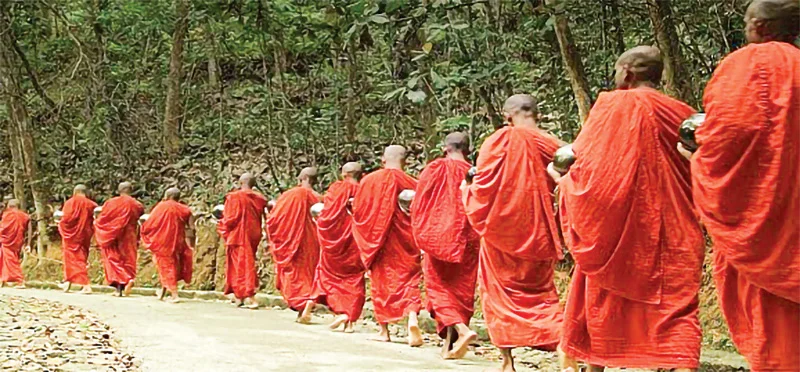
The ongoing controversy surrounding the internal disciplinary proceedings against Reverend Kekirawe Sudassana conducted by senior monks of the ecclesiastical order he belongs to–Sri Lanka Ramanna Nikaya–offers an opportunity to reflect upon dissent and discourse within Sri Lankan Buddhism. The inquiry is the result of a series of complaints made against Reverend Sudassana focused on his public discourses which have been widely shared in social media and other online portals.
As usual, this case too has polarised Buddhists in the public domain. Those in support of Reverend Sudassana see absolutely nothing wrong in what he has done and said. Similarly, those against him in the public domain, see nothing but wrong in all his public utterances and want him taken to task. Between these two extremes, the core meaning of the Buddha’s notion of ehipassiko, which literally means ‘come and see for yourself’, is completely lost.
I have followed some of the public statements and discourses of Reverend Sudassana for a while as part of my interest in popular religion. Much of what he has to say goes against long held beliefs and traditions in Sri Lankan Buddhism. I find his ideas shift between rationalism and noisy rhetoric, both not unusual in different manifestations of Sri Lankan Buddhism. For instance, the much-respected Anagarika Dharmapala was essentially a rationalist who wanted to focus on the dhamma and not on Buddhism’s rituals or even on gods. But this does not mean that Reverend Sudassana can be judged in the same way as Anagarika Dharmapala given the vast variation in historical epochs the two operated in and their different approaches to public discourse.
Reverend Sudassana has often critiqued what he sees as mythology and ritualism in Buddhism. For him, many long-held rituals and beliefs embedded in popular Sri Lankan Buddhist practices are irrational and therefore not acceptable. While to any rational thinking being, there is no contention here, one must concede that it is mythology and rituals that hold any core set of philosophical ideas such as the dhamma together as a religion. It is through these practices that religion as a matter of faith emerges from abstract ideas. This is common to any religion. It is through these practices that Buddhism, Christianity, Hinduism or Islam become religion as opposed to other philosophical ideas such as Plato’s and Socrates’ discourses or more recent trends in post-modern thinking, which do not constitute religion.
So, when Reverend Sudassana critiques and dismisses something so central to religion as belief and ritual as irrational, he needs to offer an alternative that would hold religion’s core ideas together. That, in my view, cannot be done by philosophy, the dhamma in the abstract sense or rationality as it is commonly understood today.
But when Reverend Sudassana argues against the over-commercialised merit-making practices, such as elaborate and very expensive pujas and certain customs that divert lay people from the Buddha’s pragmatic, core philosophical teachings, then, we have to pay serious attention to what he has to say. It is this kind of merit-making that I wrote about in 1995 with the use of the concept ‘grandiose religiosity’ that I coined to refer to expensive rituals and offering of alms.
Reverend Sudassana also stepped into the social minefield when he questioned the ordination of children at a very young age, inviting society to reflect on whether a child is mature enough to make a lifelong commitment to monasticism. He is not the first one to ask this question. Earlier critics include Gananath Obeyesekere and many others. This is an extremely important area that deserves the serious attention of citizens. Related to the same issue, Reverend Sudassana has also openly spoken out against child abuse within monastic environments, a topic that has traditionally been treated with strict institutional silence even through this has gained more traction as a public topic recently, at least in social media
Reverend Sudassana, through online commentaries has frequently targeted contemporary preaching styles of many Buddhist monks, explicitly calling out senior and popular monks who in his opinion perform ‘entertainment-driven’ or emotionally manipulative sermons (such as weeping while preaching) rather than focusing on true dhamma. Given the advent of what we may call ‘tele-monk’s or ‘online monks’, Reverend Sudassana’s criticism cannot be faulted if the comparison is only with the traditional preaching style of Buddhist monks. However, if this is the point of departure, then, Reverend Sudassana’s often combative style of discourse can also be critiqued in the same way. The issue in public discourse should be based on what preachers actually say and to what extent they take listeners closer to the dhamma or not. But often, such a reflective examination of dhamma content does not take place.
In certain ways, Reverend Sudassana has attempted to introduce a more rational interpretation of the Buddha as a historical figure and subsequent Buddhist history. From a historiographical point of view, this makes sense. The problem is, there is a vast variation between history as a formal academic discourse and belief in the past in terms of both perceived history and the past lives of well-known people. In the latter, there is not much space for rational reflection. That is why it is part of faith and not historiography. However, by trying to do this and attempting to separate what he views as historical fact from ‘literary or cultural interpretation’, Reverend Sudassana has drawn fierce opposition from orthodox factions of institutional Buddhism as well as many ordinary people who view his arguments as an attack on sacred text and tradition. What does all this mean? It is in answering this question that we need to reflect on the ancient Pali term, ehipassiko –‘come and see for yourself.’ In discursive terms, it is thought to be an open invitation by the Buddha himself to explore what he has preached rather than a demand for blind faith. The idea represented by ehipassiko is one of the six core qualities of dhamma in so far as the Theravada practice is concerned. the other five qualities include, svākkhāto (well-expounded by the Buddha), sandiṭṭhiko (directly visible or apparent right now), akāliko (timeless conditions, the results of which will be apparent when one practices), opaneyyiko (leading onwards to be applied within oneself) and paccattaṃ veditabbo viññūhī (to be personally known and realised by the wise).
Of these, ehipassiko is the most open invitation for reflection, which in my opinion goes very well with the Kalama Sutra or the Buddha’s charter of free inquiry. If Reverend Sudassana was motivated by ehipassiko and Kalama Sutra in his public discourses, he may have come closer to Buddhist ideals when it comes to Buddhism’s sympathies with freedom of inquiry. But at the same time, he has also moved considerably away from common sense dictating what is possible and what is not possible within the context in which he operates. First, complete rationalisation of Buddhist practice within an idiom of post-Enlightenment sense of rationalism is both not possible and dangerous. This applies to all religions. If this is done, then, faith will have to become mere philosophical reflection, thereby undermining what religion over time everywhere has done for humanity.
Second, what is actually possible to critique within the structures he is operating from (including his nikaya affiliations) needs to be clearly understood. What I can say as a scholar based on my research and reflection, are things a monk cannot say beyond a point as long as he is a monk. This common sense needs to be clearly understood if one is interested in reforming institutionalised Buddhism. It is in this area that many of the formal complaints against Reverend Sudassana have been made in the ongoing inquiry. There are numerous seriously problematic areas in his commentaries. These include claiming that the idea of karma is a myth and that rebirth is false. These are such core beliefs in Buddhism. One cannot critique them without disrupting the overall structure of the faith. But one can remain an unbeliever by virtue of personal choice but not make such opinions matters of public discourse. He has also claimed that specific powers such as the ability to read others’ minds, attributed to the Buddha are fictional. Again, beyond matters of rationality and within a discourse of faith, these things cannot be questioned in Buddhism in the same way they also cannot be in any other structure of belief. Reverend Sudassana has also been accused of providing problematic interpretations to long held positions espoused in the sutras and for claiming that that the Mahayana abhidhamma is superior to the Theravada version and so on. While the latter may be open to interpretation, Reverend Sudassana so far has not established that his grasp of the dhamma is adequate to offer such critical reinterpretations.
Third, endless combativeness is counterproductive if the aim is reform. It is much better to pick one’s battles on a rational basis rather than having a noisy opinion on everything under the sun. For instance, if Reverend Sudassana has issues with some of the less rational aspects of Buddhism like the Jataka stories, rebirth, specific rituals and so on, the better option is to underemphasise them in his sermons and public statements and replace them with life experiences of contemporary or historical times so that people understand the specifics of the dhamma being explained.
As for his more violent detractors on social media, my suggestion is to let the logic of ehipassiko come into play the way it was intended. Verbal violence, threats or ill-will have no space in Buddhism or in any decent society. If Reverend Sudassana’s discourses have negatively impacted disciplinary positions of his nikaya, I hope, they will be resolved through the kind of inquiry that is ongoing and even more importantly through broader reflection. But the senior monks in Sri Lanka Ramanna Nikaya must also reflect on why a discursive disagreement has generated this much internal reflection and interest leading to a formal inquiry at a time when very serious and continuous disciplinary and ethical violations by many monks, which are also now part of the public discourse, have not received the same attention.

Thileepan rembered on 39th death anniversary

Landslide Early Warnings issued to the districts of Colombo, Galle, Gampaha, Hambanthota, Kalutara, Kandy, Kegalle, Kurunegala, Matara, Nuwara Eliya and Ratnapura

Showers in the Western, Uva and Sabaragamuwa provinces and in Galle, Matara, Kandy, Nuwara-Eliya, Batticaloa and Ampara districts.

22A, Judicature Amendment Bills passed with 2/3 majority

TIN mandatory for key transactions from Nov. 1

Navy brings 25 Indonesian fishermen ashore after trawler capsizes

‘Dates have the highest sugar content to fight Coronavirus’

Sunday Island 27 December – Headlines

#SundayIsland 17th December – Headlines

Sunday Island – 28th March

Sunday Island Headlines – 21 March

Sunday Island – 21st February – Headlines
-

 News7 days ago
Namal Rajapaksa Buddhist gambit fails, bail denied
-

 Features7 days ago
Why the spelling Sri Lankan names in English vary
-

 Features7 days ago
Three bands, a new identity: Sri Lankan wolf snake recognised as distinct species
-
 Business7 days ago
SLIIT holds largest-ever convocation
-

 News7 days ago
Vehicle prices drop by up to Rs. 1 mn, says importers’ body
-
 News7 days ago
Govt monitors reported Saudi death sentence – Foreign Ministry
-
 Business7 days ago
Lanka’s famed beach shack battles demolition
-

 Business7 days ago
All-new Bolero MaXX Pik-Up unveiled in Lanka