
Latest News
West Indies knock England out, join South Africa in semi-finals


West Indies pulled off the biggest heist of this T20 World Cup and qualified for the semi-finals, against all expectation, and knocked out one of the favourites, England.
Having last beaten England in 2018, West Indies broke a 13-match losing streak and topped Group B to set up a semi-final against New Zealand in Sharjah. That year was also the last time West Indies played in a semi-final of the T20 World Cup.
This is only the second time England have missed out on the knockouts of a T20 World Cup after being eliminated in the group stage in 2010. After wins in their first three matches, they were confident of making the final four this time. Instead, it is South Africa who join West Indies, with England’s net run-rate leaving them third in the group.
West Indies win was made all the more remarkable because they were without former captain and veteran batter Stafanie Taylor, who is struggling with a knee injury. In her absence, Hayley Mathew and Qiana Joseph found form and wiped away the bulk of the 142-run target. Matthews, playing in her 100th T20I, scored her 14th half-century in the format while Joseph, who had a career-best of 34 before this game, scored a 38-run 52. The pair shared an opening stand of 102 inside 13 overs and West Indies were on their way. This is the sixth time West Indies have successfully chased a total of 140-plus, and the second time since their record chase of 213 against Australia last December.
England may have thought they had enough after Nat Sciver-Brunt’s half-century but lacked contributions from the rest of the order. To add to their worries, Heather Knight retired with a calf-injury on 21, with the score on 80 for 3, which halted the momentum England regained after they slipped to 34 for 3 in the seventh over.Afy Fletcher and Deandra Dottin, bowling for the first time in the tournament, took four wickets between them and conceded 37 runs in seven overs, which gave West Indies an advantage they carried through the game.
West Indies’ youngsters Zaida James and Ashmini Munisar spoke to ESPNcricinfo a few days ago about their commitment to building a new legacy for West Indies cricket and almost combined to start that today. James, recovered from a blow to the chin, tossed her second ball up to Maia Bouchier, who tossed it up to Munisar at cover point but she shelled a straightforward chance. Bouchier went on to hit the first boundary of the innings and England were up and away until Matthews brought herself on to bowl. Danni Wyatt-Hodge hit her behind point for four but when she tried that a second time, Dottin lunged forward to take a low catch and West Indies had a breakthrough. In the next over, Alice Capsey was run out for one, chancing Dottin’s arm at her peril, and immediately after the powerplay, Bouchier skied Afy Fletcher to Qiana Joseph at extra cover. England were 34 for 3 in the seventh over and stunned.
Sciver-Brunt survived an lbw review when she was on 2 when Fletcher pitched it outside leg, and went on to open her boundary count with lap over Shemaime Campbelle and that got England going. Knight bisected the extra cover and mid-off fielder for two overs in succession to take England to fifty and beyond. The pair then brought out the sweeps and England were running away with it at 79 for 3 after 12 overs when injury struck. Knight had treatment during that over but then left the field with a calf concern. At the time, the partnership was worth 46 off 36 balls, which was the only stand of more than 30 in the innings. Sciver-Brunt watched Amy Jones hand Dotting a catch at backward point and Charlie Dean pick out Matthews at mid-off as the 17th over started. She played an almost lone hand in scoring 14 runs off the 18th over and 13 off the 20th to register her 14th T20I half-century and taking England over 140.
It took until the final group stage match to see some proper aggression upfront and it came from the team with the reputation to hit big, but not always the results. Matthews, who has registered scores of 10, 8 and 34 in the tournament so far and has not been as much of a presence with the bat, hit Lauren Bell over long leg for six off the second ball. She went on to score fours through fine leg and mid-off and the first over cost Bell – the most expensive of the of the tournament so far. Matthew owned opening over and her and Joseph rode their luck to take charge of the rest of the powerplay but not without some nerves.
Joseph got off the mark with a thick outside edge between backward point and short third that went for four, then hit Sciver-Brunt to deep mid-wicket, where the ball went through Sophia Dunkley’s hands for four more. She settled in the next over and hit Charlie Dean for six before taking on England’s trump card Sophie Ecclestone for back to back boundaries. West Indies were 67 without loss in the powerplay, the highest of the tournament so far.
Dunkley’s drop was the start of one of England’s worst fielding performances recently as they put down five catches. In the fifth over, Joseph was on 31 when she skied Sciver-Brunt into the night sky and though Alice Capsey settled herself underneath it at point, she tried to catch it reverse-cup and dropped it. Then, on 35 in the eighth over, Joseph hit Sarah Glenn to mid-wicket, where Bouchier ran to her left but let it slip through her fingers. The ball followed Bouchier for a little while after that, and she did not collect cleanly at mid-wicket when Campbelle called Dottin through for a run. Bouchier berated herself and England were falling apart. According to ESPNcricinfo’s ball-by-ball data, there have been 75 dropped catches in the group stage of the tournament, and England have been responsible for nine, the third most of any side.
Brief scores:
West Indies Women 144 for 4 in 18 overs (Qiana Joseph 52, Hayley Matthews 50, Deandra Dottin 27; Nat SciverBrunt 1-33, Sophie Ecclestone 1-23, Sarah Glenn 1-20) beat England Women 141 for 7 in 20 overs (Nat Sciver-Brunt 57*, heather Knight 21; Afy Fletcher 3-21, Hayley Matthews 2-25, Deandra Dottin 1-16) by six wickets
[Cricinfo]

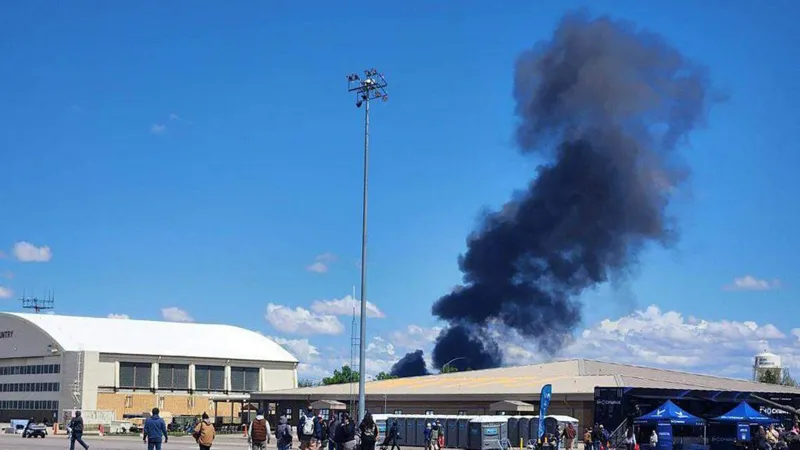
Four crew members are in stable condition after two fighter jets collided mid-air during a US air show, officials say.
All the aircrew safely ejected from US Navy EA18-G jets that were performing an aerial demonstration when they crashed, a US Navy spokesperson told the BBC’s US partner CBS News. It is unclear if they were injured.
The dramatic incident happened on Sunday, during the second and final day of the Gunfighter Skies air show, 2 miles (3.2km) northwest of Idaho’s Mountain Home Air Force Base.
A fire erupted and the base was briefly locked down as the rest of the air show was cancelled. An investigation is underway.
“The aircrew involved in the incident are in stable condition,” Mountain Air Force Base Gunfighters said in statement posted on social media on Sunday.
“Thank you to all our guests for your patience and compassion, which has allowed us to quickly and safely respond to the incident,” the statement said.
Cmdr Amelia Umayam told CBS the crew members were being checked by medical personnel
Umayam said the EA-18G Growlers were assigned to an electronic attack squadron from Washington state. The US Navy says each of those jets cost about $67m (£50.3m).
Kim Sykes of Silver Wings of Idaho, which helped organise the air show, told a local CBS affiliate that no-one at the military base was hurt.
The Gunfighter Skies air show was last held in 2018, when a glider pilot died in an accident.
The BBC has contacted the air force base and event organiser for comment.
[BBC]
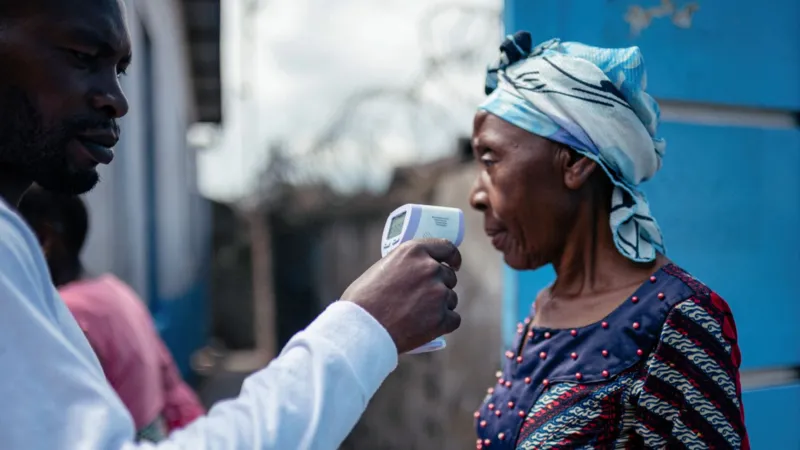
The World Health Organization (WHO) has declared an Ebola outbreak in the Democratic Republic of Congo a public health emergency of international concern.
The agency said the outbreak in DR Congo’s eastern Ituri province, which has seen around 246 suspected cases and 80 deaths reported, does not meet the criteria of a pandemic emergency.
But it warned it could potentially be “a much larger outbreak” than what is currently being detected and reported, with significant risk of local and regional spread.
The current strain of Ebola is caused by the Bundibugyo virus, the health agency said, for which there are no approved drugs or vaccines.
Early symptoms include fever, muscle pain, fatigue, headache and sore throat, and are followed by vomiting, diarrhoea, a rash and bleeding.
The WHO said there are now eight laboratory-confirmed cases of the virus, with other suspected cases and deaths across three health zones including Bunia the capital of Ituri province, and the gold-mining towns of Mongwalu and Rwampara.
One case of the virus has been confirmed in the capital Kinshasa, believed to be in a patient returning from Ituri.
The WHO said that the virus has spread beyond DR Congo, with two confirmed cases reported in neighbouring Uganda. Ugandan officials said a 59-year-old man who died on Thursday had tested positive.
In a statement, the Ugandan government said the patient who died was a Congolese citizen whose body had already been returned to DR Congo.
A laboratory has also confirmed an Ebola case in the eastern city of Goma, currently controlled by the M23 rebels, the AFP news agency reported on Sunday.
At least six Americans have been exposed to Ebola in DR Congo, and one has displayed symptoms but none have been confirmed to have been infected, the BBC’s US partner CBS reports, citing sources.
The US government was reportedly trying to transport them out of the country, possibly to a military base in Germany, STAT News reports.
The US Centers for Disease Control and Prevention (CDC) said it planned to send more staff to DR Congo and Uganda, while the US Embassy in DR Congo issued a health alert reminding citizens not to travel to Ituri province.
The BBC has contacted the CDC for comment.
The WHO said the ongoing security situation and humanitarian crisis in DR Congo, combined with high population mobility, the urban location of the hotspot, and the large number of informal healthcare facilities in the region increased the risk of spread.
[BBC]
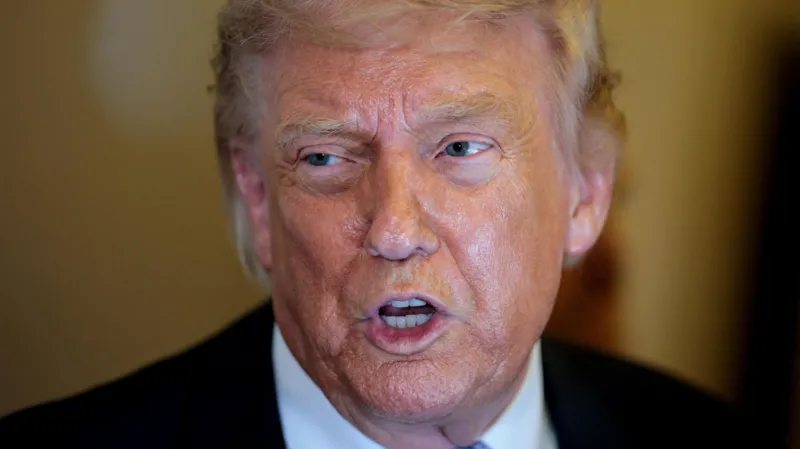
US President Donald Trump has warned Iran the “clock is ticking” as talks to bring the war to an end have stalled.
“They better get moving, FAST, or there won’t be anything left of them,” he wrote on his Truth Social platform. “TIME IS OF THE ESSENCE!”
The message came as the president was due to speak with Israeli Prime Minister Benjamin Netanyahu on Sunday.
Iranian media meanwhile reported the US had failed to make any concrete concessions in its response to Tehran’s latest proposals to end the conflict.
A lack of compromise from Washington would lead to an “impasse in the negotiations”, the semi-official Mehr news agency reported.
Trump’s message echoed his threat that a “whole civilisation” would die unless Iran agreed to a deal to end the war, shortly before the ceasefire was announced in early April.
The president warned earlier this week that truce was on “massive life support” after rejecting Tehran’s demands, labelling them “totally unacceptable”.
Esmail Baghaei, an Iranian foreign ministry spokesperson, insisted they were “responsible” and “generous”.
According to Iran’s semi-official Tasnim news agency, they included an immediate end to the war on all fronts – a reference to the continued Israeli attacks against Iran-supported Hezbollah in Lebanon – a halt to the US naval blockade of Iranian ports, and guarantees of no further attacks on Iran.
They also reportedly included a demand for compensation for war damage and an emphasis on Iranian sovereignty over the Strait of Hormuz.
Iran’s semi-official Fars news agency said on Sunday that Washington had set five conditions in response to Tehran’s proposal.
They reportedly included a demand that Iran keep only one nuclear site in operation and transfer its stockpile of highly enriched uranium to the US.
Trump suggested on Friday that he would accept a 20-year suspension by Iran of its nuclear programme – a major sticking point between the two countries – in what appeared to be confirmation of a shift in position away from a demand for a total end to it.
Israeli and US forces began massive air strikes on Iran on 28 February. The ceasefire meant to facilitate talks has largely been observed despite occasional exchanges of fire.
Iran has also continued to control the Strait of Hormuz, effectively closing the vital waterway through which around 20% of the world’s oil and liquefied natural gas travels.
The move, which Iran has said is in retaliation for US and Israeli attacks, has sent oil prices soaring globally.
The US, for its part, has been enforcing a blockade of Iranian ports to exert pressure on Tehran to agree to its terms.
Pakistan has been playing the role of mediator between the US and Iran, but both sides still appear to be far apart.
[BBC]

Fighter jet crews parachute safely after collision at US air show

WHO declares Ebola outbreak in DR Congo an international emergency

Trump warns ‘clock is ticking’ for Iran as peace progress stalls

Axar, Ashutosh, Starc keep Delhi Capitals’ playoffs hopes alive

Venkatesh, Rasikh take Royal Challengers Bengaluru into IPL 2026 playoffs

Showers will occur at times in the Western, Sabaragamuwa, Central, North-western and Northern provinces and in Anuradhapura, Galle and Matara districts

‘Dates have the highest sugar content to fight Coronavirus’

Sunday Island 27 December – Headlines

#SundayIsland 17th December – Headlines

Sunday Island – 28th March

Sunday Island Headlines – 21 March

Sunday Island – 21st February – Headlines
-
 News5 days ago
Ex-SriLankan CEO’s death: Controversy surrounds execution of bail bond
-

 Features1 day ago
Sri Lankan Airlines Airbus Scandal and the Death of Kapila Chandrasena and my Brother Rajeewa
-
Features6 days ago
High Stakes in Pursuing corruption cases
-

 Features6 days ago
When University systems fail:Supreme Court’s landmark intervention in sexual harassment case
-
 News2 days ago
Lanka’s eligibility to draw next IMF tranche of USD 700 mn hinges on ‘restoration of cost-recovery pricing for electricity and fuel’
-
 Midweek Review5 days ago
A victory that can never be forgotten
-
 Features3 days ago
Mysterious Death of United Nations Secretary General Hammarskjöld
-

 Opinion4 days ago
Electricity tariffs have skyrocketed: Can further increases be prevented?