
Latest News
Washington Sundar’s career-best 7 for 59 spins out New Zealand

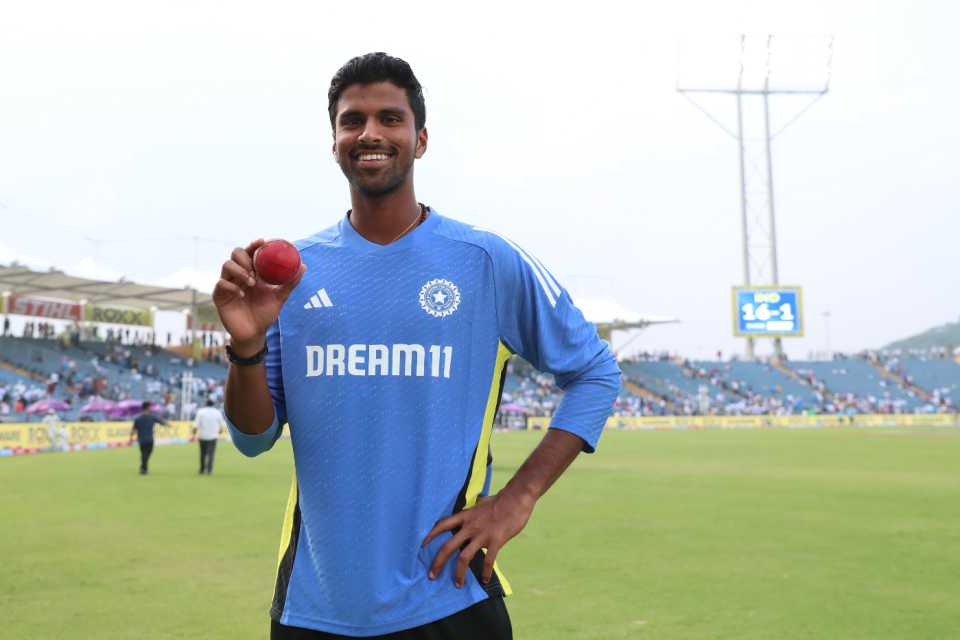
Three days ago, Washington Sundar was not even part of this Test squad, instead scoring a hundred and taking a couple of three-fors against Delhi in the Ranji Trophy. Brought in the XI ahead of the incumbent spinner (Kuldeep Yadav) and the back-up (Axar Patel) in the squad, he took seven wickets on the first day of a Test to bowl New Zealand out for 259. Five of his victims were bowled, one lbw and one caught as he took out the last seven wickets following three taken by Tamil Nadu team-mate Ravichandran Ashwin.
While this was Washington’s maiden Test five-for and his best figures in first-class cricket, the three wickets took Ashwin past Nathan Lyon’s 530 in 25 fewer Tests. The two could be involved in a showdown later in the year in Australia, but right now India were in a fight to defend their 18-series winning streak at home. Washington proved to be just the ally he needed.
India called up a second offspinner from outside the squad ostensibly to lengthen their batting without compromising on taking the ball away from left-hand batters, but two left-hand batters in the top order – Devon Conway and Rachin Ravindra – still scored fifties and threatened to take New Zealand to a big total after winning the toss on a track on which batting last won’t be fun. New Zealand were 138 for 2 when Ashwin got Conway, and 197 for 3 when Washington accounted for Ravindra.
As the series moved from Bengaluru to Pune, the clouds, seam and extra bounce all disappeared. There was no concept of good-toss-to-lose here. Nothing is ever easy in Test cricket, but this was one of the easier starts to an innings with the openers racing to 30 in seven overs without any trouble. But Ashwin was introduced early, and it took him just five balls to drift one in and then turn it past the outside edge to trap Tom Latham lbw.
There was turn from the good part of the pitch, but not consistent. The partnership between Conway and Will Young looked threatening, but a sharp review demanded by short leg Sarfaraz Khan returned a faint touch of the glove to send Young back. Now Ashwin and Ravindra Jadeja kept troubling the batters: in the 11 overs they bowled in tandem, they drew 24 false shots and conceded just 30 runs.
Post-lunch, when India started with Jasprit Bumrah and Washington, runs came freely: 35 off the eight overs. Ashwin brought control first and then the wicket of Conway. Again the ball turned, but this time it was the drift and dip that put Conway out of position, and the turn made him look like pushing at a ball he didn’t need to play.
Ravindra, Player of the Match in Bengaluru, brought New Zealand much-needed solidity because Daryl Mitchell was extremely uncertain at the start of his innings. He survived an lbw on umpire’s call, played risky sweeps of both kinds, and only looked comfortable after 20 balls or so. Ravindra, though, gave the bowlers nothing. Akash Deep got close to getting him with at short midwicket but the hit was too ferocious to catch for a fielder so close. An outside edge after two bouncers managed to beat slip and brought up his fifty.
Ten minutes before tea, now in his third spell, Washington began to get it right. The first ball of this spell turned from middle and off to go past Ravindra’s bat and hit the top of off. Things began to happen now as balls went straight on or turned from the same spot. The penultimate ball before tea beat Tom Blundell’s outside edge, and the last one, slower and wider, turned back in through the gate to take top of middle.
Post-tea, Washington bowled in all his glory: at the stumps, but getting variable turn from the pitch. An inspired review accounted for Mitchell in a rare dismissal: offspinner getting an lbw from over the wicket when the batter is forward. As it turned out, this had turned just the right amount to both be hitting him in line and taking the leg stump.
Tied down, frequently going back to full balls, Glenn Phillips ended his struggle of 9 off 31 with a chip straight to deep mid-off. Had you seen just the shot and not the field, you wouldn’t have been wrong to assume the mid-off was up tight and he was just looking to clear him.
Mitchell Santner hit two sixes in his fighting 33, but Washington kept hitting the stumps at the other end. To Tim Southee he went wide on the crease from around the wicket. The angle beat the outside edge and hit top of off. Ajaz Patel was caught back to a full ball, and played on. To bookend his work, Washington produced another beauty to account for the set batter, Santner: one that pitched on middle and off and took the top of off.
The accuracy and variations of pace and seam position, with a little help from the pitch, proved to be too good for New Zealand.
With just 10-odd overs to bat to stumps, India shelved some of their ultra-aggressive approach from their last two Tests. Still, Southee swung and seamed one past Rohit Sharma’s watchful bat to take top of off. A small bit of joy for New Zealand at the end of a tough session.
Brief scores:
India 16 for 1 in 11 overs (Tim Southee 1-4) trail New Zealand 259 in 79.1 overs (Devon Conway 76, Rachin Ravindra 65, Washington Sundar 7-59, Ravichandran Ashwin 3-64) by 243 runs
[Cricbuzz]


People living on the northern Pacific coast of Mexico are bracing for the arrival of Hurricane Polo, which is forecast to make landfall later on Monday or early on Tuesday.
The category three storm, with maximum sustained winds near 115 mph (185 km/h), is expected to move over the state of Baja California Sur, a region popular with tourists and home to the resort destination of Los Cabos.
Meteorologists at the US-based National Hurricane Center (NHC) have warned of heavy rainfall which could lead to life-threatening flooding and mudslides, especially in areas of steep terrain.
Residents on Sunday stocked up on essentials such as drinking water and food as the storm approached.
The NHC warned of the storm surge Hurricane Polo could unleash, which it said could be accompanied by large and destructive waves.
In Cabo San Lucas, famous for its natural rock arch, the authorities restricted access to the beaches. Some restaurants also closed in the town, which acts as a base for sport fishers and whale watchers.

The regional government of Baja California Sur has ordered schools to remain closed on Monday as a preventive measure.
Governor Víctor Manuel Castro Cosío said temporary shelters had been opened should residents need to be evacuated.
The federal authorities have also deployed thousands of members of the navy and the army along with specialised machinery.
Polo has been slowly moving towards Mexico’s coast line.
Meteorologists said it was being fuelled by extremely warm waters caused by the El Niño climate phenomenon.
(BBC)

Like every year, Pushpraj Rimal, a tour planner and taxi driver in Nepal’s capital, Kathmandu, was looking forward to September for his business to boom.
But what he got instead was a series of cancellations by tourists after catastrophic floods last month killed more than 1,450 people and destroyed key highways, deeply impacting the Himalayan nation heavily dependent on tourism.
“It is still a lockdown kind of situation,” the 42-year-old told Al Jazeera nearly a month after the disaster.
Pushpraj, who speaks Nepali and Hindi, works on commission for several hotels and trekking companies in Kathmandu and the scenic town of Pokhara, known for its lake nestled in the Annapurna mountain range. Pokhara also serves as a base for Himalayan trekkers.
Nepal’s tourist season peaks after the monsoon ends in August and the skies are clearer. Tourism attracts thousands of international travellers, accounting for nearly 8 percent of Nepal’s gross domestic product and employs more than 1 million people.
Last year, Nepal saw more than 1.15 million tourists visiting the country, nearly a third of them during the September-November season.
But the floods this year, triggered by a glacial mountain collapse along the Nepal-Tibet border in the north, have pushed tourists away from the unaffected areas as well.
“I had rented two cars for two months, but I have done one fourth of the business I usually do in a season. Tourists generally start pouring in from September, but most of them have cancelled this year,” he said.
“I will get no commissions from the hotels or trek organisers, nor has the taxi business worked well. … I am now waiting for the season to end.”
Rimal has two children, Hema, 14, and Rahul, 12, whom he had promised a tablet this Dussain, a prominent Hindu festival that usually falls in October. “But it seems impossible now. I will have to break their hearts and my promise to them for the very first time.”
(Aljazeera)

World javelin leader Rumesh Tharanga lived up to his reputation to win Sri Lanka a highly anticipated gold medal, beating wet weather and track conditions at the Asia Games in Nagoya Japan a little while ago.
He took the lead with a massive 88.33 metres effort in his penultimate throw before sealing the contest with 88.55 metres throw.
He beat a strong field inclusive of reigning Olympic champion Arshad Nadeem of Pakistan. (Reemus Fernando)

Showers above 50 mm expected in Uva, Eastern and Central provinces and in Polonnaruwa and Mullaittivu districts after 2.00 p.m.

PAFFREL raises concerns over Anti-Corruption (Amendment) Bill

First cases taken up by SC after enactment of 22A dismissed

Now NR named 4th suspect in Krrish case

Sri Lanka Red Cross Society honoured with Friend of Singapore Red Cross Award

Eastern University and the making of a culture of peace

‘Dates have the highest sugar content to fight Coronavirus’

Sunday Island 27 December – Headlines

#SundayIsland 17th December – Headlines

Sunday Island – 28th March

Sunday Island Headlines – 21 March

Sunday Island – 21st February – Headlines
-

 News6 days ago
Mastermind Naufer Moulavi among 15 found guilty
-

 Midweek Review6 days ago
Thileepan’s fast unto death: An authentic narrative that many missed
-
 Latest News5 days ago
Showers above 100 mm are likely at some places in the Western, Sabaragamuwa, Central and North-western provinces and in Galle and Matara Districts
-

 Editorial6 days ago
Big Bad Bills
-
Editorial5 days ago
Crimes punished and unpunished
-

 Features4 days ago
Beyond traditional jobs: Why Sri Lanka needs to facilitate the gig economy
-

 News6 days ago
No referendum needed for passage of 22 A: SC
-

 News6 days ago
One clause in Anti-Corruption (Amendment) Bill requires referendu: SC