
Features
WARTIME IN SRI LANKA

CHAPTER 11
The wheels of the vehicles of war with which Nazism [was] halted came from the latex of rubber trees collected on thousands of rubber estates in Ceylon. The millions of cups of tea that cheered troops on freezing battlements [came from] our plantations… When we talk of aid to developing countries… let us… remember that small countries like Ceylon helped Britain, the United States… and Russia when they were most in need of aid.
(Oliver Goonetilleke, as quoted in Jeffries,1969, p.63)
NU and State-run Industries A more confident NU returned to Sri Lanka in December 1939. Already the only qualified economist in government service, he now had expertise in the new field of business administration, along with an enhanced worldview from his year abroad. His value as an officer in the government had vastly increased, and his career would soon reach a new launching point – in 1942 – when Sri Lanka was beginning to mobilize for war. Wartime called for the marshalling of clear thinkers and effective administrators, persons with good judgment, unafraid to take quick decisions amid crisis conditions. NU had all these qualities in full measure. His discipline and organizing capacity equipped him to deal with the challenges presented by wartime emergencies. During this period, NU would be called upon to fill several posts linked to wartime contingencies.
Upon his return from London, NU resumed his position as Commercial Assistant in the Department of Commerce and Industries, and continued in this post for another three years with greater responsibilities. The government had sent NU to London for training in business administration primarily because it wanted to give “a lead to private enterprise by starting certain state-aided concerns on commercial lines” (J.C.W. Rock, in N.U. Jayawardena Personal Files, emphasis added). This policy was given further impetus as wartime created shortages of materials and goods, especially those required for the shipping of exports.
NU was placed in charge of the Model Coir Yarn Factory, which was the first commercial factory established by the Department of Commerce and Industries. According to NU, this was the first occasion he had of applying the knowledge acquired from his training in London. As NU explained:
In the space of 2 months work, engaged mostly part-time, I was able to reorganize the factory, introduce an efficient system of production control, execute a successful sales programme, and convert the factory from a loss to a profit-earning basis. (N.U. Jayawardena Personal Files)
NU applied for the post of Assistant Director (Factories) in December 1943.( A job application in his Personal Files shows that NU applied for this post. However, he did not take it up. There are no records to show whether this was because he was not selected, or because he was selected and decided against taking up the post. ) After having observed at first hand the latest production techniques used in British factories, NU would have been eager to apply the management principles he had studied and witnessed abroad.
The responsibility of organizing the sales section of the Department of Commerce and Industries was also entrusted to NU. This section was established to market the Department-run factories’ products, which were sold through a sales outlet on Chatham Street, known as the Marketing Department. Products are still sold under the Marketing Department’s “MD” label, though the operation was privatized some time ago.
Although NU was involved in the running of the government’s first factory, and later in the marketing of goods produced by the various government-run factories, the experience demonstrated to him the pitfalls of state involvement in industry, stemming from political expediency as well as from leaving decision-making to inexperienced and impractical civil servants. Years later, he would draw on this experience on many occasions when stating his aversion to state enterprises. He had particularly sarcastic words for D.H. Balfour, the Ministry Secretary whom he termed as “an infectiously imaginative civil servant… [graduating] from Cambridge, specializing in Chemistry, and now turned industrial entrepreneur,” whom NU noted, “displayed enthusiasm but less business judgment.” Balfour had set up a cement factory in Kankesanturai, a chemical factory in Paranathan, a paper factory in Valachchenai, a plywood factory in Galle, a steel factory in the suburbs of Colombo and a ceramics factory in Negombo, and an ilmenite factory in the Eastern Province, some of which were in some state of survival even in the 1980s. NU further noted that many of the factories set up by the government were located in the electorates of influential politicians (de Zoysa manuscript, p. 12).
NU during this time also served as the editor of the Ceylon Trade Journal, published by the Department of Commerce and Industries based on the work of the Commercial Intelligence Department. His involvement in other areas began to branch out. In November 1940, he was appointed to serve as Secretary to the Ceylon Delegation at the Eastern War Materials Conference, which was held over the course of a month in New Delhi.
Lecturing at University
In 1941, NU at age 33, the self-taught student of economics, became the teacher, when he was appointed visiting lecturer for the diploma course in Economics at the University College, Colombo. He gave lectures on Sri Lankan trade, commerce, industry and transport. The professor of Economics at that time was B.B. Das Gupta under whom NU had served earlier on the Banking Commission in 1934. In spite of his busy schedule, NU would have readily welcomed this opportunity, which brought him into contact with the intellectual community.
NU would have no doubt taught many future academics and public servants of Sri Lanka. Das Gupta commented favourably on NU’s contribution as a lecturer, noting that NU’s “official work… kept him in constant touch with economic problems,” adding that he was “a wide reader and balanced thinker.” NU’s association with the university exposed him to a different milieu, where intellectual discourse and access to a library of scholarly books were some of the advantages. S.A. Pakeman, Professor of History and Economics and acting Principal of the University College at the time, praised NU’s lectures as “most stimulating and valuable” (N.U. Jayawardena Personal Files). NU would have felt some sense of achievement when, a few years later, he was requested by the University College of Ceylon to set and be co-examiner of the two question papers in Economics for entry into the prestigious Ceylon Civil Service – of which he was never a member.
It is hard to imagine where NU found the time and energy tofulfil his diverse responsibilities, such as organizing factories and sales sections, editing a journal, preparing lectures, setting papers on Economics, and teaching. The war years were a frantically busy and tense period with its recurring crises, when many demands would be made on NU’s expertise in a variety of areas.
Wartime Sri Lanka
World War II reached Asia’s doorstep in July 1941, when the Japanese entered the conflict, by launching a surprise attack on Pearl Harbour, Hawaii. The Japanese forces made speedy advances spreading their grip in every corner of Asia, including Indonesia, Malaysia, the Philippines, Burma (now Myanmar) and Singapore. After the fall of Singapore, it was inevitable that Sri Lanka, too, would soon be targeted by the Japanese.
In January 1942, Sri Lanka was put on a war footing, and Admiral Sir Geoffrey Layton was appointed Commander-in-Chief. A Civil Defence Department was also established. Oliver Ernest Goonetilleke (OEG), who had already established his credentials as Auditor General, was appointed Civil Defence Commissioner. Ivor Jennings, newly arrived on the island, served as OEG’s deputy.
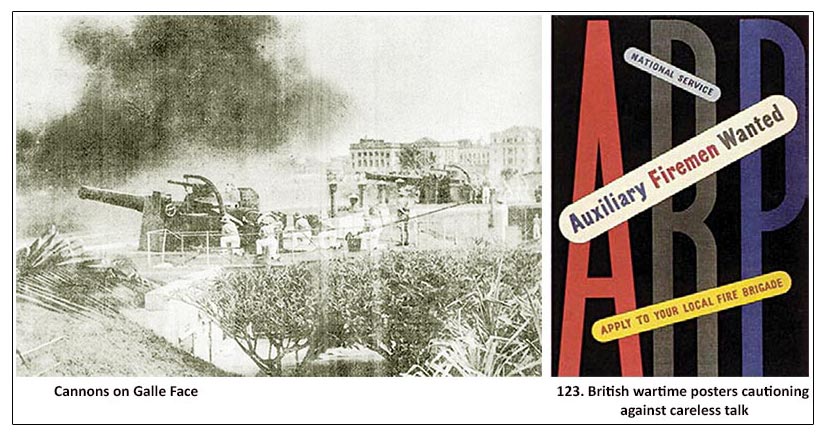
The city and country had to be prepared for any contingency. Staff had to be quickly recruited, fire-fighting and emergency workers trained and equipped, and food provisions and distribution systems established. Fire gaps, wardens’ posts, trenches, shelters and water tanks were constructed; buildings protected by sandbags, and emergency kitchens and hospitals had to be set up to prepare the city in the event of bombing. An Air Raid Precautions (ARP) unit was formed to mobilize local leaders to act as wardens of civil defence. The department recruited 4,000 regular defence workers and 64,000 men and women part-time volunteers, who were “most of the more prominent leaders from Dondra Head to Point Pedro” (Jennings, 2005, p.126). Another task of the Civil Defence Department was to prevent the spreading of rumours and panic, and the leaking of information to the enemy. Posters reminding citizens that, “careless talk costs lives” were displayed throughout the city. Hoarding by black-marketeers was another serious problem of that period of shortages and rationing.
For those living in Colombo along and other parts of the country,there were many hardships, including food shortages, blackouts, and regular air-raid drills. Due to the shortage of rice, alternative forms of grain, such as bhajiri from India had to be imported and popularized. (A network of co-operative stores helped in the distribution of bhajiri and other rationed goods. The Communist Party, which supported the war effort, joined in supervising the distribution of food. Hedi Keuneman (Viennese wife of CP leader Pieter Keuneman) wrote: “I remember this as perhaps the most satisfying work I did because it made a genuine contribution to help the local population to get a fair supply of foodstuffs with their coupons.

Loading tea crates for shipment
The chief enemies were the blackmarketeers, and I remember arriving at our Co-op very early, long before opening time every morning, in order to prevent illegal black market dealings in food” (personal communication to K. Jayawardena, December 1990). One Sri Lankan recalled Hedi and Pieter Keuneman, surrounded by a crowd outside the main railway station of Colombo, when they were promoting alternative cereals to rice as a part of the war effort: It was not the usual pavement astrologer, musician or the snake-bite specialist, but a diminutive lady clad in a cheap cotton sari and… a tall young man in shirt and shorts. They were serving a steaming cereal to the people around them… I was simply thrilled and spent a considerable length of time watching the humanitarian drama.” (G. Nanayakkara, Sunday Island, 20 Jan. 1991) According to an eyewitness account of Hyacinth Mahendrarajah, who as a young girl lived through this time:
The cost of living rocketed sky-high. Food was scarce as no ships called at Colombo, which was normally an important port of call in the East. Ships were being bombed before they reached the various ports. This resulted
in a struggle to exist on a ‘meal a day’ that consisted mainly of yams and vegetables grown in the countryside.
The tension of imminent attack by the Japanese also created some anxiety, as Hyacinth further recounts:
At school they dug trenches for the children to go into, for protection during an air raid. We were given instructions on air raid precautions and whenever the siren sounded we had to observe them. These were carried out frequently to help us remember exactly what to do in the event of a genuine air raid. ( Mahendraraja, Hyacinth, Schoolgirl’s Memories in Ceylon, WW2 People’s War – An archive of World War II memories – public writings gathered by the BBC, entry contributed on 9 July 2004, http://www.bbc. co.uk/ww2peopleswar/categories/c54629/)
NU’s daughter Neiliya, who was a small child at that time, also recalls the air raid drills: “When the air raid sirens went off, both my brothers and myself had to run with our pillows to the dining room table under which our mats were laid” (Neiliya Perera, 2006).
The Japanese Attack on Sri Lanka
When the Japanese finally did attack Sri Lanka, the government was not caught completely off-guard – they had received advance notification that a fleet of Japanese ships was advancing southeast of Devundara, from a patrolling British pilot who had been able to radio news back to base before his plane was shot down. According to OEG’s account, the island was “wide open for attack” since “our own military resources were negligible… to meet an invasion” (Jeffries, 1969, p.58).
On Easter Sunday, 5 April 1942, the attack on Sri Lanka began. A fleet of Japanese aircraft raided Colombo, targeting the harbour and Ratmalana airport, followed by an attack on Trincomalee harbour. In both attacks, only a few ships were destroyed, and there were relatively few civilian casualties. ( In Colombo there had been 85 civilian casualties, about 50 of which were patients who were killed in the bombing of the Angoda Mental Hospital, which the Japanese had mistaken for a power station.
Two ships in the harbour – a destroyer and an armed merchant vessel – and two cruisers at sea were sunk. The harbour engineering workshops were severely damaged as well. One bomb fell in the Pettah on a Muslim hotel, completely destroying it. It opened a road in the Pettah known as “Oeeji’s Way” (Jeffries, 1969, pp.53- 54; and Jennings, 2005, p.130). In the Trincomalee attack, the HMS Hermes and two tankers were sunk, and the harbour installations and wharf were badly damaged (Jennings, 2005, p.132). The attack on Colombo, which was short but intense, turned the city into a ghost town overnight. Jennings described the panic:
As soon as the raid ended, a procession of cars… started moving out of Colombo by all the main roads… Those who had bullock carts piled up their baggage, packed in their families, (others carried) their worldly goods upon their heads. One-third of the population of Colombo left the city that day, some back to their villages but many knew not whither. (Jennings, 2005, p.131)
The evacuation caused more problems than the bombing. Apart from the serious shortage of food, there was a breakdown in distribution, as many shopkeepers had fled the city. Much of the local labour force necessary to carry out essential services, too, had disappeared. OEG managed to avert a crisis when he ordered the closed shops to be opened and “called out the whole staff of the Audit Department and put them to serve in boutiques” (ibid, p.131). NU, like many government servants, sent his family off to the countryside for a short period during this time, but himself stayed back in the city. His daughter Neiliya recalls being sent off to Koskandawela, a village in Gampaha, with her mother and two brothers, to live with a family who were known to her mother’s parents and that NU would visit them on weekends.
 Accounts from this period reveal how close Sri Lanka came to being captured by the Japanese. It was a combination of luck and circumstances that saved Sri Lanka – Winston Churchill would later famously remark that the attack on Sri Lanka had been his “most
dangerous moment.” ( An account of the attack on Sri Lanka is given in a book entitled, Most Dangerous Moment: Japanese Assault on Ceylon, 1942, Mayflower (Sept. 1979), by Michael Tomlinson.) Although we know with hindsight that the Japanese had been halted in their advance and would not return to attempt further assaults on the island, at the time this was far from certain. ( Only 25 aircraft fighters were still serviceable the day after the attack on Sri Lanka, and only 4 were still
serviceable after the attack a few days later on Trincomalee (Jennings, 2005, p.133). Several fortunate circumstances averted disaster, including the fact that
the Japanese fleet did not have enough fuel to prolong the attack and had to return to Singapore for refuelling (Jeffries, p.58; and Jennings, 2005, pp.128-30).
The country would be kept on a war-footing for another three years until the Japanese were defeated in 1945. In spite of the threat of war, these were idyllic days for Neiliya
and her brothers. As she recalls:
It was here [Koskandawela] that we as children discovered the joys of fishing in streams, playing with calves, collecting eggs from chicken coops, playing with goats and their kids. Our whole life and activities centred around a mother who exposed us to all the beautiful things of the world. (Neiliya Perera, 2006)
Their stay in the village seems to have made a lasting impression on the children, for on returning to Colombo and their home in Police Park Avenue, “a single story beautiful colonial house with a large back and front garden,” Neiliya noted that:
The first thing my mother got us was a nanny goat for milk with three little kids and the three of us adopted one each. Then came a stream of animals thereafter – dogs which we had always had, two cows for milk, rabbits in numbers, a series of deer and even a baby bear and over the years we had parrots. One of the parrots called Polly would call out the names of her favourite people: ‘Nimal, Nanna’. The more exotic birds and animals belonged to my brother Nimal, who even today has as his hobby collecting
exotic birds and fish. (ibid)
On the other hand, these years when his young children were growing up were extremely busy ones for NU. Neiliya recounts an anecdote:
My father was as usual always busy at work. My mother was both father and mother… The story goes that my father worked so hard – seven days of the week, that he left home before my second brother Nimal was awake and came home after he was asleep. The most regular male visitor was the postman, and Nimal used to call the postman ‘Daddy.’ (ibid)
Oliver Goonetilleke
It was during wartime when, according to NU, he was “discovered” by Oliver Goonetilleke (OEG). It was upon OEG’s recommendation that he would be seconded to the Department of Commodity Purchase as Deputy Commissioner; and OEG was listed as a referee by NU on a job application in 1943.
OEG was one of the key figures in the colonial administrative service and also dominated the political scene during the war and post-war periods. NU was associated with him when OEG was Civil Defence and Food Commissioner, and would work closely with him as they both moved up the career ladder. There were many parallels in their lives. Oliver Goonetilleke, born in 1892, was the only son amongst the eight children of Alfred Ernest Goonetilleke, a postmaster from Kotte who was a Christian. OEG was educated at Wesley College, Colombo. Journeying by train, he walked to school from the station to save the tramcar fare of 5 cents, as his father was economically hard-pressed. Like NU, he took an external London University degree (BA), and also taught for a time at Wesley College. In 1924, OEG was Assistant Colonial Auditor, a post previously filled by British officials. In 1926 he did a postgraduate course at the London School of Economics, and in 1931 became the Colonial Auditor (renamed Auditor-General), an office he held for 11 years. As OEG’s biographer, Sir Charles Jeffries wrote:
The appointment was acclaimed as a new departure in policy and a new triumph for the Ceylonese people. The satisfaction was justified, for Goonetilleke’s promotion marked the beginning of the end of the traditional assumption that Ceylon, like other colonies, should be staffed, in the higher grades, from the general British Colonial Service. (Jeffries, 1969, p.38)
Although NU worked closely with OEG during the next several years, he would have disagreements with OEG regarding his policy on food subsidies – particularly rice subsidies. NU believed that these should have been gradually reduced following the war and warned OEG about the economic consequences of not doing so; political turmoil would end up being one of the results
(To be continued)
(Excerpted from N.U. JAYAWARDENA The first five decades)
By Kumari Jayawardena and Jennifer Moragoda ✍️

Features
Combining local resources,traditional knowledge and science to build a food-secure Sri Lanka

World Food Day 2026: Innovating today for a better food future
by Dr. Kaushalya Wijayasekara
What will be on the Sri Lankan dinner table ten years from now? Will our children be able to get nutritious food at a price their families can afford? Will farmers be able to grow enough despite changing weather and rising costs? And how much of the food we produce will actually reach the consumer, instead of being lost or wasted along the way?
These questions can’t wait. A farmer faces unpredictable weather. A family faces rising food costs. Fruit goes unsold after a good harvest. Some children do not get enough nutrition. The future of food is tied to the future of Sri Lanka itself.
World Food Day 2026 is a chance to look beyond the immediate problems and ask whether we can build a food system that feeds our people well, gives farmers better opportunities, protects the environment and makes better use of what we already have. The answer can be yes, but we will have to think differently.
We are not starting from zero. Sri Lanka has diverse crops, fisheries, traditional food knowledge, indigenous varieties, research institutions, universities and a young generation able to create new solutions. What we need is to bring these together and act. Producing more will not secure our food future on its own. It will depend on how intelligently we produce, process, preserve, distribute and consume food.
Making more of what we already have
Innovation does not always mean inventing something new. Often it means finding better uses for the resources we have.
Sri Lanka grows traditional rice varieties, kurakkan, green gram, cowpea, jackfruit, breadfruit, cassava, sweet potato, coconut and palmyrah. All of them have great potential for modern, nutritious, value-added foods. Jackfruit and breadfruit can be made into flour and other convenient products. Traditional rice varieties can go into new foods that suit changing consumer needs. Palmyrah, with its strong cultural heritage, can create new income through better processing, packaging, quality assurance and market development.
The aim is to connect our traditional food knowledge with modern consumer needs and technology, while keeping our food heritage.
Stop wasting the food we produce
Reducing food loss and waste should be a major priority. Seasonal fruits such as mango, banana, papaya and pineapple can be lost in large quantities when production exceeds demand or when storage, transport and processing facilities are inadequate. With suitable technology, these fruits can become dried products, pulps, powders, beverages and other shelf-stable foods.
Agricultural and fisheries by-products are resources too. They could be turned into food ingredients, animal feed, bio-based products and other useful materials, which would move us toward a more circular food economy.
Technology alone is not enough. We need stronger local processing facilities, cold storage, efficient transport, collection centres and market information systems, especially close to where food is produced. Cutting food loss raises the value of what our farmers and fishers already produce.
Nutrition and food safety come first
Food security means more than having enough food. People also need food that is safe and nutritious.
Sri Lanka can develop affordable, nutritious foods from local pulses, grains, vegetables, fruits and fish. Children and other vulnerable groups should get particular attention. Schoolchildren in particular deserve a focus: safe, nutritious, locally sourced products for school feeding programs would support child nutrition, local farmers and domestic food industries at the same time.
Food safety must stay at the centre of food innovation. Good hygiene, quality control, laboratory testing, traceability and appropriate food safety systems are what make new products safe as well as attractive and nutritious.
A food system that can cope with climate change
Climate change is already affecting agricultural production, water availability, crop yields and food prices. We need food systems that can handle changing conditions. That means climate-resilient crops, efficient water use, soil and water conservation, better storage and resource-efficient food processing.
Traditional knowledge matters here. Generations of Sri Lankan farmers have developed practices suited to local climates and ecosystems. Combining that experience with modern science can give us solutions that fit local conditions and are sustainable. Technology alone will not build the future of food. Science, experience and local knowledge together can.
Give young people a bigger role
Sri Lanka’s universities have an important part to play in shaping our food future. Young people should be encouraged to identify real problems in the food system and work on practical solutions in areas such as food waste, sustainable packaging, nutrition, food safety, modernising traditional foods and digital technologies.
A good research project should not always end as a research paper. Where appropriate, research should be supported to move on to products, technologies, enterprises and community solutions. That needs stronger partnerships between universities and industry, along with mentoring, research funding, business support and market connections. If young researchers and entrepreneurs can turn their ideas into viable food innovations, both consumers and producers will benefit.
A pathway designed for Sri Lanka
We do not need to copy food-system models from other countries. We can build a pathway that suits our own resources, culture and needs. It would bring together local resources, traditional knowledge, scientific research, appropriate technology and entrepreneurship, with farmers, fishers, universities, research institutions, food industries, entrepreneurs and policymakers working side by side.
The goal goes beyond selling raw materials. We need to create more value, reduce waste, improve nutrition, generate jobs and strengthen rural livelihoods. This matters especially for small and medium-scale food enterprises, which can drive local economic development when they get the right technical, financial and market support.
The choices we make today
The food future will not create itself. It will be shaped by what we grow, what we research, what we process, what we consume and what we choose not to waste.
So, the question for World Food Day 2026 is this: what can we do today so that every Sri Lankan has safe, nutritious, affordable and sustainable food tomorrow?
The answers are already around us, in our farms, fisheries, food businesses, universities, laboratories and communities. We have the resources, the traditional knowledge, the scientific expertise and talented young people. What we need now is to connect them and act.
A better food future begins with the choices we make today.
Dr. Kaushalya Wijayasekara
Senior Lecturer, Department of Biosystems Technology, Faculty of Technology, University of Ruhuna

By Admiral Ravindra C Wijegunaratne
WV, RWP and Bar, RSP, VSV, USP, NI (M) (Pakistan), ndc, psn, Bsc
(Hons) (War Studies) (Karachi) MPhil (Madras)
Former Navy Commander and Former Chief of Defence Staff
Former Chairman, Trincomalee Petroleum Terminals Ltd
Former Managing Director Ceylon Petroleum Corporation
Former High Commissioner to Pakistan
The Digampathana suicide truck attack on 16th October 2006 remains the deadliest single strike in Sri Lanka Navy history, leaving scars that time cannot erase.
It was a seemingly ordinary Monday morning on 16 October 2006, but the calm of that day would soon be shattered in a way none of us could have imagined. As the Commandant of the Naval and Maritime Academy and Flag Officer Commanding Naval Fleet at Trincomalee, I was aware that a number of my cadets were travelling that morning, part of a convoy of fifteen buses carrying naval personnel from Trincomalee, Colombo, and other bases, heading toward Dambulla to rendezvous with another group. The convoy also included trucks and escort vehicles, a routine movement planned and coordinated with the army to ensure the roads were clear. The morning started quietly. Some personnel greeted friends, handed over their weapons, or strolled to a nearby tea shop. It all seemed so ordinary—too ordinary for what would come next.

Sri Lanka Navy sunk LTTE Ships carrying arms, ammunition and warlike materials thousand miles away from Sri Lanka in Indian Ocean in September and October 2007.
By late morning, both convoys had reached the small ground at Digampathana, near the Sigiriya junction, and personnel mingled briefly, unaware that a carefully orchestrated act of terror was waiting. Then, suddenly, an empty half-truck veered directly into the convoy. It exploded with a ferocity I can still recall as if it were yesterday. Nuts, bolts, and high explosives tore through the air. Pandemonium erupted instantly. I later learned that 107 of our naval personnel were killed on the spot and another 153 critically injured. The scene was indescribable—bodies scattered, vehicles mangled, personal effects strewn across the ground. I remember later hearing that the head of the suicide bomber was recovered more than 100 meters away from the blast, a grim testament to the sheer force of the explosion.
I was in my office at the Naval and Maritime Academy when my mobile phone rang. A young midshipman from the 21st intake called, his voice trembling: “Sir, there was a huge explosion at the convoy point! Many are dead … my batch mate Wijesundara is among them.” I immediately jumped into my jeep with my escort Chief Petty Officer and driver and rushed to Digampathana, relying on every ounce of my driving skill to reach the scene. The journey, which usually took little more than an hour, felt endless that day, each passing mile weighed down by dread.
When I arrived, I was confronted with a sight that no training can prepare you for. The injured were being rushed to Dambulla Hospital, where doctors and nurses worked tirelessly, improvising in ways that saved lives despite the overwhelming chaos. I went back to the site after visiting the hospital. The remains of our naval personnel were scattered across the ground, and someone had begun collecting weapons and protective gear. I immediately contacted Surgeon Rear Admiral Nico Jayasekara and received his instructions: collect all body parts in separate bags and transport them to the Trincomalee Naval Hospital mortuary. This gruesome work had to be done with care and dignity, and it filled the icebox in my vehicle. Through DNA testing initiated by Rear Admiral Nico, we were able to identify every naval personnel lost that day, bringing some closure to grieving families.
The Navy Commander at the time, Vice Admiral Wasantha Karannagoda, was devastated. I had worked closely with him and knew how deeply he cared for his men. He ensured that the fallen were honoured with full ceremonial naval funerals at Welisara Naval Base, attended by families and comrades. Sixty-seven funerals were conducted in a single day—a number that still haunts me.
The Digampathana attack remains the largest single loss of naval life in our history. It was a day of sorrow, but also a day that reinforced our resolve. The tragedy galvanized the Navy to target the LTTE Sea Tiger wing with renewed determination and reshaped our maritime operations forever. Every time I think of that day, I remember not just the lives lost, but the courage, professionalism, and dedication of those who survived, those who treated the injured, and those who ensured the fallen were honored properly. May the souls of our naval hero’s rest in peace, their sacrifice guiding us and inspiring generations of naval personnel to come.

Tales of Mystery and Suspense – 24
I was intrigued by the title of a book I found in a book drop at the condominium of a friend, Murder at Whitby Abbey, and I brought it home with me though I will not be able to return it in the near future. It was described on the cover page as ‘a standout in the crowded medieval mystery field’, though I fear I do not know of other books in this field, apart from the Cadfael series, which I have dealt with earlier.
The book, by Cassandra Clark, is set during the reign of Richard II and has as a backdrop his precarious position, which led to his being replaced, and murdered, by his cousin Henry, who reigned as Henry IV. It is a gloomy book, the action taking place in the twelve days of Christmas leading up to the Epiphany. And the gloom is pervasive, even though this is supposed to be a time of festivity, with mummers performing, and many of those in the guest house where the heroine stays going to town to enjoy themselves, with much drinking and much music, which also fills the guesthouse.
The heroine Hildegarde is a nun, sent to try to acquire a relic being sold by Whitby Abbey, though this was also a penance set by the Abbot of the monastery that governed her abbess because she had had sex with a man. Soon after she and her companions reach the Abbey set high on a cliff, she finds that there are other bidders, and soon suspects that the hierarchy, not perhaps the Abbot who seems a weakling, but his rapacious bursar, is determined to make money, and not above creating false relics to sell to several aspirants.
After Hildegarde and her Cistercian companions – Whitby is a Benedictine Foundation – two monks, Gregory and Egbert, and a young priest Mark, reach the abbey, they find that Aelwyn, a monk they had met on their way to the guesthouse had died. This was in the apple store, and they realize, when they find the surplices of novices stuffed into the air vents, that he had been left to suffocate in the overwhelming scent of apples.
Clark
The Cistercians are asked to look into the death, perhaps because they are likely to get no cooperation from the Abbey folk, but perhaps because those in charge are keen to know what happened. And the infirmarer, an old monk, suggests Hildegarde talk to a man called Edred who worked for the bursar, and had been a friend of Aelwyn’s. But Edred too is killed, before he can keep an appointment he had made with Hildegarde, drowned in a pool near the farmhouse of the Abbey.
Meanwhile tensions arise between the fisherfolk and the abbey for the bursar wants to charge them for using the beach that technically belongs to the abbey to dry their fish and their nets. This leads to physical battles, when the guards used by the abbey, under the command it seems of the bursar whose determination to make money is not resisted by the abbot and the prior, try to storm the area where the fishermen live.
Hildegard finds out more about what had happened through two youngsters, one of whom Torold is the son of Aelwyn by a woman who worked as a prostitute for a cartel, and with whom Mark fell in love. The other works on the farm and had seen Edred meet someone near the pool, after which that someone left the place by himself. And the boy had also found in the pool a sort of dagger with the seal of the abbey.
He and his dog, and Torold who follows her, rescue Hildegarde from a man at arms who has waylaid her and tries to rape her earlier. Escaping into the abbey she was nearly been raped then by the bursar, but she managed to escape, in the process setting fire to him and the muniments room, which led, when he was rescued, to the discovery of a box with the money he said had been stolen, blame being cast on both Aelwyn and Edred.
Matters come to a head when the fisherfolk try to storm the abbey, being resisted by the men at arms stationed on the towers. But then Hildegarde realizes that behind the murders was the bursar’s clerk, whom she pursued to the cathedral. There is great drama then as she escapes from him when he tries to kill her, and then from the man at arms who had tried to both rape and kill her, but they both fall from the scaffolding she had climbed, the latter coming from a tower where he had been stationed.
Both of them think they run the rapacity of the abbey, the latter claiming to work for the nobles opposed to Richard, who is presented throughout the book as devoted to his subjects, not to power or money. But though the villains die, the bursar continues, having got over the hysteria the fire had caused and his acknowledgment then of guilt – and though the abbot and the prior seem less vicious, whether they will be able to assert themselves is questionable.
Before the climax, when the others in the guesthouse were leaving, Hildegarde found that two of them were in possession of the relic, for which they seem to have paid well. Hildegarde herself had made a derisory offer, but before she leaves the abbot gives her the relic, perhaps in gratitude for what she and her fellow Cistercians had discovered, the abbey having made as much money as it needed and more from the gullible other buyers.
Mark’s inamorata is saved from the stews because she moves in with Edred’s widow whom the bursar had thrown out of the rooms he occupied when her husband was found dead. Hildegarde had paid for lodgings, in a house run by the man who ran the brothels, but he had a kindly side and was going to finance them to make nets for the fishermen.
So, the Cistercians set off for their home as swiftly as they can to get there on the day of the Epiphany, having stopped en route to pray for King Richard whose birthday it was.

Namal, Janaki further remanded

Achintha smashes 1,500 metres record at All Island Schools Games

Rare pink diamond goes on display in France 100 years after amateur heist

Nursery owner in China jailed for life after hundreds of children poisoned

Pakistan, Sri Lanka look to find the right mix as World Cup countdown begins

Mumbai Indians and head coach Mahela Jayawardene part ways

‘Dates have the highest sugar content to fight Coronavirus’

Sunday Island 27 December – Headlines

#SundayIsland 17th December – Headlines

Sunday Island – 28th March

Sunday Island Headlines – 21 March

Sunday Island – 21st February – Headlines
-

 News7 days ago
Sri Lanka escalates anti-graft drive with Shiranthi’s jailing
-

 News7 days ago
Iranian ships stranded, Lanka fears US sanctions
-

 Latest News6 days ago
Farhan and Sadaqat help Pakistan seal series in style
-

 Latest News5 days ago
Nissanka’s return headlines Sri Lanka’s Test squad against Pakistan
-

 Features6 days ago
Intake 16: 45 years of duty and honour
-
 News6 days ago
Malwathu Chapter issues statement on talks with President over Gnanasara Thera’s robes
-
 News7 days ago
Navi Pillay’s Lankan affairs in focus as she wins 2026 Nobel Peace Prize
-
 News6 days ago
CP alleges NPP has taken the blame for illegal US sanctions on Iranian vessels