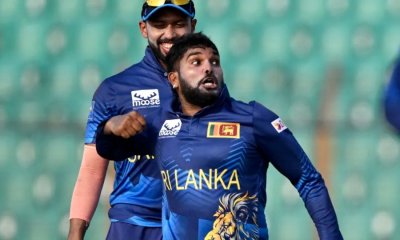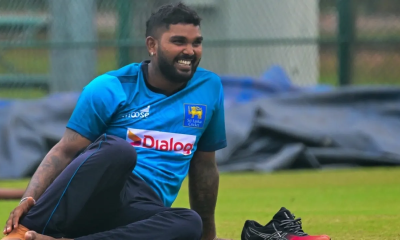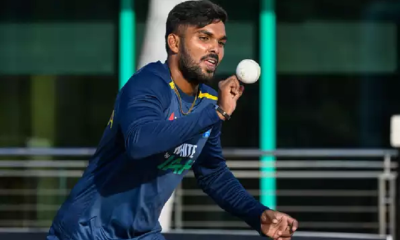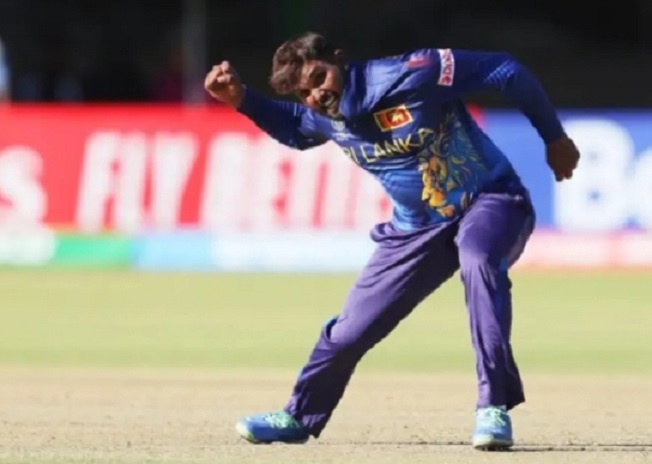
Wanindu Hasaranga received an official reprimand for breaching Level 1 of the ICC Code of Conduct during the ICC Men’s Cricket World Cup Qualifier match against Netherlands at Queen’s Sports Club in Bulawayo
The incident occurred after Hasaranga was dismissed, when he aggressively struck the boundary skirtings with his bat upon returning to the pavilion.
Following an investigation, Hasaranga was found to have violated Article 2.2 of the ICC Code of Conduct for Players and Player Support Personnel, which pertains to the “abuse of cricket equipment or clothing, ground equipment or fixtures and fittings during an International Match.”
As a result of this breach, one demerit point has been added to Hasaranga’s disciplinary record, as it was his second offense within a 24-month period, bringing his total demerit points to two.
Level 1 breaches carry a minimum penalty of an official reprimand, a maximum penalty of 50 percent of the player’s match fee, and one or two demerit points. If a player accumulates four or more demerit points within a 24-month period, these points are converted into suspension points, leading to a ban.
A player incurs a ban when they accumulate two suspension points, resulting in a suspension from either one Test match or two ODIs or two T20Is, depending on whichever comes first.
Hasaranga, the leading wicket-taker in the tournament with 20 wickets, admitted the offense and accepted the proposed sanction put forth by Shaid Wadvalla of the Emirates ICC International Panel of Match Referees. Consequently, there was no requirement for a formal hearing to be conducted.
Sri Lanka are currently sitting comfortably at the top of the Super Six table after their narrow win over Netherlands and have one foot in the Cricket World Cup later this year in India.
Delhi Capitals get into a huddle at the start of the chase [Cricinfo]
Chennai Super Kings came into IPL 2026 with a dodgy look about their bowling attack. They lost three games straight where their bowlers picked up 10 for 588 at an economy rate of 11.37. Since then, there has been an absolutely stunning turnaround. Over the last seven games, CSK’s bowlers have scooped up 51 wickets – only Gujarat Titans (52) have more – at an economy rate of 8.15 – which no-one can match.
Given first use of a slow pitch, Akeal Hosein (4-0-19-1) and Noor Ahmad (3-0-22-2) took charge of proceedings. Delhi Capitals could only put up 155 for 7, which proved too little as the surface got better to bat on in the second innings. Sanju Samson, who has contributed 24% of CSK’s runs this year, finished things off with 87 not out off 52 balls. Kartik Sharma, growing in confidence, was alongside him, with 41 off 31.
Both captains expected the pitch to be slow. The scoring pattern of the first four overs confirmed it. Fifteen dot balls. Six boundaries. Three singles and a wicket with the batter trying to force the pace. In conditions where the ball comes onto the bat, KL Rahul and Pathum Nissanka might have been able to hit the gap with the shots they played off good length balls. On this one, as much as they tried, they just found the fielder. Worse, they found themselves having to hold their shape for longer and even that didn’t always work.
With two right-handed openers, CSK had no hesitation in handing the ball to Hosein. When Nissanka fell though, DC sent Nitish Rana out in an effort to either hit Hosein out of the attack or prevent him from coming on. This is how much of a no-no matching a left-arm spinner with a left-handed batter is. But CSK bucked tradition. They gave Akeal a third over. He provided Rahul’s wicket and in the end Rana got to face only one ball from Akeal. A dot ball. DC came out of the powerplay 37 for 2. Akeal finished with figures of 4-0-19-1, which is exceptional considering he bowled only one over outside the field restrictions.
Axar Patel has 33 runs this season. Twenty-six of those came in one innings. And his strike rate is 97. It is a massive drop. The DC captain was one of the bright spots last season, their fourth-highest scorer with 263 at a very healthy strike rate of 157. He was in the middle when his team needed to rebuild and his wicket – the third that CSK took in a space of 19 balls between overs 8 and 11 – had an impact on the total they put up.
DC’s first five wickets scored 69 off 66. Sameer Rizvi, Impact Player-ed in because this was definitely an emergency, and Tristan Stubbs together put on 65 off 42 balls. Stubbs seemed to be factoring in the slowness of the pitch into his movements much better, handling Noor’s mystery spin and Gurjapneet Singh’s extra bounce with ease. Rizvi at the other end showed how batters could play against Anshul Kamboj, one of the season’s best death bowlers. He knew Kamboj liked to come around the wicket and target the wide line with yorkers. So he moved across his stumps a little bit, sweeping, slicing and smashing him down the ground.
One part of this plan was premeditation – the movement across his stumps – the other was instinct. Rizvi consciously tried to keep his shot options open, and not just target leg side. Until this match, Kamboj from around the wicket in this IPL has been box office: 63 balls, 93 runs, three sixes, eight wickets. In this game, he struggled: 12 balls, 34 runs, five sixes, no wickets. Meanwhile, Jamie Overton, one of CSK’s best bowlers, bowled only one over and spent time off the field as well.
Being in the form of his life is one thing, but to go out there knowing he is his team’s best hope for runs and managing risk accordingly is something else. Samson has always had aura. Now he has the output. For the first three games this season, he made 22 runs at an average of 7.33 and a strike rate of 116. The next seven, he’s made 380 at an average of 95 and strike rate of 172.
The six he hit first ball against Axar highlighted that the pitch was no longer a problem. A little bit of rain while the match was going on had freshened it up, making the ball come onto the bat better. Even so, DC had threats. Lungi Ngidi returning from a head injury aced his match-up against Ruturaj Gaikwad, dismissing him for a third time in 17 balls for just 10 runs in T20 cricket.
Samson held fire initially. He was 22 off 22 at the eighth over. Ten balls later, he was on fifty. Eventually, he was even entertaining thoughts of a hundred. A highlight of his game was the way he took down spin – 12 off 10 against Axar with one six and 25 off 9 against Kuldeep Yadav with three sixes and a four. CSK won a 12 vs 11 game – because they didn’t even need the impact player – with 15 balls remaining and got a net run-rate boost that could be vital as the season nears the playoffs.
The cocaine was found by Spain's Civil Guard (file image BBC)
Spanish police have seized what is thought to be a national record haul of cocaine from a ship in the Atlantic Ocean.
Between 30,000 to 45,000kg were found when the Civil Guard intercepted a freighter in international waters, the body’s main union, the AUGC, announced. It called the move a “historic blow to drug trafficking”.
The vessel was intercepted off Spain’s Canary Islands on Friday and around 20 people were arrested, the AUGC told the AFP news agency. It had travelled from Sierra Leona and was on its way to Libya.
The Civil Guard has declined to give details of the investigation for legal reasons.
Interior Minister Fernando Grande-Marlaska told reporters in Madrid that the seizure was “one of the biggest, not only nationally but internationally”.
The Civil Guard shared a photograph on X showing the drugs stuffed into the hold of the intercepted vessel.
“Today history is being written in the Maritime Service of the Civil Guard,” it wrote.
“Intercepted in international waters the largest known seizure: between 30,000 and 45,000 kg of cocaine on board a freighter.”
While the boat was headed to Libya, AFP reported that the pattern of previous operations suggests that it was due to offload the drugs onto smaller vessels for distribution in Europe.
In January, Spanish authorities made its biggest seizure of cocaine at sea from a ship that was carrying almost 10 tonnes.