
Latest News
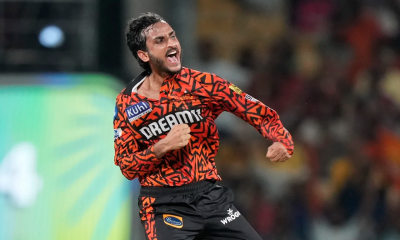
Varun and Salt star in comprehensive Kolkata Knight Riders win

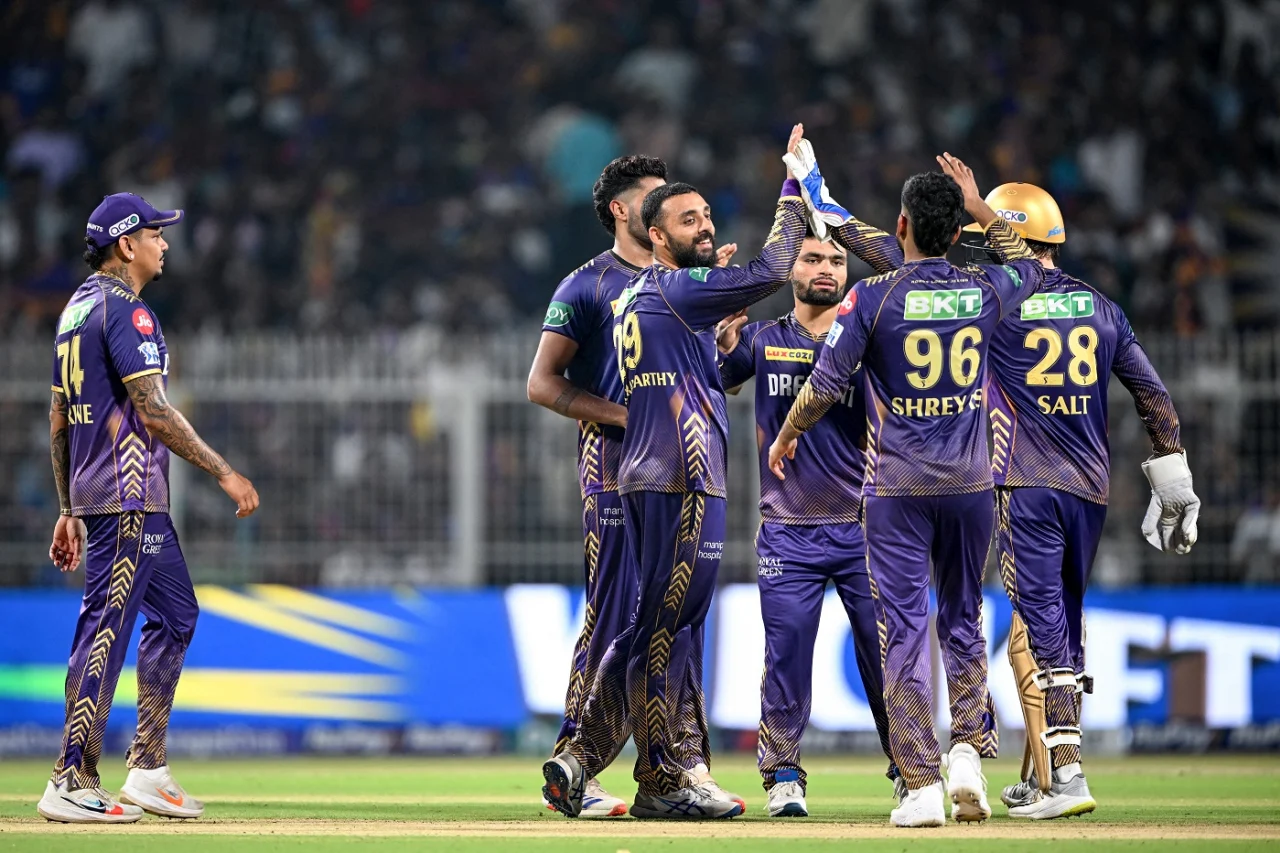
Having just hosted a run-fest where 262 was chased down with eight balls to spare, Eden Gardens reverted to a former template familiar to fans of its home team, and Kolkata Knight Riders returned to winning ways and moved to second place on the IPL table with a confident, net-run-rate-boosting seven-wicket victory over Delhi Capitals.
After a succession of flat pitches, Eden served up one with a little bit of grip, and KKR’s bowlers made full use of it after Capitals chose to bat first. Mitchell Starc and Vaibhav Arora took three wickets inside the powerplay, after which the spinners took over, with Varun Chakrawarthy and Sunil Narine combining for figures of 8-0-40-4. Reduced to 111 for 8 at one stage, Capitals set KKR a 150-plus target thanks to an unlikely, unbeaten 26-ball 35 from Kuldeep Yadav.
With Kuldeep and Axar Patel in their attack, Capitals had the tools to create a bit of pressure on this pitch, but KKR were well on their way to victory before either spinner had bowled a ball. Phil Salt made his fourth fifty in five home games this season, dominating a powerplay in which KKR rushed to 79 for no loss.
Axar Patel removed both KKR openers when he came on, but it was too little, too late for Capitals, as Shreyas Iyer and Venkatesh Iyer put on an unbroken 57 off 43 balls to end the match with 21 balls remaining.
KKR now have 12 points from nine games, and a NRR of 1.096, the best of any team in the competition.
Jake Fraser-McGurk faced just seven balls on Monday night, and five of the seven were attempted yorkers, two of which ended up as full-tosses. The other two were banged into a hard length. The bulk of these balls were from Mitchell Starc, but Vaibhav Arora also stuck to the same plan with his two balls. This wasn’t two fast bowlers searching for swing from a fullish good length with the new ball. This was death bowling inside the powerplay, and as T20 batting leans more and more towards all-out attack, it’s likely we’ll see a lot more of it in the future.
On the day, Fraser-McGurk hit a four and a six and picked out deep square leg while looking to flick Starc for another six.
By then, Capitals had already lost Prithvi Shaw, who had begun ominously with three fours off Starc, off the first three balls of the match. He had fallen in innocuous manner, strangling Arora down the leg side.
Arora took one more wicket, delivering a peach that straightened off the deck to hit the top of Shai Hope’s off stump. That ball suggested the ball would grip for the spinners too, and so it proved.
Before this match, Varun had endured a difficult season, going at 9.72 while picking up eight wickets in eight games. While Narine had defied flat conditions, particularly in Kolkata, and prevented batters from accessing the boundaries, his spin partner had gone for plenty like every other bowler in KKR’s games.
Now, though, Varun had a bit of help from the pitch, and he could have struck first ball had Harshit Rana – who had just dismissed a dangerous-looking Abishek Porel in the previous over – not dropped a sitter off a Rishabh Pant miscue at short third. Pant, though, would go after Varun again in his next over – the 11th of the Capitals innings – and miscue again, with Shreyas Iyer pouching him safely in the covers on this occasion.
Varun was getting the ball to bite on the surface, and he quickly picked up two more wickets, of Tristan Stubbs and Kumar Kushagra – who came on as Impact Sub in a failed attempt to lengthen Capitals’ batting and stem the collapse. With Narine dismissing Axar Patel at the other end, Capitals were eight down inside the 15th over.
They managed to see out their 20, though, with Kuldeep getting them that far with a mixture of skill and luck. He hit two edged fours in his first four balls, and then hit a six off Starc that was very nearly a catch at deep backward square leg, and eventually finished with a control percentage of 41. They were important runs for Capitals, though, ensuring that they got to 150.
It was evident through the initial stages of KKR’s chase that the slower ball was gripping the surface and stopping on the batters, but it was also evident that Capitals’ quicks were offering frequent width to free the arms. With Salt and Narine in the form they were in, this was asking for trouble. And the trouble was compounded when Lizaad Williams, who went for 23 in the first over, dropped a straightforward chance off Khaleel Ahmed at the start of the second to reprieve Salt on 15.
The openers raced to 79 for 0 in the powerplay, with Salt, who had the bulk of the strike, reaching a 26-ball half-century in the sixth over.
Narine went after Axar’s first ball and perished, picking out deep midwicket in the seventh over while trying to hit with the turn, and Axar bowled Salt with a trademark, inward-angling skidder in the ninth. But KKR’s required rate was well below a run a ball, and it remained so even when Williams dismissed Rinku Singh with a good, hard-length ball in the 10th over.
KKR had a long, in-form line of batters still to come, and in the end didn’t require Andre Russell, Angkrish Raghuvanshi or Ramandeep Singh to bat, as the two Iyers ticked off the remaining runs with little fuss beyond a mix-up in the 16th over when the match was already all but won.
Brief scores:
Delhi Capitals 153/9 in 20 overs (Kuldeep Yadav 35*, Rishabh Pant 27; Mitchell Starc 1-43, Vaibhav Arora 2-29, Varun Chakravarthy 3-16, Harshit Rana 2-28, Sunil Narine 1-24) lost to Kolkata Knight Riders 157/3 in 16.3 overs (Phil Salt 68, Shreyas Iyer 33*, Venkatesh Iyer 26*; Lizaad Williams 1-38, Axar Patel 2-25) by 7 wickets
(Cricinfo)









Four persons including a Budhist monk died and 32 others were injured when two SLTB buses collided head on at Weerawila at arond 12 noon today (18).
Three of the deceased were women. 22 of the injured were admitted to the Hambanthota Hospital while 10 others have been admitted to the Debarawewa hospital.

Families have gathered outside a drug treatment centre in the Afghan capital, Kabul, looking for their loved ones after it was hit in a Pakistan air strike, which Taliban authorities said killed 408 people.
The attack on Kabul’s Omar Addiction Treatment Hospital took place at about 9pm local time (16:30 GMT) on Monday.
[Aljazeera]

African football’s governing body has stripped Senegal of the Africa Cup of Nations (AFCON) title they won in a chaotic final two months ago and declared Morocco the champions.
In a stunning decision, the Confederation of African Football (CAF) said on Tuesday that its appeals board ruled that Senegal is “declared to have forfeited” the match, a 1-0 victory. The result, it said, was now “being officially recorded as 3-0” in favour of host nation Morocco.
At the January 18 final in Rabat, Senegal’s players walked off the pitch, led by coach Pape Thiaw, in protest against a penalty awarded late in regulation time to Morocco.
When play resumed after a delay of about 15 minutes, Morocco forward Brahim Diaz’s penalty was saved. In extra time, Pape Gueye scored the decisive goal that saw Senegal become champions of Africa for the second time.
The heated final also saw supporters trying to storm the field, players scuffling on the sidelines, reporters from the two countries fighting in media areas, and a bizarre sequence in which Moroccan ball boys tried to seize a towel being used by Senegalese goalkeeper Edouard Mendy – in an apparent bid to distract him and help their team win the continental title.
At a disciplinary hearing in January, CAF imposed fines of more than $1m as well as bans for Senegal and Morocco players and officials, but it had left the result untouched.
The case could go to a further appeal at the Court of Arbitration for Sport.
[Aljazeera]

SriLankan Airlines Alerts Customers to Social Media Scams

Four dead 32 injured in head on collision at Weerawila

JMSDF ship OONAMI concludes goodwill visit

Cabinet nod to amend Central Cultural Fund Act No. 57 of 1980
’National Namal Uyana’ declared as a National Heritage
Establishment of Supervisory Committees for restoring economic activities.

‘Dates have the highest sugar content to fight Coronavirus’

Sunday Island 27 December – Headlines

#SundayIsland 17th December – Headlines

Sunday Island – 28th March

Sunday Island Headlines – 21 March

Sunday Island – 21st February – Headlines
-

 News7 days ago
Historic address by BASL President at the Supreme Court of India
-

 Sports7 days ago
The 147th Royal–Thomian and 175 Years of the School by the Sea
-

 Business3 days ago
Browns EV launches fast-charging BAW E7 Pro at Rs. 5.8 million
-

 Life style4 days ago
From culture to empowerment: Indonesia’s vision for Sri Lanka
-

 News7 days ago
Power sector reforms jolted by 40% pay hike demand
-

 Opinion6 days ago
M. D. Banda: Memories of Appachchi – II
-

 Latest News4 days ago
QR code system will be implemented for fuel with effect from 06.00 a.m. today (15th)
-
 Business5 days ago
Sri Lanka Institute of Information Technology raises the bar for academic excellence