
News
v


By Amal JAYASINGHE
As once relatively wealthy Sri Lanka suffers a dire economic crisis with shortages of everything from medicines to gas, people are returning to cooking with firewood.The switch began at the beginning of the year when more than 1,000 kitchens exploded across the country, killing at least seven people and injuring hundreds more.The reason was suppliers looking to cut costs and increasing the proportion of propane, which raised the pressure to dangerous levels.
But now, along with much else in the country of 22 million people, gas is either unavailable or too expensive for most.Some tried to shift to kerosene oil cookers, but the government did not have dollars to import it along with petrol and diesel, which are also in short supply.And those who bought electric cookers were in for a rude shock when the government imposed lengthy power blackouts as it ran out of dollars to import fuel for generators.
Niluka Hapuarachchi, 41, was miraculously unharmed when her gas range exploded soon after cooking Sunday lunch in August.
“Fortunately, no one was there at the time. There were pieces of glass all over the floor. The glass-top stove had exploded. I will never use gas for cooking. It is not safe. We are now on firewood,” she said, despite moves to address the propane problem.Roadside eatery owner M.G. Karunawathi, 67, also switched to wood and said it was a choice between closing her business or putting up with smoke and soot.
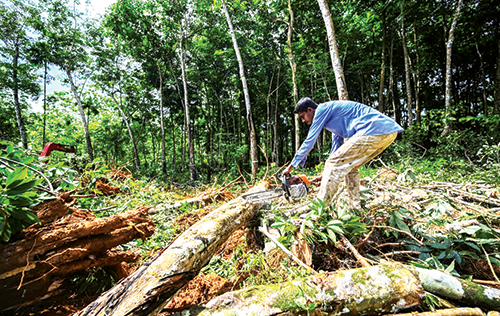
In this picture taken on June 8, 2022, a lumberjack chops trees to feed the
rising demand for firewood in Nehinna village. As once relatively wealthy
Sri Lanka suffers a dire economic crisis with shortages of everything from
medicines to gas, locals are returning to cooking with firewood. Pic by
Ishara Kodikara.
“We suffer (smoke inhalation) when cooking with firewood, but we have no choice,” Karunawathi told AFP. “It is also difficult to find firewood and it is also becoming very expensive.”
Sri Lanka used to be a middle-income country, with GDP per head comparable to the Philippines and living standards the envy of neighbouring India.
But with economic mismanagement and the crucial tourism industry hammered by Covid-19, the nation has run out of dollars needed to pay for most imports.
And the pain will likely continue for some time, with Prime Minister Ranil Wickremesinghe in parliament on Tuesday saying: “We will have to face difficulties in 2023 as well.
“This is the truth. This is the reality.”
Unofficial inflation is now second only to Zimbabwe, and the United Nations estimates about 80 percent of people skip meals because they cannot afford food.
Before the crisis, almost all households in Colombo could afford to use gas, but now woodcutter Selliah Raja, 60, is doing a roaring trade.
“Earlier we had just one customer — a restaurant that had a wood-fired oven — but we now have so many, we can’t meet the demand,” Raja told AFP.
He says his timber suppliers in the provinces have doubled their prices because of the sharp rise in demand and skyrocketing transport costs.
“Earlier, land owners paid us to uproot rubber trees that are no longer productive,” lumberjack Sampath Thushara told AFP in the tea-and-rubber-growing southern village of Nehinna.
“Today, we have to pay to get these trees.”
Foraging for wood can also be dangerous in the snake- and insect-infested forests. Last week, a father of three died from wasp stings in central Sri Lanka and four others were hospitalised.
Demand is also surging for alternative energy, and entrepreneur Riyad Ismail, 51, has seen sales light up for the hi-tech firewood stove he invented in 2008.
He has attached a small battery-powered electric fan to blow air into the barrel-shaped stove to ensure better burning, thus reducing smoke and soot associated with traditional firewood burners.
His upmarket “Ezstove” and the mass-market “Janalipa”, which uses coconut charcoal, promises a minimum 60 percent savings compared with cooking with gas.
Both his stoves — which cost around $20 and $50, respectively — have become big sellers with buyers having to go on a waiting list.
It has been so successful, Ismail says, there are several copies on the market.
“You will see many renditions of my design… other people are piggybacking (on the design),” Ismail said while making chicken satay.



The Department of Immigration and Emmigration has decided effective from 28th February 2026, to grant a free fourteen (14) day visa extension to all tourists who are unable to leave Sri Lanka due to flight cancellations. 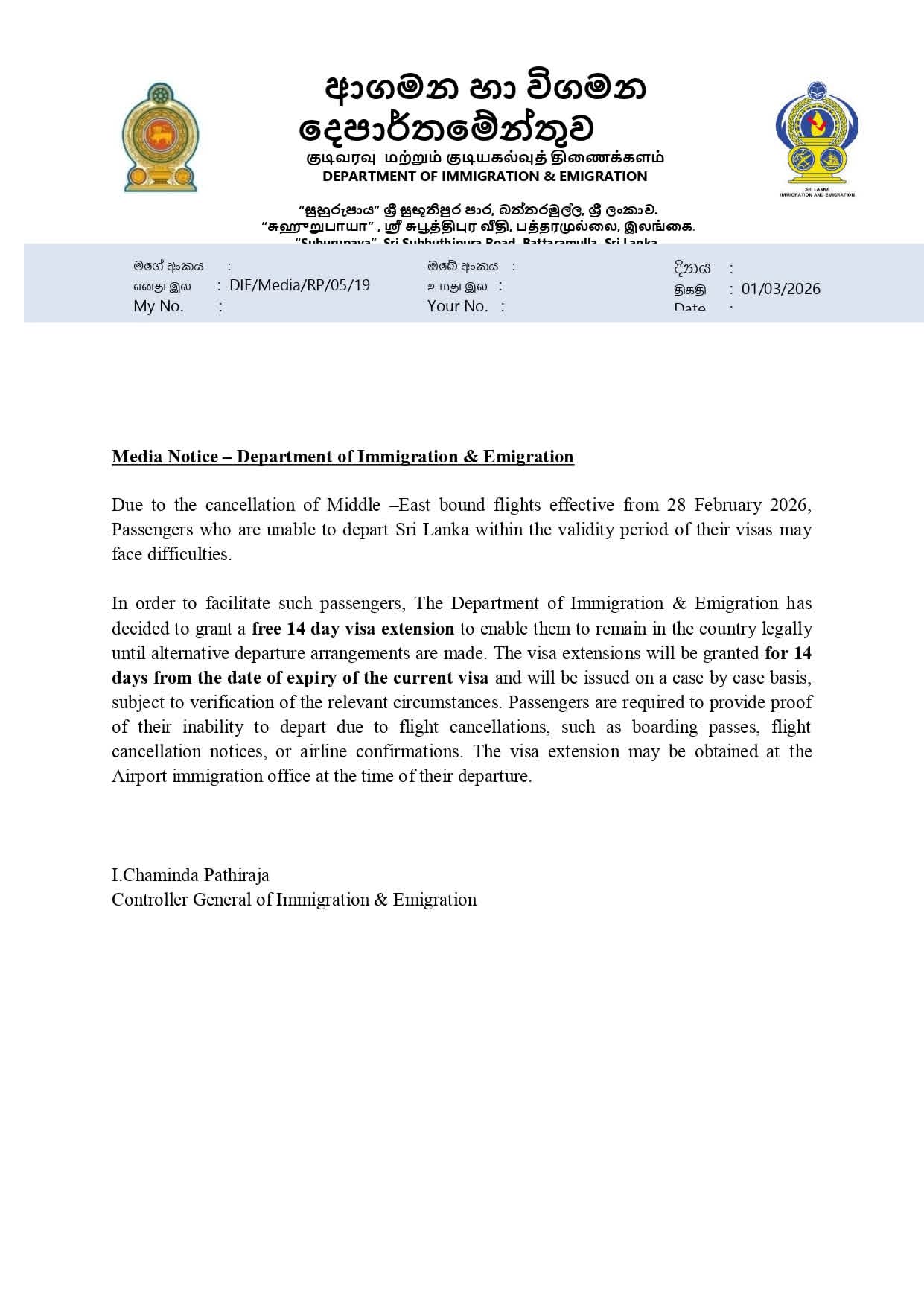
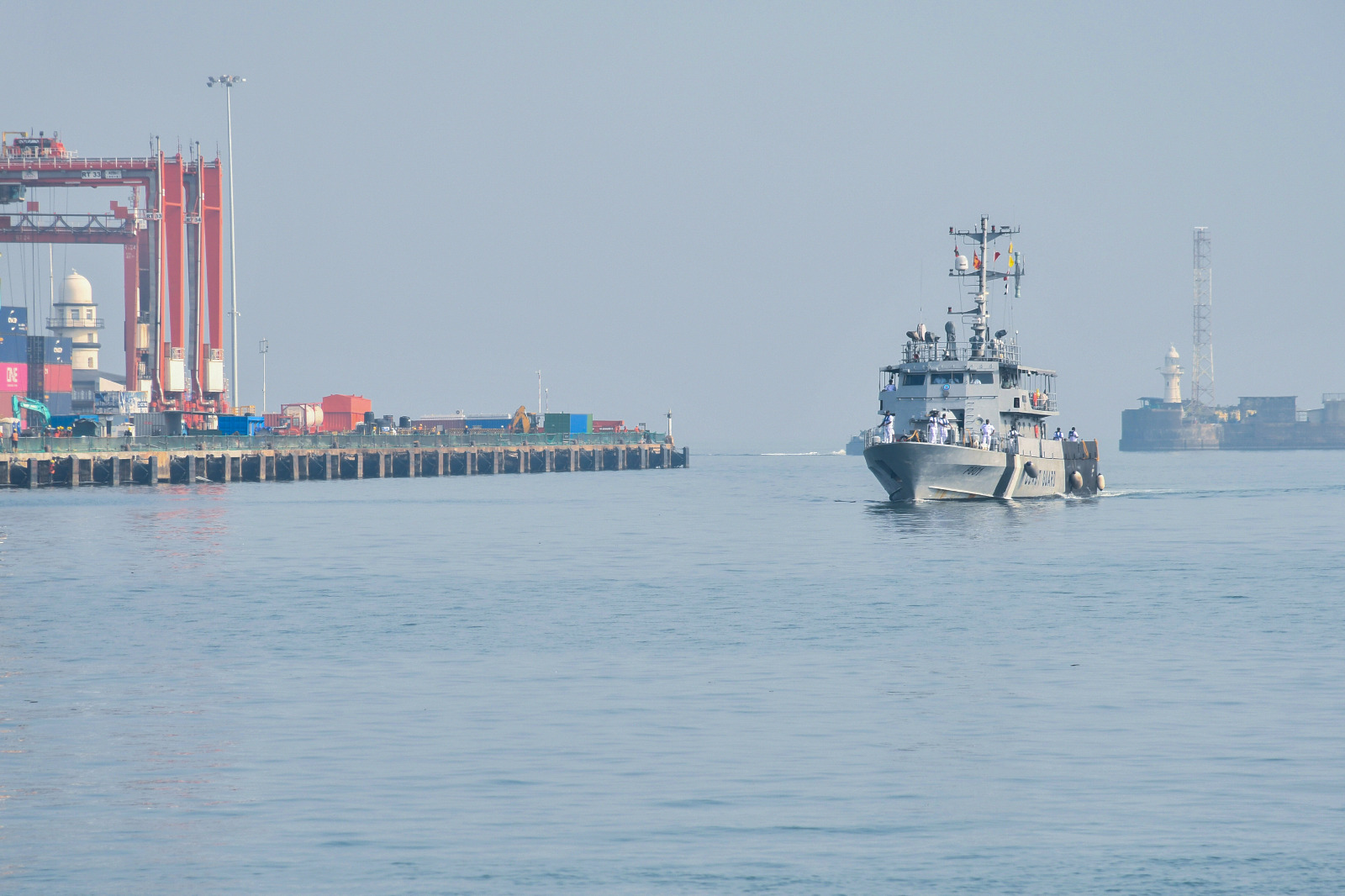
The Maldives Coast Guard Ship Huravee arrived at the Port of Colombo for replenishment purposes on 02 Mar 26. The visiting ship was welcomed by the Sri Lanka Navy (SLN) in compliance with time-honoured naval traditions.
The ship is a 48.9m long Offshore Patrol Vessel which is commanded by Lieutenant Colonel Ahmed Nafiu Mohamed.
Meanwhile, the ship’s crew is scheduled to visit several tourist attractions in the city of Colombo, during their stay in the island.

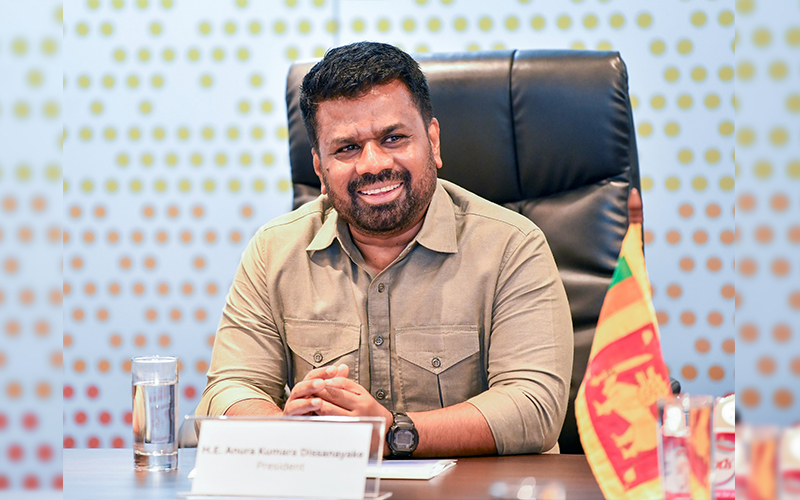
President Anura Kumara Dissanayake yesterday called for an immediate and peaceful resolution of the escalating Middle East conflict, warning that the crisis could have far-reaching repercussions on the global economy, including Sri Lanka.
Addressing Parliament, the President stressed that no military conflict benefited humanity, particularly at a time when destructive military technologies were rapidly advancing.
“Any military conflict does not create a favourable situation for any group of people,” he said, urging all parties to make urgent commitments towards peace. “As Sri Lanka, our position is that all parties involved in this war must, as soon as possible, take steps toward a peaceful world.”
He cautioned that Sri Lanka could not remain insulated from the fallout from the conflict, noting that disruptions to global oil and gas supplies, threats to migrant workers in the Middle East, and potential shocks to tourism, remittances, shipping and aviation were real concerns.
A national programme was being formulated to mitigate the impact, he said, adding that its success would hinge on broader international efforts to restore stability, the President said.
Acknowledging public anxiety shaped by past economic hardships, President Dissanayake said social stability could not be ensured through rhetoric alone but required tangible guarantees that citizens would not face another crisis.
While noting that the government had successfully navigated multiple challenges since assuming office, he described the Middle East situation as distinct due to the uncertainty surrounding its duration and outcome.
The government, he said, was closely monitoring developments. The Central Bank had conducted a review with a report on the likely economic impact expected shortly. The Ministry of Finance is also preparing an assessment of the potential effects on public life, alongside measures to ensure the uninterrupted provision of essential services locally and for Sri Lankans overseas.
“The primary responsibility for finding a path out of the crisis rests with the Government,” he said, calling on Parliament and the public to collectively confront the challenge under a unified national plan.
Providing a detailed account of the country’s energy reserves, the President said storage capacity rather than supply remained the key constraint. Excluding the Indian Oil Corporation tanks in Trincomalee, total storage capacity at Kolonnawa and Muthurajawela stands at approximately 150,000 metric tons.
Diesel stocks were currently sufficient for 33 days, with refining contributing around 1,800 metric tons daily. Petrol reserves will last 27 days, with a 35,000 metric ton shipment due on March 7 or 8 expected to extend availability to around 40 days.
Aviation fuel stocks are adequate for 49 days, supported by both daily refining and imports. Scheduled shipments include vessels from RM Parks on March 14, Sinopec on March 17, IOC on March 21 and the Ceylon Petroleum Corporation on March 28.
Crude oil supplies were sufficient to operate the refinery for 26 days, with an additional shipment expected to extend operations by a further 18 days, the President said.
“Because of this, there is no crisis regarding oil,” the President assured Parliament.

Free 14 day visa extension for visitors unable to depart Sri Lanka

US embassy in Dubai hit; Israel pounds Tehran, Beirut

Perera, Sugandika, Ranaweera take Sri Lanka to T20I series win over West Indies

Maldives Coast Guard Ship Huravee arrives in Colombo

New charges for son of Norway’s crown princess on trial for rape

US sends planes to evacuate nationals from Middle East as Iran conflict spreads

‘Dates have the highest sugar content to fight Coronavirus’

Sunday Island 27 December – Headlines

#SundayIsland 17th December – Headlines

Sunday Island – 28th March

Sunday Island Headlines – 21 March

Sunday Island – 21st February – Headlines
-

 Opinion5 days ago
Jamming and re-setting the world: What is the role of Donald Trump?
-

 Features2 days ago
Brilliant Navy officer no more
-
 Features5 days ago
An innocent bystander or a passive onlooker?
-
 Features6 days ago
Ratmalana Airport: The Truth, The Whole Truth, And Nothing But The Truth
-

 Opinion2 days ago
Sri Lanka – world’s worst facilities for cricket fans
-
 Business6 days ago
IRCSL transforms Sri Lanka’s insurance industry with first-ever Centralized Insurance Data Repository
-

 Business5 days ago
An efficacious strategy to boost exports of Sri Lanka in medium term
-

 Features3 days ago
Overseas visits to drum up foreign assistance for Sri Lanka