
Foreign News
US brings back El Salvador deportee to face charges


Kilmar Ábrego García, a 29-year-old from El Salvador mistakenly deported in March, has been returned to the US to face prosecution on two federal criminal charges.
He has been accused of participating in a trafficking conspiracy over several years to move undocumented migrants from Texas to other parts of the country.
El Salvador agreed to release Mr Ábrego García after the US presented it with an arrest warrant, Attorney General Pam Bondi said on Friday. His lawyer called the charges “preposterous”.
The White House had been resisting a US Supreme Court order from April to “facilitate” his return after he was sent to a jail in El Salvador alongside more than 250 other deportees.
In a two-count grand jury indictment, filed in a Tennessee court last month and unsealed on Friday, Mr Ábrego García was charged with one count of conspiracy to transport aliens and a second count of unlawful transportation of undocumented aliens.
Bondi said the grand jury had found that Mr Ábrego García had played a “significant role” in an alien smuggling ring, bringing in thousands of illegal immigrants to the US.
The allegations, which date back to 2016, allege he transported undocumented individuals between Texas and Maryland and other states more than 100 times.
The indictment additionally alleges he transported members of MS-13, designated a foreign terrorist organisation by the US.
The Trump administration had previously alleged Mr Ábrego García was a member of the transnational Salvadorian gang, which he has denied.
Bondi also accused Mr Ábrego García of trafficking weapons and narcotics into the US for the gang, though he was not charged with any related offences.
He appeared in court for an initial hearing on Friday in Nashville, Tennessee. An arraignment hearing is scheduled 13 June, where US Magistrate Judge Barbara Holmes will determine if there are grounds to keep him detained ahead of his trial.
For now, Mr Ábrego García remains in federal custody.
Mr Ábrego García’s lawyers have previously argued that he has never been convicted of any criminal offence, including gang membership, in the US or in El Salvador.
Simon Sandoval Moshenberg, one of his attorneys, called the charges “preposterous” and the events an “abuse of power” at a Friday news conference.
“The government disappeared Kilmar to a foreign prison in violation of a court order,” Mr Moshenberg said. “Now, after months of delay and secrecy, they’re bringing him back, not to correct their error but to prosecute him.”
He added: “This is an abuse of power, not justice. The government should give him a full and fair trial in front of the same immigration judge who heard the case in 2019.”
Speaking to reporters on Friday, President Donald Trump called Mr Ábrego García a “bad guy” and said the Department of Justice had made the right decision to return him to US soil to face trial.
Mr Ábrego García entered the US illegally as a teenager from El Salvador. In 2019, he was arrested with three other men in Maryland and detained by federal immigration authorities.
But an immigration judge granted him protection from deportation on the grounds that he might be at risk of persecution from local gangs in his home country
On 15 March, he was deported amid an immigration crackdown by the Trump administration, after Trump invoked the Alien Enemies Act, a wartime law that allows presidents to detain or deport the natives and citizens of an enemy country.
Mr Ábrego García was taken to the Cecot mega-prison in El Salvador, known for its brutal conditions.
While government lawyers initially said he was taken there as a result of “administrative error”, the Trump administration refused to order his return.
Whether or not the government had to “facilitate” his return to his home in the US state of Maryland became the subject of a weeks-long legal and political battle.
After Maryland Senator Chris Van Hollen demanded to see Mr Ábrego García in El Salvador, he was released to a different prison in that country.
On Friday, Van Hollen reiterated that “this is not about the man, it’s about his constitutional rights – and the rights of all”.
“The administration will now have to make its case in the court of law, as it should have all along.”
El Salvadoran President Nayib Bukele, a close ally of Trump, said on social media on Friday that if the administration “request the return of a gang member to face charges, of course we wouldn’t refuse”.
Mr Ábrego García is expected to make an initial appearance at a Tennessee court on Friday, where US will request he be held in pretrial custody “because he poses a danger to the community and a serious risk of flight”, according to the detention motion.
[BBC]


US authorities have found debris from a medical transport aircraft that went missing with six people on board.
The Federal Aviation Administration told the BBC it had lost contact with the Gulfstream G-100 plane just after 01:00 local time (05:00 GMT) on Saturday, while it was travelling from Bermuda to Boston, Massachusetts.
The search for survivors continues off the coast of Nantucket, a Massachusetts island, the US Coast Guard said.
Authorities have notified the next of kin of those on the flight, four Canadian nationals and two Bermudian nationals.
“Search crews located a debris field confirmed to be from the aircraft off the coast of Nantucket,” the US Coast Guard said in an update on Saturday night. It added that ships, helicopters and planes were involved in searches that would through continue the night.
The plane departed from Bermuda’s L.F. Wade International Airport at 23:40 local time, according to flight data from FlightAware, and was due to land at Boston’s Logan International at 01:30 EDT (05:30 GMT).
According to the tail number released by the Coast Guard, the plane belonged to Latitude Air Ambulances, a company that provides international medical flights for patients returning home.
Among those on board were two pilots and two medical staff, both Canadian, Clarence Togeretz, director of flight operations at Latitude, told CBC News.
The crew flew to Bermuda to collect a patient and their relative, who are not Canadian, Togeretz said.
FlightAware’s tracker shows the aircraft significantly dropped in altitude before its communications went dark, plummeting from around 7,300m (24,000ft) to 3,300m (11,000ft).
Radio transmissions shows trouble with communications between the air traffic controller and the pilot, the Boston Globe reported based on transmissions provided by LiveATC.net.
“You’re coming in blind? Is that what you said?,” the air traffic controller asked. “Are you declaring an emergency, or no?”
The pilot’s response was inaudible.
“You’re coming in a little weak so I didn’t hear what your response was, if you were declaring an emergency or not,” the air traffic controller said, according to the Globe.
The air traffic controller later confirmed the pilot had declared an emergency.
An area fire dispatcher asked emergency crews just after 01:00 EDT to prepare to meet a plane with an “electrical issue”.
The dispatcher later said “the aircraft has lost radio and radar”.
The Coast Guard said it would provide an update on Sunday morning local time.
[BBC]

A car has crashed into a crowd of rugby league supporters in the eastern Australian city of Newcastle, injuring 10 people, including three children.
New South Wales police said on Saturday that two of the injured – a five-year-old girl and a 67-year-old man – were in a critical condition and the other eight were in stable condition in hospital.
Police said they had arrested the 18-year-old man driving the vehicle and were investigating what happened. They said the crash was not believed to be related to “terrorism”.
The crowd had gathered to farewell the local rugby league side, the Newcastle Knights, ahead of their grand final against the Sydney Roosters on Sunday.
Newcastle Lord Mayor Gavin Morris said the driver, a rugby league fan, had lost control of his vehicle and had been taken into custody.
“He was revving the car, he was excited, he was a supporter, he was there for the joy of the moment,” Morris told the national broadcaster ABC.
“Somehow he lost control of the car … and he’s gone into the crowd,” he added.
Prime Minister Anthony Albanese said: “My thoughts are with everyone injured or involved in the horrible incident this morning in Newcastle.”
“Rugby league brings people together, and this should have been a weekend of excitement and pride for Newcastle fans,” he wrote in a social media post.
[Aljazeera]
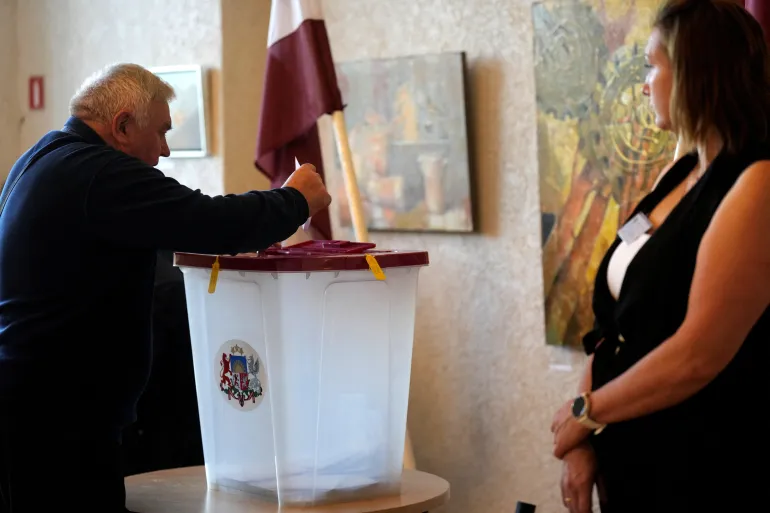
Polls have opened in Latvia for an election taking place against the backdrop of perceived security threats from Russia and a nationwide cost-of-living squeeze.
Saturday’s vote is the first electoral test for Prime Minister Andris Kulbergs after coming to power in May this year when his predecessor resigned due to a backlash from stray drone incursions from Ukraine.
Kulbergs, whose right-wing United List party is currently polling at about 20 percent, is expected to hold onto his position, but the decline of two allies in his current coalition means he is set for a complicated negotiation over the makeup of any future government.
Polls opened at 05:00 GMT and will close at 17:00 GMT. The results are not expected to change Latvia’s pro-European and pro-Ukrainian course.

About 1.5 million people are eligible to vote in the country’s 11th parliamentary election since independence from the Soviet Union in 1991.
Latvian politics are highly fragmented, with parties rarely seeing above 20 percent vote share and coalitions being the norm.
This year, 14 electoral lists are contesting the election, but polls indicate only seven are likely to enter parliament, with the rest expected to fail to meet the minimum 5 percent vote threshold.
Rising living costs, low wages, strains on the healthcare system and long-term population decline have all featured prominently in campaign debates.
Most parties in Latvia are pro-Ukraine; however, the populist Sovereign Power party – which says it wants Ukraine to win but argues money spent supporting Kyiv would be better spent at home – looks likely to become the country’s second-biggest party, with more than 9 percent of the vote. Most other parties have ruled out forming a coalition with Sovereign Power.
Latvia First, a pro-Ukraine and populist nationalist party currently polling at about 9 percent, could be a potential coalition partner for PM Kulbergs.
The Progressives, a pro-European social democratic party, are polling at 6 percent.
Ethnic Russians make up roughly one in four Latvian citizens, but their vote, which has traditionally been cast along identity-based lines, looks set to be made according to economic and social issues.
Latvia is the poorest of the Baltic states, and it has sharply increased its defence spending since Russia invaded Ukraine, now allocating nearly 5 percent of its gross domestic product (GDP) to defence.
[Aljazeera]

Fuel crunch looms

Gnansara Thera to be assigned to prison printing section: Officials

Speaker rejects Ajith Perera’s privilege complaint

OIC of FCID summoned before Maligakanda Magistrate

Sallay cleared for discharge, to return to CID custody

Senior prelate urges authorities to allow Gnanasara Thera to wear his robes in prison

‘Dates have the highest sugar content to fight Coronavirus’

Sunday Island 27 December – Headlines

#SundayIsland 17th December – Headlines

Sunday Island – 28th March

Sunday Island Headlines – 21 March

Sunday Island – 21st February – Headlines
-

 Latest News7 days ago
Gold winner Tharanga gets brand-new Honda Vezel from SLAAJ
-

 News6 days ago
US-assisted ‘Ice’ detection: NPC to examine IGP’s move to transfer drug-busting team
-

 Editorial5 days ago
Colombo Port drug bust: The plot thickens
-

 Editorial6 days ago
Drug busting, transfers and trust deficit
-

 Features3 days ago
The first woman in the foreign service or Ceylon Overseas Service it was then called
-

 Latest News4 days ago
Tharindu Rathnayake, bowlers secure Asian Games Bronze for Sri Lanka
-

 News6 days ago
Sri Lankan facing death penalty in Saudi Arabia: Mano G appeals to Crown Prince
-

 Editorial4 days ago
Fuelling discontent and protest