
Features
Uncertain Sino-US relations in the Biden Era

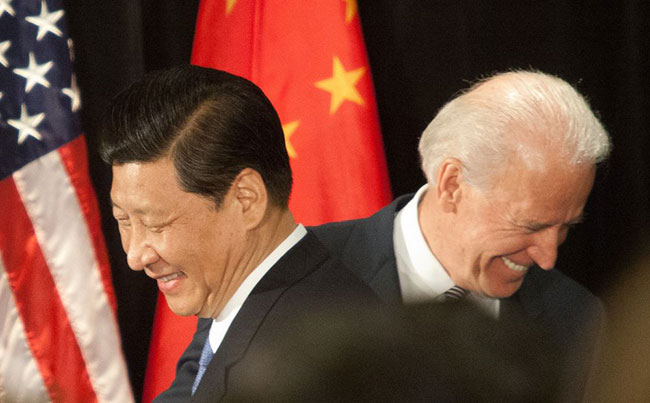
by Kumar David
A US State Department release said on 12 May 2021: “Strategic competition is the frame through which we view our relationship with the PRC. We will address it from a position of strength in which we work with our allies to defend our interests and values. We will advance our economic interests, counter Beijing’s aggressive and coercive actions, sustain key military advantages and vital security partnerships, re-engage robustly in the UN system, and stand up when China violates human and fundamental freedoms. When it is in our interest, we will conduct results-oriented diplomacy with China on shared challenges such as climate change and global public health”; (abbreviated).
So, America will strengthen its economic and strategic position and place emphasis on human rights but also collaborate on common interests such as climate change. It’s different from the Trump Era more in posture and signals than in words. Trade sanctions are off the table or will be used infrequently, belligerence is no longer in vogue and there is a well-articulated shift to concern with human-rights, a term Trump treated with derision. You will hear more about Xinjiang than trade deficits in the Bidden years.
Donald Trump was an aberration, a malignant abnormality and a dangerous one. Dangerous because political conditions in the US are scary, to say the least because the ultra-right, white-supremacists and primeval cultures, in a word the zeitgeist of potentially fascist-like threats consume the country. The information released last month by the Defence and Justice Departments that Trump was on the verge of attempting a coup after his election defeat shows how close America came to civil war. To give readers a rough measure I would stick my neck out and say that a quarter to a third of all Americans are Neanderthal in outlook; but it’s very uneven across states. To best see primitives look in states with the most anti-vaccination populace. The seven Jim Crow states are the pits – Mississippi, Louisiana, Alabama, Arkansas, Tennessee, West Virginia and South Carolina. I needed to sound this warning about America’s rumbustious unevenness as opposed China’s dull uniformity and superficial linearity before moving on.
The remainder of this article will focus on a five-game match; (1) BRI (Belt and Road Initiative) vs B3W (Build Back Better World G7 initiative), (2) Digital Yuan or DY, (3) competing corporate governance models, (4) cyber-espionage and (5) human rights. The BRI vs B3W battle will be a walkover for China. BRI has had a head start of over a decade, has commitments in hard cash and is a state-to-state undertaking between China and about 50 countries. The Americans and G7 partners hope the private sector will join as a big stakeholder to catalyse hundreds of billions of dollars in infrastructure investment in low- and middle-income countries. A senior official gambled: “We believe we will beat the BRI by offering a higher-quality choice and we’ll offer that choice with self-confidence about our model that reflects our shared values.” The shared values the West envisions are free-markets, commitment to democracy and respect for human rights. Wake up Joe from visions of honeymooning with dictators and goons! The Chinese have a better cruder measure of the likes of the (Raja)Paksas; they will win the first-set of the BRI vs B3W match 6-0.
The second set will be harder fought. Beijing makes BRI investments and grants loans to countries that cautious investors will not touch with a bargepole. It is hard to quantify the BRI investment quantum since a part is Central Government loans, much investment by Chinese SOEs and maybe a fifth of the total costs are carried in cash or kind (land, labour) by recipient countries. In the final analysis total BRI investment from all sources may be in the $3 trillion to $4 trillion range. Handouts to bankrupt or brain-dead regimes (Lanka exemplifies both disorders) are used to gain political mileage or acquire assets when non-creditworthy projects go belly-up as with no-ships Hambantota Harbour, no-fly Mattala and no-games Hambantota stadium. I do not need to amplify that many recipient countries are sinking ever deeper into the mire of debt (for no fault of Beijing you may say if you are tough), and crucially, will never escape from debt. They will pawn or give away national assets for 99-years. The criticism of perpetual indebtedness to China is gaining ground, nevertheless China will still win the second-set of the BRI vs. B3W game largely because many third world political leaders are scoundrels.
The internationalisation of the DY, game (2), is unstoppable and desirable. It is important to distinguish between China’s Digital Yuan and bitcoin and other crypto-currencies. China is expanding domestic and international digital transactions through the central bank (People’s Bank of China); DY is supported by block-chain technology making it tamper-proof and it is issued by a central bank as a national currency. As it gains acceptance it will become an international alongside the Dollar, Euro and Yen but with technical differences. The motives for internationalising the Yuan are countering US dollar dominance of global finance and curbing the clout of China’s own “fintech” giants like Ant Group and Tencent. The hegemony of the US dollar is anchored in the petrodollar. In 1971 when stagflation prompted a run on the dollar and it plummeted; other countries wanted to redeem their dollars for gold, but to protect US gold reserves Nixon removed it from the gold standard where it was convertible to gold at a fixed rate of $35 per ounce. Currently the gold price is about $1800 per ounce.
In 1973 when the US provided military aid to Israel for the Yom Kippur War OPEC was outraged and raised oil prices. But in 1979 the US and Saudi Arabia agreed to use dollars for oil contracts and recycle dollars back to America through contracts with US companies. The petrodollar, an arrangement by which oil is globally priced in dollars was born. Everybody including Iran, Russia and China are caught in this trap. The petrodollar is the mechanism by which the US dominates global finance and enforces its foreign policy. Sometime this decade the US economy will fall behind China’s in size. It is not possible for the currency of Number Two to indefinitely remain the global monetary hegemon. It is going to be a complicated and drawn out process and there is no sign of an immediate collapse of dollar global hegemony though DY will join the select club of global currencies.
China is the place with entrepreneurs and computer wizards were “mining” 65% of the world’s new digital currencies (bitcoins for short). The authorities have suddenly imposed a harsh crackdown allegedly for a vast overconsumption of electricity but more likely for two other reasons as well; to impose tighter control on a part of the economy that was running out of view of the central authorities and second to protect the launch of DY by providing it with a more monopoly-like status in the Chinese digital currency domain.
The distinction between the state-directed or guided capitalist sector and free-market capitalism needs no elaboration. Experience supports the view that in developing countries the former has invariably been more successful in encouraging growth and improving mass standards of living. My comment here is about something quite recent – the state is muscling in on private companies. E-marketing and ‘fintech’ (finance-technology) giants like Alibaba, Ant-Group and ride-hailing (Uber like) companies like Didi are being tethered and put under much tighter control. Listing in foreign markets (New York and Hong Kong), tighter scrutiny of corporate data, are desired and illegal collection and use of personal data has been alleged. The truth in my view is that it is a two pronged strategy; the regime’s obsession with political monopoly-control and an enhanced anti-trust policy intervention. At this time when anti-trust policies are falling by the wayside in America the latter this is a good forward step.
Item (4) is a long and ongoing controversy. The US accuses China of state-sponsored cyber hacking led or encouraged by the Ministry of State Security. Direct state espionage is allegedly for military and research secrets and stealing economic know-how. Allegations of encouraging felons to engage in ransomware attacks seems far fetched and military espionage obviously is a thriving two-way game. The world of espionage and counter-espionage is more spooky than an elaborate spy novel. It is shrouded in darkness but gathers everything, spies on everyone, violates every norm of privacy and decency. We can safely assume that the network of agencies that proliferate in both sides are into it to the hilt of their technical abilities.
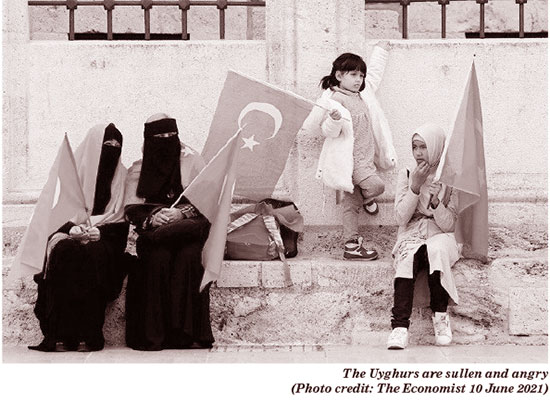
The game China will lose hands down is game (5), human rights; alleged forced labour and political oppression of the Uyghurs of Xinjiang Province. Humanitarian groups assert that Beijing has transferred Uyghurs elsewhere and forced them to work under harsh conditions in factories across the country. I have travelled a bit in China and believe that Islam is repressed and it is apparent Uyghurs are sullen and angry but I have not seen evidence that they are transported to “labour camps” in other provinces. The Chinese CP is ideologically totalitarian: “Total” in the sense that it will not share space and air with other ideologies (Falun Gong, the Christian Churches, competing political views or ‘heretical’ Marxist interpretations). This is because it is insecure and alarmed by competition in “belief space”. My Hong Kong friends hedge their bets on whether the Uyghurs are more sullen about oppression or more pleased by improving economic conditions.
A more interesting rationale for Western criticism may lie elsewhere. These factories are in the supply chains of many global brands. “We believe these practices are an affront to human dignity and an egregious example of China’s unfair, economic competition” Western critics say. A Uyghur Forced Labour Prevention bill is pending in the U.S. House of Representatives. The legislation requires disclosures from businesses about engagement with Chinese companies engaged in human rights abuses in Xinjiang. The meat of the matter may be more to do with commercial competition than love of human rights. Nevertheless the first few decades of the Twenty-first Century are panning out as the decades of human-rights and the Chinese are engaging in a match that they will eventually lose 0-6.
Tracking the evolution of Sino-American developments is best done along the five dimensions I have selected for this essay plus a few others. However, the context in which medium-term Sino-American can be better appreciated is Biden’s economic strategy which Republicans are attempting to scuttle at any cost because its success on even a modest scale will bury Trump and the GOP for a generation. Biden’s methodology is to repeat FDR’s New Deal strategy mutatis mutandis. Infrastructure building on a multi-trillion dollar scale, large universal cash handouts, enhanced unemployment support and an eviction moratorium for delays in rent payment are intended to ease conditions for the poorer half of society and at the same time create demand to spur the economy. The jury is still out on effectiveness but time is on Biden’s side.


It is also different from all past governments as it faces new and different challenges
No one knows whether the already broken ceasefire between the US and Iran, with Israel as a reluctant adjunct, will last the full 10 days, or what will come thereafter. The world’s economic woes are not over and the markets are yo-yoing in response to Trump’s twitches and Iran’s gate keeping at the Strait of Hormuz. The gloomy expert foretelling is that full economic normalcy will not return until the year is over even if the war were to end with the ceasefire. That means continuing challenges for Sri Lanka and more of the tough learning in the art of governing for the NPP.
The NPP government has been doing what most governments in Asia have been doing to cope with the current global crisis, which is also an Asian crisis insofar as oil supplies and other supply chains are concerned. What the government can and must do additionally is to be totally candid with the people and keep them informed of everything that it is doing – from monitoring import prices to the timely arranging of supplies, all the details of tender, the tracking of arrivals, and keeping the distribution flow through the market without bottlenecks. That way the government can eliminate upstream tender rackets and downstream hoarding swindles. People do not expect miracles from their government, only honest, sincere and serious effort in difficult circumstances. Backed up by clear communication and constant public engagement.
But nothing is going to stop the flow of criticisms against the NPP government. That is a fact of Sri Lankan politics. Even though the opposition forces are weak and have little traction and even less credibility, there has not been any drought in the criticisms levelled against the still fledgling government. These criticisms can be categorized as ideological, institutional and oppositional criticisms, with each category having its own constituency and/or commentators. The three categories invariably overlap and there are instances of criticisms that excite only the pundits but have no political resonance.
April 5 anniversary nostalgia
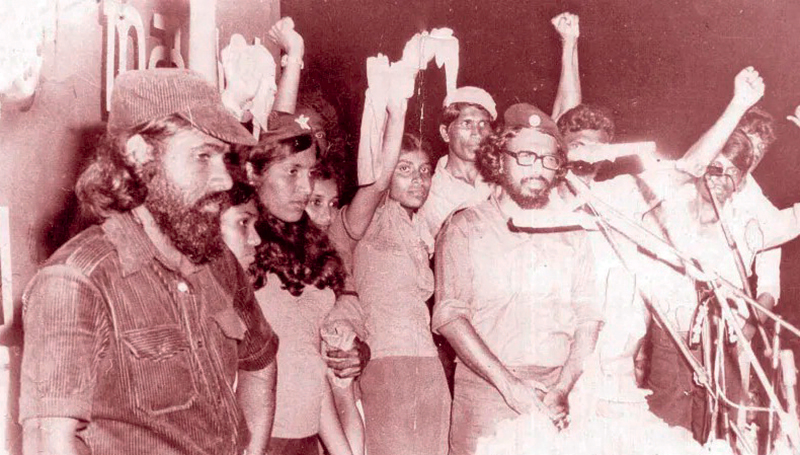
There is also a new line of criticism that might be inspired by the April 5 anniversary nostalgia for the 1971 JVP insurrection. This new line traces the NPP government to the distant roots of the JVP – its April 1965 founding “in a working-class home in Akmeemana, Galle” by a 22-year old Rohana Wijeweera and seven others; the short lived 1971 insurrection that was easily defeated; and the much longer and more devastating second (1987 to 1989) insurrection that led to the elimination of the JVP’s frontline leaders including Wijeweera, and brought about a change in the JVP’s political direction with commitment to parliamentary democracy. So far, so good, as history goes.
But where the nostalgic narrative starts to bend is in attempting a straight line connection from the 1965 Akmeemana origins of the JVP to the national electoral victories of the NPP in 2024. And the bend gets broken in trying to bridge the gap between the “founding anti-imperialist economics” of the JVP and the practical imperatives of the NPP government in “governing a debt-laden small open economy.” Yet this line of criticism differs from the other lines of criticism that I have alluded to, but more so for its moral purpose than for its analytical clarity. The search for clarity could begin with question – why is the NPP government more than a JVP offspring? The answer is not so simple, but it is also not too complicated.
For starters, the JVP was a political response to the national and global conditions of the 1960s and 1970s, piggybacking socialism on the bandwagon of ethno-nationalism in a bi-polar world that was ideologically split between status quo capitalism and the alternative of socialism. The NPP government, on the other hand, is not only a response to, but is also a product of the conditions of the 2010s and 2020s. The twain cannot be more different. Nothing is the same between then and now, locally and globally.
A pragmatic way to look at the differences between the origins of the JVP and the circumstances of the NPP government is to look at the very range of criticisms that are levelled against the NPP government. What I categorize as ideological criticisms include criticisms of the government’s pro-IMF and allegedly neo-liberal economic policies, as well as the government’s foreign policy stances – on Israel, on the current US-Israel war against Iran, the geopolitics of the Indian Ocean, and the apparent closeness to the Modi government in India. These criticisms emanate from the non-JVP left and Sinhala Buddhist nationalists.
Strands of nationalism
To digress briefly, there are several strands in the overall bundle of Sri Lankan nationalism. There is the liberal inclusive strand, the left-progressive strand, the exclusive Sinhala Buddhist Nationalist (SBN) strand, and the defensive strands of minority nationalisms. Given Sri Lanka’s historical political formations and alliances, much overlapping goes on between the different strands. The overlapping gets selective on an issue by issue basis, which in itself is not unwelcome insofar as it promotes plurality in place of exclusivity.
Historically as well, and certainly after 1956, the SBN strand has been the dominant strand of nationalism in Sri Lanka and has had the most influential say in every government until now. Past versions of the JVP frequently straddled the dominant SBN space. Currently, however, the dominant SBN strand is in one of its more dormant phases and the NPP government could be a reason for the current dormancy. This is an obvious difference between the old JVP and the new NPP.
A second set of criticisms, or institutional criticisms, emanate from political liberals and human rights activists and these are about the NPP government’s actions or non-actions in regard to constitutional changes, the future of the elected executive presidency, the status of provincial devolution and the timing of provincial council elections, progress on human rights issues, the resolution of unfinished postwar businesses including the amnesia over mass graves. These criticisms and the issues they represent are also in varying ways the primary concerns of the island’s Tamils, Muslims and the Malaiyaka (planntationn) Tamils. As with the overlapping between the left and the non-minority nationalists, there is also overlapping between the liberal activists and minority representatives.
A third category includes what might be called oppositional criticisms and they counterpose the JVP’s past against the NPP’s present, call into question the JVP’s commitment to multi-party democracy and raise alarms about a creeping constitutional dictatorship. This category also includes criticisms of the NPP government’s lack of governmental experience and competence; alleged instances of abuse of power, mismanagement and even corruption; alleged harassment of past politicians; and the failure to find the alleged mastermind behind the 2019 Easter bombings. At a policy and implementational level, there have been criticisms of the government’s educational reforms and electricity reforms, the responses to cyclone Ditwah, and the current global oil and economic crises. The purveyors of oppositional criticisms are drawn from the general political class which includes political parties, current and past parliamentarians, as well as media pundits.
Criticisms as expectations
What is common to all three categories of criticisms is that they collectively represent what were understood to be promises by the NPP before the elections, and have become expectations of the NPP government after the elections. It is the range and nature of these criticisms and the corresponding expectations that make the NPP government a lot more than a mere JVP offspring, and significantly differentiate it from every previous government.
The deliverables that are expected of the NPP government were never a part of the vocabulary of the original JVP platform and programs. The very mode of parliamentary politics was ideologically anathema to the JVP of Akmeemana. And there was no mention of or concern for minority rights, or constitutional reforms. On foreign policy, it was all India phobia without Anglo mania – a halfway variation of Sri Lanka’s mainstream foreign policy of Anglo mania and India phobia. For a party of the rural proletariat, the JVP was virulently opposed to the plantation proletariat. The JVP’s version of anti-imperialist economics would hardly have excited the Sri Lankan electorate at any time, and certainly not at the present time.
At the same time, the NPP government is also the only government that has genealogical antecedents to a political movement or organization like the JVP. That in itself makes the NPP government unique among Sri Lanka’s other governments. The formation of the NPP is the culmination of the evolution of the JVP that began after the second insurrection with the shedding of political violence, acceptance of political plurality and commitment to electoral democracy.
But the evolution was not entirely a process of internal transformation. It was also a response to a rapidly and radically changing circumstances both within Sri Lanka and beyond. This evolution has not been a rejection of the founding socialist purposes of the JVP in 1968, but their adaptation in the endless political search, under constantly changing conditions, for a non-violent, socialist and democratic framework that would facilitate the full development of the human potential of all Sri Lankans.
The burden of expectations is unmistakable, but what is also remarkable is their comprehensiveness and the NPP’s formal commitment to all of them at the same time. No previous government shouldered such an extensive burden or showed such a willing commitment to each and every one of the expectations. In the brewing global economic crisis, the criticisms, expectations and the priorities of the government will invariably be focussed on keeping the economy alive and alleviating the day-to-day difficulties of millions of Sri Lankan families. While what the NPP government can and must do may not differ much from what other Asian governments – from Pakistan to Vietnam – are doing, it could and should do better than what any and all past Sri Lankan governments did when facing economic challenges.
by Rajan Philips

After threatening to annihilate one of the planet’s oldest civilizations, TACO* Trump chickened out again by grasping the ceasefire lifeline that Pakistan had assiduously prepared. Trump needed the ceasefire badly to stem the mounting opposition to the war in America. Israeli Prime Minister Netanyahu wanted the war to continue because he needed it badly for his political survival. So, he contrived a fiction and convinced Trump that Lebanon is not included in the ceasefire. Trump as usual may not have noticed that Pakistan’s Prime Minister Shehbaz Shariff had clearly indicated Lebanon’s inclusion in his announcement of the ceasefire at 7:50 PM, Tuesday, on X. Ten minutes before Donald Trump’s fake deadline.
True to form on Wednesday, Israel unleashed the heaviest assault by far on Lebanon, reportedly killing over 300 people, the highest single-day death toll in the current war. Iran responded by re-closing the Strait of Hormuz and questioning the need for talks in Islamabad over the weekend. There were other incidents as well, with an oil refinery attacked in Iran, and Iranian drones and missiles slamming oil and gas infrastructure in UAE, Saudi Arabia, Bahrain and Qatar.
The US tried to insist that Lebanon is not part of the ceasefire, with the argumentative US Vice President JD Vance, who was in Budapest, Hungary, campaigning for Viktor Orban, calling the whole thing a matter of “bad faith negotiation” as well as “legitimate misunderstanding” on the part of Iran, and warning Iran that “it would be dumb to jeopardise its ceasefire with Washington over Israel’s attacks in Lebanon.”
But as the attack in Lebanon drew international condemnation – from Pope Leo to UN Secretary General António Guterres, and several world leaders, and amidst fears of Lebanon becoming another Gaza with 1,500 people including 130 children killed and more than a million people displaced, Washington got Israel to stop its “lawn mowing” in southern Lebanon.
Prime Minister Benjamin Netanyahu agreed to “open direct negotiations with Lebanon as soon as possible,”. Lebanese President Joeseph Aoun has also called for “a ceasefire between Israel and Lebanon, followed by direct negotiations between them.” Israel’s involvement in Lebanon remains a wild card that threatens the ceasefire and could scuttle the talks between the US and Iran scheduled for Saturday in Islamabad.
Losers and Winners
After the ceasefire, both the Trump Administration and Iran have claimed total victories while the Israeli government wants the war to continue. The truth is that after more than a month into nonstop bombing of Iran, America and Israel have won nothing. Only Iran has won something it did not have when Trump and Netanyahu started their war. Iran now has not only a say over but control of the Strait of Hormuz. The ceasefire acknowledges this. Both Trump and Netanyahu are under fire in their respective countries and have no allies in the world except one another.
The real diplomatic winner is Pakistan. Salman Rushdie’s palimpsest-country has emerged as a key player in global politics and an influential mediator in a volatile region. Pakistan’s Prime Minister Shehbaz Sharif and Chief of Defence Field Marshal Asim Munir have both been praised by President Trump and credited for achieving the current ceasefire. The Iranian regime has also been effusive in its praise of Pakistan’s efforts.
It is Pakistan that persisted with the effort after initial attempts at backdoor diplomacy by Egypt, Pakistan and Türkiye started floundering. Sharing a 900 km border and deep cultural history with Iran, and having a skirmish of its own on the eastern front with Afghanistan, Pakistan has all the reason to contain and potentially resolve the current conflict in Iran. Although a majority Sunni Muslim country, Pakistan is home to the second largest Shia Muslim population after Iran, and is the easterly terminus of the Shia Arc that stretches from Lebanon. The country also has a mutual defense pact with Saudi Arabia that includes Pakistan’s nuclear cover for the Kingdom. An open conflict between Iran and Saudi Arabia would have put Pakistan in a dangerously awkward position.
It is now known and Trump has acknowledged that China had a hand in helping Iran get to the diplomatic table. Pakistan used its connections well to get Chinese diplomatic reinforcement. Pakistani Foreign Minister Ishaq Dar flew to Beijing to brief his Chinese counterpart and secured China’s public support for the diplomatic efforts. The visit produced a Five-Point Plan that became a sequel to America’s 15-point proposal and the eventual ten-point offer by Iran.
There is no consensus between parties as to which points are where and who is agreeing to what. The chaos is par for the course the way Donald Trumps conducts global affairs. So, all kudos to Pakistan for quietly persisting with old school toing and froing and producing a semblance of an agreement on a tweet without a parchment.
It is also noteworthy that Israel has been excluded from all the diplomatic efforts so far. And it is remarkable, but should not be surprising, the way Trump has sidelined Isreal from the talks. Prime Minister Netanyahu has been enjoying overwhelming support of Israelis for starting the war of his life against Iran and getting the US to spearhead it. But now the country is getting confused and is exposed to Iranian missiles and drones far more than ever before. The Israeli opposition is finally coming alive realizing what little has Netanyahu’s wars have achieved and at what cost. Israel has alienated a majority of Americans and has no ally anywhere else.
It will be a busy Saturday in Islamabad, where the US and Iranian delegations are set to meet. Iran would seem to have insisted and secured the assurance that the US delegation will be led by Vice President Vance, while including Trump’s personal diplomats – Steve Witkoff and son-in-law Jared Kushner. Iran has not announced its team but it is expected to be led, for protocol parity, by Iran’s Speaker Mohammad Bagher Ghalibaf, and will likely include its suave Foreign Minister Abbas Araghchi. Vice President Vance’s attendance will be the most senior US engagement with Iran since Secretary of State John Kerry negotiated the 2015 nuclear deal under President Obama.
The physical arrangements for the talks are still not public although Islamabad has been turned into a security fortress given the stakes and risks involved. The talks are expected to be ‘indirect’, with the two delegations in separate rooms and Pakistani officials shuttling between them. The status of Iran’s enriched uranium and the reopening of the Strait of Hormuz will be the major points of contention. After Netanyahu’s overreach on Wednesday, Lebanon is also on the short list
The 2015 nuclear deal (the Joint Comprehensive Action Plan) took months of negotiations and involved multiple parties besides the US and Iran, including China, France, Germany, UK, Russia and the EU. That served the cause of regional and world peace well until Trump tore up the deal to spite Obama. It would be too much to expect anything similar after a weekend encounter in Islamabad. But if the talks could lead to at least a permanent ceasefire and the return to diplomacy that would be a huge achievement.
(*As of 2025–2026, Donald Trump is nicknamed “TACO Trump” by Wall Street traders and investors as an acronym for “”. This term highlights a perceived pattern of him making strong tariff threats that cause market panic, only to later retreat or weaken them, causing a rebound.)
by Rajan Philips

We are passing through the ten-day interregnum called a ceasefire over the War on Iran. The world may breathe briefly, but this pause is not reassurance—it is a deliberate interlude, a vacuum in which every actor positions for the next escalation. Iran is far from secure. Behind the veneer of calm, external powers and local forces are preparing, arming, and coordinating. The United States is unlikely to deploy conventional ground troops; the next moves will be executed through proxies whose behaviour will defy expectation. These insurgents are shaped, guided, and amplified by intelligence and technology, capable of moving silently, striking precisely, and vanishing before retaliation. The ceasefire is not peace—it is the prelude to disruption.
The Kurds, historically instruments of Tehran against Baghdad, are now vectors for the next insurgency inside Iran. This movement is neither organic nor local. It is externally orchestrated, with the CIA as the principal architect. History provides the blueprint: under Mohammad-Reza Shah Pahlavi, Kurdish uprisings were manipulated, never supported out of sympathy. They were instruments of leverage against Iraq, a way to weaken a rival while projecting influence beyond Iran’s borders. Colonel Isa Pejman, Iranian military intelligence officer who played a role in Kurdish affairs, recalled proposing support for a military insurgency in Iraq, only for the Shah to respond coldly: “[Mustafa] Barzani killed my Army soldiers… please forget it. The zeitgeist and regional context have been completely transformed.” The Kurds were pawns, but pawns with strategic weight. Pejman later noted: “When the Shah wrote on the back of the letter ‘Accepted’ to General Pakravan, I felt I was the true leader of the Kurdish movement.” The seeds planted then are now being activated under new, technologically empowered auspices.
Iran’s geographic vulnerabilities make this possible. The Shah understood the trap: a vast territory with porous borders, squeezed by Soviet pressure from the north and radical Arab states from the west. “We are in a really terrible situation since Moscow’s twin pincers coming down through Kabul and Baghdad surround us,” he warned Asadollah Alam. From Soviet support for the Mahabad Republic to Barzani’s dream of a unified Kurdistan, Tehran knew an autonomous Kurdish bloc could destabilize both Iraq and Iran. “Since the formation of the Soviet-backed Mahabad Republic, the Shah had been considerably worried about the Kurdish threat,” a US assessment concluded.
Today, the Kurds’ significance is operational, not symbolic. The CIA’s recent rescue of a downed F-15 airman using Ghost Murmur, a quantum magnetometry system, demonstrated the reach of technology in intelligence operations. The airman survived two days on Iranian soil before extraction. This was not a simple rescue; it was proof that highly mobile, technologically augmented operations can penetrate Iranian territory with surgical precision. The same logic applies to insurgency preparation: when individuals can be tracked through electromagnetic signatures, AI-enhanced surveillance, and drones, proxy forces can be armed, guided, and coordinated with unprecedented efficiency. The Kurds are no longer pawns—they are a living network capable of fracturing Iranian cohesion while providing deniability to foreign powers.
Iran’s engagement with Iraqi Kurds was always containment, not empowerment. The Shah’s goal was never Kurdish independence. “We do not approve an independent [Iraqi] Kurdistan,” he stated explicitly. Yet their utility as instruments of regional strategy was undeniable. The CIA’s revival of these networks continues a long-standing pattern: insurgent groups integrated into the wider calculus of international power. Israel, Iran, and the Kurds formed a triangular strategic relationship that terrified Baghdad. “For Baghdad, an Iranian-Israeli-Kurdish triangular alliance was an existential threat,” contemporary reports noted. This is the template for modern manipulation: a networked insurgency, externally supported, capable of destabilizing regimes from within while giving foreign powers plausible deniability.
Iran today faces fragility. Years of sanctions, repression, and targeted strikes have weakened educational and scientific hubs; Sharif University in Tehran, one of the country’s leading scientific centres, was bombed. Leaders, scholars, and innovators have been eliminated. Military readiness is compromised. Generations-long setbacks leave Iran exposed. Against this backdrop, a Kurdish insurgency armed with drones, AI-supported surveillance, and precision munitions could do more than disrupt—it could fracture the state internally. The current ten-day ceasefire is a mirage; the next wave of revolt is already being orchestrated.
CIA involvement is deliberate. Operations are coordinated with allied intelligence agencies, leveraging Kurdish grievances, mobility, and ethnolinguistic networks. The Kurds’ spread across Iran, Iraq, Turkey, and Syria provides operational depth—allowing insurgents to strike, vanish, and regroup with impunity. Barzani understood leverage decades ago: “We could be useful to the United States… Look at our strategic location on the flank of any possible Soviet advance into the Middle East.” Today, the calculation is inverted: Kurds are no longer instruments against Baghdad; they are potential disruptors inside Tehran itself.
Technology is central. Ghost Murmur’s ability to detect a single heartbeat remotely exemplifies how intelligence can underpin insurgent networks. Drones, satellite communications, AI predictive modeling, and battlefield sensors create an infrastructure that can transform a dispersed Kurdish insurgency into a high-precision operation. Iran can no longer rely on fortifications or loyalty alone; the external environment has been recalibrated by technology.
History provides the roadmap. The Shah’s betrayal of Barzani after the 1975 Algiers Agreement demonstrated that external actors can manipulate both Iranian ambitions and Kurdish loyalties. “The Shah sold out the Kurds,” Yitzhak Rabin told Kissinger. “We could not station our troops there and keep fighting forever,” the Shah explained to Alam. The Kurds are a pivot, not a cause. Networks once acting under Tehran’s influence are now being repurposed against it.
The insurgency exploits societal fissures. Kurdish discontent in Iran, suppressed for decades, provides fertile ground. Historical betrayal fuels modern narratives: “Barzani claimed that ‘Isa Pejman sold us out to the Shah and the Shah sold us out to the US.’” Intelligence agencies weaponize these grievances, pairing them with training, technological augmentation, and covert support.
Geopolitically, the stakes are immense. The Shah’s defensive-offensive doctrine projected Iranian influence outward to neutralize threats. Today, the logic is inverted: the same networks used to contain Iraq are being readied to contain Iran. A technologically augmented Kurdish insurgency, covertly backed, could achieve in months what decades of sanctions, diplomacy, or repression have failed to accomplish.
The operation will be asymmetric, high-tech, and dispersed. UAVs, quantum-enhanced surveillance, encrypted communications, and AI-directed logistics will dominate. Conventional Iranian forces are vulnerable to this type of warfare. As Pejman reflected decades ago, “Our Army was fighting there, rather than the Kurds who were harshly defeated… How could we keep such a place?” Today, the challenge is magnified by intelligence superiority on the insurgents’ side.
This is not a temporary flare-up. The CIA and its allies are constructing a generational network of influence. Experience from Iraq, Syria, and Lebanon proves these networks endure once operationalised. The Shah recognized this: “Iran’s non-state foreign policy under the Shah’s reign left a lasting legacy for the post-Revolution era.” Today, those instruments are being remade as vectors of foreign influence inside Iran.
The future is stark. Iran faces not simply external threats, but a carefully engineered insurgency exploiting historical grievances, technological superiority, and precise intelligence. The Kurds are central. History, technology, and geopolitical calculation converge to create a transformative threat. Tehran’s miscalculations, betrayals, and suppressed grievances now form the lattice for this insurgency. The Kurds are positioned not just as an ethnic minority, but as a vector of international strategy—Tehran may be powerless to stop it.
Iran’s containment strategies have been weaponized, fused with technology, and inverted against it. The ghosts of Barzani’s Peshmerga, the shadows of Algiers, and the Shah’s strategic vision now converge with Ghost Murmur, drones, and AI. Tehran faces a paradox: the instruments it once controlled are now calibrated to undermine its authority. The next Kurdish revolt will not only fight in the mountains but in the electromagnetic shadows where intelligence operates, consequences are lethal, and visibility is scarce.
by Nilantha Ilangamuwa

Salt and Patidar power RCB past Mumbai Indians

Prasidh, Buttler set up comfortable win for Gujarat Titans

Heat Index at Caution level’ in the Northern, North-central, North-western, Western and Southern provinces and in Trincomalee district.

Showers above 75 mm are likely at some places in the Western, Sabaragamuwa, Central, Southern and North-western provinces.

Sun directly overhead Pesalai, Mankulam and Nedunkerny about 12:11 noon

PNS TAIMUR & ASLAT arrive in Colombo

‘Dates have the highest sugar content to fight Coronavirus’

Sunday Island 27 December – Headlines

#SundayIsland 17th December – Headlines

Sunday Island – 28th March

Sunday Island Headlines – 21 March

Sunday Island – 21st February – Headlines
-

 News6 days ago
Lankan-origin actress Subashini found dead in India
-

 News1 day ago
CEB orders temporary shutdown of large rooftop solar systems
-

 News4 days ago
AG: Coal procurement full of irregularities
-

 Business3 days ago
Israeli attack on Lebanon triggers local stock market volatility
-

 Business4 days ago
Hayleys Mobility introduces Premium OMODA C9 PHEV
-

 Business3 days ago
HNB Assurance marks 25 years with strategic transformation to ‘HNB Life’
-

 News6 days ago
UN Regional Director launches SL’s first Country Gender Equality Profile during official visit
-

 News6 days ago
Dialog Launches ‘GanuDenu QR’, Making Cashless Transfers Free for All with eZ Cash and Dialog Finance