
Foreign News
UK to send warship to South America amid Venezuela tensions

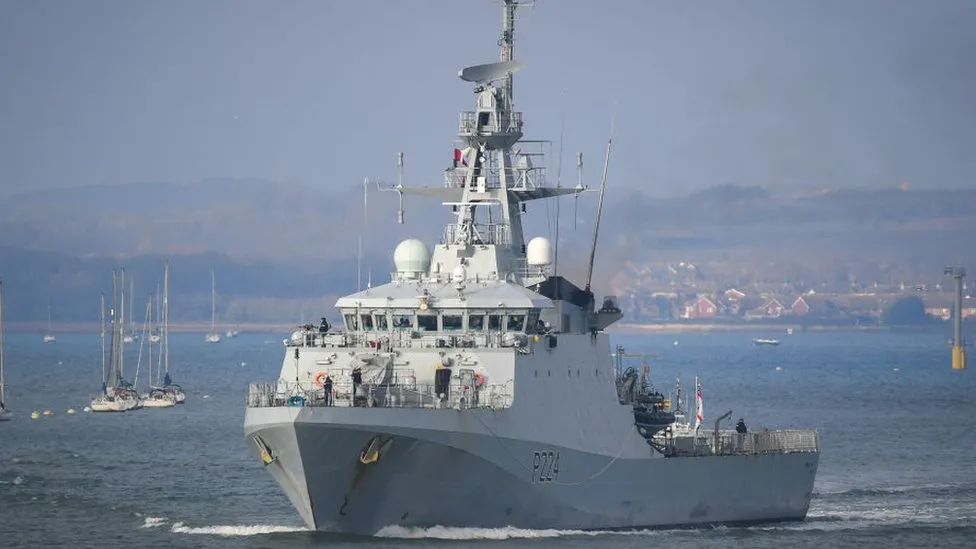
The UK is preparing to send a warship to Guyana in a show of diplomatic and military support for the former British colony, the BBC has learned.
It comes after neighbouring Venezuela renewed its claim for a disputed part of Guyanese territory that is rich in oil and minerals.
The Ministry of Defence confirmed HMS Trent would take part in joint exercises after Christmas.
Guyana, a Commonwealth member, is South America’s only English-speaking nation.
HMS Trent – an offshore patrol vessel – had been deployed to the Caribbean to search for drug smugglers but was re-tasked after Venezuela’s government threatened to annex the Essequibo region of Guyana earlier this month.
This raised fears that Venezuela might invade and spark the first interstate war in South America since the Falklands Conflict in 1982.
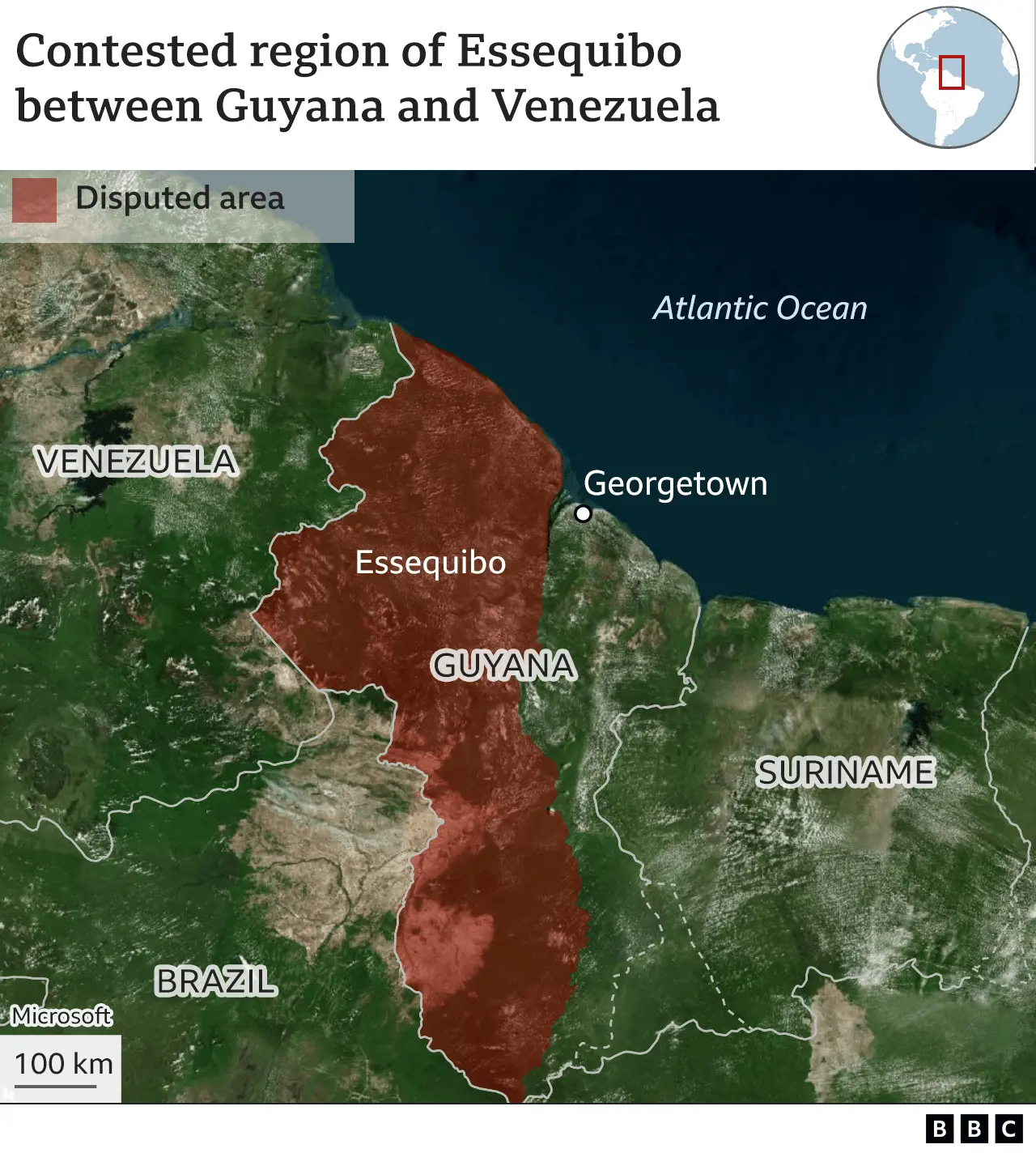
Venezuela has long claimed ownership of Essequibo, a 61,000 square mile region which comprises about two-thirds of Guyana. Its hills and jungles are rich in gold, diamonds and bauxite, while huge oil deposits have been found off its coast.
While Guyana’s economy is growing fast, Venezuela’s is suffering.
Nicolas Maduro, the president of Venezuela, staged a referendum on 3 December to assert popular support for his country’s claim to Essequibo. The result was widely challenged and disputed but he nonetheless published new maps and legislation showing Essequibo as part of Venezuela, named a new governor and offered identity cards to those living in the sparsely populated region.
He has also ordered the state oil company to issue extraction licences.
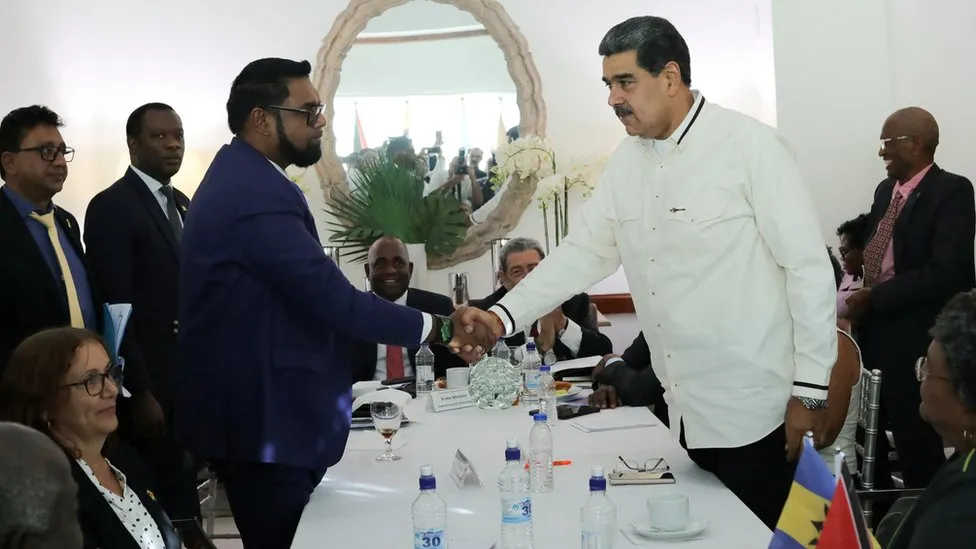
The Venezuelan president has subsequently met Guyana’s President, Irfaan Ali, and agreed not to use force, but he has maintained his territorial claim and both sides are still at odds over how the border dispute could be settled legally.
This week the Lloyd’s insurance market in London added Guyana to its list of riskiest shipping zones.
A Ministry of Defence spokesperson told the BBC: “HMS Trent will visit regional ally and Commonwealth partner Guyana later this month as part of a series of engagements in the region during her Atlantic Patrol Task deployment.”
HMS Trent has a crew of 65, a top speed of 24 knots and a range of 5,000 nautical miles.It is armed with 30mm cannon and a contingent of Royal Marines. It can also deploy Merlin helicopters and unmanned aircraft.
HMS Trent left its home port of Gibraltar in early December and is currently alongside in Bridgetown, Barbados for Christmas.
The warship is expected to anchor off the capital of Guyana, Georgetown, and conduct visits, joint activities and training with the country’s navy and other allies. It cannot go alongside because the port is too shallow.
The vessel is mainly used for tackling piracy and smuggling, protecting fisheries, counter-terrorism, providing humanitarian aid, and search and rescue operations, but the Royal Navy says it is also designed for border patrols and defence diplomacy.
The decision to send HMS Trent to Guyana is part of a growing UK effort to show international diplomatic support for Guyana.
This week the Foreign Secretary Lord Cameron said the UK would “continue to work with partners in the region to ensure the territorial integrity of Guyana is upheld and prevent escalation”.
David Rutley, the Foreign Office Minister for the Americas, visited Georgetown on 18 December, the first G7 representative to do so since Venezuela renewed its claim. He promised Guyana the UK’s “unequivocal backing” and welcomed Venezuela’s promise to avoid using force.
Mr Rutley continued: “The border issue has been settled for over 120 years. Sovereign borders must be respected wherever they are in the world. “The UK will continue to work with partners in the region, as well as through international bodies, to ensure the territorial integrity of Guyana is upheld.”
Venezuela’s Foreign Minister, Yvan Gil, criticised the visit, accusing the UK of destabilising the region. In a post on X – formerly Twitter – he said: “The former invading and enslaving empire, which illegally occupied the territory of Guayana Esequiba and acted in a skillful and sneaky manner against the interests of Venezuela, insists on intervening in a territorial controversy that they themselves generated.”
Venezuela disputes the border which was established under an international agreement in 1899.
Guyana was formerly known as British Guiana before it secured its independence in 1966.
(BBC)









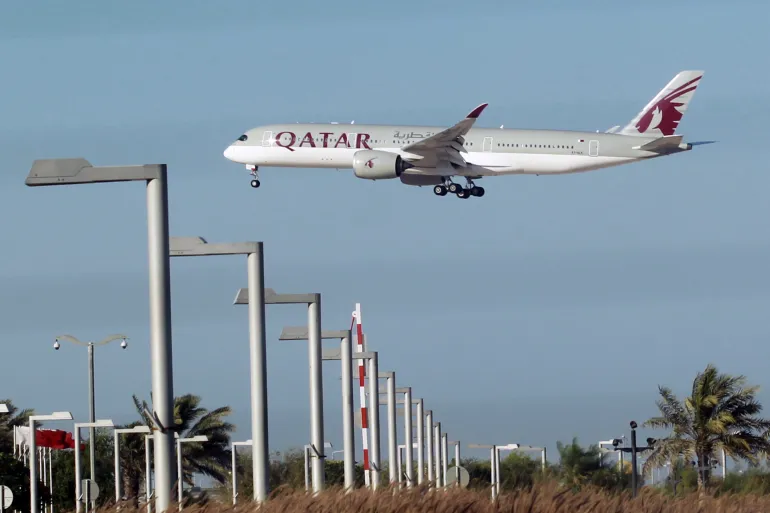
Qatar has partially reopened its airspace days after Iranian missile and drone strikes forced the country to ground all flights as a United States-Israeli military campaign against Iran continues into its seventh day.
The Qatar Civil Aviation Authority announced the limited opening on Friday evening, saying flights would operate through “designated navigational contingency routes with limited operational capacity” in coordination with the Qatari armed forces.
The move marks a cautious first step towards restoring air links to one of the Gulf’s most important aviation hubs but falls well short of a return to normality, with scheduled commercial flights to and from Doha remaining suspended until a further official announcement is made.
The Qatar Civil Aviation Authority said the partial reopening covers only a narrow category of flights “designated for passenger evacuation” and air cargo services.
Passengers with confirmed bookings were urged to follow updates from their airlines directly before travelling to the airport.
Early on Saturday, Qatar Airways said it “intends to operate repatriation flights on 07 March, departing Hamad International Airport to the following airports: London (LHR), Paris (CDG), Madrid (MAD), Rome (FCO), Frankfurt (FRA)”.
It added that priority would be given to “stranded passengers with families, elderly passengers, and those with urgent medical and compassionate travel needs”.
The Gulf country has been repeatedly struck by Iranian missiles and drones throughout the now seven-day conflict, forcing the country to activate its air force and use interceptors to defend its territory. Qatar’s Ministry of Defence confirmed the country had been struck by 14 ballistic missiles and four drones fired from Iran on Thursday.
More than 2,000 flights have been cancelled at Doha’s Hamad international airport since the conflict began.
Aviation across the Gulf
Across the Gulf, airports and airlines have been scrambling to manage the fallout from nearly a week of Iranian missile and drone barrages, launched in retaliation for the ongoing US-Israeli military campaign – codenamed Operation Epic Fury – which has killed at least 1,332 people in Iran since strikes began last Saturday, according to Iranian officials.
Emirates airline announced it is operating a reduced schedule while working to restore full network operations, carrying approximately 30,000 passengers out of Dubai on Friday alone.
By Saturday, the airline said it would have 106 daily return flights operating to 83 destinations, close to 60 percent of its full network, with a return to 100 percent expected “within the coming days, subject to airspace availability”.
Dubai international airport, the world’s busiest airport for international passengers, was evacuated on Sunday following Iranian strikes and has recorded close to 4,000 flight cancellations since Monday.
Abu Dhabi’s Zayed international airport has seen more than 1,000 cancellations and continues to operate at limited capacity.
Kuwait, also impacted by Iranian strikes, saw its airport undergo sustained physical damage in drone strikes, leaving some workers with minor injuries, and its airspace remains fully closed to commercial traffic.
Kuwait Airways has begun rerouting citizens with prior bookings through Jeddah, Saudi Arabia.
An estimated 23,000 flights have been cancelled since late February, according to analytics firm Cirium.
[Aljazeera]

The Inter-American Court of Human Rights (IACHR) has ordered Peru to pay reparations to the family of Celia Ramos, a mother of three whose death resulted from a campaign of forced sterilizations during the 1990s.
Thursday’s landmark ruling stated that the 34-year-old Ramos was coerced into sterilization against her will, causing an allergic reaction that led to her death.
The court ordered Peru to pay her family $340,000 as part of the ruling.
It noted that the Peruvian government had “failed to fulfill its obligation to initiate and conduct a thorough investigation” into Ramos’s case, heightening the strain on her family.
“Ms Ramos Durand’s family members — especially her three daughters, who were children at the time of the events — suffered profound harm as a consequence of the sterilization and death of Celia Edith Ramos Durand and the impunity surrounding the case,” the IACHR wrote in its decision.
Peru’s campaign of forced sterilization took place under the late President Alberto Fujimori, whose tenure included widespread human rights abuses that continue to cast a shadow over the country.
The scheme largely targeted poor and Indigenous women who were often tricked or coerced into sterilisation procedures.
This week’s ruling is the first time the human rights court has weighed in on the issue, which has been the subject of years of legal contestation in Peru.
“After almost 30 years of searching for justice, the Inter-American Court of Human Rights recognised the responsibility of the Peruvian state in the forced sterilization and death of Celia Ramos,” the Peruvian feminist organisation DEMUS said in a social media post, celebrating the ruling.
“This ruling marks a fundamental step in reparations for Celia, her family and the thousands of victims of forced sterilizations in Peru.”
As many as 314,000 women and 24,000 men were sterilized against their will in Peru under Fujimori’s government, which sought to forcibly lower the birth rate as a means of addressing poverty.
The procedures were particularly invasive for the women involved, and some suffered long-term complications, including death.
Family members often received little information about the circumstances that led to loved ones dying after the unnecessary operations. Some survivors did not realise what had happened to them until years later, when they discovered they were unable to have children.
In Ramos’s case, the 34-year-old mother had gone to a state health clinic for medical assistance on July 3, 1997, but was instead forced to undergo tubal ligation.
Ramos, however, suffered a severe allergic reaction during the procedure. She was placed in a recovery room, but the clinic was not able to treat her adequately.
In its decision, the IACHR explained that the clinic “lacked the necessary equipment and medications for adequate risk assessment or to handle emergencies”.
Ramos was ultimately transferred to an intensive care unit in the city of Piura, where she died 19 days later, on July 22, 1997.
The state did not carry out an autopsy and declined to share details with her family.
The compensation outlined in this week’s ruling includes reimbursement for the costs of medical procedures conducted to save Ramos’s life and the estimated loss of income from her death.
In October 2024, the Committee on the Elimination of Discrimination against Women at the United Nations ruled that Peru’s sterilization programme amounted to sex-based violence and discrimination against poor, rural and Indigenous women.
The committee’s statement cited a lack of adequate medical facilities and a lack of informed consent, just as the IACHR did in its decision this week.
“The victims described a consistent pattern of being coerced, pressured, or deceived into undergoing sterilizations at clinics lacking proper infrastructure or trained personnel,” committee member Leticia Bonifaz said.
“The procedures were carried out without informed consent from these victims, with some of them, especially those from remote areas, unable to read and speak Spanish, or fully understand the nature of the procedure.”
Scholars have concluded that Fujimori’s sterilization campaign was driven, in part, by racist views among government officials who saw rural, Indigenous communities as an obstacle to economic modernisation.
[Aljazeera]

The United States-Israeli war on Iran is estimated to have cost Washington $3.7bn so far in its first 100 hours alone, or nearly $900m a day, driven largely by the huge expenditure of munitions, according to new research.
An analysis by Washington-based think tank the Center for Strategic and International Studies (CSIS) underlined the colossal cost of the war, which entered its seventh day on Friday, as the US attacks Iran with stealth bombers and advanced weapons systems.
Researchers Mark Cancian and Chris Park said only a small amount of the estimated $3.7bn cost of the war in the first 100 hours – or $891.4m each day – was already budgeted for, while most of the costs – $3.5bn – were not.
That meant the Pentagon would likely need to request more funding soon to cover the unbudgeted costs, they said, which was likely to prove a political challenge for the Trump administration and provide “a focal point for opposition to the war,” they said.
Domestic cost-of-living concerns, inflation, and now a knock-on effect of rising gas prices due to the conflict are likely to further diminish support among US citizens for the war. It is also dividing Trump’s “America First” base, which he had promised in his presidential campaigns to not enter “foreign wars”.
Noting that the US Department of Defense had released limited specifics on its operations, the researchers said their analysis drew on Congressional Budget Office (CBO) estimates of the operations and support costs for each unit, adjusting for inflation and unit size, and adding 10 percent for costs of “a higher operational tempo”.
Their analysis said the US had expended more than 2,000 munitions of various types in the first 100 hours of the war, and estimated it would cost $3.1bn to replenish the munitions inventory on a like-for-like basis, with the costs increasing by $758.1m a day.
(Aljazeera)

Selling pressure makes a dent in CSE’s early trading gains

Qatar partially reopens airspace as Iranian strikes continue to hit Gulf

The final voyage of the Iranian warship sunk by the US

AI-generated Iran war videos surge as creators use new tech to cash in

Huge explosions rock major Tehran airport as Israel strikes ‘regime infrastructure’

India hit back but Sutherland, Hamilton impress to give Australia the edge

‘Dates have the highest sugar content to fight Coronavirus’

Sunday Island 27 December – Headlines

#SundayIsland 17th December – Headlines

Sunday Island – 28th March

Sunday Island Headlines – 21 March

Sunday Island – 21st February – Headlines
-

 Features6 days ago
Brilliant Navy officer no more
-

 Opinion6 days ago
Sri Lanka – world’s worst facilities for cricket fans
-

 News2 days ago
University of Wolverhampton confirms Ranil was officially invited
-

 News3 days ago
Legal experts decry move to demolish STC dining hall
-

 Features6 days ago
A life in colour and song: Rajika Gamage’s new bird guide captures Sri Lanka’s avian soul
-

 Business3 days ago
Cabinet nod for the removal of Cess tax imposed on imported good
-

 Features7 days ago
Overseas visits to drum up foreign assistance for Sri Lanka
-

 News2 days ago
Female lawyer given 12 years RI for preparing forged deeds for Borella land