
Foreign News
Trump’s assault on USAID leaves China soft power opening in Southeast Asia

As the United States winds back humanitarian assistance in Southeast Asia, its rival China may see an opportunity to expand its influence in a region where it has directed billions of dollars in investment and aid, analysts say.
In a little over three weeks since US President Donald Trump’s inauguration, Washington has frozen nearly all foreign aid and moved to effectively abolish the US Agency for International Development (USAID), a longstanding source of soft power in the region.
USAID, the biggest disburser of US foreign aid, spent $860m in Southeast Asia alone last year, funding projects on everything from treating HIV to preserving biodiversity and strengthening local governance.
Many projects, which run primarily through grants to local NGOs, face an uncertain future as the Trump administration pulls the US back from the world stage as part of his “America first” agenda.
For Beijing, the circumstances provide an ideal opportunity for it to step in, said Yanzhong Huang, a senior fellow for global health at the Council on Foreign Relations.
“The suspension of health, education, and humanitarian programmes – key pillars of US soft power – may create vacuums that China can fill,” Huang told Al Jazeera.
“This strategic retreat could strengthen Beijing’s influence across the region, particularly in current US aid recipients like Indonesia, the Philippines, Myanmar, and Cambodia.”
As the Trump administration generated headlines with its moves to gut USAID last week, Beijing made news by stepping in with $4.4m to fund a de-mining project in Cambodia that had been left in the lurch by Washington.
Heng Ratana, head of the Cambodian Mine Action Centre, told the Khmer Times newspaper the Chinese aid would help his organisation clear more than 3,400 hectares (8,400 acres) of land filled with landmines and unexploded ordnance.
China’s embassies in the US, Cambodia and Thailand did not respond to Al Jazeera’s requests for comment.
Joshua Kurlantzick, a senior fellow for Southeast Asia and South Asia at the Council on Foreign Relations, said USAID’s demise comes as US influence in the region is waning more generally and as China scales up its public diplomacy.
Southeast Asian leaders are concerned about “chaotic policymaking” in the US, Kurlantzick told Al Jazeera, particularly in countries such as Vietnam, Indonesia and Thailand, where the US devotes significant aid and security assistance.
“Beijing is indeed already portraying the US as uncaring and unable to lead regionally or globally and I expect Beijing to increase its aid and investment now in many parts of the developing world,” Kurlantzick told Al Jazeera.
While the future of many USAID programmes in the region is unclear, some analysts believe that China is likely to leave projects with a more political or ideological focus to other partners to the region, such as the European Union, Australia, Japan or the Asian Development Project, a Manila-based regional development bank.
“China’s existing international aid or international development programme is quite sizeable. But it happens to be quite different from what USAID does in that the latter seems to be devoting a lot of resources to ideology-based initiatives, for democracy, for LGBTQ, for diversity, for inclusiveness, for climate change,” John Gong, a professor of economics at the University of International Business and Economics in Beijing, told Al Jazeera.
“Whether China is going to step into the void vacated by the United States, I am very sceptical. We are talking about different things here. And besides, I don’t think the Chinese government is keen on competing with Washington on this front,” Gong said.
China’s foreign assistance has been heavily geared towards infrastructure, as laid out in the Belt and Road Initiative (BRI), Beijing’s flagship infrastructure investment project estimated to be worth more than $1 trillion.
Other projects, such as its hospital ship Peace Ark, have provided medical assistance.
Almost all of China’s foreign aid to Southeast Asia – some 85 percent – has taken the form of non-concessional loans with a focus on energy and transport, according to Grace Stanhope, a research associate at the Lowy Institute’s Indo-Pacific Development Centre.

Beijing’s infrastructure-heavy approach has made it a visible presence in the region, albeit not always a popular one, Stanhope told Al Jazeera, due to delays and “blow-out” budgets for projects such as the East Coast Rail Link in Malaysia and Jakarta-Bandung high-speed rail line in Indonesia.
Some critics have referred to these and other projects as a form of “debt-trap” diplomacy intended to breed dependency on China, a charge Beijing has denied.
In a survey carried out by the Singapore-based Iseas Yusof-Ishak Institute last year, 59.5 percent of respondents across 10 Southeast Asian countries chose China as the most influential economic power in the region.
Just over half, however, expressed distrust of China, with 45.5 percent fearing that China could threaten their country economically or militarily. Japan was seen as the “most trusted” major power, followed by the US and the EU.
Though heavily focused on infrastructure, China has been slowly trying to shift its model of assistance towards more “soft” aid such as public health, agriculture and digitisation, said Joanne Lin, a senior fellow at the Iseas Yusof-Ishak Institute’s ASEAN studies centre in Singapore.
“The extent of China’s aid will of course depend on China’s economic ability as it is facing constraints such as its slowing growth and trade tensions with Washington which may limit its ability to replace US aid in full,” Lin told Al Jazeera.
Lin said Southeast Asian countries prefer a “diversified approach” to foreign aid and development assistance that is not dependent on a single donor – whether the US or China.
Despite its high-profile presence in Southeast Asia, China has been scaling back its development assistance in the region in recent years.
While China was the region’s top donor from 2015 to 2019, it has since slid to fourth place, according to the Lowy Institute.
Funding has similarly dried up, falling from $10bn in 2017 to $3bn in 2022, according to the think tank.
China faces its own problems at home, including slowing economic growth and high youth unemployment, that could limit its focus on affairs overseas, said Steve Balla, an associate professor of political science and international affairs at George Washington University.
“The domestic issues may serve to limit [Chinese President Xi Jinping’s] attention to international affairs. The issues with Belt and Road may limit the regime’s options for how to step into spaces left by the US,” Balla told Al Jazeera.
Bethany Allen, head of programme for China Investigations and Analysis at the Australian Strategic Policy Institute, expressed a similar sentiment.
“China is already capitalising on US disengagement in the first Trump era by deepening its economic, diplomatic and cultural influence in Southeast Asia. Initiatives like the Belt and Road Initiative, Confucius, and the Lancang-Mekong Cooperation Mechanism are tools for expanding soft power,” Allen told Al Jazeera, referring to a global programme to promote the study of Chinese language and culture, and a forum to promote cooperation between China and the Mekong subregion.
“However, China’s lowering economic growth means slowing BRI, resulting in the country’s soft power project might be less aggressive than in the past decade. High-profile debt concerns and pushback against Chinese influence [in Malaysia and Indonesia] also limit its appeal,” she said.
[Aljazeera]

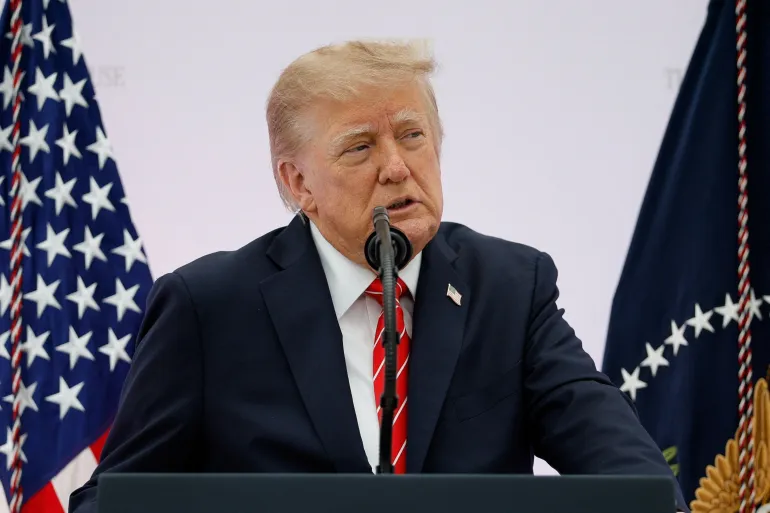
United States President Donald Trump has said the US will not attack Iran before the November 3 midterm elections.
The US president said late on Thursday: “we are having productive discussions with the Islamic Republic of Iran,” in a post on Truth Social. “We will not be attacking Iran at any time prior to the midterm elections to be held in the United States on November 3rd.”
Oil prices fell early on Friday as Middle East supply concerns eased somewhat after tensions in the energy-rich Gulf region had mounted in recent weeks.
The possibility of renewed fighting had appeared to drive up oil prices in trading on Thursday. Some analysts believe Trump’s comments were an attempt to try and bring prices back down.
Iran’s Foreign Minister Abbas Araghchi said Tehran is reviewing the US response to its seven day plan to reopen the Strait of Hormuz, and that Iran will respond within the “next few days”.
He added that negotiations are continuing through mediators, Iran’s Tasnim news agency reported.
Iranian media reported “massive explosions” in the southern Strait of Hormuz on Friday, with Fars citing unnamed military sources as saying tankers using “unauthorised” routes may have struck sea mines.
On Tuesday, US Vice President JD Vance said Iran must make a “meaningful” reduction in its uranium enrichment capacity as part of an agreement to end the war. Experts say this demand may signal a softening of Washington’s earlier insistence that Tehran abandon enrichment altogether.
On Monday, Iranian President Masoud Pezeshkian said negotiations with Washington were “futile”, accusing the US of using negotiations to attack Iran.
Russian President Vladimir Putin told Pezeshkian that Russia will “do everything” to help end the US-led war on Iran, Russian news agencies reported on Thursday.
[Aljazeera]

US authorities have found debris from a medical transport aircraft that went missing with six people on board.
The Federal Aviation Administration told the BBC it had lost contact with the Gulfstream G-100 plane just after 01:00 local time (05:00 GMT) on Saturday, while it was travelling from Bermuda to Boston, Massachusetts.
The search for survivors continues off the coast of Nantucket, a Massachusetts island, the US Coast Guard said.
Authorities have notified the next of kin of those on the flight, four Canadian nationals and two Bermudian nationals.
“Search crews located a debris field confirmed to be from the aircraft off the coast of Nantucket,” the US Coast Guard said in an update on Saturday night. It added that ships, helicopters and planes were involved in searches that would through continue the night.
The plane departed from Bermuda’s L.F. Wade International Airport at 23:40 local time, according to flight data from FlightAware, and was due to land at Boston’s Logan International at 01:30 EDT (05:30 GMT).
According to the tail number released by the Coast Guard, the plane belonged to Latitude Air Ambulances, a company that provides international medical flights for patients returning home.
Among those on board were two pilots and two medical staff, both Canadian, Clarence Togeretz, director of flight operations at Latitude, told CBC News.
The crew flew to Bermuda to collect a patient and their relative, who are not Canadian, Togeretz said.
FlightAware’s tracker shows the aircraft significantly dropped in altitude before its communications went dark, plummeting from around 7,300m (24,000ft) to 3,300m (11,000ft).
Radio transmissions shows trouble with communications between the air traffic controller and the pilot, the Boston Globe reported based on transmissions provided by LiveATC.net.
“You’re coming in blind? Is that what you said?,” the air traffic controller asked. “Are you declaring an emergency, or no?”
The pilot’s response was inaudible.
“You’re coming in a little weak so I didn’t hear what your response was, if you were declaring an emergency or not,” the air traffic controller said, according to the Globe.
The air traffic controller later confirmed the pilot had declared an emergency.
An area fire dispatcher asked emergency crews just after 01:00 EDT to prepare to meet a plane with an “electrical issue”.
The dispatcher later said “the aircraft has lost radio and radar”.
The Coast Guard said it would provide an update on Sunday morning local time.
[BBC]

A car has crashed into a crowd of rugby league supporters in the eastern Australian city of Newcastle, injuring 10 people, including three children.
New South Wales police said on Saturday that two of the injured – a five-year-old girl and a 67-year-old man – were in a critical condition and the other eight were in stable condition in hospital.
Police said they had arrested the 18-year-old man driving the vehicle and were investigating what happened. They said the crash was not believed to be related to “terrorism”.
The crowd had gathered to farewell the local rugby league side, the Newcastle Knights, ahead of their grand final against the Sydney Roosters on Sunday.
Newcastle Lord Mayor Gavin Morris said the driver, a rugby league fan, had lost control of his vehicle and had been taken into custody.
“He was revving the car, he was excited, he was a supporter, he was there for the joy of the moment,” Morris told the national broadcaster ABC.
“Somehow he lost control of the car … and he’s gone into the crowd,” he added.
Prime Minister Anthony Albanese said: “My thoughts are with everyone injured or involved in the horrible incident this morning in Newcastle.”
“Rugby league brings people together, and this should have been a weekend of excitement and pride for Newcastle fans,” he wrote in a social media post.
[Aljazeera]

Afghanistan fast bowlers hit back after Bangladesh’s strong start

Sri Lanka chose to bat first in Rawalpindi

Sutherland and Litchfield lead Australia to quick and convincing win in ODI series opener

USS Tulsa departs Colombo

Appointments for 1,540 Grama Niladhari Officers

Trump says US will not strike Iran before midterm elections

‘Dates have the highest sugar content to fight Coronavirus’

Sunday Island 27 December – Headlines

#SundayIsland 17th December – Headlines

Sunday Island – 28th March

Sunday Island Headlines – 21 March

Sunday Island – 21st February – Headlines
-

 Features6 days ago
The first woman in the foreign service or Ceylon Overseas Service it was then called
-

 News5 days ago
Geneva takes up Sallay’s case and govt. ignores opportunity to answer accusations
-

 Editorial7 days ago
Fuelling discontent and protest
-

 Foreign News6 days ago
Ten injured after car crashes into rugby supporters in Australia
-

 News6 days ago
Nearly 20 Iranian tankers stranded off Lanka amid US sanctions
-

 Latest News7 days ago
Tharindu Rathnayake, bowlers secure Asian Games Bronze for Sri Lanka
-

 Features4 days ago
Preventing grievances from becoming communal
-

 Features5 days ago
Sri Lanka Cricket Bill: Governance reform is not yet a cricket strategy