
Foreign News
Trump threatens Russia with tariffs while unveiling Ukraine weapons plan


US President Donald Trump has announced the US will send “top-of-the-line weapons” to Ukraine via Nato countries, while also threatening Russia with severe tariffs if a deal to end the war is not reached within 50 days.
“We want to make sure Ukraine can do what it wants to do,” Trump said following a meeting with Nato chief Mark Rutte in Washington.
Rutte confirmed the US had decided to “massively supply Ukraine with what is necessary through Nato” and that the Europeans would foot the bill.
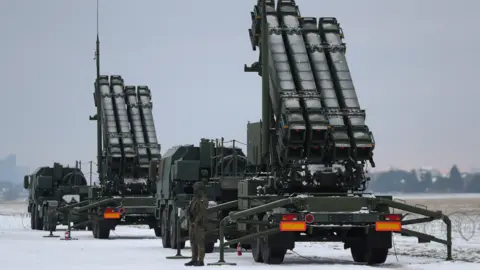
European countries will send Kyiv their own Patriot air defence systems – which Ukraine relies on to repel Russia’s deadly air strikes – and replacements will then be issued by the US, Trump said.
Neither Rutte nor Trump elaborated on the weaponry that will be sent to Kyiv but Rutte said the deal included “missiles and ammunition”.
However, the president did say “top-of-the-line-weapons” worth billions of dollars would be “quickly distributed to the battlefield” in order to support Ukraine.
“If I was Vladimir Putin today… I would reconsider whether I should not take negotiations about Ukraine more seriously,” Rutte said, as Trump nodded.
Ukrainian President Volodymyr Zelensky said on X that he spoke with Trump after his meeting with Rutte, and thanked him for his “willingness to support Ukraine and to continue working together to stop the killings and establish a lasting and just peace”.
“We discussed the necessary means and solutions with the President to provide better protection for people from Russian attacks and to strengthen our positions. We are ready to work as productively as possible to achieve peace,” he said.
On the tariffs front, Trump said that the US would impose 100% secondary tariffs targeting Russia’s remaining trade partners if a peace deal with Ukraine was not reached within 50 days.
This would see any country that trades with Russia face the tax if they want to sell their products to the US.
For example, if India keeps buying oil from Russia, US companies that purchase Indian goods would have to pay a 100% import tax, or tariff, when the products reach American shores.
This would make the goods so expensive that US businesses would likely choose to buy them cheaper from elsewhere, resulting in lost revenue for India.
The intention is also to hobble Russia’s economy. Theoretically, if Moscow was unable to generate money by selling oil to other nations it would also have less money to finance its war in Ukraine.
Given that oil and gas account for almost a third of Moscow’s state revenue and more than 60% of its exports, 100% tariffs could make something of a dent Russia’s finances.
Still, the Moscow Stock Exchange Index rose sharply following the announcement, likely as investors were expecting Trump – who last week teased a “major statement” on Russia – to pledge even harsher measures.
Although detail about both the tariffs and the Nato weapons deal was scant, Monday was the first time Trump pledged new military equipment for Ukraine since returning to the White House.
The briefing was also notable for the tone struck by US president, whose rhetoric on Vladimir Putin has become increasingly harsh.
Not for the first time, Trump implied Kyiv bore some responsibility for Russia’s decision to launch its full-scale invasion of Ukraine in February 2022.
But he mostly appeared frustrated at the lack of progress in ending a conflict which he once seemed to believe could be easily solvable.
Asked about his relationship with Putin, Trump said that the two speak “a lot about getting this thing done” but voiced his displeasure at the fact that “very nice phone calls” with the Russian president are often followed by devastating air strikes on Ukraine – which have been growing in intensity and frequency.
“After that happens three or four times you say: the talk doesn’t mean anything,” Trump said.
“I don’t want to call him an assassin but he’s a tough guy. It’s been proven over the years, he fooled a lot of people – Clinton, Bush, Obama, Biden,” he added. “He didn’t fool me. At a certain point talk doesn’t talk, it’s got to be action.”
Two rounds of ceasefire talks between Russia and Ukraine took place earlier this year but no other meetings have so far been scheduled – something Moscow has blamed on Kyiv.
Ukraine’s President Zelensky is currently hosting US envoy Keith Kellogg in Kyiv and earlier on Monday hailed a “productive meeting” – saying he was “grateful” to Trump for his support.
The Kremlin did not immediately comment on the announcement – but commentary trickling in from Moscow appeared to indicate a measure of relief.
Pro-Kremlin pundit and former Putin aide Sergei Markov called the tariffs announcement “a bluff” that indicated Trump had “given up on trying to achieve peace in Ukraine”.
Senator Konstantin Kosachev argued that “if this is all Trump had to say about Ukraine today, then so far it’s been much ado about nothing”.
In 50 days a lot could change “both on the battlefield and in the moods of the powers that be in the US and Nato,” Kosachev wrote.
[BBC]

US authorities have found debris from a medical transport aircraft that went missing with six people on board.
The Federal Aviation Administration told the BBC it had lost contact with the Gulfstream G-100 plane just after 01:00 local time (05:00 GMT) on Saturday, while it was travelling from Bermuda to Boston, Massachusetts.
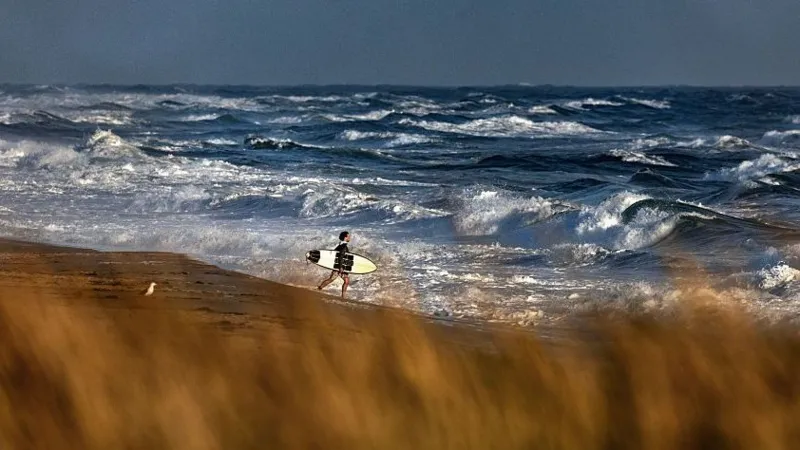
The search for survivors continues off the coast of Nantucket, a Massachusetts island, the US Coast Guard said.
Authorities have notified the next of kin of those on the flight, four Canadian nationals and two Bermudian nationals.
“Search crews located a debris field confirmed to be from the aircraft off the coast of Nantucket,” the US Coast Guard said in an update on Saturday night. It added that ships, helicopters and planes were involved in searches that would through continue the night.
The plane departed from Bermuda’s L.F. Wade International Airport at 23:40 local time, according to flight data from FlightAware, and was due to land at Boston’s Logan International at 01:30 EDT (05:30 GMT).
According to the tail number released by the Coast Guard, the plane belonged to Latitude Air Ambulances, a company that provides international medical flights for patients returning home.
Among those on board were two pilots and two medical staff, both Canadian, Clarence Togeretz, director of flight operations at Latitude, told CBC News.
The crew flew to Bermuda to collect a patient and their relative, who are not Canadian, Togeretz said.
FlightAware’s tracker shows the aircraft significantly dropped in altitude before its communications went dark, plummeting from around 7,300m (24,000ft) to 3,300m (11,000ft).
Radio transmissions shows trouble with communications between the air traffic controller and the pilot, the Boston Globe reported based on transmissions provided by LiveATC.net.
“You’re coming in blind? Is that what you said?,” the air traffic controller asked. “Are you declaring an emergency, or no?”
The pilot’s response was inaudible.
“You’re coming in a little weak so I didn’t hear what your response was, if you were declaring an emergency or not,” the air traffic controller said, according to the Globe.
The air traffic controller later confirmed the pilot had declared an emergency.
An area fire dispatcher asked emergency crews just after 01:00 EDT to prepare to meet a plane with an “electrical issue”.
The dispatcher later said “the aircraft has lost radio and radar”.
The Coast Guard said it would provide an update on Sunday morning local time.
[BBC]
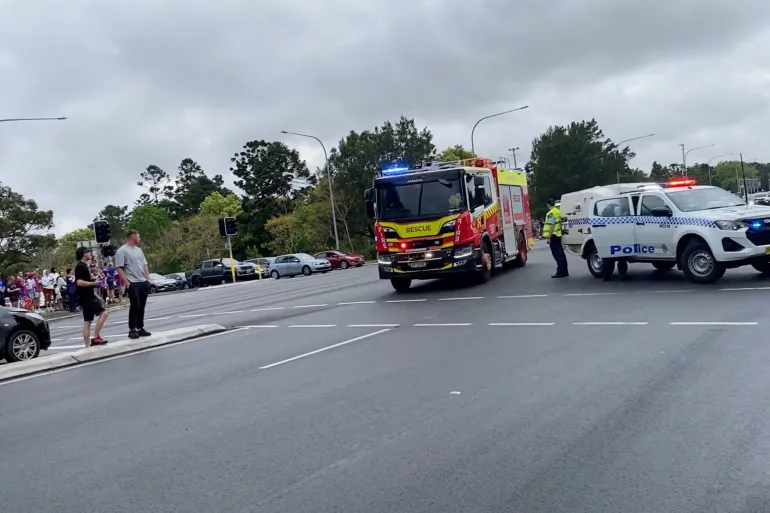
A car has crashed into a crowd of rugby league supporters in the eastern Australian city of Newcastle, injuring 10 people, including three children.
New South Wales police said on Saturday that two of the injured – a five-year-old girl and a 67-year-old man – were in a critical condition and the other eight were in stable condition in hospital.
Police said they had arrested the 18-year-old man driving the vehicle and were investigating what happened. They said the crash was not believed to be related to “terrorism”.
The crowd had gathered to farewell the local rugby league side, the Newcastle Knights, ahead of their grand final against the Sydney Roosters on Sunday.
Newcastle Lord Mayor Gavin Morris said the driver, a rugby league fan, had lost control of his vehicle and had been taken into custody.
“He was revving the car, he was excited, he was a supporter, he was there for the joy of the moment,” Morris told the national broadcaster ABC.
“Somehow he lost control of the car … and he’s gone into the crowd,” he added.
Prime Minister Anthony Albanese said: “My thoughts are with everyone injured or involved in the horrible incident this morning in Newcastle.”
“Rugby league brings people together, and this should have been a weekend of excitement and pride for Newcastle fans,” he wrote in a social media post.
[Aljazeera]
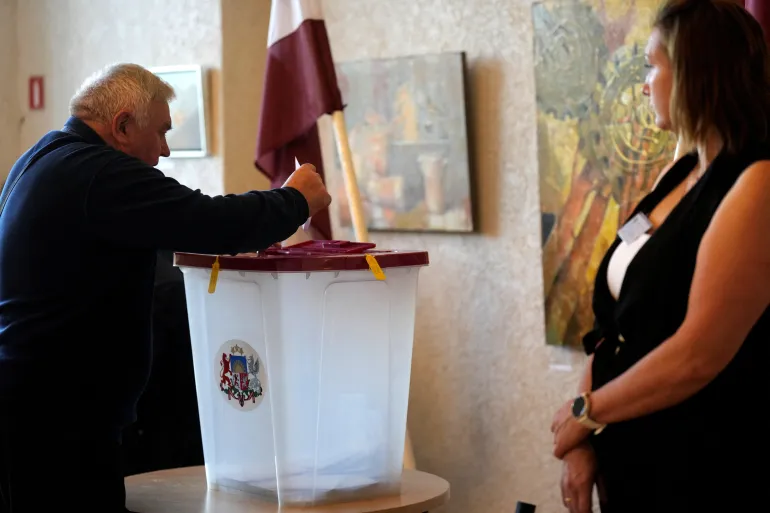
Polls have opened in Latvia for an election taking place against the backdrop of perceived security threats from Russia and a nationwide cost-of-living squeeze.
Saturday’s vote is the first electoral test for Prime Minister Andris Kulbergs after coming to power in May this year when his predecessor resigned due to a backlash from stray drone incursions from Ukraine.
Kulbergs, whose right-wing United List party is currently polling at about 20 percent, is expected to hold onto his position, but the decline of two allies in his current coalition means he is set for a complicated negotiation over the makeup of any future government.
Polls opened at 05:00 GMT and will close at 17:00 GMT. The results are not expected to change Latvia’s pro-European and pro-Ukrainian course.

About 1.5 million people are eligible to vote in the country’s 11th parliamentary election since independence from the Soviet Union in 1991.
Latvian politics are highly fragmented, with parties rarely seeing above 20 percent vote share and coalitions being the norm.
This year, 14 electoral lists are contesting the election, but polls indicate only seven are likely to enter parliament, with the rest expected to fail to meet the minimum 5 percent vote threshold.
Rising living costs, low wages, strains on the healthcare system and long-term population decline have all featured prominently in campaign debates.
Most parties in Latvia are pro-Ukraine; however, the populist Sovereign Power party – which says it wants Ukraine to win but argues money spent supporting Kyiv would be better spent at home – looks likely to become the country’s second-biggest party, with more than 9 percent of the vote. Most other parties have ruled out forming a coalition with Sovereign Power.
Latvia First, a pro-Ukraine and populist nationalist party currently polling at about 9 percent, could be a potential coalition partner for PM Kulbergs.
The Progressives, a pro-European social democratic party, are polling at 6 percent.
Ethnic Russians make up roughly one in four Latvian citizens, but their vote, which has traditionally been cast along identity-based lines, looks set to be made according to economic and social issues.
Latvia is the poorest of the Baltic states, and it has sharply increased its defence spending since Russia invaded Ukraine, now allocating nearly 5 percent of its gross domestic product (GDP) to defence.
[Aljazeera]

Showers or thundershowers will occur at several places in the most part of the island after 1.00 p.m

GS1 Lanka drives Sri Lanka’s shift to 2D barcodes

Geneva takes up Sallay’s case and govt. ignores opportunity to answer accusations

Section of wartime KKS High Security Zone vacated to facilitate economic development in the area

Lawyer lodges complaint against Govt. Printer, Media Ministry Secy.

Sri Lankan troops in joint anti-terrorist exercise in Russia

‘Dates have the highest sugar content to fight Coronavirus’

Sunday Island 27 December – Headlines

#SundayIsland 17th December – Headlines

Sunday Island – 28th March

Sunday Island Headlines – 21 March

Sunday Island – 21st February – Headlines
-

 Latest News5 days ago
Gold winner Tharanga gets brand-new Honda Vezel from SLAAJ
-

 Features5 days ago
Why Sri Lanka needs an Inclusive Civic Nationalism – urgently
-

 News4 days ago
US-assisted ‘Ice’ detection: NPC to examine IGP’s move to transfer drug-busting team
-

 Features6 days ago
Thailand’s biggest new global star …
-
 News6 days ago
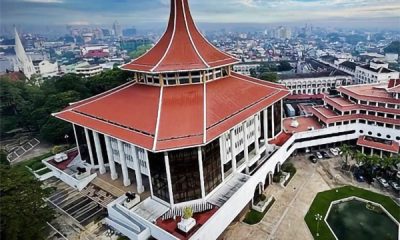
First cases taken up by SC after enactment of 22A dismissed
-

 News5 days ago
Civil society activist accuses govt. of favouring Ven. Gnanasara
-

 Editorial3 days ago
Colombo Port drug bust: The plot thickens
-

 Editorial6 days ago
Aftershocks of 22A