
Foreign News
Trump and Xi reach trade deal, easing tensions in fierce US-China rivalry

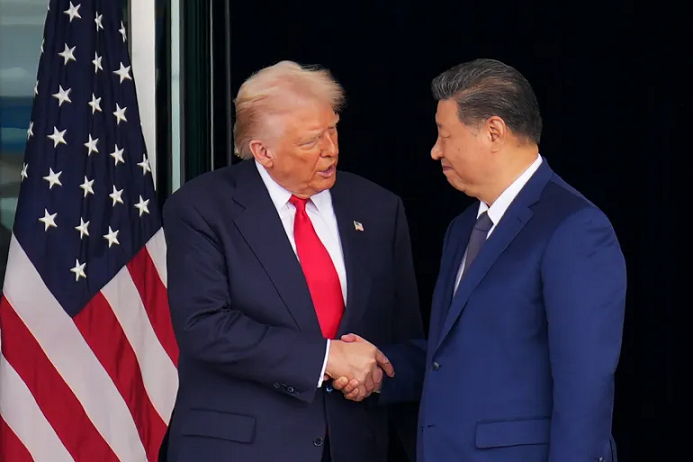
United States President Donald Trump and Chinese President Xi Jinping have agreed to call off a mutual escalation in their countries’ trade war, lowering the temperature in a heated confrontation that has threatened to upend the global economy.
Trump and Xi sealed a one-year trade truce on Thursday on the sidelines of the Asia-Pacific Economic Cooperation (APEC) summit in South Korea, where the two leaders met face-to-face for the first time since 2019.
But while Trump and Xi’s agreement offered a reprieve to businesses unsettled by months of back-and-forth trade salvoes, it did little to roll back existing trade barriers and left numerous points of contention between the sides unresolved.
“The apparent results of this meeting will be a pause and a small roll back in the trade war,” Dennis Wilder, a professor at Georgetown University who worked on China at the CIA and the White House’s National Security Council, told Al Jazeera.
“Both sides have not given up their trade weapons but merely have agreed to stop firing as long as both sides hold to the agreements,” Wilder said.
Under the deal, China agreed to defer its planned export controls on rare earths, while the US will drop a threatened 100 percent tariff on Chinese goods.
Trump said he would also lower a 20 percent fentanyl-related tariff to 10 percent after Xi agreed to “work very hard” to stem flows of the synthetic opiate.
“I believe he is going to work very hard to stop the death that is coming in,” Trump said on Air Force One after departing South Korea.
Trump, who hailed his 90-minute meeting with Xi as “amazing”, said the issue of rare earths had been “settled” under the agreement, which he said would be renegotiated every year.
“There’s no roadblock at all on rare earths – that will hopefully disappear from our vocabulary for a little while,” Trump said.
Trump, whose meeting with Xi capped a whirlwind tour of Asia that included stops in Malaysia and Japan, said China had also agreed to purchase “tremendous amounts” of American soya beans.
After Trump’s comments, Xi said the sides had reached a “consensus to address problems” in the talks, but did not directly reference specific details of the agreement.
Washington and Beijing should “promptly refine and finalise follow-up actions” to implement the consensus and “offer tangible results to reassure both countries and the global economy,” Xi said, according to a readout by the state-run Xinhua News Agency.
China’s Ministry of Commerce later confirmed aspects of the agreement, including the one-year deferral of its export controls.
The ministry also said Trump had agreed to suspend plans to extend Washington’s blacklist of firms prohibited from doing business with US companies and individuals to subsidiaries, and that both sides would pause tit-for-tat port fees.
Asian stock markets were largely unmoved, with benchmark indexes in Hong Kong, Shanghai and Sydney closing lower and Japan’s main index finishing flat.
China’s plans to require companies anywhere in the world to obtain a licence to export goods containing even trace amounts of its rare earths had raised fears of massive disruption to global supply chains.
Chinese producers hold a near monopoly on the supply of the critical minerals, which are used to make everything from smartphones to fighter jets.
Shan Guo, a partner with Shanghai-based consultancy Hutong Research, said the cut in the fentanyl tariff was “largely expected”.
“China has been asking for the fentanyl cut since Stockholm, it is now getting what it wants using rare earth as leverage,” Guo told Al Jazeera, referring to US-China trade negotiations that took place in the Swedish capital in July.
“It is a 10 percent cut instead of 20, likely because US still wants to maintain some leverage as the two sides talk more going forward. Regardless, this lowered tariff on China will reduce the competitive disadvantage of Chinese goods vs ASEAN peers,” Guo said, referring to the bloc of 11 Southeast Asian economies, many of which, like China, rely heavily on exports.

Expectations for a deal had been modest ahead of the summit, and Thursday’s agreement left most tariffs and export controls hindering trade between the sides in place.
Trump’s pledge to halve his fentanyl tariff would leave the average US duty on Chinese goods at around 47 percent, and China’s average tariff on US products at about 32 percent.
Washington continues to include more than 1,000 Chinese firms on its export control list, while Beijing has dozens of US companies on its comparable “unreliable entity list”.
Deborah Elms, head of trade policy at the Hinrich Foundation in Singapore, said the agreement could be seen as a “partial freeze” or “minor rollback” in the US-China trade war.
Cameron Johnson, a partner at Shanghai-based consultancy Tidalwave Solutions, said US-China ties should not deteriorate in the near term, describing the agreement as “probably the best both sides could have done given the circumstances”.
But Johnson noted Trump’s comments that the agreement would be subject to annual review.
“It allows both sides to calibrate the relationship, and also buying power, of each side every year now going forward,” he told Al Jazeera.
[Aljazeera]


South Korean authorities have found that two fighter jets collided mid-air in 2021 because the pilots were taking pictures and videos.
The incident took place while the jets were on a flight mission in the central city of Daegu, according to Seoul’s Board of Audit and Inspection.
The pilots survived with no injuries, but the collision damaged the planes, costing the military 880 million won ($596,000; £440,500) in repairs.
One of the pilots, who has since left the military, was made to pay a fine of 88 million won.
The incident took place because that pilot had wanted to take photos to commemorate his last flight with his military unit.
Taking photos of significant flights was “a widespread practice among pilots at the time”, the audit board said in a report published on Wednesday.
The pilot had declared his intent to do so in a briefing before the flight, according to the report.
He was flying the wingman aircraft and was following the lead aircraft during the mission. While flying back to their base, he started taking pictures using his personal mobile phone.
Upon noticing this, the pilot of the lead aircraft then asked another pilot on his plane to film a video of the wingman aircraft.
The wingman pilot then abruptly flew his jet up higher and flipped it so that it could be better captured on camera. This manoeuvre brought the two planes very close to each other.
To avoid a crash, the lead aircraft tried to rapidly descend. But the two F-15K jets eventually collided, damaging the lead aircraft’s left wing and the wingman aircraft’s tail stabiliser.
South Korea’s air force suspended the wingman pilot, who has since left the military to work for a commercial airline.
Subsequently, the air force sought to fine the wingman pilot 880 million won to cover the full amount of the repair costs. When the pilot appealed against the fine, it prompted an investigation by the audit board.
The wingman pilot acknowledged his sudden manoeuvre led to the collision, but argued that the lead aircraft’s pilot had “tacitly consented” to the manoeuvre since he was aware that filming was taking place.
The audit board eventually ruled that the wingman pilot should only pay a tenth of what the air force sought.
It said that the air force should bear some responsibility for not properly regulating pilots’ personal use of cameras.
The board also took into account that the wingman pilot had a good track record prior to the incident, and that he had managed to prevent further damage by promptly commandeering a safe return of his aircraft to the base.
The report did not mention whether any action was taken against the other pilots involved in the incident.
[BBC]

A strong magnitude 7.5 earthquake has struck off northern Japan, prompting authorities to issue a tsunami warning for waves of up to 3 metres (10 feet).
The quake hit on Monday at 4:53pm local time (07:53 GMT) in waters off Iwate prefecture on Japan’s Pacific coast, according to the Japan Meteorological Agency (JMA). It was felt across a wide area, shaking buildings in Tokyo, hundreds of kilometres (miles) to the south.
The JMA warned that the first tsunami waves could reach parts of the northern coastline immediately. “Evacuate immediately from coastal regions and riverside areas to a safer place such as high ground or an evacuation building,” the agency said.
“Tsunami waves are expected to hit repeatedly. Do not leave safe ground until the warning is lifted.”
Live footage from public broadcaster NHK showed no immediate signs of damage at several ports in Iwate.
Prime Minister Sanae Takaichi said the government had set up a crisis management team and was working to assess the impact of the earthquake.
“For those of you who live in areas for which the warnings have been issued, please evacuate to higher, safer places such as higher ground,” Takaichi told reporters.
[Aljazeera]

Thousands of prisoners in Myanmar have been granted amnesty or had their sentences reduced. The pardon order by Min Aung Hlaing is one of his first official acts since the coup leader became president this month.
The move comes as the lawyer for jailed former leader Aung San Suu Kyi told the Reuters news agency that her sentence has been reduced. Former president Win Myint, detained since the 2021 coup, was also pardoned of his convictions, a statement from the presidency said.
Min Aung Hlaing approved an amnesty for 4,335 prisoners, Myanmar’s state television MRTV reported.
A communique on behalf of Min Aung Hlaing said “those serving death sentences shall have their sentences commuted to life imprisonment”, without naming specific prisoners.
“The President has pardoned Win Myint,” said another statement from Min Aung Hlaing’s office. Win Myint was “granted a pardon and the reduction of his remaining sentences under specified conditions”, MRTV said.
Suu Kyi, 80, is serving a 27-year sentence on charges her allies describe as politically motivated. Her sentence was cut by one-sixth, her lawyer told Reuters, but it remains unclear whether the Nobel Peace Prize winner will be allowed to serve the rest of her sentence under house arrest. Min Aung Hlaing placed Suu Kyi under arrest after the coup.
Amnesties typically happen as Myanmar marks Independence Day in January and its New Year in April.
Among those to be released are 179 foreign nationals, who will be deported. The amnesty also includes the commutation of all death sentences to life imprisonment, life sentences reduced to 40 years, and a one-sixth reduction in term lengths for all other prisoners.
[Aljazeera]

Compensation payments and reconstruction activities related to the Ditwah relief measures must be expedited with special attention at the district level – PM

South Korean fighter jets collided due to pilots taking pictures, report finds

Showers above 75 mm are likely at some places in the Western, Sabaragamuwa, Central, Uva and Southern provinces and in Ampara and Batticaloa districts

Parliament urged to probe questionable payment of USD 2.5 mn from Treasury

USD 2 mn bribe: CID ordered to arrest Shasheendra R, warrant issued against ex-SriLankan CEO’s wife

Lanka faces crisis of conscience over fate of animals: Call for compassion, law reform, and ethical responsibility

‘Dates have the highest sugar content to fight Coronavirus’

Sunday Island 27 December – Headlines

#SundayIsland 17th December – Headlines

Sunday Island – 28th March

Sunday Island Headlines – 21 March

Sunday Island – 21st February – Headlines
-
 News2 days ago
Rs 13 bn NDB fraud: Int’l forensic audit ordered
-

 Business5 days ago
Harnessing nature’s wisdom: Experts highlight “Resist–Align” path to resilience
-
 Opinion3 days ago
Shutting roof top solar panels – a crime
-

 News5 days ago
Gratiaen Trust announces longlist for the 33rd Annual Gratiaen Prize
-

 News4 days ago
From Nuwara Eliya to Dubai: Isha Holdings markets Agri products abroad
-
 Latest News7 days ago
Singapore Zoo’s first Sri Lankan leopard cubs make their public debut
-
 News5 days ago
Heroin haul transported on 50-million-rupee contract
-
 News3 days ago
Church calls for Deputy Defence Minister’s removal, establishment of Independent Prosecutor’s Office