
News
Top academic calls for punitive measures against those abusing scholarships offered to govt.

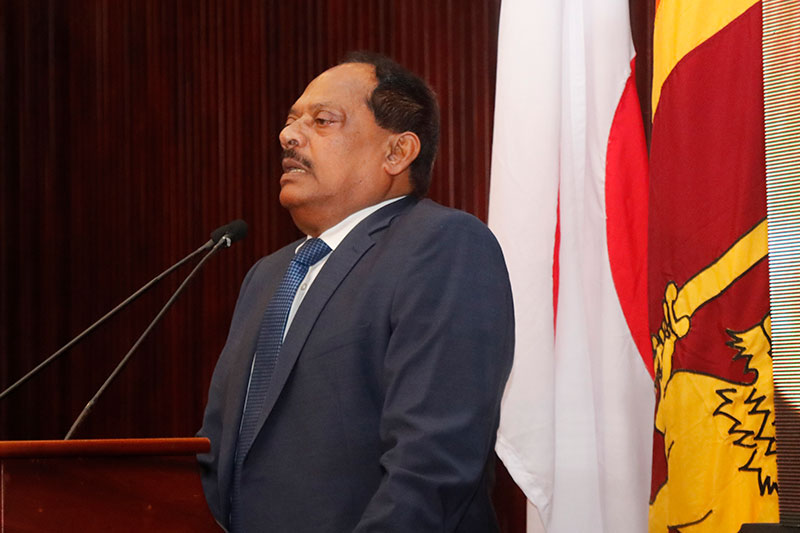
JaGAAS lifetime awards 2025:
Vice Chancellor of the NSBM Green University, Prof. E. A. Weerasinghe, said that the government should take punitive measures against those chosen for foreign scholarships in case they violated bond conditions.
Tougher action was required to discourage public servants and academics from brazenly violating the trust placed on them, the top administrator said yesterday (23), in a brief interview with The Island after receiving Japanese Graduates’ Alumni Association of Sri Lanka (JaGAAS) lifetime awards 2025 at the BMICH on March 21. Prof. Weerasinghe received the award for exemplifying leadership and entrepreneurship in human capital development in higher education.
The other recipients were: Ms Baba Shigeko, Ito Yoshiaki, Koga Michio, Mikasa Jitsuo, Ogawa Kiyoko, Jagath Chandana Ramanayake, emeritus Prof. Yamada Yoshiaki, Prof. N.S. Cooray, Prof. Ranjith Dissanayake, retired IGP Chandra Fernando, Merrick Gooneratne, Dr. Nishantha Nanayakkara, Dr. OP.G. Rohan Pallewatta, Prof. Piyadasa Ratnayake, Ananda Shelton Thenuwara, Dayasiri Warnakulasooriya and Prof. E.A. Weerasinghe.
They received the coveted JaGAAS lifetime awards from Japanese Ambassador in Colombo Akio Isomata who, in his brief address, declared their dedication would inspire more people to pursue similar opportunities for study, collaboration and innovation.
Responding to The Island queries, Prof. Weerasinghe found fault with successive governments for failing to deal with wrongdoers. Alleging that academics were among the worst culprits, Prof. Weerasinghe said that along with him three others – a researcher with the National Dangerous Drugs Control Board and two University lecturers were chosen jointly by the governments of Japan and Sri Lanka. “We proceeded to Japan in 1990 and having obtained a doctorate in economics from Osaka City University I returned home in 1997. My colleagues decided against doing so. The researcher stayed in Japan while the remaining two migrated to Australia.”
Prof. Weerasinghe said that his former colleagues, now in Australia, once sought the opportunity to join the University. But they were told not to expect opportunities in the motherland after having betrayed the trust the country placed on them.
Prof. Weerasinghe said that though he could have easily migrated to New Zealand with his wife and two children, they decided to come back home. At the time Weerasinghe had received a Japanese scholarship he was serving the University of Sri Jayewardenapura as an assistant lecturer. “In terms of the bond conditions, I served the University for a period of seven years,” Prof. Weerasinghe said, adding that he never once regretted the decision to pursue a career here.
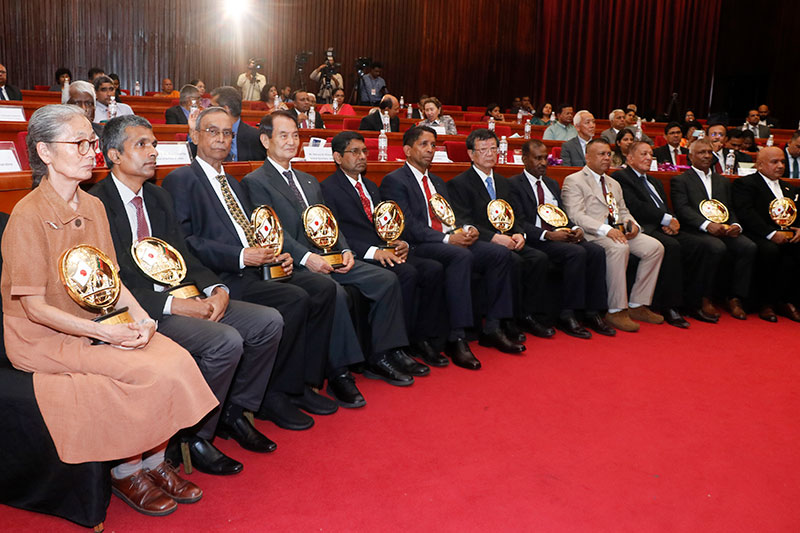
Recipients of JaGAAS lifetime awards
At the end of his sabbatical leave, Prof. Weerasinghe was offered the opportunity to serve as the Director General (DG) of the National Institute of Business Management (NIBM) in 2005. Prof. Weerasinghe emphasized that the NIBM had been in a much deteriorated state and restoration of the public faith in the Institution seemed a herculean task. “The University released me without pay,” a smiling Prof. Weerasinghe said, recalling his efforts to expand NIBM to other major towns, including Galle, Matara and Kandy, over the years.
The academic emphasised that in spite of the raging war in the Northern and Eastern regions and occasional terrorist attacks in the South the government sustained the NIBM. Sometime after the conclusion of the conflict in 2009, Prof. Weerasinghe, in his capacity as the DG, NIBM has proposed transforming the institute to a fully-fledged University. “Some were skeptical about my proposal. But, I pushed hard and finally managed to convince the powers that be that NIBM could be the foundation for a fully-fledged University,” Prof. Weerasinghe said.
Prof. Weerasinghe paid a glowing tribute to the Bank of Ceylon (BoC) for providing the wherewithal to launch the project in 2013. The BoC provided a staggering Rs 10 bn on a Treasury guarantee that made it possible for us to establish NSBM Green University in 2016, Prof. Weerasinghe said, declaring that his team ensured that the loan was paid on time. “There had never been an issue regarding the repayment of the loan and today we are a fully self-financed, state-of-the-art international-level University eyeing further expansion.’’
VC Weerasinghe said that recently they finalised a Rs 7.3 bn loan with the BoC in support of further expansion. Asked to explain the impact of the Covid-19 epidemic and the subsequent unprecedented economic crisis that compelled the government to declare bankruptcy in early 2022, Prof. Weerasinghe said that they received the maximum backing of the people who had faith in the University.
Emphasising the responsibility on the part of the government whoever is in power to ensure stability, Prof. Weerasinghe said that during the first phase of the project he had to work with 12 Ministers. The VC didn’t mince his words when he pointed out unnecessary difficulties caused by political appointments over the years. It would be easy to cause chaos, disrupt systems and undermine institutions that were managed without being a burden to the Treasury, Prof. Weerasinghe said. However, restoring public faith in such institutions would be extremely difficult, the Japanese scholar mentioned.
“NSBM Green University belongs to the government. Therefore, the University belongs to the people. Primary difference is we do not depend on government funds at all,” Prof. Weerasinghe said. According to him the University produced over 20,000 graduates and at the moment over 13,000 students were at five faculties, namely business, computing, engineering, science and postgraduate studies. “We have over 70 degree programmes to suit students,” Prof. Weerasinghe said, underscoring the pivotal importance of the government recognizing the contribution made by the University.
By Shamindra Ferdinando



Chamindra Kularatne, the suspended Deputy Secretary General of Parliament and Chief of Staff, has told the Opposition that he will seek the intervention of the Inter-Parliamentary Union (IPU), Commonwealth Parliamentary Association (CPA), Association of Secretaries General of Parliament (ASGP) and the United Nations Human Rights Council (UNHRC).
Kularatne has also declared his intention to move the Court of Appeal against the suspension that came into effect on 23 January on the basis of an inquiry conducted by retired Additional Secretary S.K. Liyanage.
The inquiry found fault with Kularatne for receiving a pension for a three-year and seven-month period he served as the Secretary to the Chief Government Whip during the previous administration. However, political sources said that though that particular appointment had been on a contract basis, in terms of a gazette issued at that time, it was made pensionable. Therefore, there couldn’t have been any issue with regard to Kularatne receiving a pension as stipulated in the gazette, sources said. The Island learns that Public Administration, Provincial Councils and Local Government Ministry advised that the Cabinet of Ministers be consulted regarding the matter but the Parliament acted even without bothering to seek Kularatne’s explanation.
The Staff Advisory Committee (SAC), chaired by Speaker Dr. Jagath Wickremaratne, has initiated the inquiry, though such an action should have been the prerogative of the Secretary General of Parliament, Kushani Rohanadeera, sources familiar with the developments relating to the unprecedented case, said. The SAC has also disregarded stipulation that in case of an inquiry against the Deputy Secretary General of Parliament, it should have been conducted by an officer senior to him.
The SAC consists of the Speaker, Chief Government Whip Bimal Rathnayake, Deputy Finance Minister Prof. Anil Jayantha (he represents President Anura Kumara Dissanayake who also holds the Finance portfolio) and Opposition Leader Sajith Premadasa/Chief Opposition Whip Gayantha Karunatilleke. Sources said that the SAC had been deeply divided over the decision, with SJB Karunatilleke expressing opposition to the course of action proposed by the Speaker, while Prof. Jayantha didn’t extend his support. Before Kularatne had been informed of the SAC decision on 23 January, he wasn’t given an opportunity to respond to whatever allegations directed at him, sources said.
Kularatne’s complaint to IPU would be the second against Speaker Dr. Wickremaratne since his appointment as the Speaker on 17 December, 2024. The first complaint has been lodged by Jaffna District independent group member Ramanathan Archuna. Parliament accepted the NPP’s proposal to appoint the Polonnaruwa District lawmaker after their first choice Asoka Ranwala resigned after being exposed for false claims of his higher educational qualifications.
Sources said that the ruling party had targeted Kularatne because an influential section, within the government, believed that he had sneaked on the Speaker. Kularatne’s sacking and related accusations and counter accusations dominated social media.
Opposition Leader Sajith Premadasa and ITAK Batticaloa District lawmaker Shanakiyan Rasamanickam threw their weight behind Kularatne with Premadasa questioning the legality of the action taken without seeking an explanation from the official.
Authoritative sources said that in terms of the Parliament (Powers and Privileges) Act, in addition to members of Parliament, officials, too, received protection.
During the United National Front government of Prime Minister Ranil Wickremesinghe, the then Speaker, the late W.J. M. Lokubandara, interdicted Director General (Administration) Lacille de Silva over alleged misconduct though the official claimed he was punished for leaking information. Lacille de Silva successfully moved court against his interdiction and secured his position.
By Shamindra Ferdinando
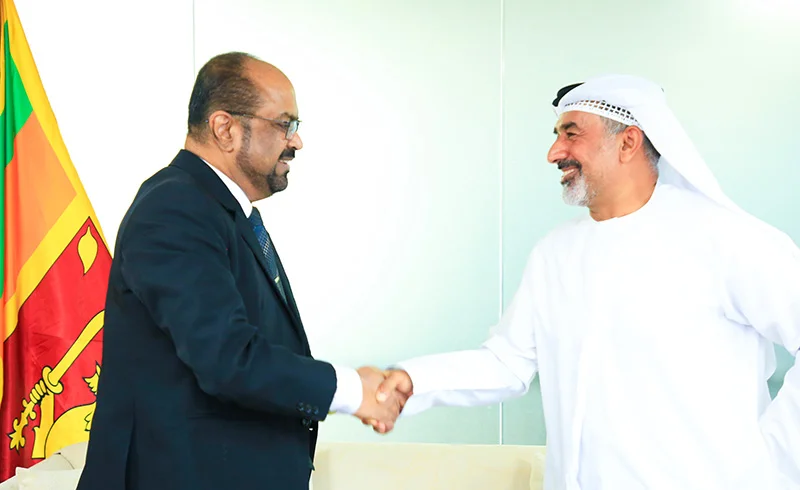
The Ambassador of the United Arab Emirates (UAE) to Sri Lanka, Khaled Nasser Al Ameri, met Minister of Power and Energy Eng. Kumara Jayakody yesterday (26) to review progress on bilateral energy cooperation and explore new avenues for collaboration, with a strong focus on regional energy security and strategic infrastructure development.
The high-level discussion centred on the implementation status of understandings reached in recent years, particularly in the energy sector, and on identifying fresh opportunities to deepen engagement between Sri Lanka and the UAE. Both sides underscored the importance of translating earlier agreements into tangible outcomes amid Sri Lanka’s ongoing energy transition.
A key focus of the talks was the proposed development of the Trincomalee region as a regional energy hub. The meeting reviewed follow-up actions related to the tripartite Memorandum of Understanding signed last year between Sri Lanka, India and the UAE, which envisages collaborative development of energy-related infrastructure and logistics in and around Trincomalee, leveraging its strategic location in the Indian Ocean.
Officials discussed the next steps required to operationalise elements of the agreement, including coordination mechanisms, investment frameworks and timelines, with a view to positioning Trincomalee as a focal point for energy storage, supply and distribution in the region.
The discussions also addressed broader cooperation on regional energy security, with both parties acknowledging the growing importance of resilient, diversified and sustainable energy systems amid global volatility.
The UAE reiterated its willingness to support Sri Lanka’s energy objectives, including through technical expertise, investment and strategic partnerships aligned with the country’s long-term power sector goals.
Minister Jayakody highlighted Sri Lanka’s commitment to strengthening international partnerships to ensure energy security, accelerate infrastructure development and support the shift towards a more reliable and future-ready energy mix.
Ambassador Al Ameri reaffirmed the UAE’s interest in expanding its role as a key partner in Sri Lanka’s energy sector, building on existing goodwill and cooperation.
The meeting reflects Colombo’s broader diplomatic and economic efforts to attract strategic partners to its energy sector, particularly for large-scale projects with regional significance, as Sri Lanka seeks to stabilise supply, enhance security and position itself as an emerging energy and logistics hub in the Indian Ocean, the Ministry said.
By Ifham Nizam

The Pathfinder Foundation’s Repository for Sri Lanka Peace Initiatives was inaugurated by Erik Solheim—former Norwegian Special Envoy to the Sri Lanka peace process, former Minister of the Environment and International Development of Norway, and former Executive Director of the United Nations Environment Programme (UNEP)—at the invitation of Milinda Moragoda, Founder, and Bernard Goonetilleke, Chairman of the Pathfinder Foundation, both among the principal negotiators of the peace process.
Over several decades, Sri Lanka repeatedly sought to resolve the separatist conflict through negotiations. Despite several initiatives, none succeeded in bringing the conflict to a negotiated conclusion.
Over the years, numerous publications—both local and foreign—have examined Sri Lanka’s conflict. SCOPP maintained a substantial body of documentation on the peace process, from January 2002 to January 2008, and the Norwegian facilitators also hold an extensive collection of records. Nevertheless, a major gap remains: the absence of a consolidated repository that brings together available documentation on the peace process, particularly one that preserves material relating to negotiations that did not reach a conclusive settlement.
Responding to this gap and encouraged by many associated with or studying the process, the Pathfinder Foundation has taken steps to establish a dedicated repository to collect and preserve documentation on Sri Lanka’s peace initiatives. Under this project, the Foundation will gather relevant information on the peace process from local and international sources.

Nipah virus outbreak in India triggers Asia airport screenings

India and EU announce landmark trade deal

Sri Lanka women to tour West Indies for ODI and T20I series in February-March 2026

Scotland bank on ICC assurances over Sharif visa after naming T20 World Cup squad

England bat, Sri Lanka bring back Wanindu Hasaranga

Don Bradman baggy green sold for AU$460,000

‘Dates have the highest sugar content to fight Coronavirus’

Sunday Island 27 December – Headlines

#SundayIsland 17th December – Headlines

Sunday Island – 28th March

Sunday Island Headlines – 21 March

Sunday Island – 21st February – Headlines
-
 Business2 days ago
ComBank, UnionPay launch SplendorPlus Card for travelers to China
-
 Business3 days ago
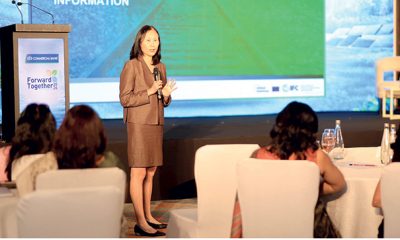
ComBank advances ForwardTogether agenda with event on sustainable business transformation
-
 Opinion6 days ago
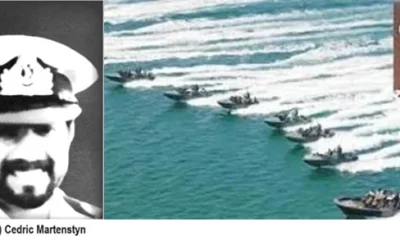
Remembering Cedric, who helped neutralise LTTE terrorism
-
 Business6 days ago
CORALL Conservation Trust Fund – a historic first for SL
-
 Opinion3 days ago
Conference “Microfinance and Credit Regulatory Authority Bill: Neither Here, Nor There”
-

 Opinion5 days ago
A puppet show?
-

 Opinion2 days ago
Luck knocks at your door every day
-

 Features7 days ago
The middle-class money trap: Why looking rich keeps Sri Lankans poor