
Features
Tony Peries: First Lankan Director of George Steuarts

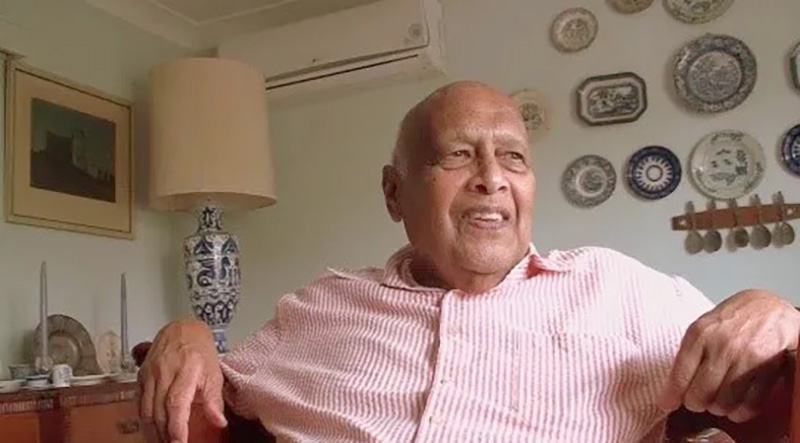
When a young Sri Lankan walked into the office of George Steuart on February 1, 1953, no one is likely to have imagined that he would become not only the first Sri Lankan Chairman of what was then essentially a British firm, but also the youngest man to hold that important office.
The young man, whose name was John Francis Anthony Paul Peries, and was generally known as Tony Peries, had been edu cated at St. Joseph’s College, Colombo, and had applied for a post as a trainee Tea Taster. His father, W. Peries, a Director of Mackwoods, was held in the highest esteem in agency circles.
At that time D.C Wilson was Chairman of George Steuarts and the other British Directors were Gourlay, Kerr, McLeod, Nelson, and Gilmour.
In keeping with a practice that went back to the earliest days of the firm the Directors decided that the young recruit should sign Articles of Agreement and the wording of this document is strongly reminiscent of the Deed of Indenture which Capt. James Steuart, the founder of the firm, signed with his father in 1805 Agreement which Peries and the Directors signed was:
Articles of Agreement
Made the first day of February one thousand nine hundred and fifty three between D.C. Wilson, W.H. Gourlay, C.G.C. Kerr, A.D McLeod,, C.M. Nelson, and R.J Gilmour carrying on business under the ·name and style of George Steuart and Company at 45, Queen Street, Colombo 1 {hereinafter called the employers) of the first part and John Francis Anthony Paul Peries of 7, Elibank Road, Colombo 5 {herein after called the said apprentice) of the second part.
This Indenture. witnesseth firstly that the said apprentice of his own free will and consent doth place and of the said term such leave to be taken at the convenience of the said employer and always provided that leave of absence for one year not taken or granted in that year shall not be available during any other year of the said term and seventhly that the said employers undertake to remunerate the said apprentice during the first year of the term by payment of Rs.3,600/ by twelve monthly instalments of Rs.300/ during the second year of the term by payment of Rs.4,200/ by twelve monthly instalments of Rs.350/ and during the third and final year of the said term by payment of Rs.4,800/ by twelve monthly instalments of Rs.400/ each instalment hereunder being payable as at and on the last business day of each calendar month the first instalment being payable on the 28th day of February 1953.
Peries was the last executive to sign such an Agreement. Since then executives receive letters containing their individual terms and conditions of employment, but all letters of appointment issued to executives still contain a sting in the tail:
“Our office hours are from 8.30 to 4.30 p.m. on working days with an hour’s interval for lunch, the office norn1ally being closed on Saturdays and Sundays, but you will no doubt realise that for an executive the timely discharge of responsibilities is of much greater importance than the observance of scheduled hours. We reserve the right to vary these hours if we consider it desirable to do so.”
Peries was initially appointed to the Produce Department which he eventually took over from G.H Savage when he retired in 1955. He became the first Sri Lankan Director of the firm in 1963.
Peries proved an apt pupil as stories soon circulated of his virtuosity as a tea taster. On one occasion he remarked that there was something wrong with the water in a brew. On inquiry it was found that the distilled water normally used had run out of supply and some other brand had been substituted. On another occasion Peries on testing a sample of tea said there was a fault in the Number Three Roller on the estate from which that sample had been sent. Inquiries proved him correct.
Peries had wide interests. He joined the Ceylon Artillery Second volunteer Regiment as a Second Lieutenant and was a Lieutenant when he resigned in 1955. He learned flying and earned his Wing from the Flying Training School at Ratmalana. After having qualified as a pilot, he took to yachting. He was a member of the S.S.C., the Motor Sports club and the Royal Colombo Golf Club and represented the Otter Aquatic Club in swimming and water polo. He was also a keen student of international affairs. Peries, like his predecessor Waddilove, was a Roman Catholic.
Peries became the first Sri Lankan Chairman of George Steuarts in 1969 with the departure of Waddilove and after the election of Mrs Sirima Bandaranaike’s United Left Government on May 27, 1970, the Agency Houses were subjected to a long and searching probe with the appointment of a Commission of Inquiry into Agency Houses. The Commission, which was appointed in 1971, submitted its final report in December 1974 Peries and all the Directors of the firm appeared before the Commission whose Chairman was Bernard Soysa, the Parliamentary Secretary to the Minister of Finance.
In both its interim and financial reports the Commission had nothing of an adverse nature to say about George Steuarts and only reproduced statistics and factual data which the firm itself had provided in reply to questionnaires.
The report revealed that in 1970 George Steuarts managed 23 companies incorporated in Sri Lanka, and 23 incorporated in the United Kingdom.
Of the total acreage managed by all Agency Houses in Sri Lanka, George Steuarts controlled the largest percentage of tea lands with 17.6 per cent. The second highest was Carson Cumber batch and Leechman and Co which controlled 14.9 per cent, and third were Whittalls Estates and Agencies with 14.7 per cent.
In the case of rubber, Carson Cumberbatch and Leechmans had the largest percentage of lands with 29.1per cent. Whittalls were second with 14.2 per cent and George Steuarts third with 12.9 per cent.
On the Ceylonisation of staff in relation to executives the Commission’s report showed that while there had been 13 non-national executives, with no nationals as executives at George Steuarts in 1946, the position in 1960 was that there were 10 non-national executives, and 15 nationals as executives. In 1970 all 28 executives were nationals.
In respect of Directors there had been five non-nationals as Directors in 1946, and no nationals. In 1960 there were six non nationals as Directors, and no nationals By 1970 there were two non-nationals as Directors and six nationals.
In the holding of equity capital non-nationals held 91.43 per cent in 1965, while nationals held 8.57 per cent. By 1973 non nationals held 18.33 per cent, and nationals 81.67 per cent.
On the role of Agency Houses in the economy of the country the Report disclosed that, of the Island’s total production of 468 million pounds of tea in 1971, 260.8 million pounds or 62.1 per cent of total output was produced on estates managed by Agency Houses
Rubber estates managed by Agency Houses produced 95.9. million pounds or 27.3 per cent of the total production of 350.9 million pounds.
Coconut estates managed by Agency Houses produced 86 million nuts or 3.9 per cent of the Island’s total production of 2,447 million nuts.
That production on estates controlled by Agency Houses was well above the national average was seen in the fact that while Agency Houses controlled 46.8 per cent of all tea lands, these estates produced 62.1 per cent of the Island’s total output of tea. Similarly, Agency Houses controlled 20.9 per cent of all rubber lands but these estates produced 27.3 per cent of the national output. No breakdown was provided in the case of coconuts where estates controlled by the Agency Houses accounted for only 3 9 per cent of total production
The Report of the Agency Houses Commission published in December 1974 ultimately became of only academic interest as its recommendations were overtaken by events and Peries himself had left Sri Lanka on March 18, 1973. His departure literally overnight caused a sensation 1n George Steuarts as it had been kept secret from everyone except one Director, who was sworn to secrecy.
Peries’s sudden departure was a reaction to a period of gloom and uncertainty which had begun with a warning by the Minister of Finance, Felix Dias Bandaranaike, that the private sector was facing its last chance and that if they did not provide employment to unemployed youth, they faced the prospect of being hung up from lamp posts as had happened elsewhere. In 1971 the Janatha Vimukthi Peramuna (Peoples Liberation Front) which consisted entirely of youths, staged an insurrection and gained control for some time of parts of the Island.
The departure overnight of the Chairman. who was a national of the country, contributed to pessimism in London and other capitals of the world about the future of Sri Lanka, and [at some point] after Peiris’s departure George Steuarts lost the agency of Consolidated Estates Ltd. to another Agency House.
Michael Roberts adds: YOU SEE ABOVE the pages 104-09 of The George Steuart Story …. I have a copy of the book because I received it as a GIFT from Trevor Moy, one of the Directors in 1985. Moy’s covering leter indicates quite clearly that the book was composed by Donovan Moldrich (then an experienced newpaper reporter and Editor; and a good friend). There is no indication within the book of Donovan’s role in the enterprise. I will be composing a separate item on the patriotism and work of Donovan Moldrich — work pursued with support from his intelligent wife Shona.
They can surely rest in peace.



Minister Bimal Rathnayake has urged all Sri Lankan refugees in India to return to Sri Lanka, stating that provision has been made for their reintegration. He called on India to grant citizenship to those who wished to stay on in India, but added that the government would welcome them back with both hands if they chose Sri Lanka. He gave due credit to the Organisation for Eelam Refugees Rehabilitation (OfERR), an NGO led by S. C. Chandrahasan, the son of S. J. V. Chelvanayakam, widely regarded as the foremost advocate of a federal solution and a historic leader of the Federal Party. OfERR has for decades assisted refugees, particularly Sri Lankan Tamils in India, with documentation, advocacy and voluntary repatriation support. Given the slow pace of resettlement of Ditwah cyclone victims, the government will need to make adequate preparations for an influx of Indian returnees for which it will need all possible assistance. The minister’s acknowledgement indicates that the government appreciates the work of NGOs when they directly assist people.
The issue of Sri Lankan refugees in India is a legacy of the three-decade long war that induced mass migration of Tamil people to foreign countries. According to widely cited estimates, the Sri Lankan Tamil diaspora today exceeds one million and is often placed between 1 and 1.5 million globally, with large communities in Canada, the United Kingdom and Australia. India, particularly Tamil Nadu, continues to host a significant refugee population. Current figures indicate that approximately 58,000 to 60,000 Sri Lankan Tamil refugees live in camps in India, with a further 30,000 to 35,000 living outside camps, bringing the total to around 90,000. These numbers have declined over time but remain one of the most visible human legacies of the conflict.
The fact that the government has chosen to make this announcement at this time indicates that it is not attempting to gloss over the human rights issues of the past that continue into the present. Those who suffered victimisation during the war may be encouraged that their concerns remain on the national agenda and have not been forgotten. Apart from those who continue to be refugees in India, there are more than 14,000 complaints of missing persons still under investigation according to the Office on Missing Persons, which has received tens of thousands of complaints since its establishment. There are also unresolved issues of land taken over by the military as high security zones, though some land has been released, and prisoners held in long term detention under the Prevention of Terrorism Act, which the government has pledged to repeal and replace.
Sequenced Response
In addressing the issue of Sri Lankan Tamil refugees in India, the government is sending a message to the Tamil people that it is not going to gloss over the past. The indications are that the government is sequencing its responses to problems arising from the past. The government faces a range of urgent challenges, some inherited from previous governments, such as war era human rights concerns, and others that have arisen more recently after it took office. The most impactful of these crises are not of its own making. Global economic instability has affected Sri Lanka significantly. The Middle East war has contributed to a shortage of essential fuels and fertilizers worldwide. Sri Lanka is particularly vulnerable to rising fuel prices. Just months prior to these global pressures, Sri Lanka faced severe climate related shocks, including being hit by a cyclone that led to floods and landslides across multiple districts and caused loss of life and extensive damage to property and livelihoods.
From the beginning of its term, the government has been compelled to prioritise economic recovery and corruption linked to the economy, which were central to its electoral mandate. As the International Monetary Fund has emphasised, Sri Lanka must continue reforms to restore macroeconomic stability, reduce debt vulnerabilities and strengthen governance. The economic problems that the government must address are urgent and affect all communities, whether in the north or south, and across Sinhalese, Tamil and Muslim populations. These problems cannot be postponed. However, issues such as dealing with the past, holding provincial council elections and reforming the constitution are not experienced as equally urgent by the majority, even though they are of deep importance to minorities. Indeed, the provincial council system was designed to address the concerns of the minorities and a solution to their problems.
Unresolved grievances tend to reappear in new forms when not addressed through political processes. Therefore, they need to be addressed sooner rather than later, even if they are not the most immediate priorities for the government. It must not be forgotten that the ethnic conflict and the three decade long war it generated was the single most destructive blow to the country, greatly diminishing its prospects for rapid economic development. Prolonged conflict reduced investment, diverted public expenditure and weakened institutions. If Sri Lanka’s early leaders had been able to negotiate peacefully and resolve their differences, the country might have fulfilled predictions that it could become the “Switzerland of the East.”
Present Opportunity
The present government has a rare opportunity to address the issues of the past in a way that ensures long term peace and justice. It has a two thirds majority in parliament, giving it the constitutional space to undertake significant reforms. It has also demonstrated a more inclusive approach to ethnic and religious minorities than many earlier governments which either mobilized ethnic nationalism for its own purposes or feared it too much to take political risks to undertake necessary reforms. Public trust in the government, as noted by international observers, remains relatively strong. During her recent visit, IMF Director General Kristalina Georgieva stated that “there is a window of opportunity for Sri Lanka,” noting that public trust in the government provides a foundation for reform.
It also appears that decades of public education on democracy, human rights and coexistence have had positive effects. This education, carried out by civil society organisations over several decades, sometimes in support of government initiatives and more often in the face of government opposition, provides a foundation for political reform aimed at justice and reconciliation. Civil society initiatives, inter-ethnic dialogue and rights-based advocacy have contributed to shaping a more informed public about controversial issues such as power-sharing, federalism and accountability for war crimes. The government would do well to expand the appreciation it has deservedly given to OfERR to other NGOs that have dedicated themselves addressing the ethnic and religious mistrust in the country and creating greater social cohesion.
The challenge for the government is to engage in reconciliation without undue delay, even as other pressures continue to grow. Sequencing is necessary, but indefinite postponement carries risks. If this opportunity for conflict resolution is not taken, it may be a long time before another presents itself. Sri Lanka may then continue to underperform economically, remaining an ethnically divided polity, not in open warfare, but constrained by unresolved tensions. The government’s recent reference to Tamil refugees in India is therefore significant. It shows that even while prioritising urgent economic and global challenges, it has not forgotten the past. Sri Lanka has a government with both the mandate and the capacity to address that past in a manner that secures a more stable and just future for all its people.
By Jehan Perera
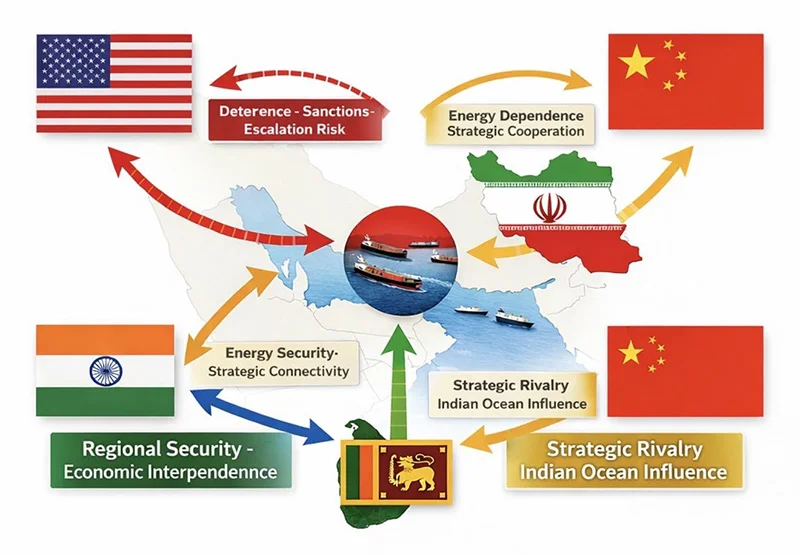
The unfolding tensions and diplomatic manoeuvres around the Strait of Hormuz offer more than a snapshot of regional instability. They reveal a deeper transformation in global statecraft, one where influence is exercised through calibrated engagement rather than outright confrontation. This is strategic diplomacy in its modern form: restrained, calculated, and layered with competing interests.
At first glance, the current developments may appear as routine diplomatic exchanges aimed at preventing escalation. However, beneath the surface lies a complex web of signalling among major and middle powers. The United States seeks to maintain deterrence without triggering an open conflict. Iran aims to resist pressure while avoiding isolation. Meanwhile, China and India, two rising powers with expanding global interests are navigating the situation with careful precision.
China’s position is anchored in economic pragmatism. As a major importer of Gulf energy, Beijing has a direct stake in ensuring that the Strait of Hormuz remains open and stable. Any disruption would reverberate through its industrial base and global supply chains. Consequently, China advocates de-escalation and diplomatic resolution. Yet, this is not purely altruistic. Stability serves China’s long-term strategic ambitions, including the protection of its Belt and Road investments and maritime routes. At the same time, Beijing remains alert to India’s growing diplomatic footprint in the region. Should India deepen its engagement with Iran and other Gulf actors, it could gradually reshape the strategic balance in areas traditionally influenced by China.
India’s approach, in contrast, reflects a confident and increasingly sophisticated foreign policy. By engaging Iran directly, while maintaining working relationships with Western powers, New Delhi is positioning itself as a credible intermediary. This is not merely about energy security, though that remains a key driver. It is also about strategic autonomy the ability to act independently in a multipolar world. India’s diplomacy signals that it is no longer a passive player but an active shaper of regional outcomes. Its engagement with Iran, particularly in the context of connectivity and trade routes, underscores its intent to secure long-term strategic access while countering potential encirclement.
Iran, for its part, views the situation through the lens of survival and strategic resilience. Years of sanctions and pressure have shaped a cautious but pragmatic diplomatic posture. Engagement with external actors, including India and China, provides Tehran with avenues to ease isolation and assert relevance. However, Iran’s trust deficit remains significant. Its diplomacy is transactional, focused on immediate gains rather than long-term alignment. The current environment offers opportunities for tactical advantage, but Iran is unlikely to make concessions that could compromise its core strategic objectives.
Even actors on the periphery, such as North Korea, are closely observing these developments. Pyongyang interprets global events through a narrow but consistent framework: regime survival through deterrence. The situation around Iran reinforces its belief that leverage, particularly military capability, is a prerequisite for meaningful negotiation. While North Korea is not directly involved, it draws lessons that may shape its own strategic calculations.
What emerges from these varied perspectives is a clear departure from traditional bloc-based geopolitics. The world is moving towards a more fluid and fragmented order, where alignments are temporary and issue-specific. States cooperate on certain matters while competing with others. This creates a dynamic but unpredictable environment, where misinterpretation and miscalculation remain constant risks.
It is within this evolving context that Sri Lanka’s strategic relevance becomes increasingly visible. The recent visit by the US Special Envoy for South and Central Asia, Sergio Gor, to the Colombo Port; is not a routine diplomatic courtesy call. It is a signal. Ports are no longer just commercial gateways; they are strategic assets embedded in global power competition. A visit of this nature underscores how Sri Lanka’s maritime infrastructure is being viewed through a geopolitical lens particularly in relation to sea lane security, logistics, and regional influence.
Such engagements reflect a broader reality: global powers are not only watching the Strait of Hormuz but are also positioning themselves along the wider Indian Ocean network that connects it. Colombo, situated along one of the busiest east–west shipping routes, becomes part of this extended strategic theatre. The presence and interest of external actors in Sri Lanka’s ports highlight an emerging pattern of influence without overt control a hallmark of modern strategic diplomacy.
For Sri Lanka, these developments are far from abstract. The island’s strategic location along major Indian Ocean shipping routes places it at the intersection of these global currents. The Strait of Hormuz is a vital artery for global energy flows, and any disruption would have immediate consequences for Sri Lanka’s economy, particularly in terms of fuel prices and supply stability.
Moreover, Sri Lanka must manage the competing interests of larger powers operating within its vicinity. India’s expanding regional role, China’s entrenched economic presence, and the growing attention from the United States all converge in the Indian Ocean. This requires a careful balancing act. Aligning too closely with any one power risks alienating others, while inaction could leave Sri Lanka vulnerable to external pressures.
The appropriate response lies in adopting a robust foreign policy that engages all major stakeholders while preserving national autonomy. This involves strengthening diplomatic channels, enhancing maritime security capabilities, and investing in strategic foresight. Sri Lanka must also recognise the growing importance of non-traditional security domains, including cyber threats and information warfare, which increasingly accompany geopolitical competition.
Equally important is the need for internal coherence. Effective diplomacy abroad must be supported by institutional strength at home. Policy consistency, professional expertise, and strategic clarity are essential if Sri Lanka is to navigate an increasingly complex international environment.
The situation in the Strait of Hormuz thus serves as both a warning and an opportunity. It highlights the fragility of global systems, but also underscores the potential for skilled diplomacy to manage tensions. For Sri Lanka, the challenge is not merely to observe these developments, but to position itself wisely within them.
In a world where power is no longer exercised solely through force, but through influence and presence, strategic diplomacy becomes not just an option, but a necessity. The nations that succeed will be those that understand this shift now and act with clarity, balance, and foresight.
Mahil Dole is a senior Sri Lankan police officer with over four decades of experience in law enforcement and intelligence. He previously served as Head of the Counter-Terrorism Division of the State Intelligence Service and has conducted extensive interviews with more than 100 suicide cadres linked to terrorist organisations. He is a graduate of the Asia-Pacific Centre for Security Studies (Hawaii).
By Mahil Dole
Senior Police Officer (Retd.), Former Head of Counter-Terrorism Division, State Intelligence Service, Sri Lanka
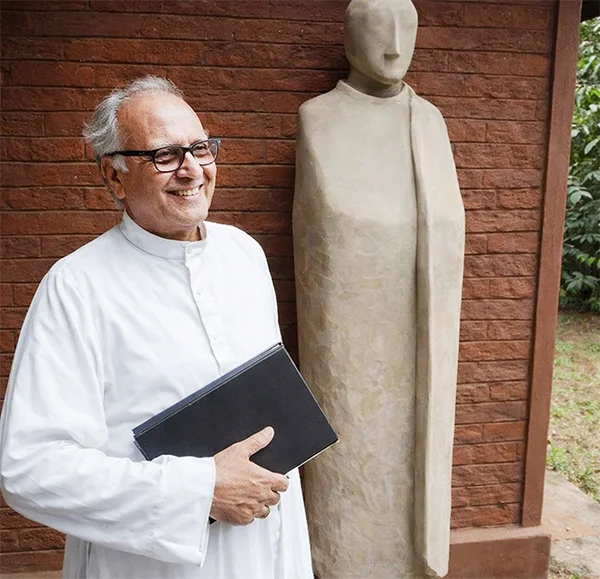
I knew that I would have to share my thoughts about the most inspiring thought leader of my life, one day. When I spoke of his virtues two years ago, at the time of him celebrating his 90th birthday with “Tulana” research centre, his coveted creation, reaching 50th year, I did not expect this day to be so soon. I am referring to the heavenly departure of Rev. Professor Aloysius Peiris, SJ, known to most as “Fr. Aloy’”.
Overview
Fr. Aloy was born on 9th April, 1934 in Ampitiya, Kandy and peacefully passed away on 22nd March, 2026 just few weeks before his 93rd birthday. Hailing from a family that has produced nuns and priests, his religious formation as a Jesuit opened pathways to reach east and west alike, as an eminent theologian, erudite scholar, and an exemplary priest.
Fr. Aloy became the first Sri Lankan Catholic Priest to obtain a Ph.D. in Buddhist Philosophy from the Vidyodaya Campus, University of Sri Lanka. It was Fr. Marceline Jayakody, OMI who became popularly known as Pansale Piyathuma (The priest of the Buddhist temple), because of his association with Buddhist culture, influencing his much-popular hymns with authentic local flavour. I would not hesitate to hail, Fr. Aloy as Pansale Piyathuma (The priest of the Buddhist monastery). It was heartening to see Buddhist monks visiting him to study pitakas and “suttas which are revered religious texts, under his valued guidance. He was awarded the prestigious Honourary Doctorate of Literature (D.Litt) by the same institution, now University of Kelaniya in 2015.
Moreover, Fr. Aloy obtained three theological degrees, an L.Ph. from Sacred Heart College in Shembaganur, India (1959), STL from the Pontifical Theological Faculty in Naples (1966), and a Th.D. from Tilburg University (1987). Fr. Aloy also has a BA in Pali and Sanskrit from the University of London (1961). As he shared with my friend Asoka Dias, during a recent interview of Sirsa TV, the proficiency in both western and eastern languages opened many doors for him to reach out to deserving communities.
It is heat-warming to recall my first encounter with Fr. Aloy as a student awaiting to start my Advanced Level classes, on his 50th birthday. He guided me how to study rhythmically maintaining the needed balance. My fruitful association with him has spanned over 42 years with enriching guidance, engaging dialogue, and entrusting commitment. I must whole-heartedly acknowledge that He was the one who pursued me to embark on an academic career, moving from the lucrative private sector as an engineer turned manager. It was a conscious shift listening to my yearning inner purpose, and Fr. Aloy was a guiding light and a glittering beacon, showing the salient way. I would simply recognize him with utmost respect, as an authentic thought leader who was an inspirer, influencer, and an initiator.
Fr Aloy as an Inspirer
Fr Aloy inspired millions around the globe through his scholarly writing. His books and articles have been translated into many languages. Among them, An Asian Theology of Liberation and Love Meets Wisdom appear prominently. He is the author of more than 30 books and well over 500 Research Papers. He was of the view that any authentic theology for Asia must grapple with both poverty and religious pluralism. He calls for a theology born from listening not only to Scripture, but also to the suffering of the poor and the wisdom of ancient traditions like Buddhism. There comes the connection to love and wisdom. Fr Aloy argued that Christianity (focused on “love” or agape) and Buddhism (focused on “wisdom” or prajna) are complementary, proposing that authentic engagement requires embracing the core strengths of both traditions to achieve spiritual maturity.
He has been the editor of Vagdevi, a journal of religious reflection, until his demise. I remember receiving a copy of the latest a few months ago, where his authentic views on contemporary Christianity, were clearly and coherently expressed. Same with the case of many of his sought-after religious writings, such as Give Vatican II a Chance, Leadership in the Church, Relishing our Faith in Working for Justice, Lent in Lanka – Reflections and Resolutions and God’s Reign for God’s Poor. I must confess that, though representing a different specialty, my writing has been immensely inspired by Fr. Aloy.
Fr. Aloy as an Influencer
He was a distinctly different thinker in terms of linking theology with poverty on one side and inter-religious dialogue on the other side. He argued that any theology for Asia must consider the realities of poverty, pluralism, and power. Religion, as he perceived, must be a force for healing and liberation and not for division and fragmentation. He was a key resource in the 1980s for the Federation of Asian Bishops’ Conferences (FABC), where he helped shape a distinctly Asian Catholic theology dialogical, incarnational, and deeply rooted in the continent’s spiritual traditions.
I recall him having numerous conversations with Rev. Fr. Oscar Abeyrathne (popularly known as Swami Thaththa, initiator of Kithudana Pubuduwa (Catholic Charismatic Renewal” in Sri Lanka). If I may observe, Fr Aloy as the “influencer,” Fr. Oscar was the “implementor.” As a youth leader of “Kithudana Pubuduwa,” I learnt how to wear the national dress with pride and how to participate in Catholic rituals with enhanced oriental flavour. When, “tyer pyres” were prevalent with burning youth, during 88-89 insurrection, we as youth were guided towards a non-violent path, yet, upholding social justice, by both of them.
Fr. Aloy as an Initiator
I remember cycling from my native home in Pamunuwila to an “oasis” overtly known worldwide yet having its humble presence amidst lush greenery. That is what Fr. Aloy initiated 52 years ago as “Tulana”. To be precise, Tulana Research Centre for Encounter and Dialogue. The word Tulana has its origin in Sanskrit, can be translated as discernment. It also symbolically means balancing, harmonis+ing, and complementing, with due reference to Christianity and Buddhism.
According to Fr. Aloy, the primary founding motivation was as a response to two challenges – the challenge of the spirituality and philosophy of Sri Lanka’s major religion, Buddhism, and the challenge of the socio-political aspirations of the highly educated but marginalised rural youth. The vast library, aptly named as Fr. S. G. Perera Memorial Oriental Library, includes mainly the book collection of the late Fr. S. G. Perera, the first Sinhalese Jesuit in Sri Lanka, who gifted his collection to Fr. Pieris so many years ago. I had the rare privilege of reading, relating, and reflecting, in this revered resource centre during my Advanced Level and university times. The collection of science fiction stories I published, were mostly written at Tulana library.
Apart from the rich knowledge base, Tulana has a rare collection of pantings, carvings and many other symbolic ways of demonstrating the eastern perspectives of Christianity. Among many, the creations by Ven. Hathigammana Uthththarananda Thero, depicting Christ in a Buddhist context, are indeed serene and significant.
I will fail in my duty if I do not mention another feat of Fr. Aloy as an initiator. It is the Centre for Education of Hearing Impaired Children (CEHIC). Located in Dalugama, Kelaniya, it is a “small miracle of hope,” for many. Since the inception in 1982, Fr. Aloy has been steadfastly supporting Rev. Sr. Greta Nalawatta, in healing thousands, and paving the path of prosperity. I remember late Prof. Carlo Fonseka saying at CEHIC, what he saw of curing the medically-declared deafness through a holistic auditory-verbal method is a “real miracle.” It gives me immense happiness to be a member of the Education Board of CEHIC, in contributing to the valued vision of Fr Aloy.
A Spiritual Sage of our Age
Many more can be written about Fr. Aloy, as a salient spiritual sage of our age. His intellectual and interactional prowess with people-friendly approach paved way for him to be a sought-after sharer. He was multi-talented in being a musician from his early age as well. He battled a key health challenge but the way he perceived, it was “joyful suffering.” He was not hesitant to call a spade a spade, despite receiving bouquets and brickbats alike. He was highly critical of “Ecclesiastics Politics,” the way he described some inner dynamics of the Church.
Fr. Aloy truly lived a life, meaningfully aligned to the aspiration of St. Ignatius Loyola, the founder of Society of Jesus, his religious order. It is to find God in all things and taking action for the greater glory of God ( Ad Maiorem Dei Gloriam). He duly responded to the question raised by the Buddha (in Yamakavagga). “However many holy words you read, however many you speak, what good will they do you if you do not act on upon them?”
Life is to love, learn, lead and to leave a legacy. Goodbye, my beloved inspirer, influencer, and initiator. May Rev. Fr. Aloysious Peiris, SJ have a blissful heavenly journey.
The writer is
Senior Professor in Management
Postgraduate Institute of Management, University of Sri Jayewardenepura
by Ajantha S. Dharmasiri

‘Dates have the highest sugar content to fight Coronavirus’

Sunday Island 27 December – Headlines

#SundayIsland 17th December – Headlines

Sunday Island – 28th March

Sunday Island Headlines – 21 March

Sunday Island – 21st February – Headlines
-

 News6 days ago
CIABOC questions Ex-President GR on house for CJ’s maid
-
 News5 days ago
Bailey Bridge inaugurated at Chilaw
-

 Features1 day ago
Trincomalee oil tank farm: An engineering marvel
-

 News4 days ago
CIABOC tells court Kapila gave Rs 60 mn to MR and Rs. 20 mn to Priyankara
-

 News5 days ago
Pay hike demand: CEB workers climb down from 40 % to 15–20%
-

 Editorial6 days ago
Couple QR-based quota with odd-even rationing
-
 Features4 days ago
Science and diplomacy in a changing world
-

 News3 days ago
Colombo, Oslo steps up efforts to strengthen bilateral cooperation in key environmental priority areas